
Use of the Challenge Point Framework to Guide
- Slides: 6
Use of the Challenge Point Framework to Guide Motor Learning of Stepping Reactions for Improved Balance Control in People With Stroke: A Case Series by Courtney L. Pollock, Lara A. Boyd, Michael A. Hunt, and S. Jayne Garland ptjournal Volume 94(4): 562 -570 April 1, 2014 © 2014 American Physical Therapy Association
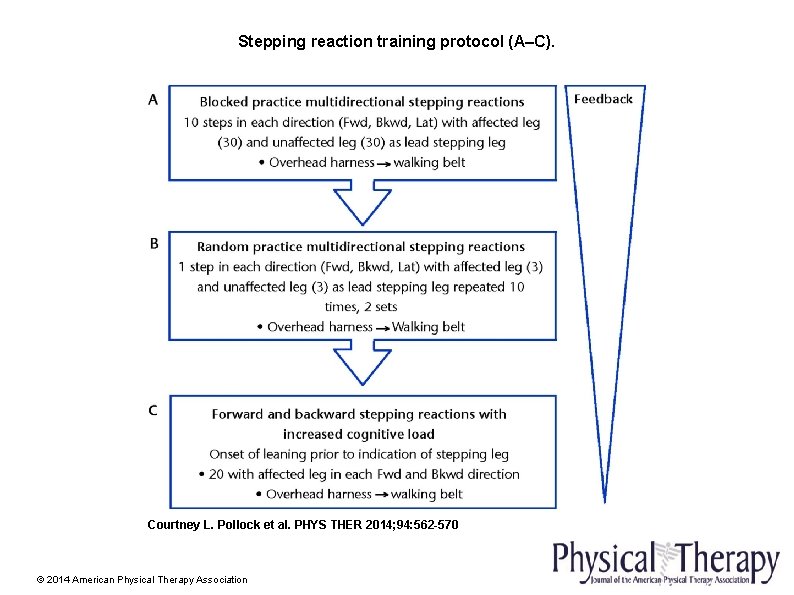
Stepping reaction training protocol (A–C). Courtney L. Pollock et al. PHYS THER 2014; 94: 562 -570 © 2014 American Physical Therapy Association
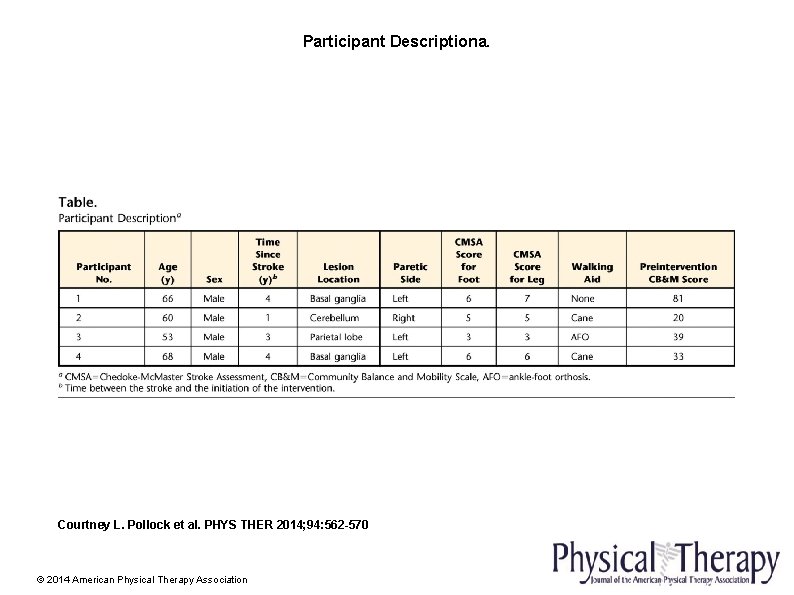
Participant Descriptiona. Courtney L. Pollock et al. PHYS THER 2014; 94: 562 -570 © 2014 American Physical Therapy Association
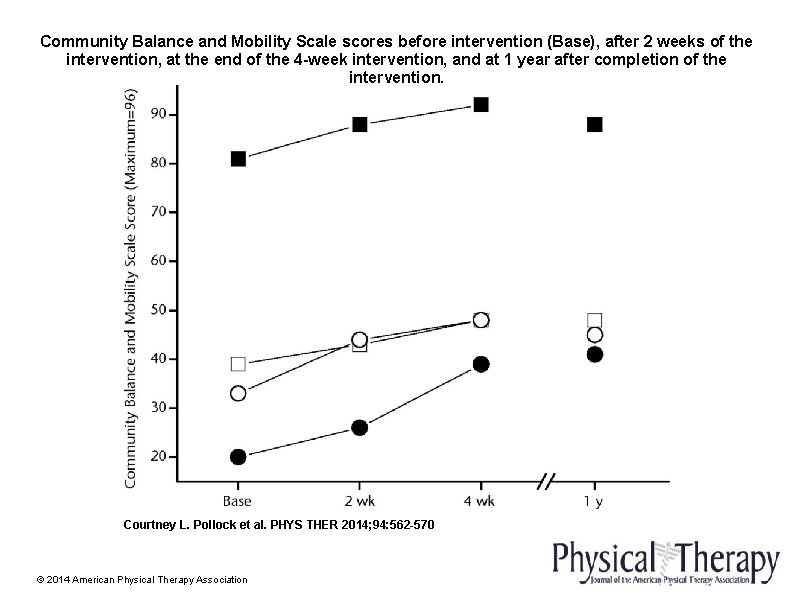
Community Balance and Mobility Scale scores before intervention (Base), after 2 weeks of the intervention, at the end of the 4 -week intervention, and at 1 year after completion of the intervention. Courtney L. Pollock et al. PHYS THER 2014; 94: 562 -570 © 2014 American Physical Therapy Association
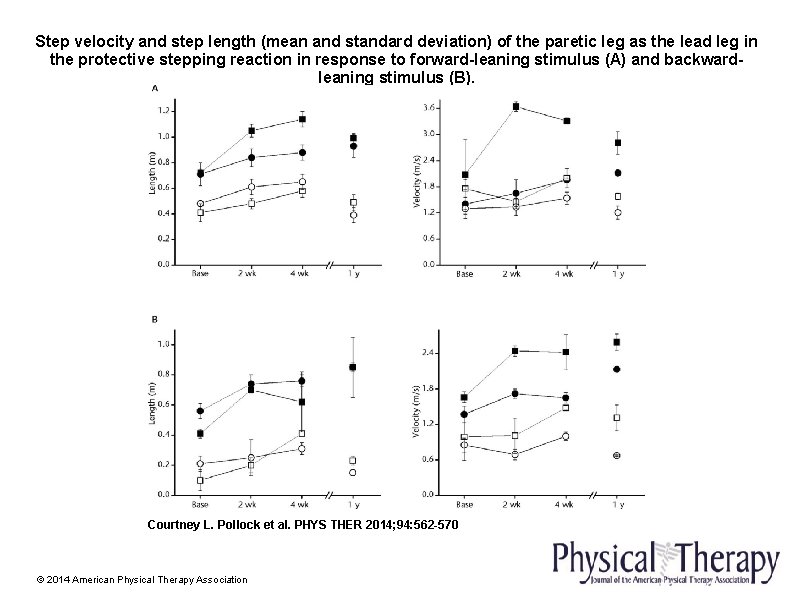
Step velocity and step length (mean and standard deviation) of the paretic leg as the lead leg in the protective stepping reaction in response to forward-leaning stimulus (A) and backwardleaning stimulus (B). Courtney L. Pollock et al. PHYS THER 2014; 94: 562 -570 © 2014 American Physical Therapy Association
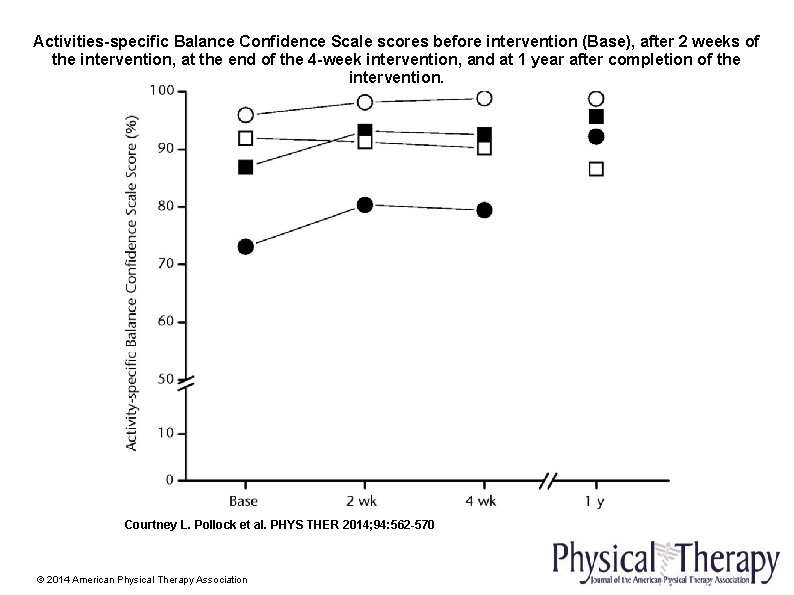
Activities-specific Balance Confidence Scale scores before intervention (Base), after 2 weeks of the intervention, at the end of the 4 -week intervention, and at 1 year after completion of the intervention. Courtney L. Pollock et al. PHYS THER 2014; 94: 562 -570 © 2014 American Physical Therapy Association