
USE OF SWARM INTELLIGENCE IN SPACECRAFT CONSTELLATIONS FOR
- Slides: 1
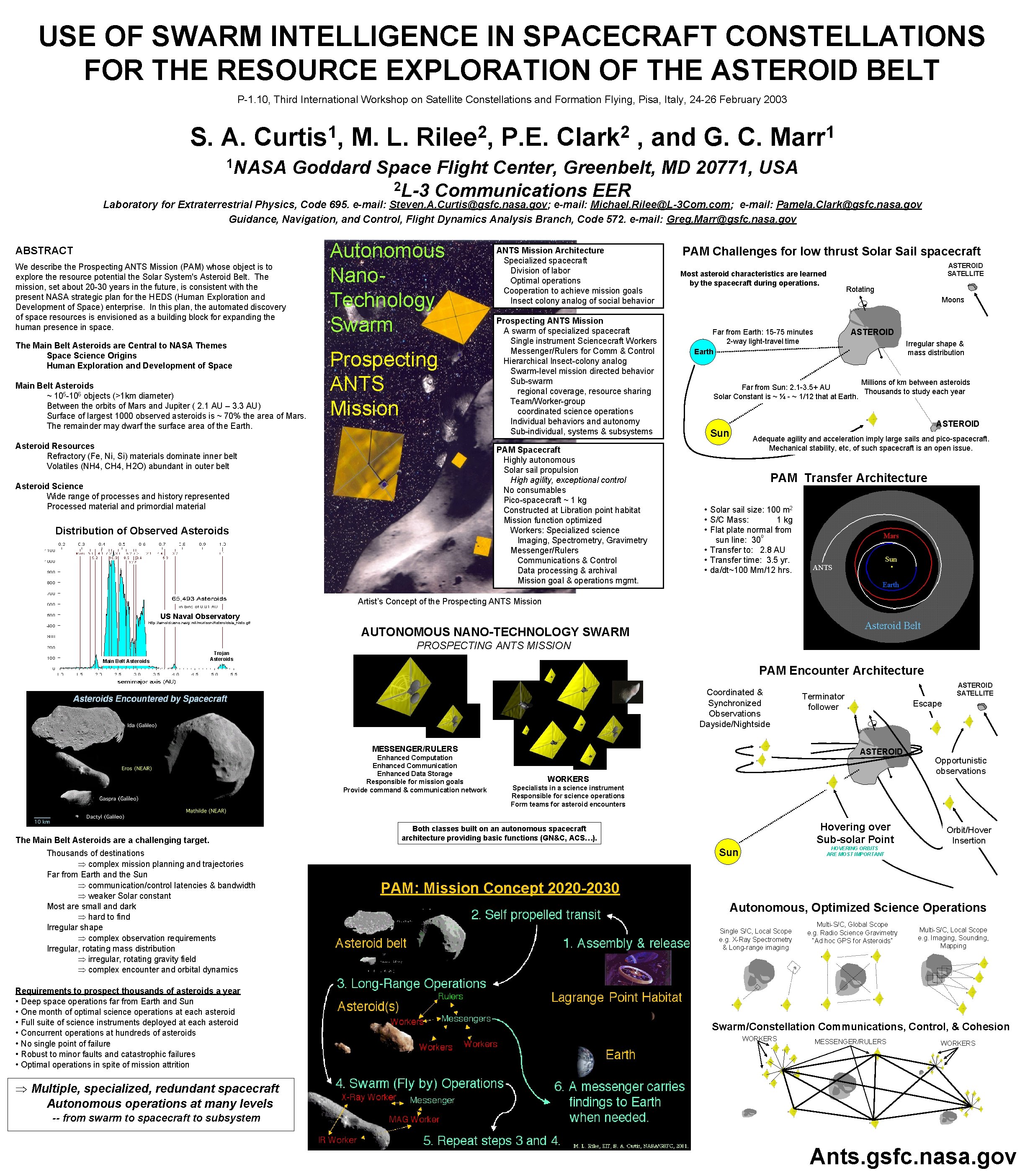
USE OF SWARM INTELLIGENCE IN SPACECRAFT CONSTELLATIONS FOR THE RESOURCE EXPLORATION OF THE ASTEROID BELT P-1. 10, Third International Workshop on Satellite Constellations and Formation Flying, Pisa, Italy, 24 -26 February 2003 S. A. 1 Curtis , 1 NASA M. L. 2 Rilee , P. E. 2 Clark , and G. C. 1 Marr Goddard Space Flight Center, Greenbelt, MD 20771, USA 2 L-3 Communications EER Laboratory for Extraterrestrial Physics, Code 695. e-mail: Steven. A. Curtis@gsfc. nasa. gov; e-mail: Michael. Rilee@L-3 Com. com; e-mail: Pamela. Clark@gsfc. nasa. gov Guidance, Navigation, and Control, Flight Dynamics Analysis Branch, Code 572. e-mail: Greg. Marr@gsfc. nasa. gov ABSTRACT We describe the Prospecting ANTS Mission (PAM) whose object is to explore the resource potential the Solar System's Asteroid Belt. The mission, set about 20 -30 years in the future, is consistent with the present NASA strategic plan for the HEDS (Human Exploration and Development of Space) enterprise. In this plan, the automated discovery of space resources is envisioned as a building block for expanding the human presence in space. The Main Belt Asteroids are Central to NASA Themes Space Science Origins Human Exploration and Development of Space Main Belt Asteroids ~ 105 -106 objects (>1 km diameter) Between the orbits of Mars and Jupiter ( 2. 1 AU – 3. 3 AU) Surface of largest 1000 observed asteroids is ~ 70% the area of Mars. The remainder may dwarf the surface area of the Earth. Autonomous Nano. Technology Swarm Prospecting ANTS Mission Asteroid Resources Refractory (Fe, Ni, Si) materials dominate inner belt Volatiles (NH 4, CH 4, H 2 O) abundant in outer belt ANTS Mission Architecture Specialized spacecraft Division of labor Optimal operations Cooperation to achieve mission goals Insect colony analog of social behavior Prospecting ANTS Mission A swarm of specialized spacecraft Single instrument Sciencecraft Workers Messenger/Rulers for Comm & Control Hierarchical Insect-colony analog Swarm-level mission directed behavior Sub-swarm regional coverage, resource sharing Team/Worker-group coordinated science operations Individual behaviors and autonomy Sub-individual, systems & subsystems PAM Spacecraft Highly autonomous Solar sail propulsion High agility, exceptional control No consumables Pico-spacecraft ~ 1 kg Constructed at Libration point habitat Mission function optimized Workers: Specialized science Imaging, Spectrometry, Gravimetry Messenger/Rulers Communications & Control Data processing & archival Mission goal & operations mgmt. Asteroid Science Wide range of processes and history represented Processed material and primordial material Distribution of Observed Asteroids PAM Challenges for low thrust Solar Sail spacecraft Most asteroid characteristics are learned by the spacecraft during operations. ASTEROID SATELLITE Rotating Moons ASTEROID Far from Earth: 15 -75 minutes 2 -way light-travel time Earth Irregular shape & mass distribution Millions of km between asteroids Far from Sun: 2. 1 -3. 5+ AU Thousands to study each year Solar Constant is ~ ¼ - ~ 1/12 that at Earth. ASTEROID Sun Adequate agility and acceleration imply large sails and pico-spacecraft. Mechanical stability, etc, of such spacecraft is an open issue. PAM Transfer Architecture • Solar sail size: 100 m 2 • S/C Mass: 1 kg • Flat plate normal from o sun line: 30 • Transfer to: 2. 8 AU • Transfer time: 3. 5 yr. • da/dt~100 Mm/12 hrs. Mars Sun ANTS Earth Artist’s Concept of the Prospecting ANTS Mission US Naval Observatory Asteroid Belt http: //arnold. usno. navy. mil/murison/Asteroids/a_histo. gif AUTONOMOUS NANO-TECHNOLOGY SWARM Main Belt Asteroids Trojan Asteroids PROSPECTING ANTS MISSION PAM Encounter Architecture Coordinated & Synchronized Observations Dayside/Nightside MESSENGER/RULERS Enhanced Computation Enhanced Communication Enhanced Data Storage Responsible for mission goals Provide command & communication network The Main Belt Asteroids are a challenging target. Thousands of destinations complex mission planning and trajectories Far from Earth and the Sun communication/control latencies & bandwidth weaker Solar constant Most are small and dark hard to find Irregular shape complex observation requirements Irregular, rotating mass distribution irregular, rotating gravity field complex encounter and orbital dynamics Requirements to prospect thousands of asteroids a year • Deep space operations far from Earth and Sun • One month of optimal science operations at each asteroid • Full suite of science instruments deployed at each asteroid • Concurrent operations at hundreds of asteroids • No single point of failure • Robust to minor faults and catastrophic failures • Optimal operations in spite of mission attrition ASTEROID SATELLITE Terminator follower Escape ASTEROID WORKERS Opportunistic observations Specialists in a science instrument Responsible for science operations Form teams for asteroid encounters Hovering over Sub-solar Point Both classes built on an autonomous spacecraft architecture providing basic functions (GN&C, ACS…). Orbit/Hover Insertion HOVERING ORBITS ARE MOST IMPORTANT Sun PAM: Mission Concept 2020 -2030 Autonomous, Optimized Science Operations Single S/C, Local Scope e. g. X-Ray Spectrometry & Long-range imaging Multi-S/C, Global Scope e. g. Radio Science Gravimetry “Ad hoc GPS for Asteroids” Multi-S/C, Local Scope e. g. Imaging, Sounding, Mapping Swarm/Constellation Communications, Control, & Cohesion WORKERS MESSENGER/RULERS WORKERS Multiple, specialized, redundant spacecraft Autonomous operations at many levels -- from swarm to spacecraft to subsystem Ants. gsfc. nasa. gov