
Use of Regional Climate Models in Impacts Assessments


- Slides: 36
Use of Regional Climate Models in Impacts Assessments L. O. Mearns Institute for the Study of Society and the Environment National Center for Atmospheric Research Colloquium on Climate and Health Boulder, Colorado July 17, 2006
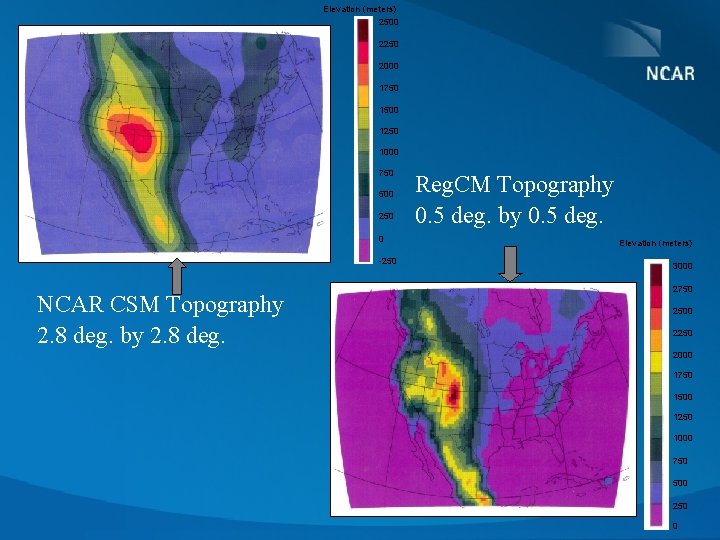
Elevation (meters) 2500 2250 2000 1750 1500 1250 1000 750 500 250 0 -250 NCAR CSM Topography 2. 8 deg. by 2. 8 deg. Reg. CM Topography 0. 5 deg. by 0. 5 deg. Elevation (meters) 3000 2750 2500 2250 2000 1750 1500 1250 1000 750 500 250 0
Resolutions Used in Climate Models • High resolution global coupled oceanatmosphere model simulations are not yet feasible (~ 250 - 300 km) • High resolution global atmospheric model simulations are feasible for time-slice experiments ~ 50 -100 km resolution for 1030 years (~ 100 km) • Regional model simulations at resolution 10 -30 km are feasible for simulations 20 -50 years (~ 50 km)
Benefits of High Resolution Modeling • Improves weather forecasts (e. g. , Kalnay et al. 1998), down to to 10 km and improves seasonal climate forecasts, but more work is needed (Mitchell et al. , Leung et al. , 2002). • Improves climate simulations of large scale conditions and provides greater regional detail potentially useful for climate change impact assessments • Often improves simulation of extreme events such as precipitation and extreme phenomena (hurricanes).
Regional Climate Modeling • Adapted from mesoscale research or weather forecast models. Boundary conditions are provided by large scale analyses or GCMs. • At higher spatial resolutions, RCMs capture climate features related to regional forcings such as orography, lakes, complex coastlines, and heterogeneous land use. • GCMs at 200 – 250 km resolution provide reasonable large scale conditions for downscaling.
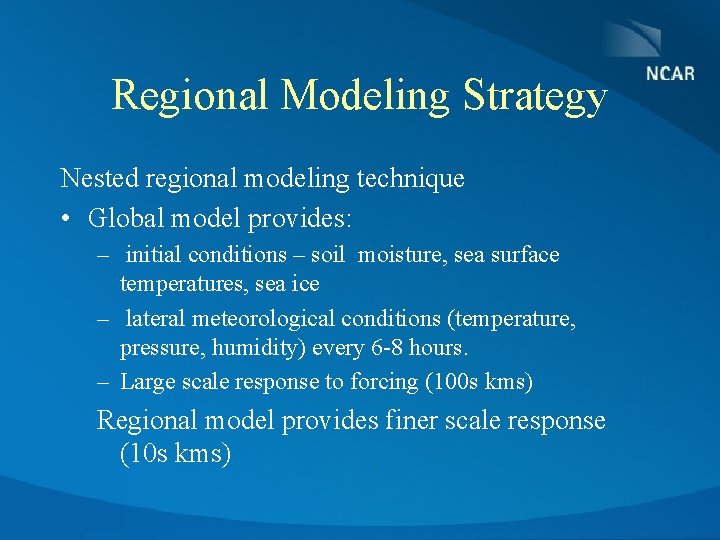
Regional Modeling Strategy Nested regional modeling technique • Global model provides: – initial conditions – soil moisture, sea surface temperatures, sea ice – lateral meteorological conditions (temperature, pressure, humidity) every 6 -8 hours. – Large scale response to forcing (100 s kms) Regional model provides finer scale response (10 s kms)
Now that we can have more regional detail, what difference does it make in any given impacts assessment? What is the added value? Do we have more confidence in the more detailed results? How important is spatial scale versus other factors regarding simulating future climate?
Use of Regional Climate Model Results for Impacts Assessments • Agriculture: Brown et al. , 2000 (Great Plains – U. S. ) Guereña et al. , 2001 (Spain) Mearns et al. , 1998, 1999, 2000, 2001, 2003, 2004 (Great Plains, Southeast, and continental US) Carbone et al. , 2003 (Southeast US) Doherty et al. , 2003 (Southeast US) Tsvetsinskaya et al. , 2003 (Southeast U. S. ) Easterling et al. , 2001, 2003 (Great Plains, Southeast) Thomson et al. , 2001 (U. S. Pacific Northwest) White et al. , 2006 (California (wine))
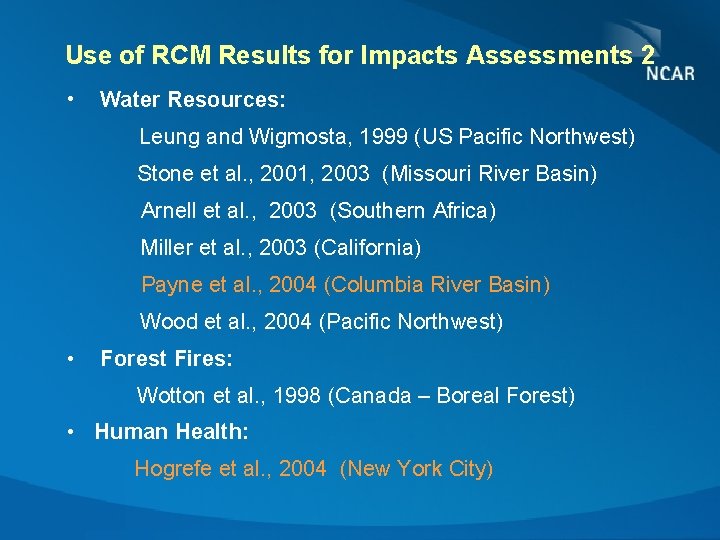
Use of RCM Results for Impacts Assessments 2 • Water Resources: Leung and Wigmosta, 1999 (US Pacific Northwest) Stone et al. , 2001, 2003 (Missouri River Basin) Arnell et al. , 2003 (Southern Africa) Miller et al. , 2003 (California) Payne et al. , 2004 (Columbia River Basin) Wood et al. , 2004 (Pacific Northwest) • Forest Fires: Wotton et al. , 1998 (Canada – Boreal Forest) • Human Health: Hogrefe et al. , 2004 (New York City)
Examples of RCM Use in Climate and Impacts Studies • Water Resources – Pacific Northwest • Agriculture – Wine Production in US • Human Health – New York • European Prudence Program • New Program – NARCCAP
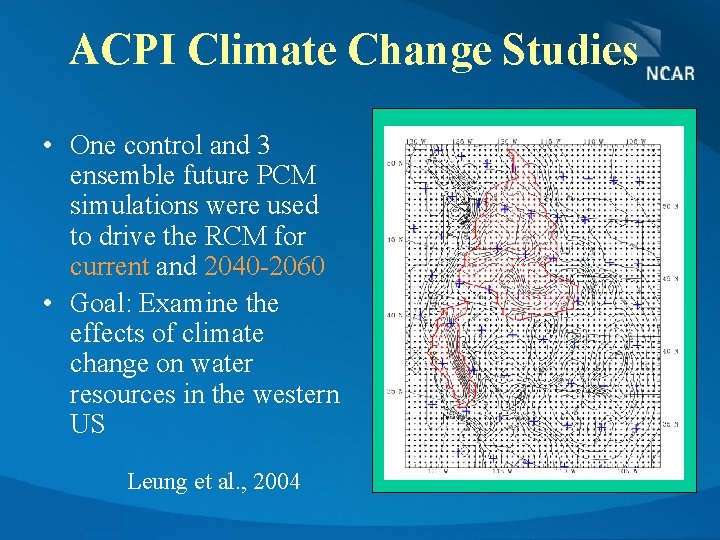
ACPI Climate Change Studies • One control and 3 ensemble future PCM simulations were used to drive the RCM for current and 2040 -2060 • Goal: Examine the effects of climate change on water resources in the western US Leung et al. , 2004
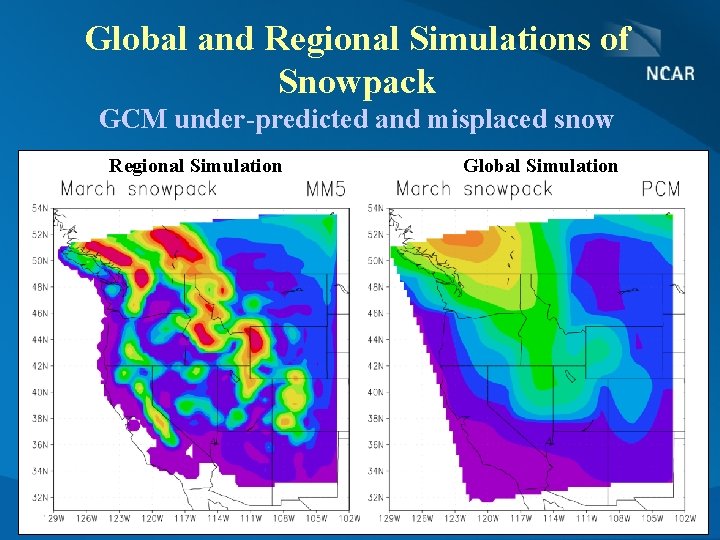
Global and Regional Simulations of Snowpack GCM under-predicted and misplaced snow Regional Simulation Global Simulation
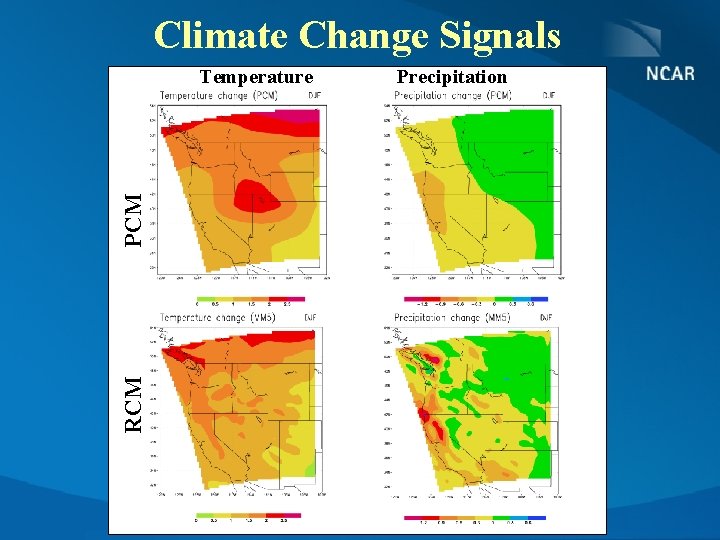
Climate Change Signals RCM PCM Temperature Precipitation
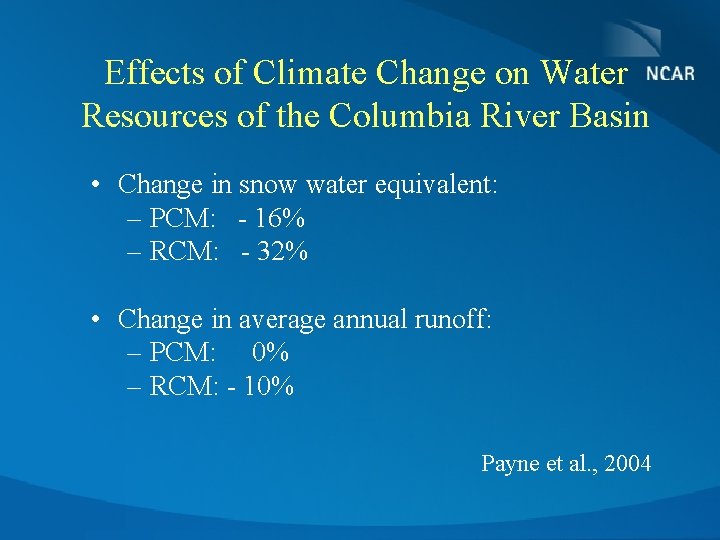
Effects of Climate Change on Water Resources of the Columbia River Basin • Change in snow water equivalent: – PCM: - 16% – RCM: - 32% • Change in average annual runoff: – PCM: 0% – RCM: - 10% Payne et al. , 2004
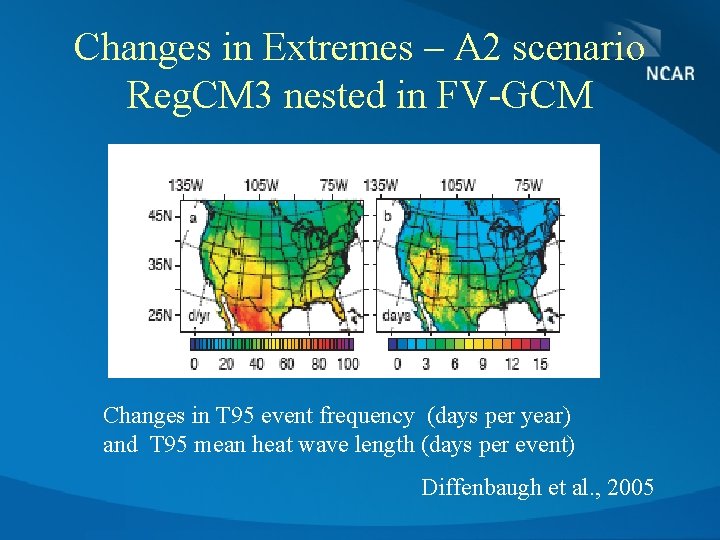
Changes in Extremes – A 2 scenario Reg. CM 3 nested in FV-GCM Changes in T 95 event frequency (days per year) and T 95 mean heat wave length (days per event) Diffenbaugh et al. , 2005
Climate Change and Wine Production in the US Extreme heat could, by the end of the 21 st century, result in loss of 80 percent of wine growing area in the US. Significant shift in wine growing areas, to the Northwest and Northeast. Current wine growing areas in California, for example, would no longer be viable areas for wine production. White et al. , 2006
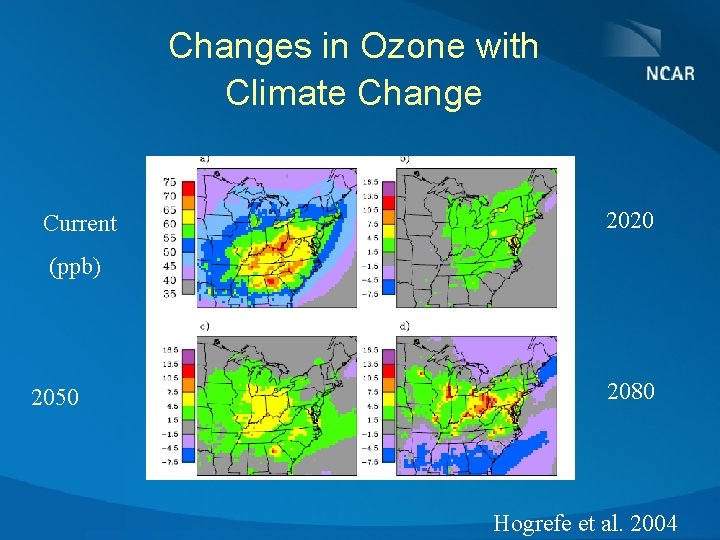
Modeling the Impact of Global Climate and Regional Land Use Change on Regional Climate and Air Quality over the Northeastern United States C. Hogrefe, J. -Y. Ku, K. Civerolo, J. Biswas, B. Lynn, D. Werth, R. Avissar, C. Rosenzweig, R. Goldberg, C. Small, W. D. Solecki, S. Gaffin, T. Holloway, J. Rosenthal, K. Knowlton, and P. L. Kinney Hogrefe et al. , 2004 U. S. EPA STAR Program
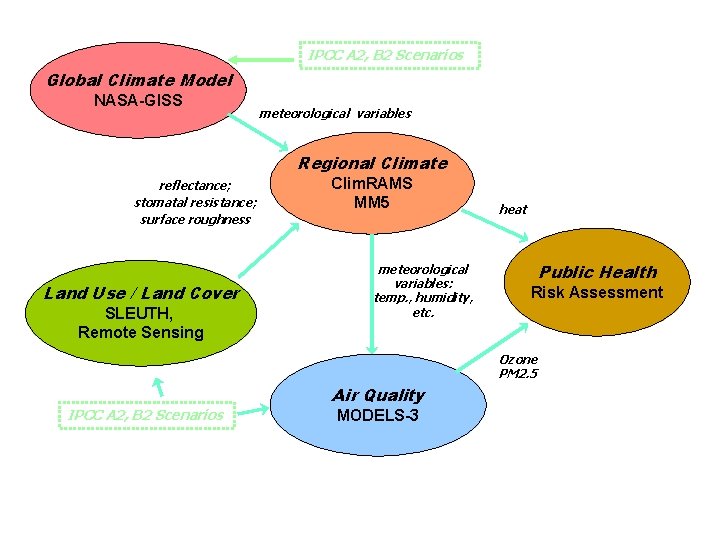
NY Climate & Health Project: Project Components • • • Model Global Climate Model and Evaluate Land Use Model Regional Climate Model Regional Air Pollution (ozone, PM 2. 5) Evaluate Health Impacts (heat, air pollution) – For 2020 s, 2050 s, and 2080 s
IPCC A 2, B 2 Scenarios Global Climate Model NASA-GISS meteorological variables Regional Climate reflectance; stomatal resistance; surface roughness Land Use / Land Cover SLEUTH, Remote Sensing Clim. RAMS MM 5 meteorological variables: temp. , humidity, etc. heat Public Health Risk Assessment Ozone PM 2. 5 IPCC A 2, B 2 Scenarios Air Quality MODELS-3
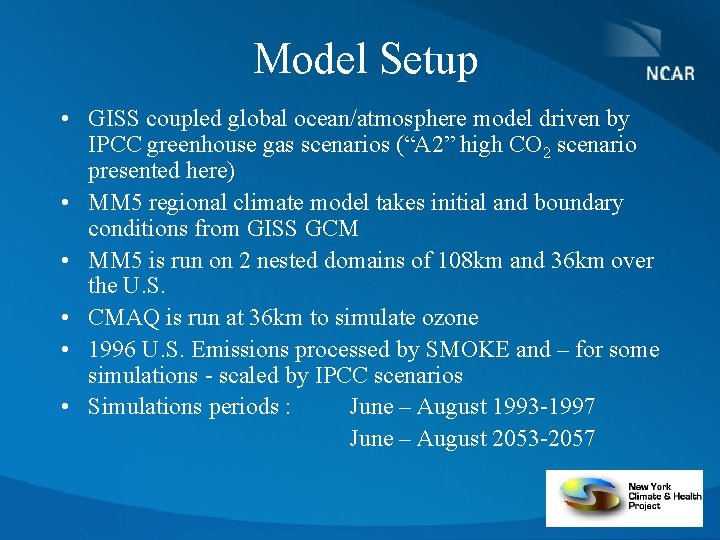
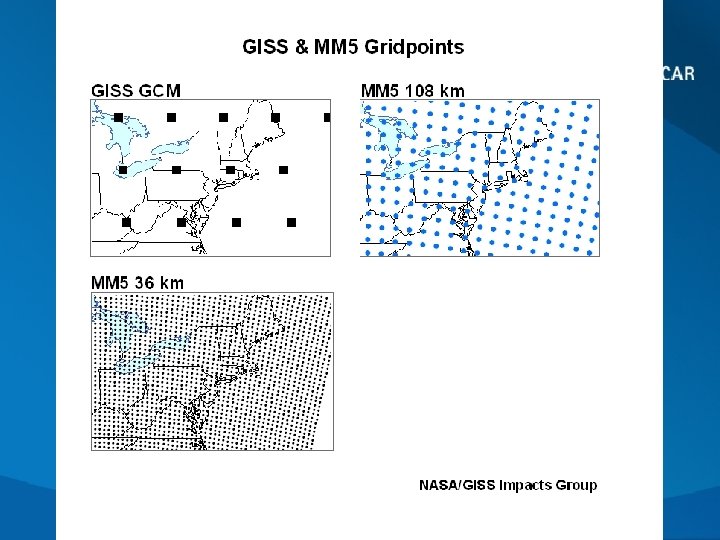
Model Setup • GISS coupled global ocean/atmosphere model driven by IPCC greenhouse gas scenarios (“A 2” high CO 2 scenario presented here) • MM 5 regional climate model takes initial and boundary conditions from GISS GCM • MM 5 is run on 2 nested domains of 108 km and 36 km over the U. S. • CMAQ is run at 36 km to simulate ozone • 1996 U. S. Emissions processed by SMOKE and – for some simulations - scaled by IPCC scenarios • Simulations periods : June – August 1993 -1997 June – August 2053 -2057
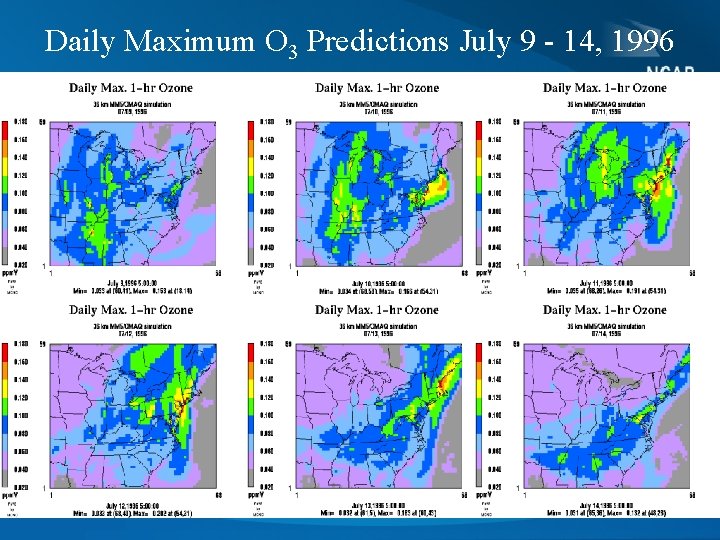
Daily Maximum O 3 Predictions July 9 - 14, 1996
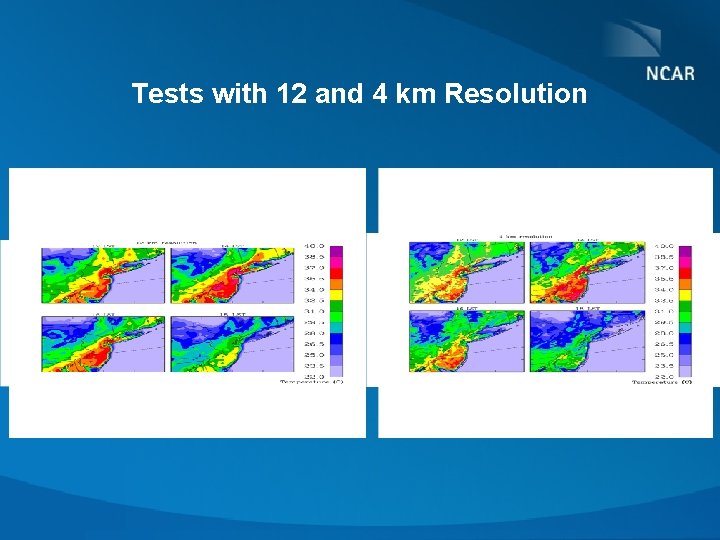
Tests with 12 and 4 km Resolution
Changes in Ozone with Climate Change Current 2020 (ppb) 2050 2080 Hogrefe et al. 2004
Putting spatial resolution in the context of other uncertainties • Must consider the other major uncertainties regarding future climate in addition to the issue of spatial scale – what is the relative importance of uncertainty due to spatial scale? • These include: – Specifying alternative future emissions of ghgs and aerosols – Modeling the global climate response to the forcings (i. e. , differences among GCMs)
Programs Exploring Multiple Uncertainties • PRUDENCE - over Europe • NARCCAP – over North America • CREAS: Cenários REgionais de Mudança de Clima para América do Sul (Regional Climate Change Scenarios for South America)
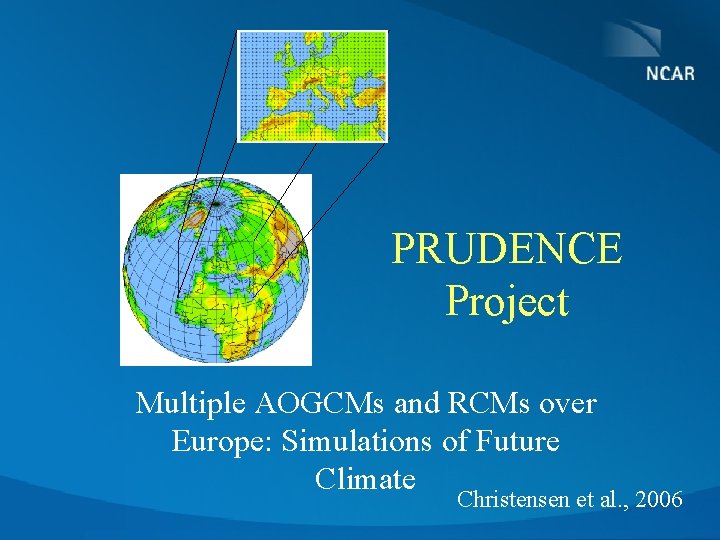
PRUDENCE Project Multiple AOGCMs and RCMs over Europe: Simulations of Future Climate Christensen et al. , 2006
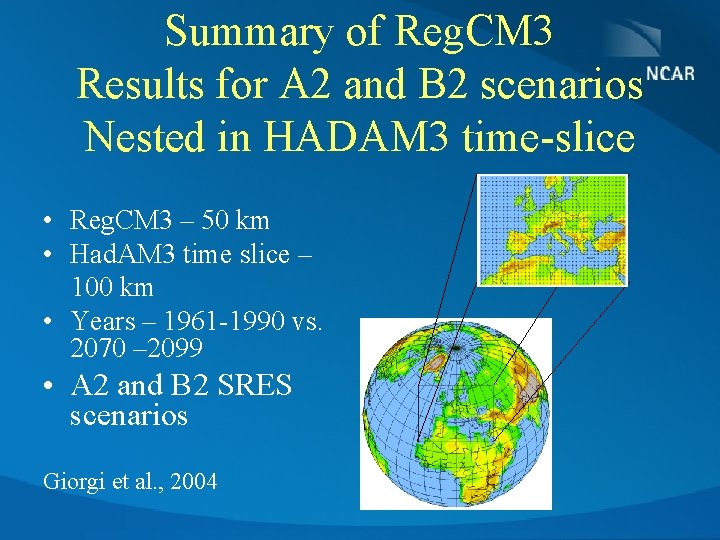
Summary of Reg. CM 3 Results for A 2 and B 2 scenarios Nested in HADAM 3 time-slice • Reg. CM 3 – 50 km • Had. AM 3 time slice – 100 km • Years – 1961 -1990 vs. 2070 – 2099 • A 2 and B 2 SRES scenarios Giorgi et al. , 2004
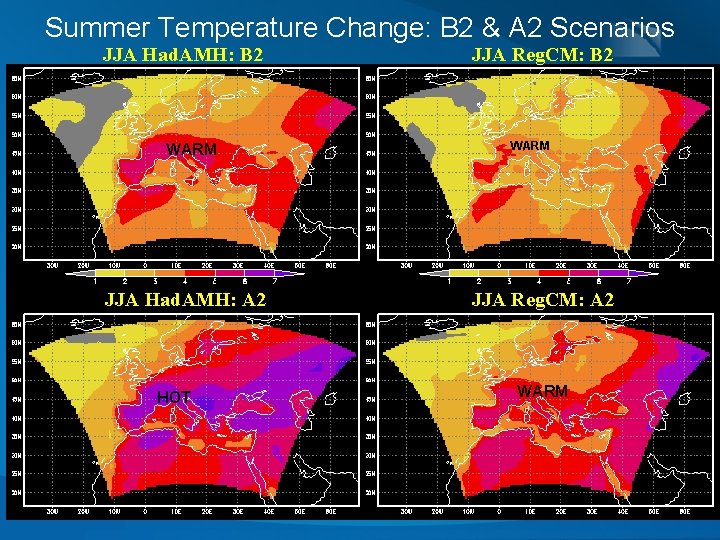
Summer Temperature Change: B 2 & A 2 Scenarios JJA Had. AMH: B 2 WARM JJA Had. AMH: A 2 HOT JJA Reg. CM: B 2 WARM JJA Reg. CM: A 2 WARM
NARCCAP North American Regional Climate Change Assessment Program Multiple AOGCM and RCM Climate Scenarios Project over North America www. narccap. ucar. edu
Participants Linda O. Mearns, National Center for Atmosheric Research, Ray Arritt, Iowa State, Daniel Caya, OURANOS, Phil Duffy, LLNL, Filippo Giorgi, Abdus Salam ICTP, William Gutowski, Iowa State, Isaac Held, GFDL, Richard Jones, Hadley Centre, Rene Laprise, UQAM, Ruby Leung, PNNL, Doug Nychka, NCAR Jeremy Pal, ICTP, John Roads, Scripps, Lisa Sloan, UC Santa Cruz, Ron Stouffer, GFDL, Gene Takle, Iowa State, Bill Collins, NCAR, Francis Zwiers, CCCma
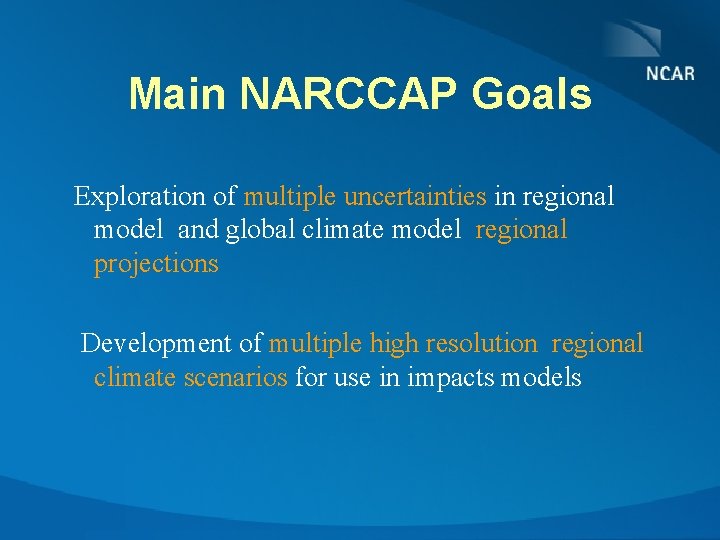
Main NARCCAP Goals Exploration of multiple uncertainties in regional model and global climate model regional projections Development of multiple high resolution regional climate scenarios for use in impacts models
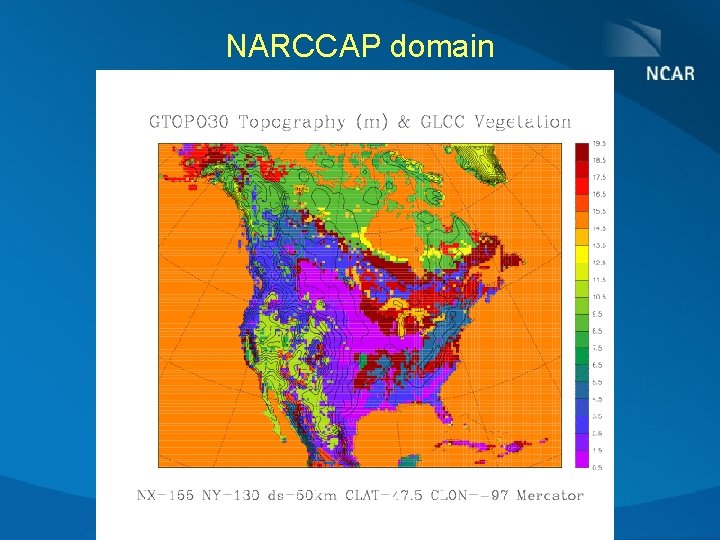
NARCCAP domain
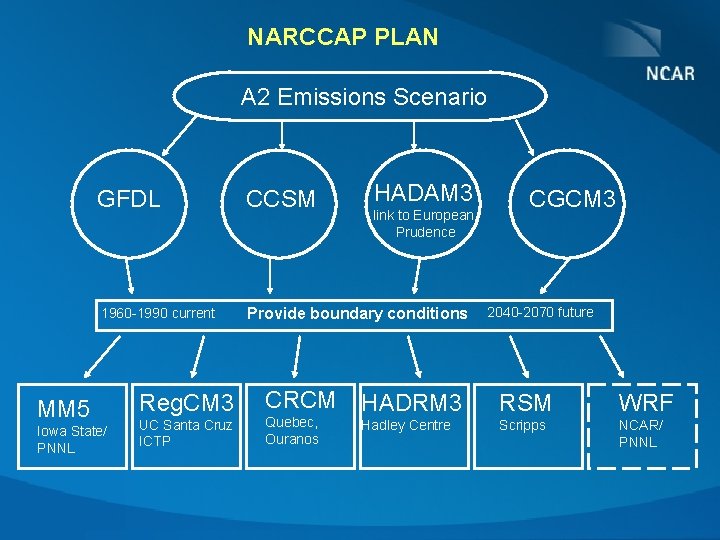
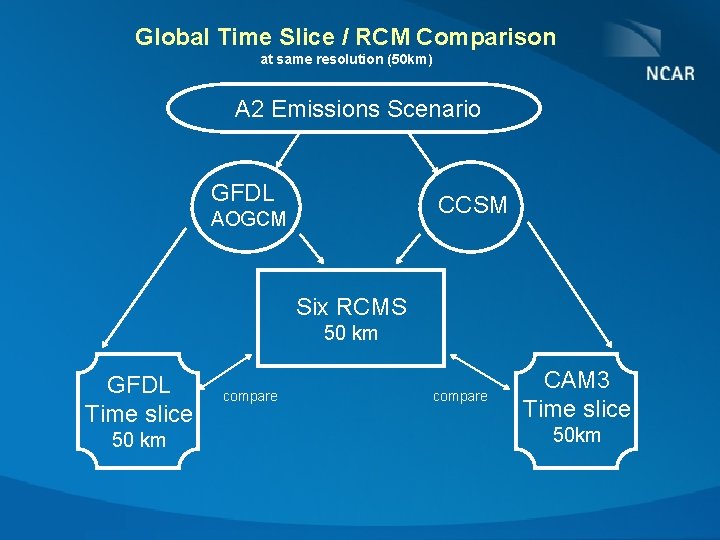
NARCCAP PLAN A 2 Emissions Scenario HADAM 3 GFDL CCSM 1960 -1990 current Provide boundary conditions MM 5 Iowa State/ PNNL Reg. CM 3 UC Santa Cruz ICTP CRCM Quebec, Ouranos link to European Prudence CGCM 3 2040 -2070 future HADRM 3 RSM WRF Hadley Centre Scripps NCAR/ PNNL
Global Time Slice / RCM Comparison at same resolution (50 km) A 2 Emissions Scenario GFDL CCSM AOGCM Six RCMS 50 km GFDL Time slice 50 km compare CAM 3 Time slice 50 km
Final Thoughts • Exploration of multiple uncertainties • Establishing greater confidence in high resolution simulations