
USE OF ONTOLOGYBASED STUDENT MODEL IN SEMANTICORIENTED ACCESS
USE OF ONTOLOGY-BASED STUDENT MODEL IN SEMANTICORIENTED ACCESS TO THE KNOWLEDGE IN DIGITAL LIBRARIES Desislava Paneva Institute of Mathematics and Informatics Bulgarian Academy of Sciences dessi@cc. bas. bg
Presentation overview • Basic concepts and characteristics of digital libraries • Digital libraries and e. Learning systems vis-à-vis • Student modelling – main issues, standards, Semantic web approach for model constructing, examples • Main elements of the student model • Student ontology • Scenario for implementation of student ontology • Conclusion and future work • References
Basic concepts and characteristics of digital libraries Digital libraries (DL) are organised collections of digital content made available to the public, offering services and infrastructure to support preservation and presentation of visual and knowledge objects anytime and anywhere. The main characteristics of digital libraries: • Ability to share information • New forms and formats for information presentation • Easy information update • Accessibility from anywhere, at any time • Services available for searching, selecting, grouping and presenting digital information, extracted from a number of locations • Personalization and adaptation • Contemporary methods and tools for digital information protection and preservation • Different types of computer equipment and software • No limitations related to the size of content to be presented, etc.
Basic concepts and characteristics of digital libraries The functionalities and advanced services of contemporary digital libraries: • Multi-layer and personalized search, context-based search, relevant feedback • Resource and collection management • Metadata management • Indexing • Semantic annotation of digital resources and collection • Multi-object and multi-feature search • Different media type search, etc. Architectures: • Hypermedia digital library • Grid-based infrastructure • Hyperdatabase infrastructure
Digital libraries and e. Learning systems vis-à-vis • Knowledge-on-Demand • Just-in-time methods for supporting knowledge • Provision of more efficient and more flexible tools for transforming digital content to suit the needs of end-users • Sustaining of resources • Resource description • Heterogeneous resources in a coherent way • Intellectual property rights • Flexible architectures that provide interoperability • Innovative services • Effective user modelling tools, etc.
Student modelling can be defined as the process of acquiring knowledge about the student in order to provide services, adaptive content and personalized instructional flow/s according to specific student’s requirements. Main questions: • Student interests: What is the student interested in? What needs to be done or accomplished? • Student preferences: How is something done or accomplished? • Student objectives and intents: What the student actually wants to achieve? • Student motivation: What is the force that drives the student to be engaged in learning activities? • Student experience: What is the student’s previous experience that may have an impact on learning achievement? • Student activities: What the student does in the learning environment? • ….
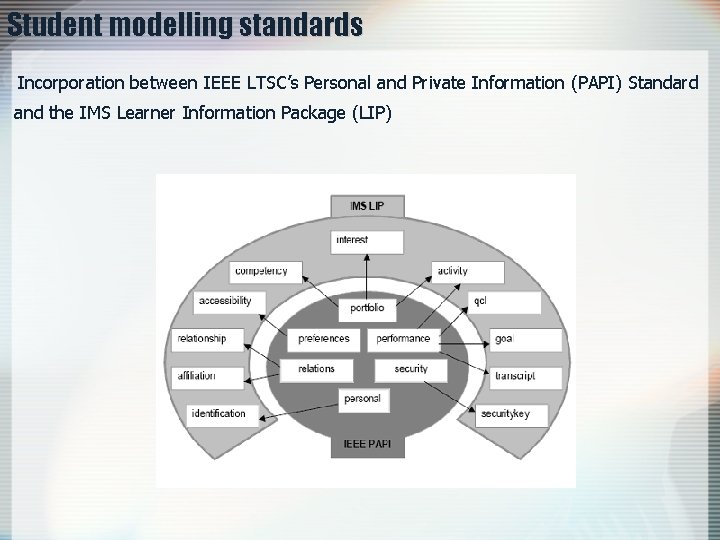
Student modelling standards Incorporation between IEEE LTSC’s Personal and Private Information (PAPI) Standard and the IMS Learner Information Package (LIP)
Student modelling – Semantic web approach • Earliest ideas of using ontologies for learner modelling (Chen&Mizoguchi, 1999). • Use of ontologies for reusable and “scrutable” student models (Kay, 1999) Main tools for constructing a student model ontology are: • Ontology modelling languages - OIL, DAML+OIL, RDF/RDFS, OWL, etc. • Ontology development tools - Apollo, Link. Factory®, OILEd, Onto. Edit. Free, Ontolingua server, Onto. Saurus, Open. Kno. ME, Protégé-2000, Sym. Onto. X, Web. ODE, Web. Onto, Onto. Builder, etc. • Ontology merge and integration tools – Chimaera, FCA-Merge (a method for bottom-up merging of ontologies), PROMPT, ODEMerge, etc. • Ontology-based annotation tools – Aero. DAML, COHSE, Mn. M, Ongto. Annotate, Onto. Mat-Annotizer, SHOE Knowledge Annotator, etc. • Ontology storing and querying tools - ICS-FORTH RDFSuite, Sesame, Inkling, rdf. DB, RDFStore, Extensible Open RDF (EOR), Jena, TRIPLE, KAON Tool Suite, Cerebra®, Ontopia Knowledge Suite, Empolis K 42, etc.
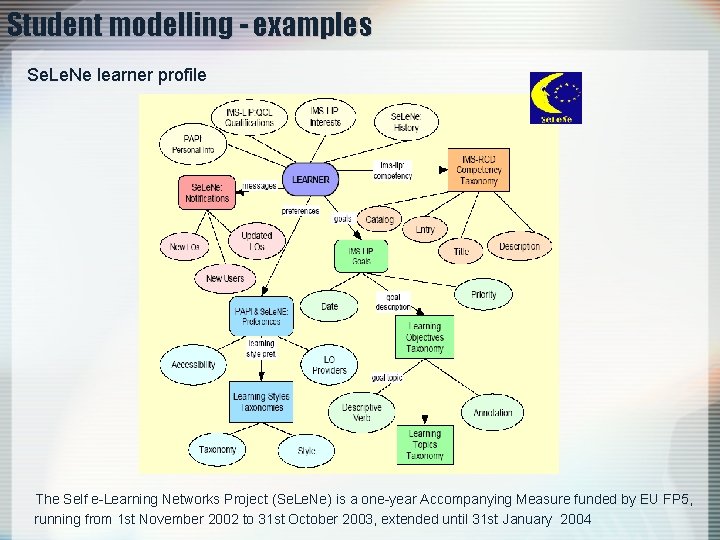
Student modelling - examples Se. Le. Ne learner profile The Self e-Learning Networks Project (Se. Le. Ne) is a one-year Accompanying Measure funded by EU FP 5, running from 1 st November 2002 to 31 st October 2003, extended until 31 st January 2004
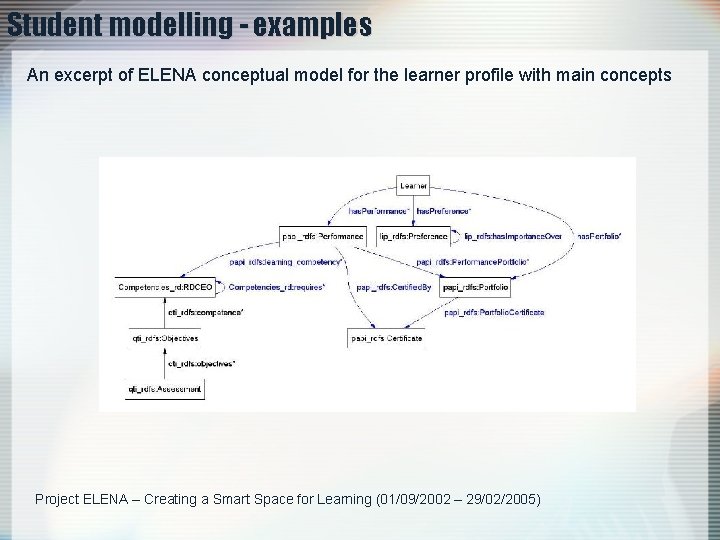
Student modelling - examples An excerpt of ELENA conceptual model for the learner profile with main concepts Project ELENA – Creating a Smart Space for Learning (01/09/2002 – 29/02/2005)
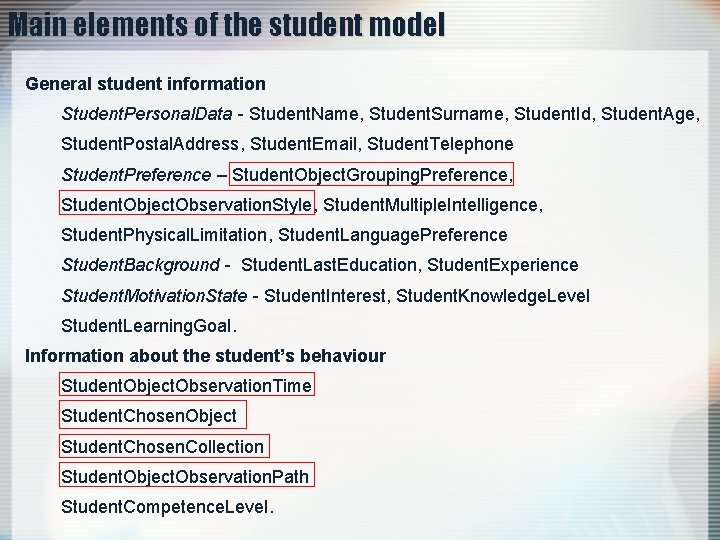
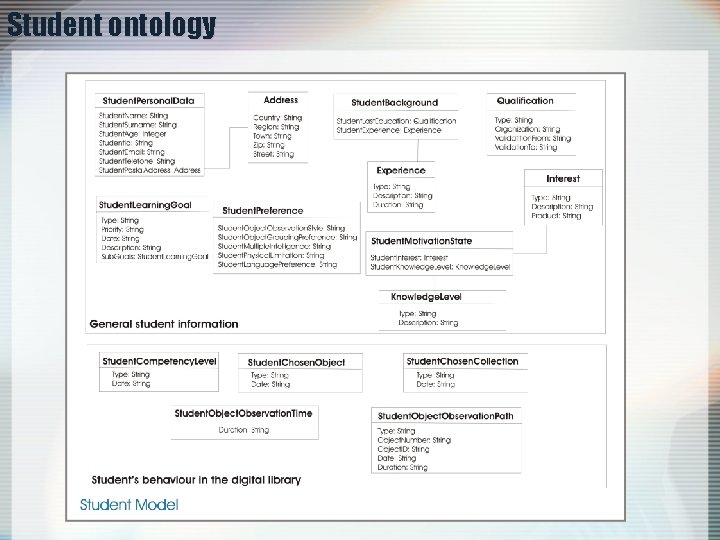
Main elements of the student model General student information Student. Personal. Data - Student. Name, Student. Surname, Student. Id, Student. Age, Student. Postal. Address, Student. Email, Student. Telephone Student. Preference – Student. Object. Grouping. Preference, Student. Object. Observation. Style, Student. Multiple. Intelligence, Student. Physical. Limitation, Student. Language. Preference Student. Background - Student. Last. Education, Student. Experience Student. Motivation. State - Student. Interest, Student. Knowledge. Level Student. Learning. Goal. Information about the student’s behaviour Student. Object. Observation. Time Student. Chosen. Object Student. Chosen. Collection Student. Object. Observation. Path Student. Competence. Level.
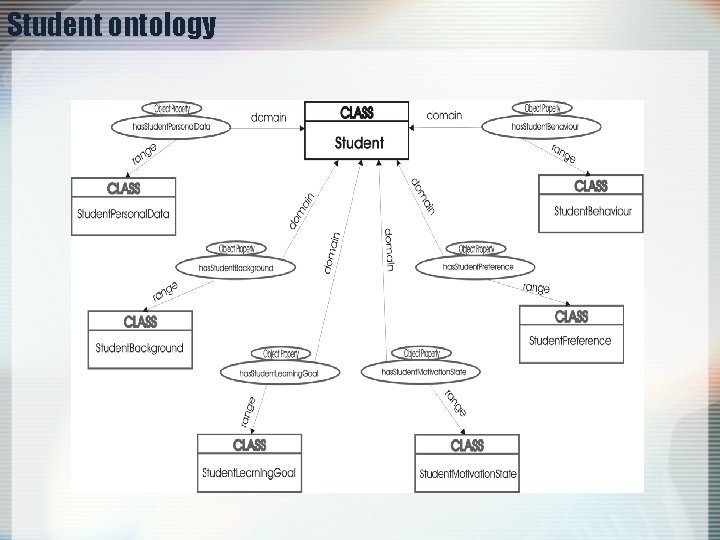
Student ontology
Student ontology
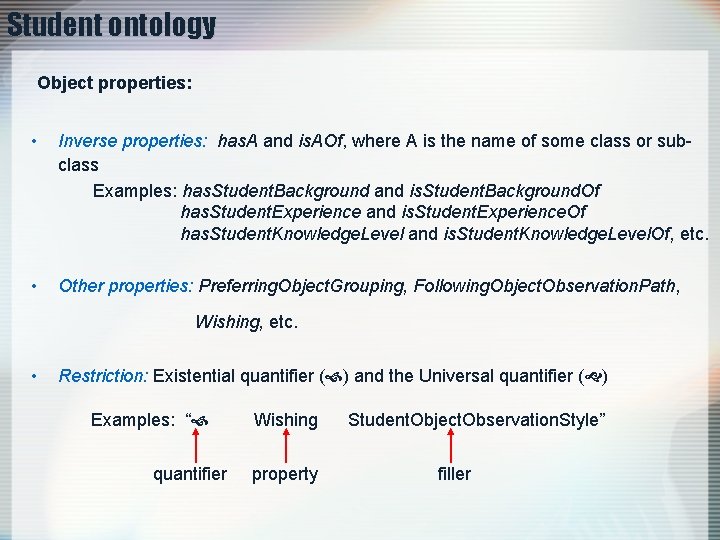
Student ontology Object properties: • Inverse properties: has. A and is. AOf, where A is the name of some class or subclass Examples: has. Student. Background and is. Student. Background. Of has. Student. Experience and is. Student. Experience. Of has. Student. Knowledge. Level and is. Student. Knowledge. Level. Of, etc. • Other properties: Preferring. Object. Grouping, Following. Object. Observation. Path, Wishing, etc. • Restriction: Existential quantifier ( ) and the Universal quantifier ( ) Examples: “ quantifier Wishing property Student. Object. Observation. Style” filler
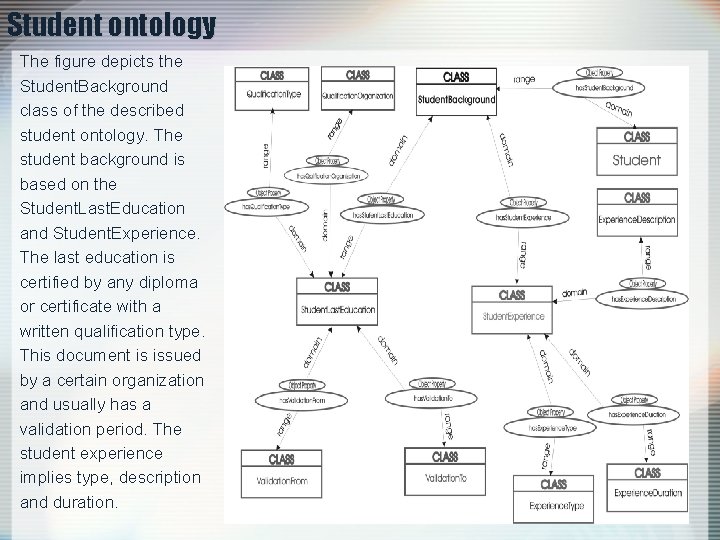
Student ontology The figure depicts the Student. Background class of the described student ontology. The student background is based on the Student. Last. Education and Student. Experience. The last education is certified by any diploma or certificate with a written qualification type. This document is issued by a certain organization and usually has a validation period. The student experience implies type, description and duration.
Scenario for implementation of student ontology • Personalized search § Student motivation state - student knowledge level (beginner, advanced, high) and student interest § Student learning goal § Student background § Student behaviour in the digital library – chosen objects/collections, object observation path, etc. § Student object observation style § Language preference § Student physical limitations, etc. • Context-based search § Student preferences – object grouping preference, etc.
Conclusion and future work • Modelling and creation of domain ontology, describing the knowledge for the digital objects of the digital library. • Merging this ontology with the presented student ontology • Development of semantic-based DL services such as semantic annotation of digital objects, indexing, metadata management, etc. • Development and implementation of semantic search, personalized search, context-based search, multi-object search, multi-feature search, etc. using the merged ontology and following the implementation scenario.
References • LTSC Learner Model Working Group of the IEEE (2000) IEEE p 1484. 2/d 7, 2000 -11 -28 Draft Standard for Learning Technology - Public and Private Information for Learners, Technical report Available Online: http: //www. edutool. com/papi_learner_07_main. pdf • Smythe, C. , F. Tansey, R. Robson (2001) IMS Learner Information Package Information Model Specification, Technical report Available Online: http: //www. imsglobal. org/profiles/lipinfo 01. html • Chen, W. , R. Mizoguchi (1999) Communication Content Ontology for Learner Model Agent in Multi-Agent Architecture, In Proceedings of AIED 99 Workshop on Ontologies for Intelligent Educational Systems • Kay, J. (1999) Ontologies for reusable and scrutable student model, In Proceedings of AIED 99 Workshop on Ontologies for Intelligent Educational Systems • Heckmann, D. , A. Krueger (2003) A User Modeling Markup Language (User. ML) for Ubiquitous Computing, In Proceedings of the Ninth International Conference on User Modeling, Berlin Heidelberg: Springer, pp. 393 -397 • OWL Web Ontology Language Overview. W 3 C Recommendation 10 February 2004, Available Online: http: //www. w 3. org/TR/owl-features/ • Self, J. (1990) Bypassing the intractable problem of student modelling. In C. Frasson & G. Gauthier (Eds. ), Intelligent Tutoring Systems: At the Crossroads of Artificial Intelligence and Education. New Jersey: Ablex. Chen • Lane, C. (1998) Gardner’s multiple Intelligence. Available online: http: //www. tecweb. org/stylesframe. html • Lane, C. (2000) Learning styles and multiple intelligences in distributed learning/IMS projects. San Clemente, CA, The Education Coalition (TEC) • Sison, R. , M. Shimura (1998) Student Modelling and Machine Learning. International Journal of Artificial Intelligence in Education volum 9, pp. 128 -158
- Slides: 18