
Use of Negative Pressure Therapy in Fecal Containment
- Slides: 1
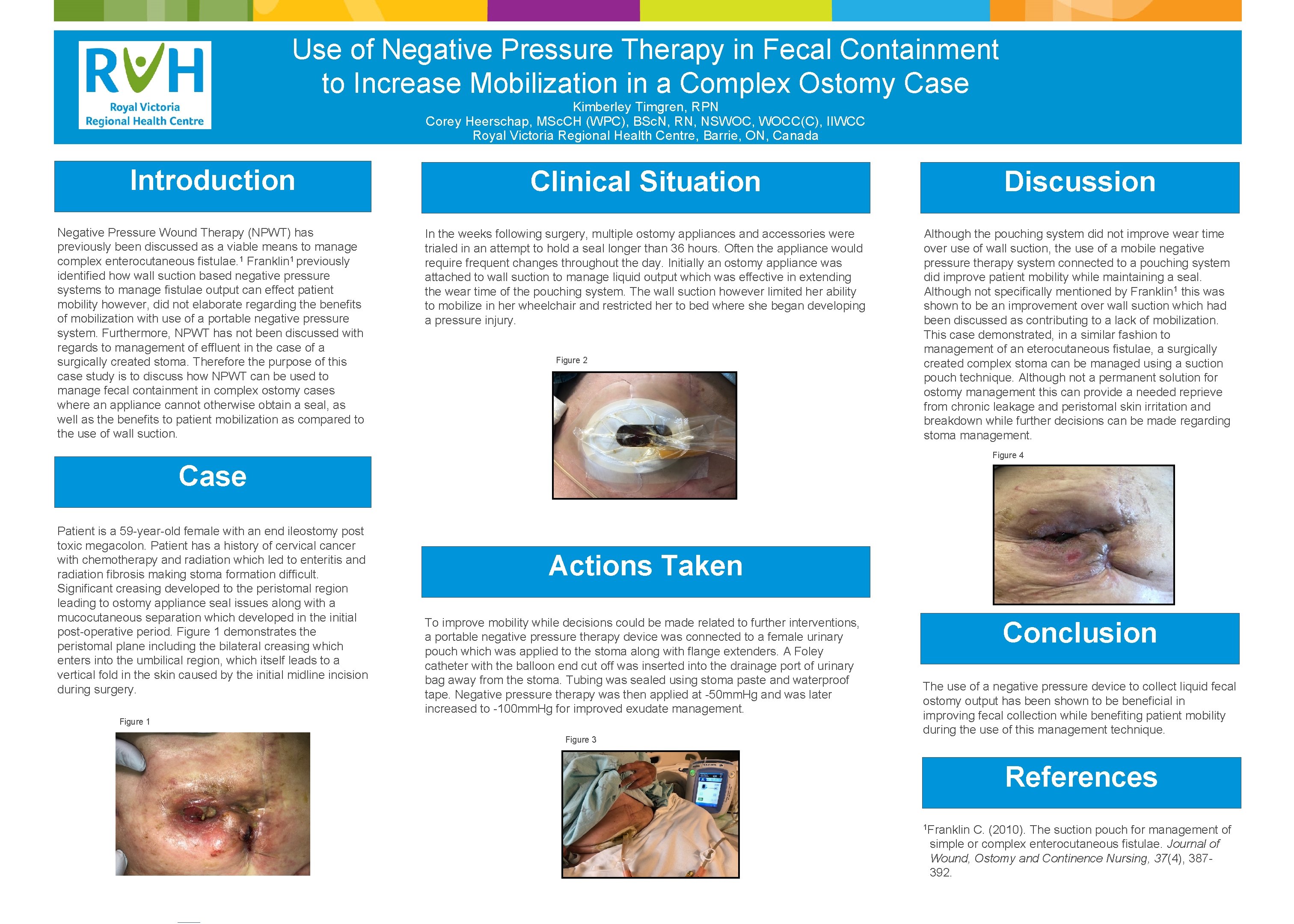
Use of Negative Pressure Therapy in Fecal Containment to Increase Mobilization in a Complex Ostomy Case Kimberley Timgren, RPN Corey Heerschap, MSc. CH (WPC), BSc. N, RN, NSWOC, WOCC(C), IIWCC Royal Victoria Regional Health Centre, Barrie, ON, Canada Introduction Clinical Situation Discussion Negative Pressure Wound Therapy (NPWT) has previously been discussed as a viable means to manage complex enterocutaneous fistulae. 1 Franklin 1 previously identified how wall suction based negative pressure systems to manage fistulae output can effect patient mobility however, did not elaborate regarding the benefits of mobilization with use of a portable negative pressure system. Furthermore, NPWT has not been discussed with regards to management of effluent in the case of a surgically created stoma. Therefore the purpose of this case study is to discuss how NPWT can be used to manage fecal containment in complex ostomy cases where an appliance cannot otherwise obtain a seal, as well as the benefits to patient mobilization as compared to the use of wall suction. In the weeks following surgery, multiple ostomy appliances and accessories were trialed in an attempt to hold a seal longer than 36 hours. Often the appliance would require frequent changes throughout the day. Initially an ostomy appliance was attached to wall suction to manage liquid output which was effective in extending the wear time of the pouching system. The wall suction however limited her ability to mobilize in her wheelchair and restricted her to bed where she began developing a pressure injury. Although the pouching system did not improve wear time over use of wall suction, the use of a mobile negative pressure therapy system connected to a pouching system did improve patient mobility while maintaining a seal. Although not specifically mentioned by Franklin 1 this was shown to be an improvement over wall suction which had been discussed as contributing to a lack of mobilization. This case demonstrated, in a similar fashion to management of an eterocutaneous fistulae, a surgically created complex stoma can be managed using a suction pouch technique. Although not a permanent solution for ostomy management this can provide a needed reprieve from chronic leakage and peristomal skin irritation and breakdown while further decisions can be made regarding stoma management. Figure 2 Figure 4 Case Patient is a 59 -year-old female with an end ileostomy post toxic megacolon. Patient has a history of cervical cancer with chemotherapy and radiation which led to enteritis and radiation fibrosis making stoma formation difficult. Significant creasing developed to the peristomal region leading to ostomy appliance seal issues along with a mucocutaneous separation which developed in the initial post-operative period. Figure 1 demonstrates the peristomal plane including the bilateral creasing which enters into the umbilical region, which itself leads to a vertical fold in the skin caused by the initial midline incision during surgery. Actions Taken To improve mobility while decisions could be made related to further interventions, a portable negative pressure therapy device was connected to a female urinary pouch which was applied to the stoma along with flange extenders. A Foley catheter with the balloon end cut off was inserted into the drainage port of urinary bag away from the stoma. Tubing was sealed using stoma paste and waterproof tape. Negative pressure therapy was then applied at -50 mm. Hg and was later increased to -100 mm. Hg for improved exudate management. Figure 1 Figure 3 Conclusion The use of a negative pressure device to collect liquid fecal ostomy output has been shown to be beneficial in improving fecal collection while benefiting patient mobility during the use of this management technique. References 1 Franklin C. (2010). The suction pouch for management of simple or complex enterocutaneous fistulae. Journal of Wound, Ostomy and Continence Nursing, 37(4), 387392. @Team. RVH Team RVH www. rvh. on. ca