
Use of MDG Indicators and Statistics by ADB
Use of MDG Indicators and Statistics by ADB International Conference on Millennium Development Goals Statistics Hotel Dusit Thani, Manila, Philippines 21 -10 -2011 Kaushal Joshi Senior Statistician Development Indicators and Policy Research Division, Economics and Research Department, Asian Development Bank, Manila
Outline • Introduction: About ADB • Strategies, sectoral interventions, resource allocations and MDGs • Managing for Development Results • Monitoring regional MDG progress • Research, knowledge and statistics 2
Introduction: About ADB • Development Financial Institution • Strategy 2020 Ø ADB’s long-term strategic framework • Vision “An Asia and Pacific Region free of poverty” • Mission “To help its DMCs reduce poverty and improve living conditions and quality of life” 3
Introduction: About ADB (2) Ø Three complementary strategic agendas v Inclusive growth v Environmentally sustainable growth v Regional cooperation and integration 4
Introduction: About ADB (3) Core areas of operations v Infrastructure v Environment, including climate change v Regional cooperation and integration v Finance sector development v Education Other areas of operations v Health v Agriculture v Disaster and emergency assistance 5
Strategies, sectoral interventions, resource allocations and MDGs • MDGs endorsed in 2002 and remain key motivators of ADB’s corporate strategy. • MDGs are mainstreamed in the Country Partnership Strategy (CPS). • MDGs influence sectoral interventions and analytical work and overall country operational objectives. • CPS results framework, which contains MDG indicators and statistics, provides a basis for resource allocation. • ADB’s poverty reduction efforts are aligned with MDGs around NPRS/PRSP in partnership with Governments, NGOs/Civil Society and developments partners. 6
Strategies, sectoral interventions, resource allocations and MDGs (2) • Supporting achievement of MDGs is integrated into the Work Program and Budget Framework (WPBF) 2010 -2012. • ADF X operations, which cover the first 4 years of Strategy 2020, will help DMCs to achieve the MDG targets by 2015. • Over the past 6 years, ADF has helped some of the poorest countries in Asia and the Pacific help achieve MDGs in various ways. 7
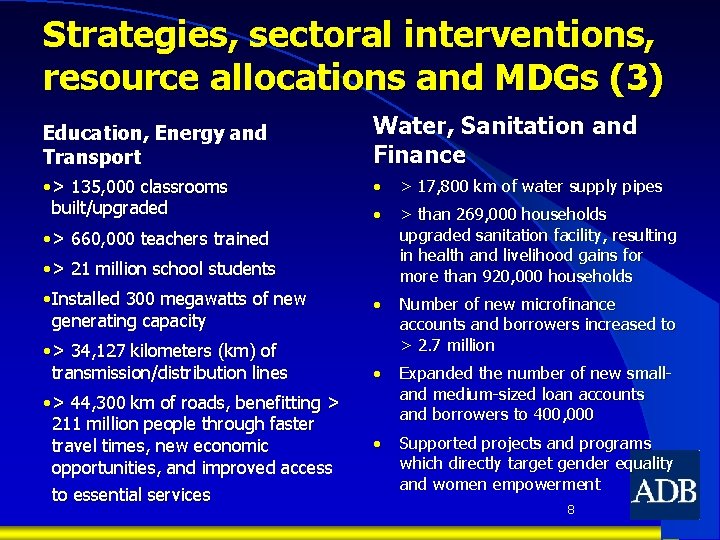
Strategies, sectoral interventions, resource allocations and MDGs (3) Education, Energy and Transport • > 135, 000 classrooms built/upgraded Water, Sanitation and Finance • > 17, 800 km of water supply pipes • > than 269, 000 households upgraded sanitation facility, resulting in health and livelihood gains for more than 920, 000 households • Number of new microfinance accounts and borrowers increased to > 2. 7 million • Expanded the number of new smalland medium-sized loan accounts and borrowers to 400, 000 • Supported projects and programs which directly target gender equality and women empowerment • > 660, 000 teachers trained • > 21 million school students • Installed 300 megawatts of new generating capacity • > 34, 127 kilometers (km) of transmission/distribution lines • > 44, 300 km of roads, benefitting > 211 million people through faster travel times, new economic opportunities, and improved access to essential services 8
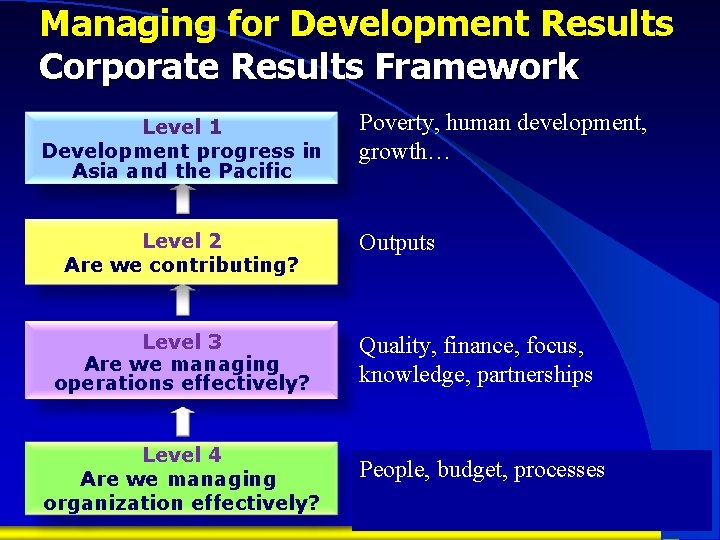
Managing for Development Results Corporate Results Framework Level 1 Development progress in Asia and the Pacific Level 2 Are we contributing? Level 3 Are we managing operations effectively? Level 4 Are we managing organization effectively? Poverty, human development, growth… Outputs Quality, finance, focus, knowledge, partnerships People, budget, processes
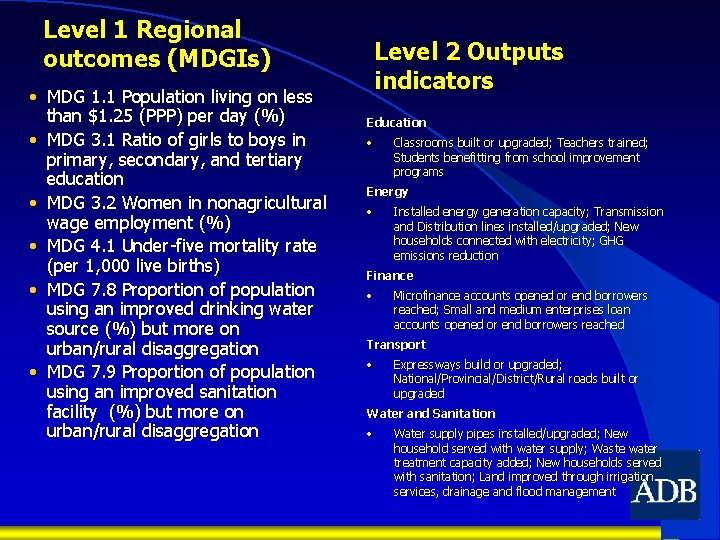
Level 1 Regional outcomes (MDGIs) • MDG 1. 1 Population living on less than $1. 25 (PPP) per day (%) • MDG 3. 1 Ratio of girls to boys in primary, secondary, and tertiary education • MDG 3. 2 Women in nonagricultural wage employment (%) • MDG 4. 1 Under-five mortality rate (per 1, 000 live births) • MDG 7. 8 Proportion of population using an improved drinking water source (%) but more on urban/rural disaggregation • MDG 7. 9 Proportion of population using an improved sanitation facility (%) but more on urban/rural disaggregation Level 2 Outputs indicators Education • Classrooms built or upgraded; Teachers trained; Students benefitting from school improvement programs Energy • Installed energy generation capacity; Transmission and Distribution lines installed/upgraded; New households connected with electricity; GHG emissions reduction Finance • Microfinance accounts opened or end borrowers reached; Small and medium enterprises loan accounts opened or end borrowers reached Transport • Expressways build or upgraded; National/Provincial/District/Rural roads built or upgraded Water and Sanitation • Water supply pipes installed/upgraded; New household served with water supply; Waste water treatment capacity added; New households served with sanitation; Land improved through irrigation services, drainage and flood management
Monitoring Regional MDG Progress • Partnership with UNDP and ESCAP to support MDG progress tracking, raise awareness, and improve policies and institutions involved in achieving MDGs. • Joint Asia-Pacific MDG Reports for regional assessment as input to the global UN MDG assessment. • 2010/11 report focused on overall priorities and opportunities and on hunger and food security; health and basic services; and improvement of basic infrastructure. 11
Research, knowledge and statistics • Key Indicators for Asia and the Pacific – Annual statistical flagship publication. Ø Special chapters on regional policy relevant issues (poverty & inequality, quality employment) Ø Statistical tables and statistical commentaries on progress assessment • Statistical Database system (SDBS) available for external users access (http: //www. adb. org/statistics/sdbs. asp) • Framework of Inclusive Growth Indicators (FIGI) – consists of 35 indicators, 10 of which are MDG indicators. 12
Research, knowledge and statistics Statistical Capacity Building • Improving administrative data sources for MDG indicators (Handbook on Use of Administrative Data Sources). • Measuring informal employment and the informal sector. • International Comparison Program (ICP) – provides inputs for the computation/ compilation of PPP-based poverty line (e. g. , 13 $1. 25 PPP).
In summary: • MDGs indicators are important motivator of corporate strategy, work program and results framework. • MDGs are mainstreamed into country strategies and business plans. • ADB operations and knowledge work help countries attain MDGs in the region. • ADB plays important role with regional partners to monitor progress of MDGs in the region. 14
Thank You kjoshi@adb. org 63 2 632 5969 www. adb. org 15
- Slides: 15