
Use of MC Tools in LHCb Patrick Robbe

Use of MC Tools in LHCb Patrick Robbe (LAL Orsay), 17 July 2006
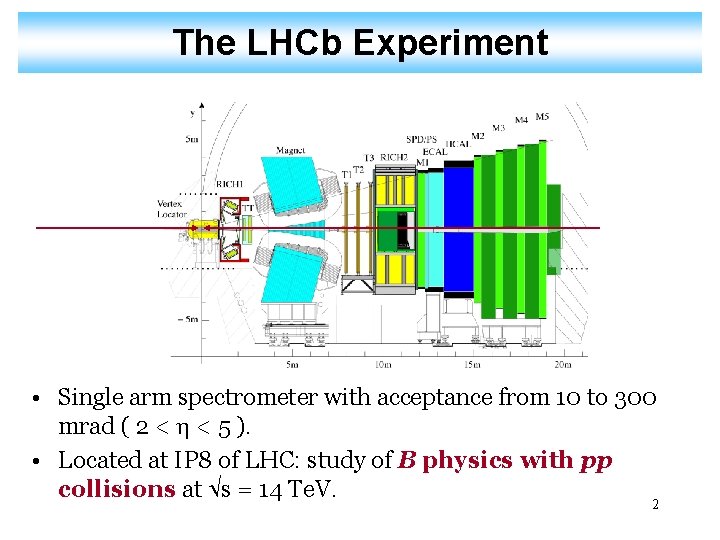
The LHCb Experiment • Single arm spectrometer with acceptance from 10 to 300 mrad ( 2 < h < 5 ). • Located at IP 8 of LHC: study of B physics with pp collisions at s = 14 Te. V. 2
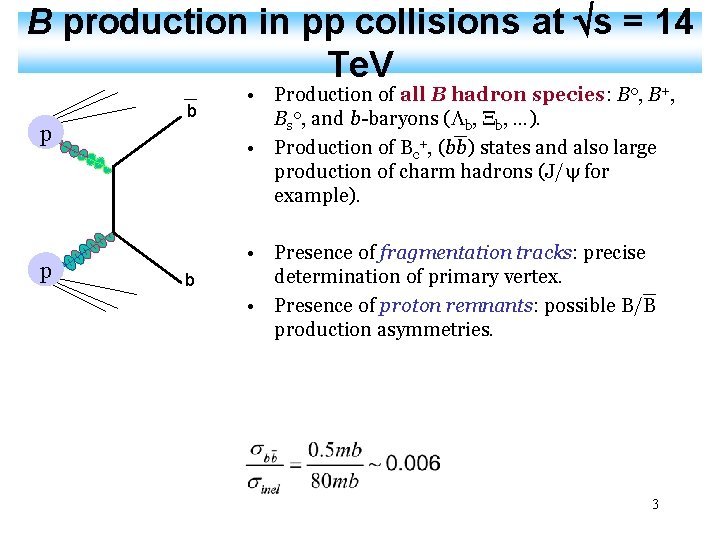
B production in pp collisions at s = 14 Te. V p p b b • Production of all B hadron species: B 0, B+, Bs 0, and b-baryons (Lb, Xb, …). • Production of Bc+, (bb) states and also large production of charm hadrons (J/y for example). • Presence of fragmentation tracks: precise determination of primary vertex. • Presence of proton remnants: possible B/B production asymmetries. 3
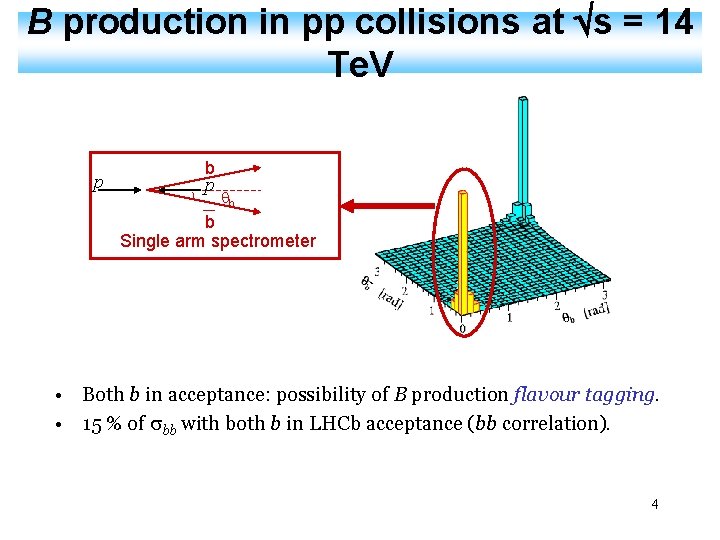
B production in pp collisions at s = 14 Te. V p b p b b Single arm spectrometer • Both b in acceptance: possibility of B production flavour tagging. • 15 % of sbb with both b in LHCb acceptance (bb correlation). 4
Physics Program of LHCb • Measurement and study of CP violation in the B meson sector: • Properties of Bs 0/Bs 0 oscillations, • CP Asymmetries for example in B 0 p+p-p 0 (CKM a angle), B 0 J/y Ks 0 (CKM b angle), Bs 0 h+h- (CKM g angle) • Study of rare B decays (search for New Physics, eg B 0 K* m m) • Precise determination of B physics parameters (Lb initial polarizations and asymmetries, Bc+ mass, width and branching fractions, …) • Charm physics, top and Higgs physics. • ~20000 B 0 and ~5000 Bs 0 per second in LHCb: need for an efficient trigger: • Level 0: high p. T objects in calorimeters and muon detectors, • High Level Trigger: displaced vertices, dimuon mass and exclusive reconstruction of interesting final states. • Reduce rate from 40 MHz to 2 k. Hz. 5
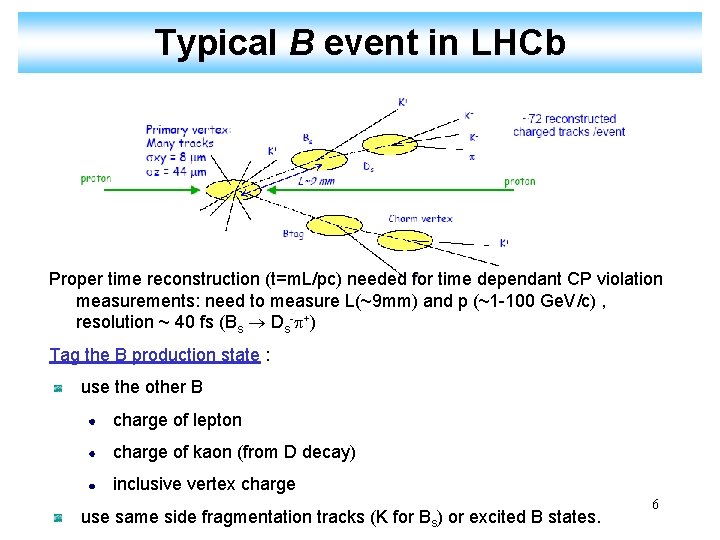
Typical B event in LHCb Proper time reconstruction (t=m. L/pc) needed for time dependant CP violation measurements: need to measure L(~9 mm) and p (~1 -100 Ge. V/c) , resolution ~ 40 fs (Bs Ds-p+) Tag the B production state : use the other B charge of lepton charge of kaon (from D decay) inclusive vertex charge use same side fragmentation tracks (K for Bs) or excited B states. 6
Generator Properties for LHCb • Description of pp collisions at LHC energy: • Assess trigger rates, • Assess reconstruction efficiencies of both signal and tag B. • Description of B and D decays: • Compute reconstruction efficiencies, • Compute tagging efficiencies: content of B and D decays to K and leptons, • Composition of background (CP measurement dilutions, rare decays) • Mode specific features (angular distributions, asymmetries) • Description of background in LHCb: beam bas interactions, … 7
Generation Software Structure • Software is based on Gaudi and LHCb common software: – General functionalities provided (persistency, histograms, …) • All generators are “wrapped” into Gaudi algorithms or tools to make them “callable and controllable” from the framework: – Job options to control what to generate and how to generate it • All generators interfaced with Hep. MC – IO Exchange format between generators themselves and with detector simulation – “Encapsulated” in LHCb Event model ( Hep. MCEvent ) • Transient store access • Persistency Access of generator information in analysis applications. 8
Generation Software Structure (2) • Structure is flexible enough to adapt a large variety of generators. • Production and decay steps are separated. Different generators can be used for both phases. (For example Pythia + Evt. Gen). • Pile-up and beam properties are generated separately. • Particle properties (masses, widths, …) and random number generator are common between all generators used for consistency and for reproducibility of events. 9
What to generate • Need different types of “events” – Particle guns (calibration, test beams, single beam in IP 8) – Single pp-collisions and bunch crossing at different luminosities (pile-up) – Minimum bias – “Signal” events: B 0, Bs 0 and B+ forced to decay in many decay modes to study physics performances of LHCb for important CP or mixing analysis, but also bbaryons, open charm, heavy quarkonia, Higgs, Z 0, etc. – Beam gas in the VELO and beam pipe – LHC machine background ( survivors of beam gas in accelerator ) 10
Generator Packages Used (1) • PYTHIA: • Main generator used in LHCb for the production part. • We currently use version 6. 3 • We would like to start studying the use of the C++ Pythia versions. • HERWIG: • Recently introduced in LHCb simulation software. • Used to generate Minimum Bias events, we will also use it to generate inclusive B and signal B events (simple exchange with Pythia). • Evt. Gen: • Main generator used in LHCb for the production part. • PHOTOS : used in Evt. Gen as a universal tool to generate radiative corrections to hadron decays. • LHAPDF: PDF repository called from Pythia. 11
Generator Packages Used (2) • SHERPA: under investigation for use in LHCb as a production and also as a decay generator. • Bc. Veg. Py: Bc+ generator implemented as a user process in Pythia. • HIJING: used to generate beam-gas events in the Velo. • Acer. MC: study of background processes with heavy quarks in the final state (Wbb, Zbb, ttbb) • Charybdis: black hole generator. 12
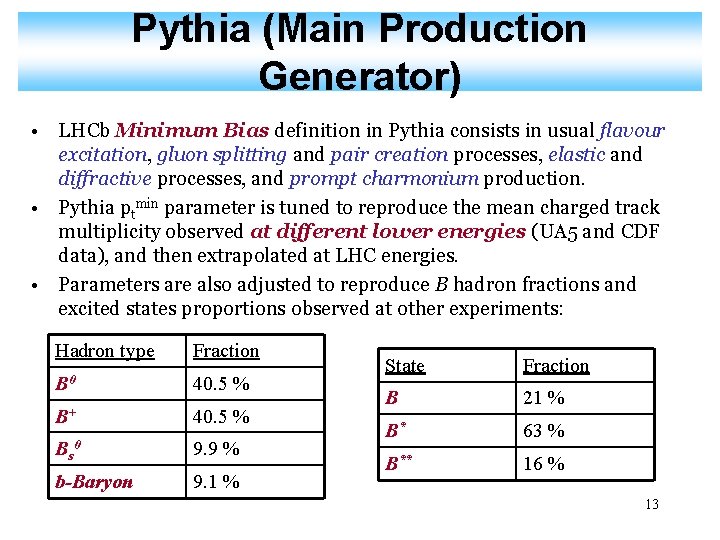
Pythia (Main Production Generator) • LHCb Minimum Bias definition in Pythia consists in usual flavour excitation, gluon splitting and pair creation processes, elastic and diffractive processes, and prompt charmonium production. • Pythia ptmin parameter is tuned to reproduce the mean charged track multiplicity observed at different lower energies (UA 5 and CDF data), and then extrapolated at LHC energies. • Parameters are also adjusted to reproduce B hadron fractions and excited states proportions observed at other experiments: Hadron type Fraction B 0 40. 5 % B+ 40. 5 % Bs 0 9. 9 % b-Baryon 9. 1 % State Fraction B 21 % B* 63 % B** 16 % 13
Evt. Gen (Main Decay Generator) • Use of Ba. Bar Evt. Gen version as decay generator to decay all hadrons produced by Pythia. • Implementation of specificities of hadronic environment: • Incoherent production of B hadrons (B 0 and Bs 0 oscillations) • CP violation • Add decay models for modes under study at LHCb: B D K, Lb L V, … • Use of most recent versions of Ba. Bar decay table which is very detailed for B 0/B+ decays and tuned to reproduce multiplicity measurements. • Used in LHCb simulation for large data challenge. • LHCb Evt. Gen version is the starting point of the LHC Evt. Gen version. • Evt. Gen is interfaced with PHOTOS: important for efficiency and background computations to know the effect of radiative corrections in a large variety of B decay channels. 14
Signal Samples with Pythia + Evt. Gen • Events containing a B hadron are extracted from Minimum Bias, all hadrons are declared as stable in Pythia. • Then all hadrons are decayed using Evt. Gen. • One of the B hadron is forced to decay into a “signal decay mode” to obtain a sample with only this mode. • Generator level cuts are applied to this B hadron (momentum cut, angular acceptance cut, …): even if B hadron production is not so rare, event generation can take longer because of these cuts. • Interface issues: • Particles are transferred from Pythia to Evt. Gen using the Hep. MC classes. • Particle masses, widths, and lifetimes are identical in Pythia and Evt. Gen: tuning needed to be sure that all decay modes are compatible with them. • Both generators use the same random number generator. 15
Heavy Quarkonia Production Models • Prompt J/ signals are important for the physics at LHCb: • Main channels to study B physics contain a J/y in the final state. Prompt J/ y can be a background to these analysis. • They can be used as calibration signals to estimate the proper time resolution of the detector. • LHCb will contain a di-muon trigger. • Studying heavy quarkonia (J/y but also Y) is in itself an important subject: • improved knowledge of QCD • study of the production mechanisms and comparison with NRQCD, Color Singlet Model (CSM) • LHCb will allow to record a large sample of heavy quarkonia and then is participating in the development and the 16 test of production model inside Pythia 6. 3.
NRQCD In Pythia (1) • Production of charm and beauty hidden flavor states in PYTHIA was incomplete: • Only color singlet processes (Color Singlet Model). • CSM largely fails in shape and normalization. • Not too flexible • Cannot allow simultaneous production of ψ’s and Υ’s, nor Υ(1 S) and Υ(2 S), etc. • Collaboration between Pythia authors, GENSER team and LHCb to introduce, test and validate NRQCD for heavy quarkonia production in PYTHIA • Since Pythia 6. 324 code is integrated and Pythia can deal with charmonia and bottomonia sectors: • Possibility to produce simultaneously J/ψ and Υ (introduced as different processes) • Still not possible to generate Υ’ and ψ’ simultaneously, but can be implemented in near future 17
NRQCD In Pythia (2) • New processes available: • cc S-wave with color-singlet and color-octet contributions. • New modes for cc production (not only gluon fusion). • Altarelli-Parisi evolution equations: allows the final- state shower evolution both for color-octet charmonia and for bottomonia. • Polarization implementation for quarkonia. • Production of in P wave charmonia and S and P wave bottomonia. • See for more details: http: //indico. cern. ch/material. Display. py? contrib. Id=3&materi al. Id=slides&conf. Id=3722 18
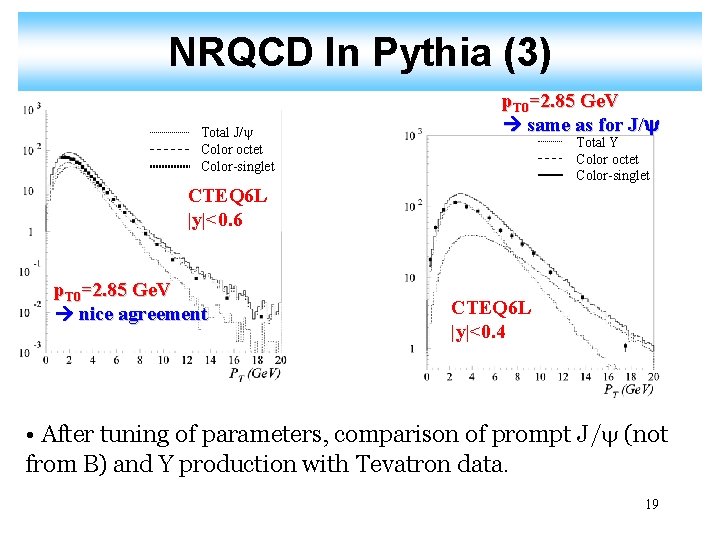
NRQCD In Pythia (3) Total J/y Color octet Color-singlet p. T 0=2. 85 Ge. V same as for J/ Total Y Color octet Color-singlet CTEQ 6 L |y|<0. 6 p. T 0=2. 85 Ge. V nice agreement CTEQ 6 L |y|<0. 4 • After tuning of parameters, comparison of prompt J/y (not from B) and Y production with Tevatron data. 19
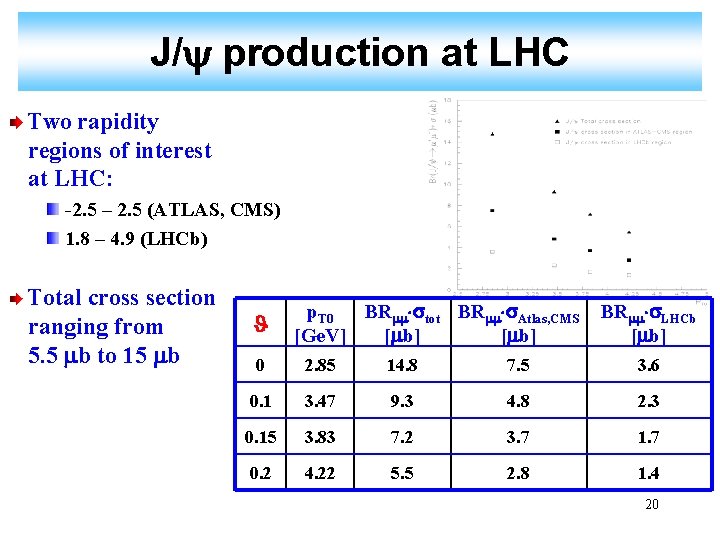
J/ production at LHC Two rapidity regions of interest at LHC: -2. 5 – 2. 5 (ATLAS, CMS) 1. 8 – 4. 9 (LHCb) Total cross section ranging from 5. 5 b to 15 b p. T 0 BR tot BR Atlas, CMS [Ge. V] [ b] BR LHCb [ b] 0 2. 85 14. 8 7. 5 3. 6 0. 1 3. 47 9. 3 4. 8 2. 3 0. 15 3. 83 7. 2 3. 7 1. 7 0. 2 4. 22 5. 5 2. 8 1. 4 20
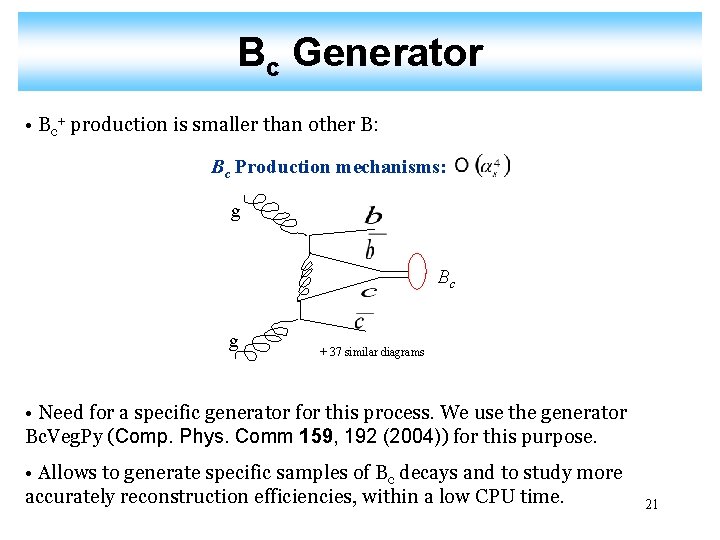
Bc Generator • Bc+ production is smaller than other B: Bc Production mechanisms: g Bc g + 37 similar diagrams • Need for a specific generator for this process. We use the generator Bc. Veg. Py (Comp. Phys. Comm 159, 192 (2004)) for this purpose. • Allows to generate specific samples of Bc decays and to study more accurately reconstruction efficiencies, within a low CPU time. 21
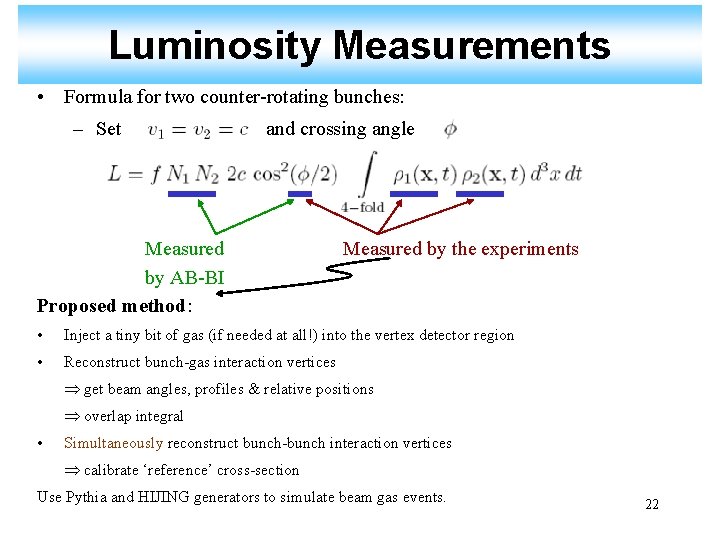
Luminosity Measurements • Formula for two counter-rotating bunches: – Set and crossing angle Measured by AB-BI Proposed method: Measured by the experiments • Inject a tiny bit of gas (if needed at all!) into the vertex detector region • Reconstruct bunch-gas interaction vertices get beam angles, profiles & relative positions overlap integral • Simultaneously reconstruct bunch-bunch interaction vertices calibrate ‘reference’ cross-section Use Pythia and HIJING generators to simulate beam gas events. 22
Conclusions • LHCb Simulation Software is interfaced with a variety of Monte Carlo generators and is flexible enough to use other generators. • Main requirements for external generators are: • Possibility to modify particle properties, • Possibility to use an external random number generator, • Possibility to interface with Hep. MC classes. • Adaptation of Evt. Gen and implementation of heavy quarkonia production in Pythia could be interesting for other LHC experiments. • Look forward at C++ generators: expect more possibilities and simpler interface with C++ simulation software. 23
- Slides: 23