
Use of Hormones in Cattle History of cattle
- Slides: 22
Use of Hormones in Cattle
History of cattle Cattle were important indicators of economic, social and political status in early civilizations Selective breeding was practiced as early as 5000 B. C. But it was the agricultural revolution in Europe during the 17 th and 18 th centuries A. D Improved agricultural practices yielded better results in bigger, stronger and more productive animals
Difference between Dairy and Beef Cattle Beef: Beef cattle have an overall square shape The legs are full and thick, the neck full and short, their skin soft and pliable Dairy: In contrast, dairy cows appear more wedge-shaped, with prominent hipbones and tail The udder is the most important aspect of a dairy cow and should be plump and extend forward.
What are Hormones and why do we use it? Hormones are chemicals that are produced naturally in the bodies of all animals, including humans. They are chemical messages released into the blood by hormone-producing organs that travel to and affect different parts of the body. They control important body functions such as growth, development and reproduction. They help reduce the waiting time and the amount of feed eaten by an animal before slaughter in meat industries.
History of Hormones • As early as the 1930 s, it was realized that cows injected with material drawn from bovine (cow) pituitary glands produced more milk. • In the 1980 s, it became possible to produce large quantities of pure b. GH by using recombinant DNA technology. • In 1993, the Food and Drug Administration (FDA) approved the recombinant bovine growth hormone • The female sex hormone estrogen was also shown to affect growth rates in cattle and poultry in the 1930 s • Synthetic estrogens started being used to increase the size of cattle and chickens in the early 1950 s. • DES was found to cause cancer and its use in food production was phased out in the late 1970 s.
Types of Hormone Some of the approved drugs are naturally produced throughout life in people and animals, such as estradiol (estrogen), progesterone, and testosterone Some of the approved drugs are synthetic versions of the natural hormones, such as melengestrol acetate, trenbolone acetate and zeranol For DAIRY COW America uses r. GBH
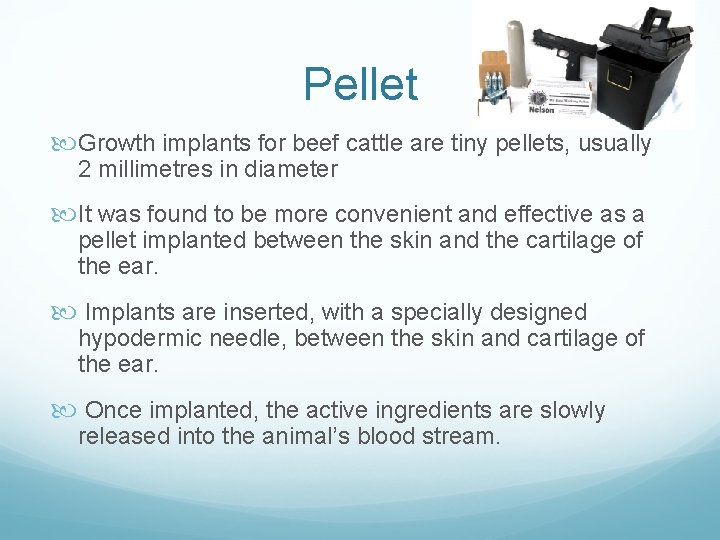
Pellet Growth implants for beef cattle are tiny pellets, usually 2 millimetres in diameter It was found to be more convenient and effective as a pellet implanted between the skin and the cartilage of the ear. Implants are inserted, with a specially designed hypodermic needle, between the skin and cartilage of the ear. Once implanted, the active ingredients are slowly released into the animal’s blood stream.
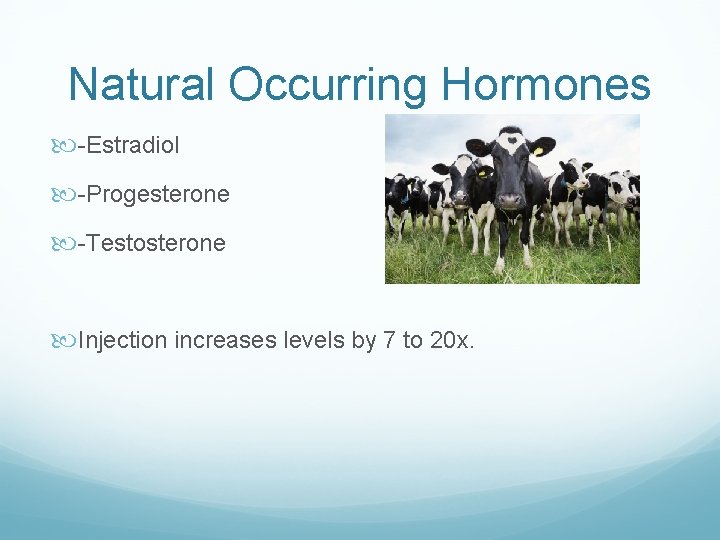
Natural Occurring Hormones -Estradiol -Progesterone -Testosterone Injection increases levels by 7 to 20 x.
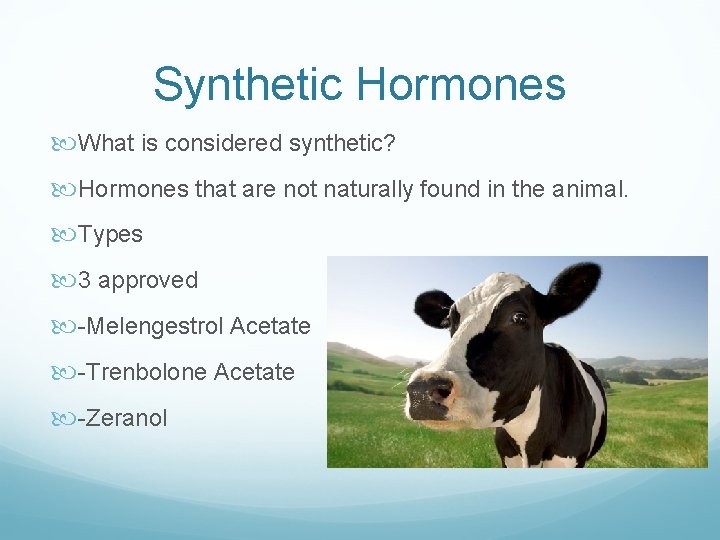
Synthetic Hormones What is considered synthetic? Hormones that are not naturally found in the animal. Types 3 approved -Melengestrol Acetate -Trenbolone Acetate -Zeranol
Estradiol -Female sex hormone -Enhances fertility and increases sumbmission rates -Given via injection or through pellet.
Zeranol - Not a steroid. - Derived from mold. - FDA 150 microgram/kg for meat - 4 ug/kg of meat (Lindsay)
Progesterone -Female menstrual cycle, pregnancy and embryogenesis -Helps prevent heat and ovulation -CIDR insert
Melengestrol Acetate - FDA 25 ppb. (25 ug/kg) - About 0. 5 ug/kg of meat (Daxenberger) - In cattle feed.
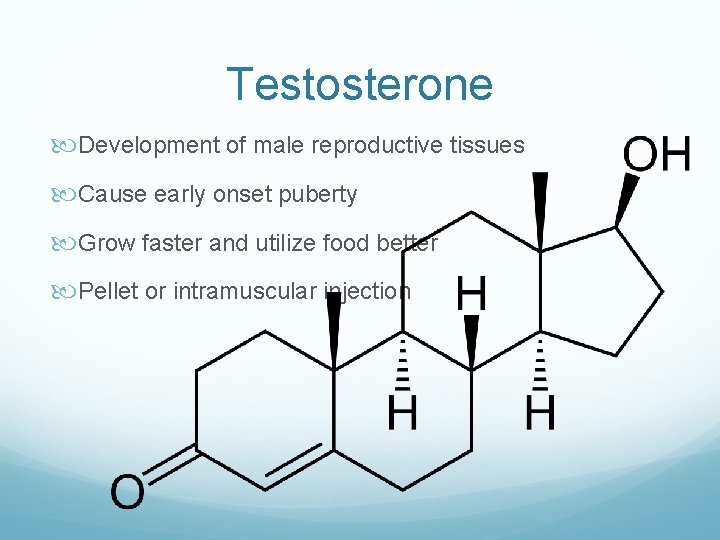
Testosterone Development of male reproductive tissues Cause early onset puberty Grow faster and utilize food better Pellet or intramuscular injection
Trenbolone Acetate -FDA 50 ug/kg for meat. (Safe Consumption) -1 ppb= 1 ug/kg (Pottier) - Fast Growth
Hormones in Milk & Dairy Products - Injection of recombinant bovine somatotropin (r. BST) or recombinant bovine growth hormone – genetically engineered artificial growth hormone - Forces cows to artificially increase milk production by 10 -15% - Approx 17% of all cows in the US were injected - The FDA approved in 1993 despite dispute, European Union, Japan, Australia, New Zealand Canada bans usage of r. GBH. HMM.
GENERAL INFORMATION ON HORMONE USAGE What does it do to the cow? What does it do to the environment? What does it do to US?
Impact on animal - Deformed calves - Painful bacterial infection of udder (mastitis) in cows causing unwanted secretion in milk - Vaginal and rectal prolapse Mainly due to wrong handling of implants ie accidentally crushing it
Impacts on Humans - Reproductive systems of humans disrupted - Hormone residues in beef have been examined to cause lower sperm counts in boys - Eventual development of breast, prostate and colon cancer - Associated to higher levels of IGF-1 – there are concerns to elevating cancer risks
Environmental Impacts - Hormones also passes through the cattle, excreted in manure - Aquatic ecosystems are vulnerable to hormone residues - Affects gender and reproductive capacity of fish
Should you REALLY be worried? Natural hormones implants are not generally a worry – quantities are insignificant to what humans and animals are already producing
Your options. . - Purchase only organic meat and milk - Choose hormone-free beef & r. BGH-free dairy products at the supermarket - Foods that carry “USDA-certified organic” label - Buy imported cheeses and dairy products from countries where they are banned -. . Just avoid eating beef altogether