
Use of Force Law Enforcement II Copyright and
- Slides: 38
Use of Force Law Enforcement II
Copyright and Terms of Service Copyright © Texas Education Agency, 2011. These materials are copyrighted © and trademarked ™ as the property of the Texas Education Agency (TEA) and may not be reproduced without the express written permission of TEA, except under the following conditions: 1) Texas public school districts, charter schools, and Education Service Centers may reproduce and use copies of the Materials and Related Materials for the districts’ and schools’ educational use without obtaining permission from TEA. 2) Residents of the state of Texas may reproduce and use copies of the Materials and Related Materials for individual personal use only, without obtaining written permission of TEA. 3) Any portion reproduced must be reproduced in its entirety and remain unedited, unaltered and unchanged in any way. 4) No monetary charge can be made for the reproduced materials or any document containing them; however, a reasonable charge to cover only the cost of reproduction and distribution may be charged. Private entities or persons located in Texas that are not Texas public school districts, Texas Education Service Centers, or Texas charter schools or any entity, whether public or private, educational or noneducational, located outside the state of Texas MUST obtain written approval from TEA and will be required to enter into a license agreement that may involve the payment of a licensing fee or a royalty. Contact TEA Copyrights with any questions you may have. Copyright © Texas Education Agency 2011. All rights reserved. Images and other multimedia content used with permission. 2
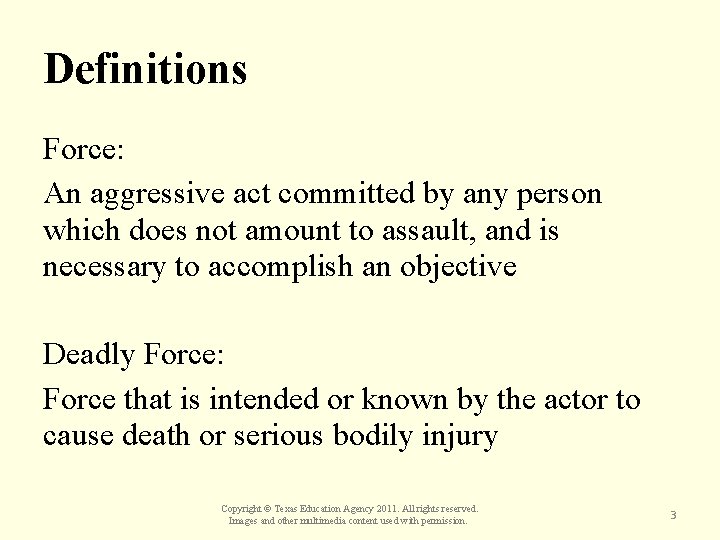
Definitions Force: An aggressive act committed by any person which does not amount to assault, and is necessary to accomplish an objective Deadly Force: Force that is intended or known by the actor to cause death or serious bodily injury Copyright © Texas Education Agency 2011. All rights reserved. Images and other multimedia content used with permission. 3
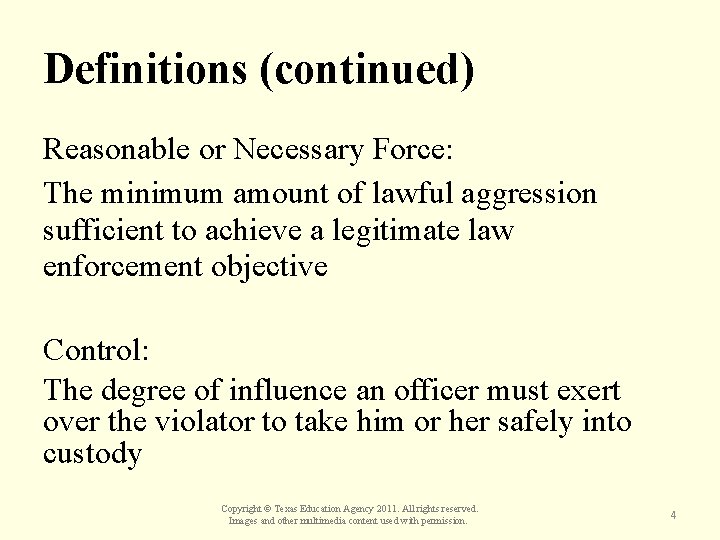
Definitions (continued) Reasonable or Necessary Force: The minimum amount of lawful aggression sufficient to achieve a legitimate law enforcement objective Control: The degree of influence an officer must exert over the violator to take him or her safely into custody Copyright © Texas Education Agency 2011. All rights reserved. Images and other multimedia content used with permission. 4
Part I WHEN CITIZENS ARE AUTHORIZED TO USE FORCE Copyright © Texas Education Agency 2011. All rights reserved. Images and other multimedia content used with permission. 5
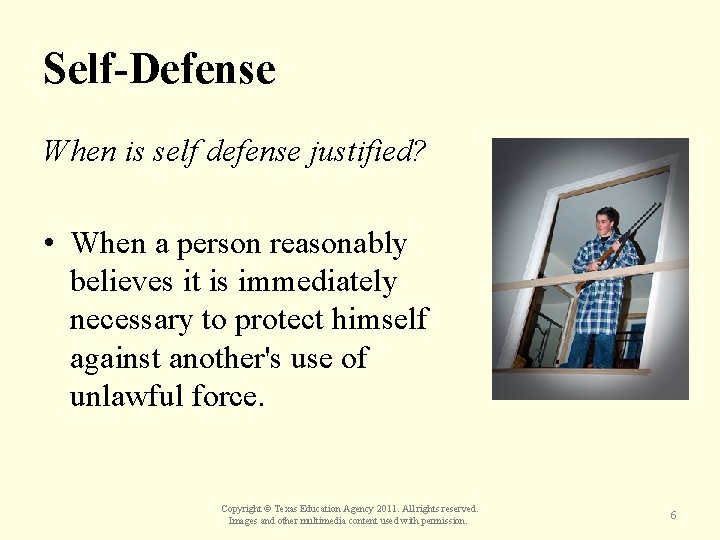
Self-Defense When is self defense justified? • When a person reasonably believes it is immediately necessary to protect himself against another's use of unlawful force. Copyright © Texas Education Agency 2011. All rights reserved. Images and other multimedia content used with permission. 6
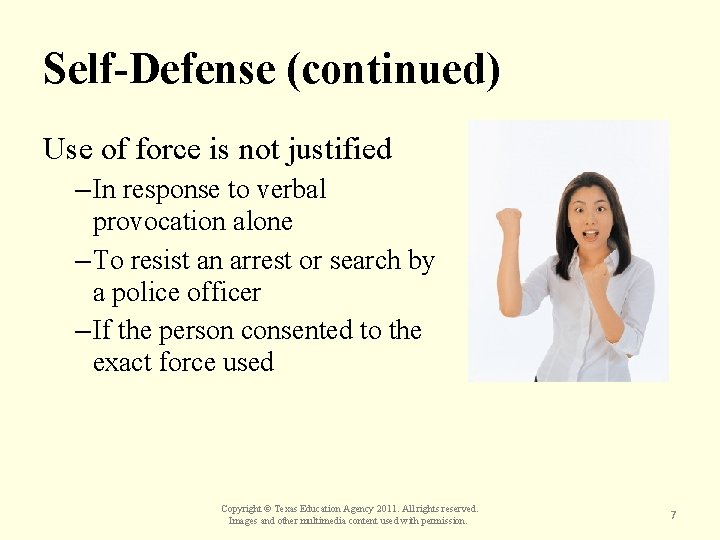
Self-Defense (continued) Use of force is not justified – In response to verbal provocation alone – To resist an arrest or search by a police officer – If the person consented to the exact force used Copyright © Texas Education Agency 2011. All rights reserved. Images and other multimedia content used with permission. 7
Self-Defense (continued) Use of force to resist an arrest or search is justified when the person believes – The police officer is using greater force than necessary and – It is immediately necessary to protect him or herself Copyright © Texas Education Agency 2011. All rights reserved. Images and other multimedia content used with permission. 8
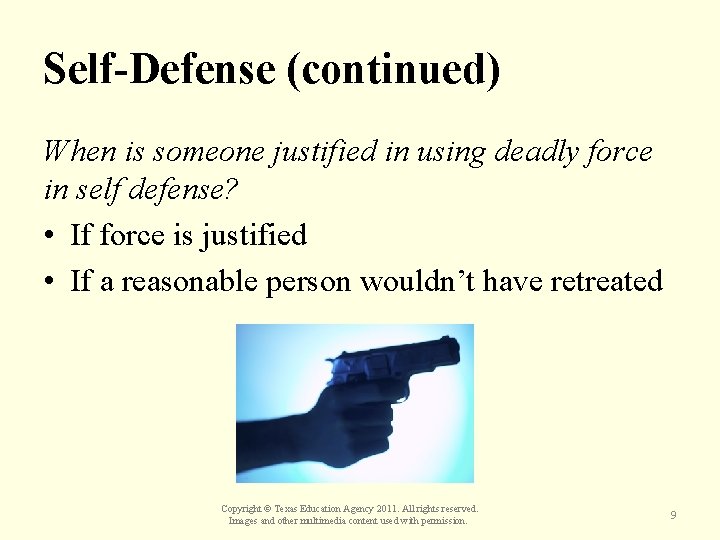
Self-Defense (continued) When is someone justified in using deadly force in self defense? • If force is justified • If a reasonable person wouldn’t have retreated Copyright © Texas Education Agency 2011. All rights reserved. Images and other multimedia content used with permission. 9
Self-Defense (continued) • He or she reasonably believes deadly force is immediately necessary – To protect him or herself against another's use or attempted use of deadly force or – To prevent another's imminent commission of • Aggravated kidnapping • Murder • Sexual assault • Aggravated sexual assault • Robbery • Aggravated robbery Copyright © Texas Education Agency 2011. All rights reserved. Images and other multimedia content used with permission. 10
Protection of Life • Deadly force can be used to protect a third person from unlawful use of deadly force • A person is justified in using force to prevent another from committing suicide or inflicting serious bodily injury on him or herself • A person is justified in using force and deadly force when it is immediately necessary to preserve another's life in an emergency Copyright © Texas Education Agency 2011. All rights reserved. Images and other multimedia content used with permission. 11
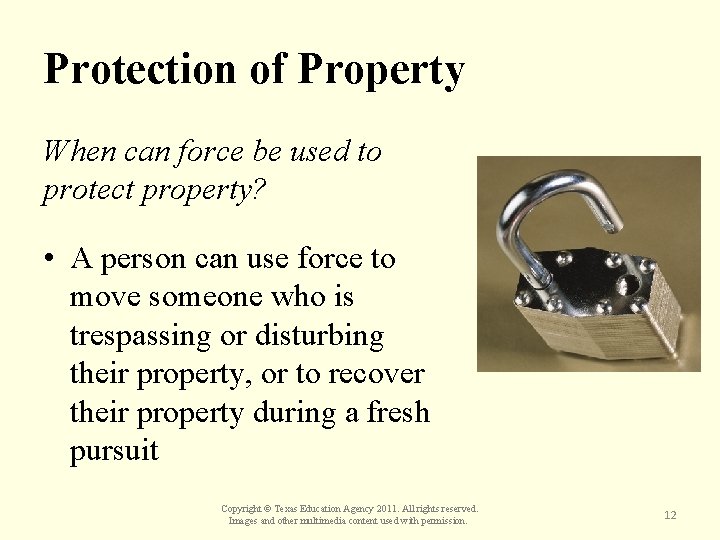
Protection of Property When can force be used to protect property? • A person can use force to move someone who is trespassing or disturbing their property, or to recover their property during a fresh pursuit Copyright © Texas Education Agency 2011. All rights reserved. Images and other multimedia content used with permission. 12
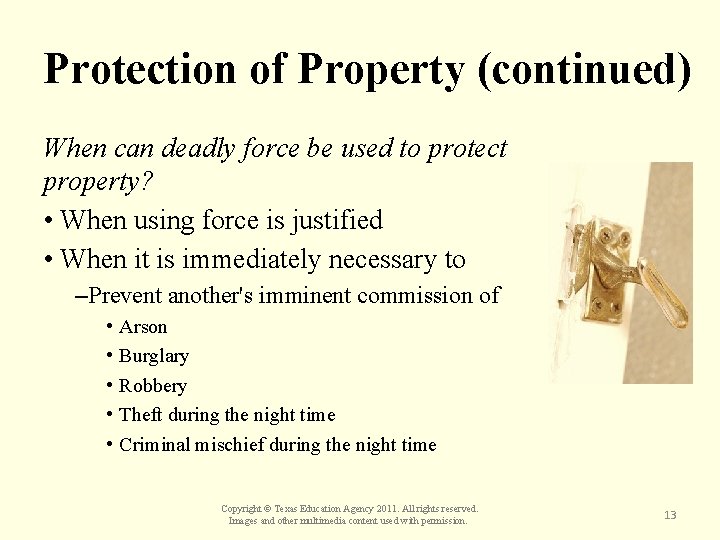
Protection of Property (continued) When can deadly force be used to protect property? • When using force is justified • When it is immediately necessary to –Prevent another's imminent commission of • Arson • Burglary • Robbery • Theft during the night time • Criminal mischief during the night time Copyright © Texas Education Agency 2011. All rights reserved. Images and other multimedia content used with permission. 13
Protection of Property (continued) • When it is immediately necessary to – Prevent the suspect who is fleeing immediately after committing all of the above except criminal mischief at night time and – He or she believes • The land or property cannot be recovered by any other means or • The use of force to protect or recover the property would expose the person to risk of death or serious bodily injury Copyright © Texas Education Agency 2011. All rights reserved. Images and other multimedia content used with permission. 14
Protection of Property (continued) A person can use force or deadly force to protect a third person's property if he or she is already justified to use it and – He or she has been asked to – He or she has a legal duty to or – The property belongs to his or her spouse, parent, child, or roommate Copyright © Texas Education Agency 2011. All rights reserved. Images and other multimedia content used with permission. 15
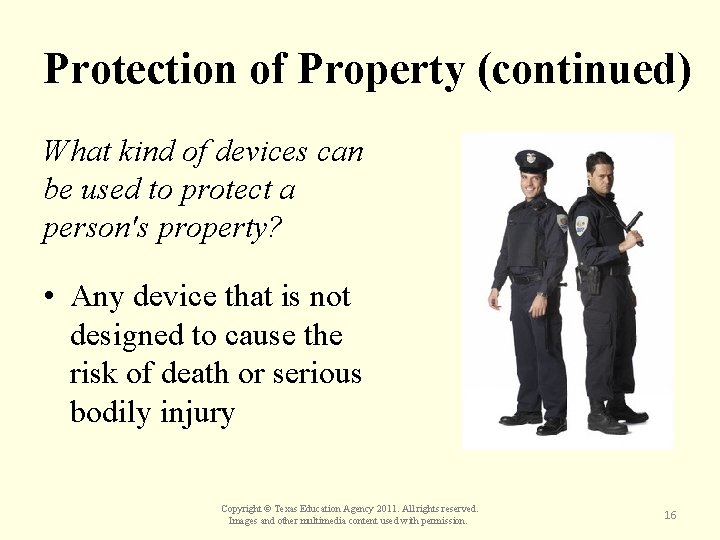
Protection of Property (continued) What kind of devices can be used to protect a person's property? • Any device that is not designed to cause the risk of death or serious bodily injury Copyright © Texas Education Agency 2011. All rights reserved. Images and other multimedia content used with permission. 16
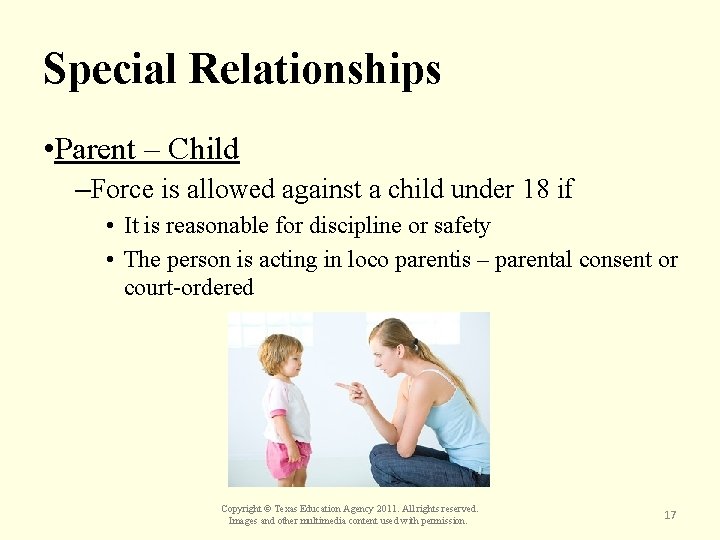
Special Relationships • Parent – Child –Force is allowed against a child under 18 if • It is reasonable for discipline or safety • The person is acting in loco parentis – parental consent or court-ordered Copyright © Texas Education Agency 2011. All rights reserved. Images and other multimedia content used with permission. 17
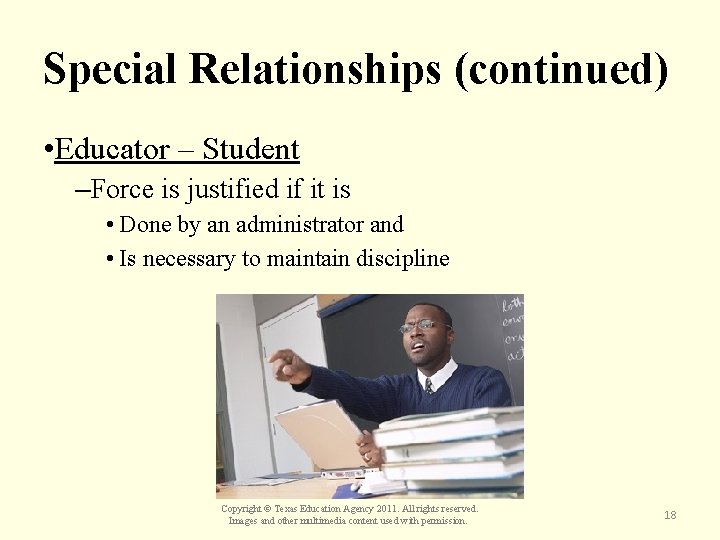
Special Relationships (continued) • Educator – Student –Force is justified if it is • Done by an administrator and • Is necessary to maintain discipline Copyright © Texas Education Agency 2011. All rights reserved. Images and other multimedia content used with permission. 18
Special Relationships (continued) Guardian – Incompetent Force is allowed if it is • Done by the caretaker or guardian and • Is necessary for their welfare, or • The person is in an institution and it is necessary to maintain discipline Copyright © Texas Education Agency 2011. All rights reserved. Images and other multimedia content used with permission. 19
Part II WHEN POLICE OFFICERS ARE ALLOWED TO USE FORCE Copyright © Texas Education Agency 2011. All rights reserved. Images and other multimedia content used with permission. 20
Police Officer's Role The police role is defensive; officers are defending the community when confronting an offender • When does a police officer have the duty to retreat? • A police officer never has the duty to retreat Copyright © Texas Education Agency 2011. All rights reserved. Images and other multimedia content used with permission. 21
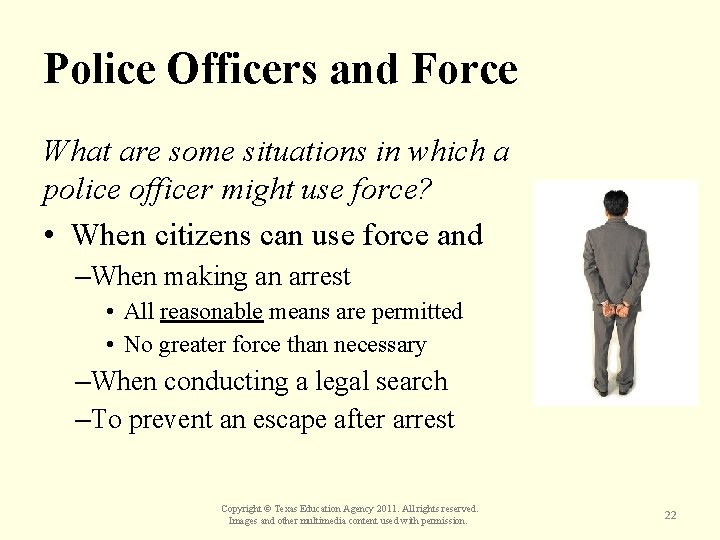
Police Officers and Force What are some situations in which a police officer might use force? • When citizens can use force and –When making an arrest • All reasonable means are permitted • No greater force than necessary –When conducting a legal search –To prevent an escape after arrest Copyright © Texas Education Agency 2011. All rights reserved. Images and other multimedia content used with permission. 22
Police Officers and Force (continued) Why would the police officer believe deadly force is immediately necessary? • The conduct for which the arrest is authorized included the use or attempted use of deadly force or • There is a substantial risk that the suspect will cause death or serious bodily injury if the arrest is delayed Copyright © Texas Education Agency 2011. All rights reserved. Images and other multimedia content used with permission. 23
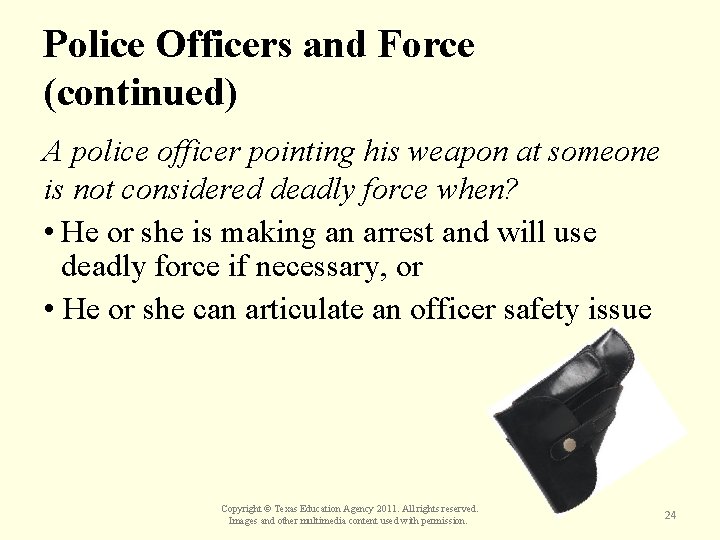
Police Officers and Force (continued) A police officer pointing his weapon at someone is not considered deadly force when? • He or she is making an arrest and will use deadly force if necessary, or • He or she can articulate an officer safety issue Copyright © Texas Education Agency 2011. All rights reserved. Images and other multimedia content used with permission. 24
Police Officers and Force (continued) Tennessee v. Garner (1985) • The fleeing felon rule • Deadly force was allowed on someone who committed a felony and was fleeing • It is no longer allowed unless deadly force is justified Copyright © Texas Education Agency 2011. All rights reserved. Images and other multimedia content used with permission. 25
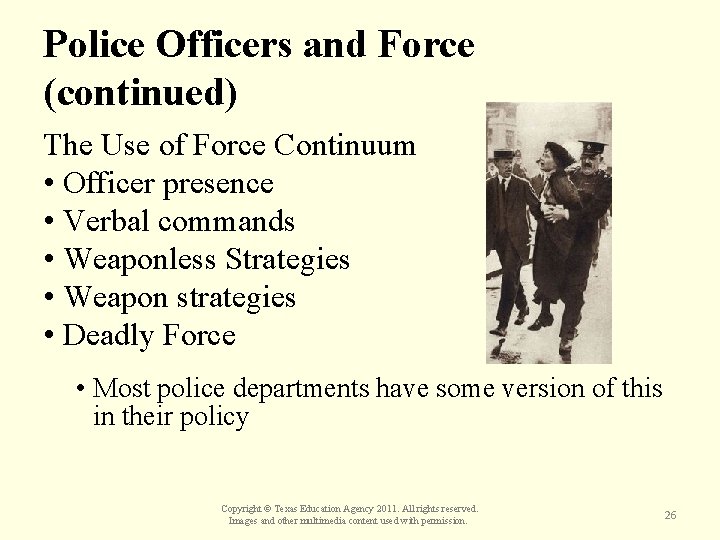
Police Officers and Force (continued) The Use of Force Continuum • Officer presence • Verbal commands • Weaponless Strategies • Weapon strategies • Deadly Force • Most police departments have some version of this in their policy Copyright © Texas Education Agency 2011. All rights reserved. Images and other multimedia content used with permission. 26
Police Officers and Force (continued) How much force can an officer use against a suspect? • One level of force higher on the Use of Force Continuum than what the suspect is using or attempting to use Copyright © Texas Education Agency 2011. All rights reserved. Images and other multimedia content used with permission. 27
Police Officers and Force (continued) Factors that determine how quickly an officer can escalate their level of force –The nature of the crime –Whether the suspect is obeying commands –If the suspect is armed –If the suspect has a previous arrest record –The number of suspects –The number of backup officers Copyright © Texas Education Agency 2011. All rights reserved. Images and other multimedia content used with permission. 28
Police Officers and Force (continued) Factors that determine how quickly an officer can escalate their level of force (continued) –Size of the suspect(s) –Size of the officer –Fatigue – 3 to 5 seconds –Age –Sex –Perception of skills Copyright © Texas Education Agency 2011. All rights reserved. Images and other multimedia content used with permission. 29
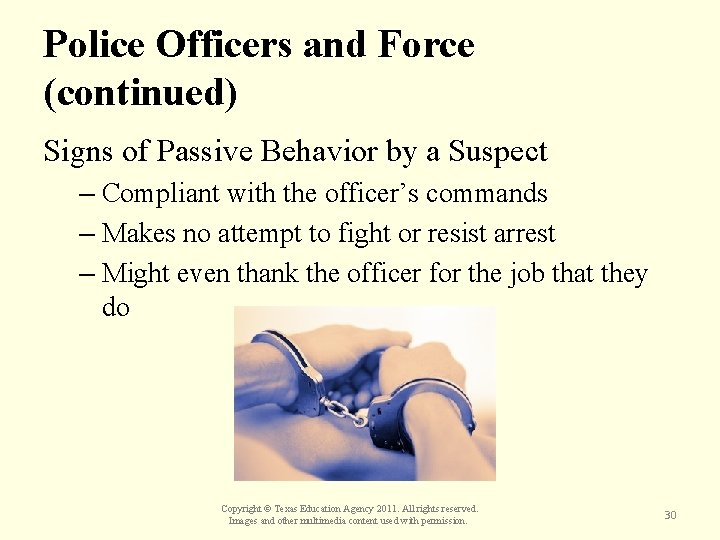
Police Officers and Force (continued) Signs of Passive Behavior by a Suspect – Compliant with the officer’s commands – Makes no attempt to fight or resist arrest – Might even thank the officer for the job that they do Copyright © Texas Education Agency 2011. All rights reserved. Images and other multimedia content used with permission. 30
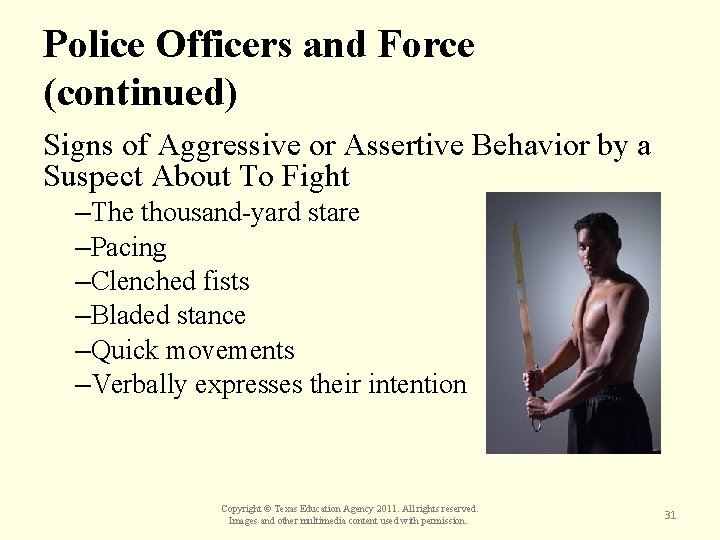
Police Officers and Force (continued) Signs of Aggressive or Assertive Behavior by a Suspect About To Fight –The thousand-yard stare –Pacing –Clenched fists –Bladed stance –Quick movements –Verbally expresses their intention Copyright © Texas Education Agency 2011. All rights reserved. Images and other multimedia content used with permission. 31
Police Officers and Force (continued) • How Officers Effectively Handle Angry People – The officer is honest – The officer allows the person to vent – Depending on the situation, the officer • Refrains from escalating force and waits for the person to calm down before arresting them or • Matches the person’s intensity and force to neutralize them – The officer engages in conversation • “The gift of gab” Copyright © Texas Education Agency 2011. All rights reserved. Images and other multimedia content used with permission. 32
Police Officers and Force (continued) Factor’s that Contribute to a Person’s Hostility Towards Police – Issues going on in a person’s life such as • • – – Family problems Money or job problems Health problems Legal problems Bad previous police encounters The demeanor of the officer Drugs or alcohol Their sense of justice and its fairness in relation to them Copyright © Texas Education Agency 2011. All rights reserved. Images and other multimedia content used with permission. 33
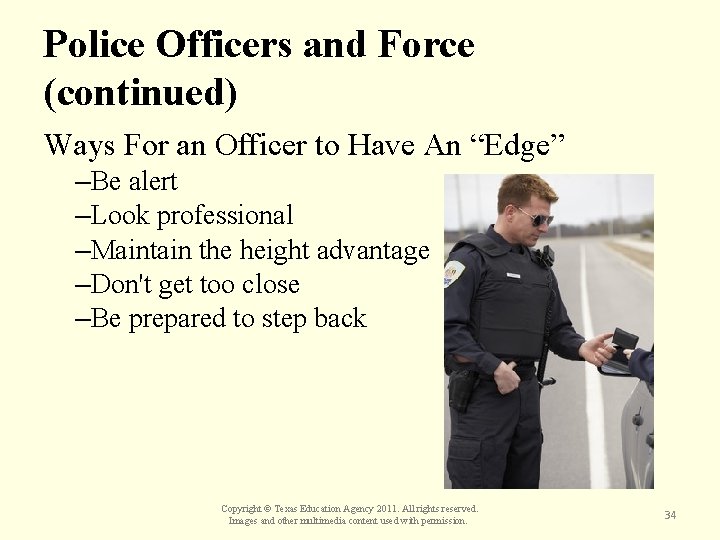
Police Officers and Force (continued) Ways For an Officer to Have An “Edge” –Be alert –Look professional –Maintain the height advantage –Don't get too close –Be prepared to step back Copyright © Texas Education Agency 2011. All rights reserved. Images and other multimedia content used with permission. 34
Police Officers and Force (continued) Excessive Force Consequences – Departmental discipline – State court criminal action – State court civil action – Federal civil rights – criminal and civil Copyright © Texas Education Agency 2011. All rights reserved. Images and other multimedia content used with permission. 35
Police Officers and Force (continued) Legal Issues – An officer has the duty to intervene if officers are engaging in excessive force in his or her presence – There can be personal liability for failing to stop others Copyright © Texas Education Agency 2011. All rights reserved. Images and other multimedia content used with permission. 36
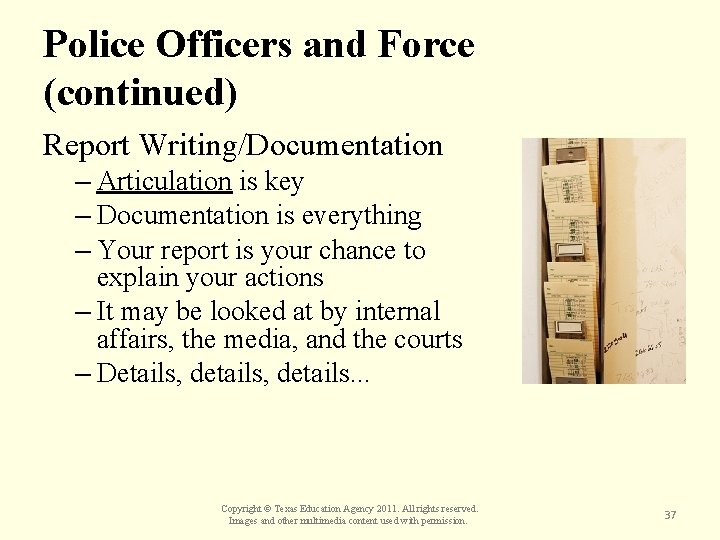
Police Officers and Force (continued) Report Writing/Documentation – Articulation is key – Documentation is everything – Your report is your chance to explain your actions – It may be looked at by internal affairs, the media, and the courts – Details, details. . . Copyright © Texas Education Agency 2011. All rights reserved. Images and other multimedia content used with permission. 37
Resources • Texas Commission on Law Enforcement Officer Standards and Education (TCLOSE) Training http: //www. tcleose. state. tx. us/ Copyright © Texas Education Agency 2011. All rights reserved. Images and other multimedia content used with permission. 38