
Use of ELogbook in VEPP5 Control System D
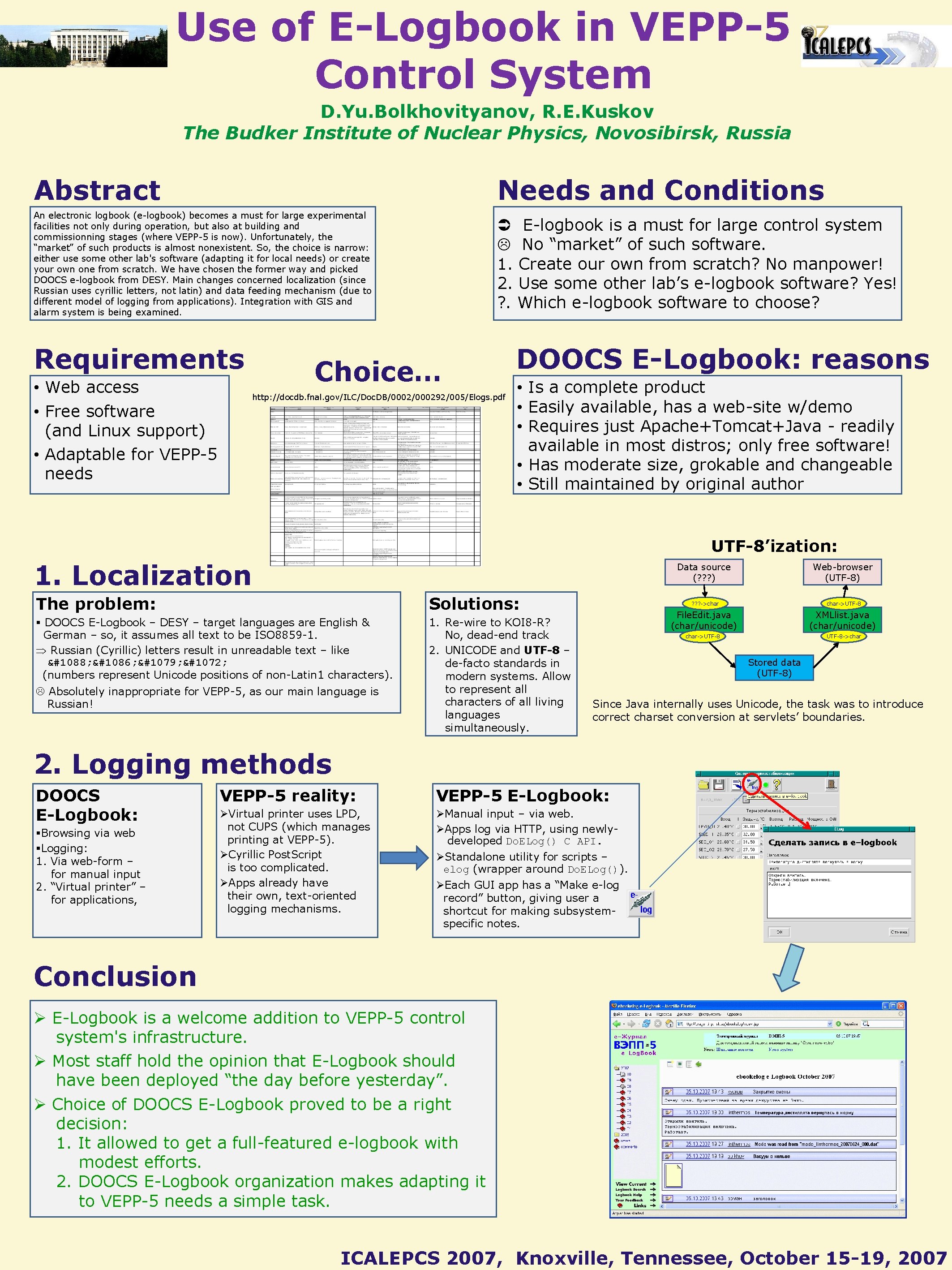
Use of E-Logbook in VEPP-5 Control System D. Yu. Bolkhovityanov, R. E. Kuskov The Budker Institute of Nuclear Physics, Novosibirsk, Russia Abstract Needs and Conditions An electronic logbook (e-logbook) becomes a must for large experimental facilities not only during operation, but also at building and commissionning stages (where VEPP-5 is now). Unfortunately, the “market” of such products is almost nonexistent. So, the choice is narrow: either use some other lab's software (adapting it for local needs) or create your own one from scratch. We have chosen the former way and picked DOOCS e-logbook from DESY. Main changes concerned localization (since Russian uses cyrillic letters, not latin) and data feeding mechanism (due to different model of logging from applications). Integration with GIS and alarm system is being examined. E-logbook is a must for large control system No “market” of such software. 1. Create our own from scratch? No manpower! 2. Use some other lab’s e-logbook software? Yes! ? . Which e-logbook software to choose? Requirements • Web access • Free software (and Linux support) • Adaptable for VEPP-5 needs Choice… http: //docdb. fnal. gov/ILC/Doc. DB/000292/005/Elogs. pdf DOOCS E-Logbook: reasons • Is a complete product • Easily available, has a web-site w/demo • Requires just Apache+Tomcat+Java - readily available in most distros; only free software! • Has moderate size, grokable and changeable • Still maintained by original author UTF-8’ization: 1. Localization The problem: Solutions: § DOOCS E-Logbook – DESY – target languages are English & German – so, it assumes all text to be ISO 8859 -1. Russian (Cyrillic) letters result in unreadable text – like р о з а (numbers represent Unicode positions of non-Latin 1 characters). Absolutely inappropriate for VEPP-5, as our main language is Russian! 1. Re-wire to KOI 8 -R? No, dead-end track 2. UNICODE and UTF-8 – de-facto standards in modern systems. Allow to represent all characters of all living languages simultaneously. Data source (? ? ? ) Web-browser (UTF-8) ? ? ? ->char->UTF-8 File. Edit. java (char/unicode) XMLlist. java (char/unicode) char->UTF-8 ->char Stored data (UTF-8) Since Java internally uses Unicode, the task was to introduce correct charset conversion at servlets’ boundaries. 2. Logging methods DOOCS E-Logbook: §Browsing via web §Logging: 1. Via web-form – for manual input 2. “Virtual printer” – for applications, VEPP-5 reality: VEPP-5 E-Logbook: ØVirtual printer uses LPD, not CUPS (which manages printing at VEPP-5). ØCyrillic Post. Script is too complicated. ØApps already have their own, text-oriented logging mechanisms. ØManual input – via web. ØApps log via HTTP, using newlydeveloped Do. ELog() C API. ØStandalone utility for scripts – elog (wrapper around Do. ELog()). ØEach GUI app has a “Make e-log record” button, giving user a shortcut for making subsystemspecific notes. Conclusion Ø E-Logbook is a welcome addition to VEPP-5 control system's infrastructure. Ø Most staff hold the opinion that E-Logbook should have been deployed “the day before yesterday”. Ø Choice of DOOCS E-Logbook proved to be a right decision: 1. It allowed to get a full-featured e-logbook with modest efforts. 2. DOOCS E-Logbook organization makes adapting it to VEPP-5 needs a simple task. ICALEPCS 2007, Knoxville, Tennessee, October 15 -19, 2007
- Slides: 1