
Use of Effective Feedback to Improve Pupil Attainment
Use of Effective Feedback to Improve Pupil Attainment Tile Hill Wood School and Language College Coventry EPS Psychology for You
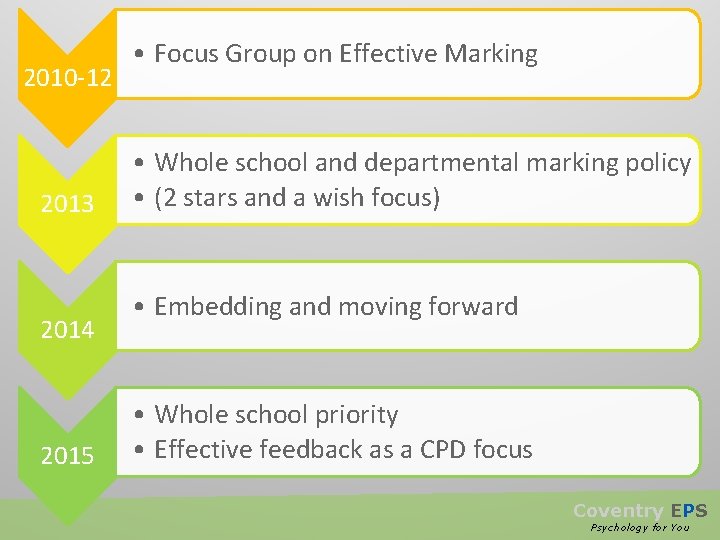
2010 -12 2013 2014 2015 • Focus Group on Effective Marking • Whole school and departmental marking policy • (2 stars and a wish focus) • Embedding and moving forward • Whole school priority • Effective feedback as a CPD focus Coventry EPS Psychology for You
Overview • • Rationale Defining effective feedback Models and principles of effective feedback Summary and next steps Coventry EPS Psychology for You
Rationale • Sutton Trust Research drew upon thousands of studies and reviewed >20 approaches to improving learning. • Providing effective feedback was identified as the most cost-effective approach. One study estimates impact to be x 124 greater than reducing class sizes. • The Sutton Trust reports a gain of +9 months. An Af. L study indicated an impact of half a GCSE grade per student per subject. • Requires sustained professional development. Coventry EPS Psychology for You
Activity 1 Define: What is feedback? Discuss with your partner and attempt to write a brief definition Coventry EPS Psychology for You
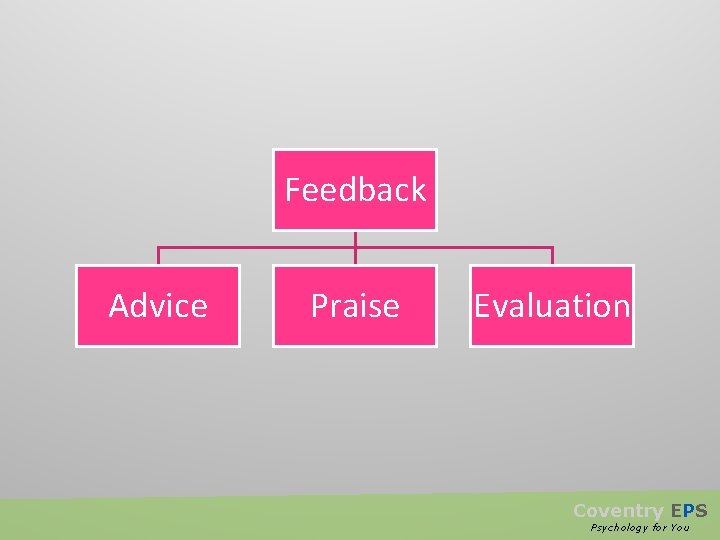
Feedback Advice Praise Evaluation Coventry EPS Psychology for You
Defining feedback • How we are doing in our efforts to reach a goal (Wiggins 2012) • Feedback provides information that fills a gap between what is understood and what is aimed to be understood (Sadler, 1989) • Feedback reduces discrepancy between current understandings or performance and a goal (Hattie, 2007) • Feedback provides a recipe for future action (William, 2011) Coventry EPS Psychology for You
Sports Example A student runs the mile in track. The goal is to run a 5 minute mile. At the end of each lap in practice races, the coaches yell out the times for each lap and bits of feedback (“You’re not swinging your arms”) followed by advice (“Pick it up, you need to take two seconds off the next lap to get it under 5: 10”). Coventry EPS Psychology for You
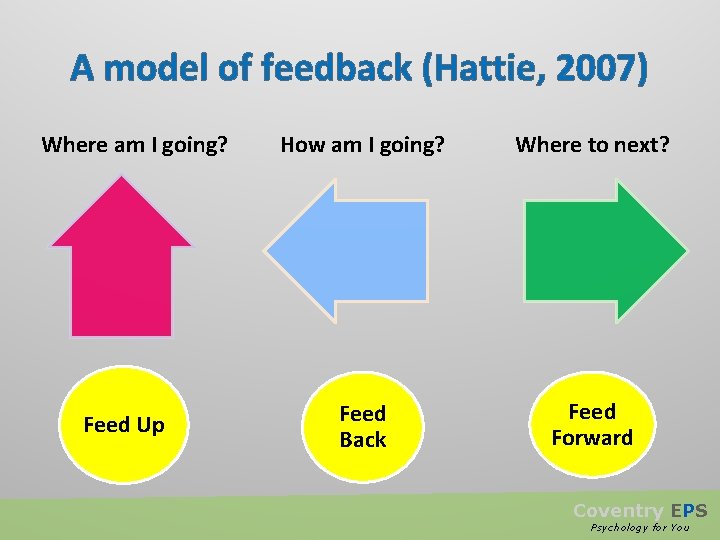
A model of feedback (Hattie, 2007) Where am I going? Feed Up How am I going? Where to next? Feed Back Feed Forward Coventry EPS Psychology for You
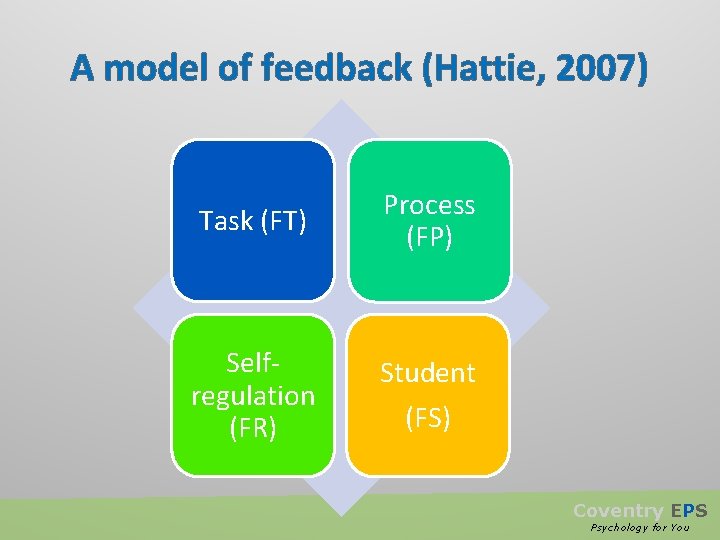
A model of feedback (Hattie, 2007) Task (FT) Process (FP) Selfregulation (FR) Student (FS) Coventry EPS Psychology for You
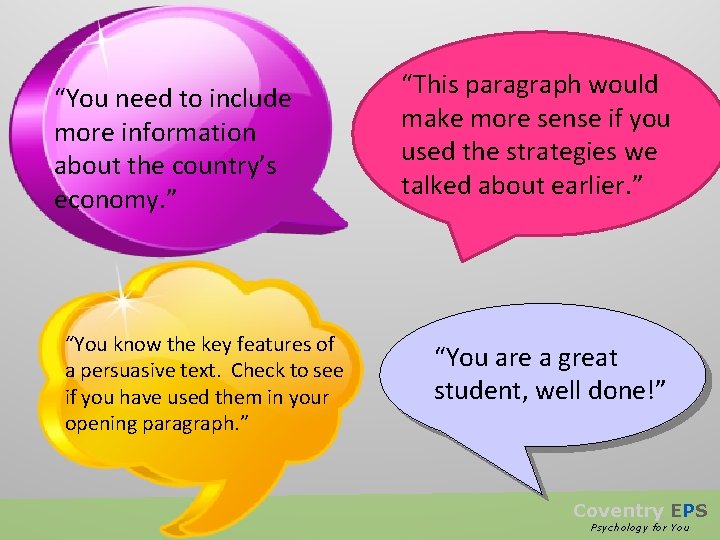
“You need to include more information about the country’s economy. ” “You know the key features of a persuasive text. Check to see if you have used them in your opening paragraph. ” “This paragraph would make more sense if you used the strategies we talked about earlier. ” “You are a great student, well done!” Coventry EPS Psychology for You
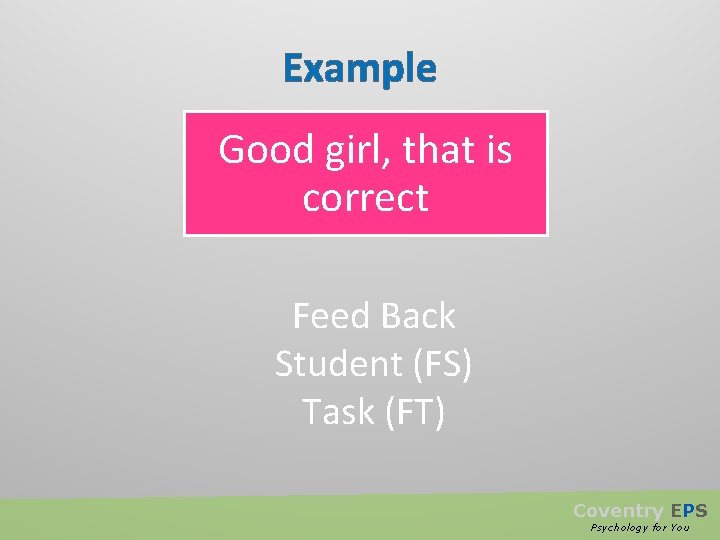
Example Good girl, that is correct Feed Back Student (FS) Task (FT) Coventry EPS Psychology for You
Activity 2 Using Hattie’s model, categorise the following 8 feedback statements: FT / FP / FR / FS Feed Back / Feed Forward Coventry EPS Psychology for You
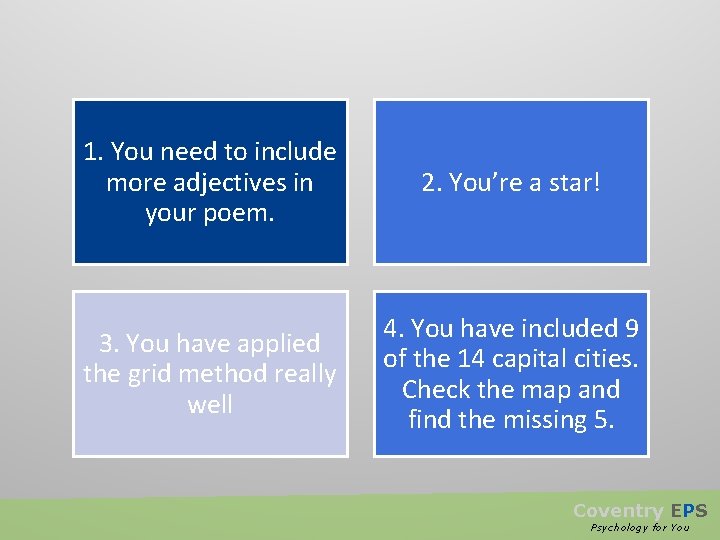
1. You need to include more adjectives in your poem. 2. You’re a star! 3. You have applied the grid method really well 4. You have included 9 of the 14 capital cities. Check the map and find the missing 5. Coventry EPS Psychology for You
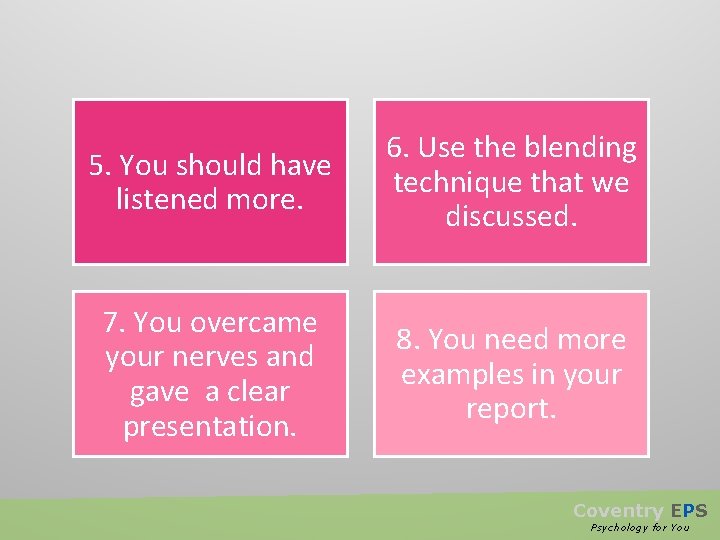
5. You should have listened more. 6. Use the blending technique that we discussed. 7. You overcame your nerves and gave a clear presentation. 8. You need more examples in your report. Coventry EPS Psychology for You
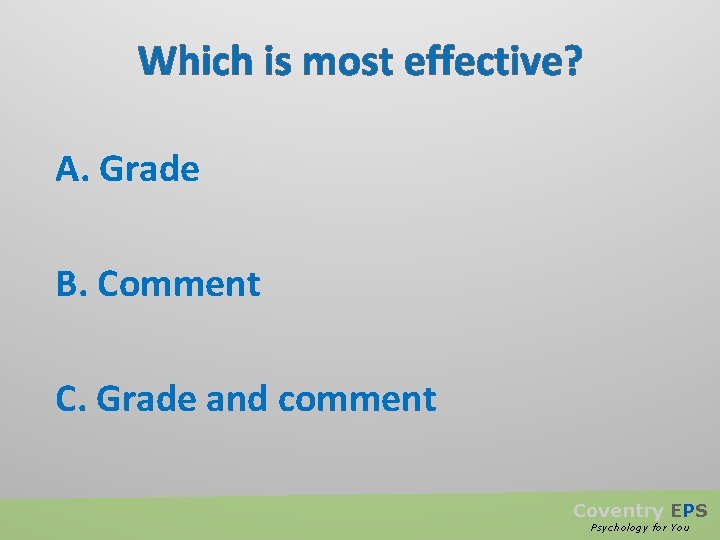
Which is most effective? A. Grade B. Comment C. Grade and comment Coventry EPS Psychology for You
Grades, Praise and Feedback • Mixing praise with other comments can reduce the impact of feedback. Feedback through comments alone led to learning gains, whereas marks alone or comments accompanied by marks or giving praise did not (Butler, 1988) • Grades do not lead to improvements in subsequent work (Kohm, 1994). Therefore, grades should be reserved for summative feedback. • Grades are most beneficial when they are linked to explicit criteria which enables feed back and feed forward. Coventry EPS Psychology for You
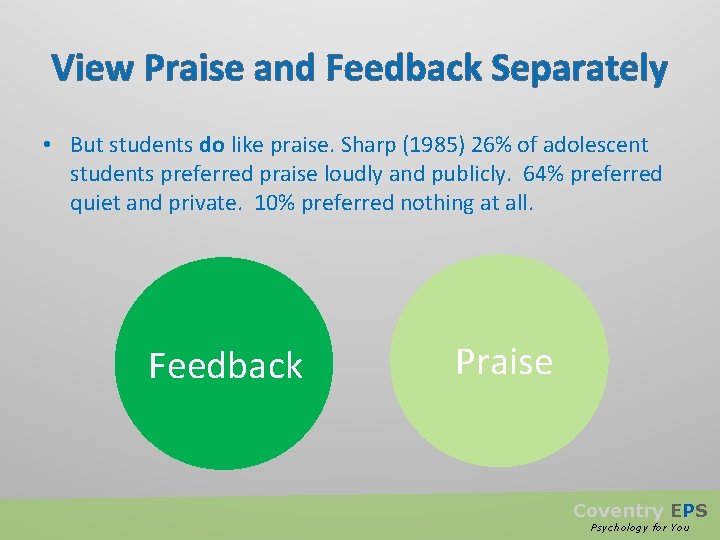
View Praise and Feedback Separately • But students do like praise. Sharp (1985) 26% of adolescent students preferred praise loudly and publicly. 64% preferred quiet and private. 10% preferred nothing at all. Feedback Praise Coventry EPS Psychology for You
Summary • • An integral, yet complex component of teaching. Effective feedback is not praise, advice or evaluation. Effective feedback is the 3 Fs. FT and FP are most beneficial, FS is least. Keep feedback and praise separate. Where possible, reserve grades for summative. Preserve self-esteem by emphasising what’s right. Coventry EPS Psychology for You
Next steps – WOW weeks • Over the next two weeks reflect and evaluate on the feedback you have been giving • Consider your strengths and what you can do differently with feedback • Buddy up with somebody in your department and take a couple of books along to discuss your findings Coventry EPS Psychology for You
A whole school approach September 2014 onwards We are going to develop the ideas we’ve discussed today through: - Department meetings - TSP foci - CPD / sharing good practice & learning from each other - Student voice - Continued external support Coventry EPS Psychology for You
- Slides: 21