
Use of diffraction in determine the residual stress
![High Velocity Oxyl-fuel (HVOF) Advantages of HVOF [4]: • High velocity and low oxygen.](https://slidetodoc.com/presentation_image_h2/49d6f301c81dc3e9f621024938e5105e/image-6.jpg "High Velocity Oxyl-fuel (HVOF) Advantages of HVOF [4]: • High velocity and low oxygen.")
![References [1] Oladijo O. P. et al. (2012). Surface Coatings Technology, 206, 4725 -4729.](https://slidetodoc.com/presentation_image_h2/49d6f301c81dc3e9f621024938e5105e/image-22.jpg "References [1] Oladijo O. P. et al. (2012). Surface Coatings Technology, 206, 4725 -4729.")

- Slides: 24
Use of diffraction in determine the residual stress of HVOF WC-17 Co coatings O. P. Oladijo 1, 2, 3, L. A. Cornish 2, 3 T. P Ntsoane 4, N. Sacks 2, 3 and A. M. Venter 3, 4 1 Department of Chemical, Material and Metallurgical Engineering, Botswana International University of Science and Technology 2 School of Chemical and Metallurgical Engineering, University of the Witwatersrand 3 DST/NRF Centre of Excellence in Strong Materials 4 South African Nuclear Energy Corporation (Necsa)
Introduction • Thermal spray WC-Co coatings protect substrates against different environments and loads e. g. abrasive wear, high temperatures, chemically aggressive fluids and hot gas corrosion. • WC-Co cermet composites are widely used, owing to their high hardness, reasonable toughness and excellent wear resistance [1]. • Residual stresses are a contributing factor in shortening service life for thermal spray coatings [2]. • Residual stresses in thermal spray coatings are responsible for decreased bending strength, fatigue life and bond strength [3].
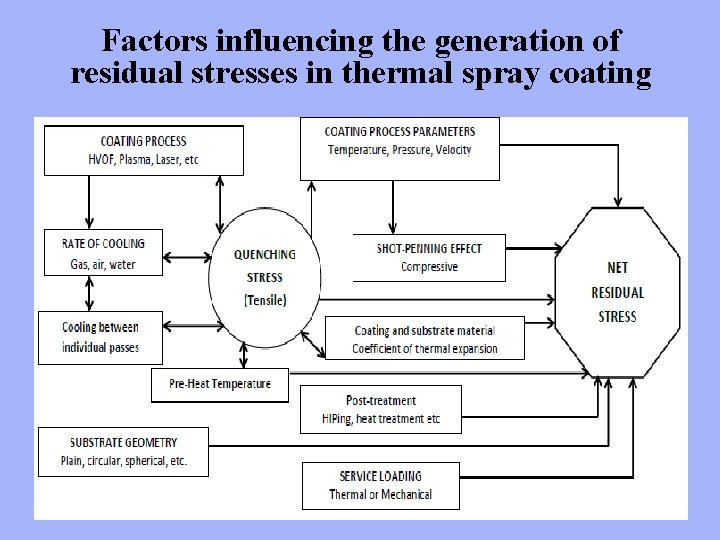
Factors influencing the generation of residual stresses in thermal spray coating
Aims and objectives Identifying & understanding the nature of stresses between the coating and substrate. • • To study the microstructures of HVOF sprayed WC-Co coatings on different metal substrates. • To explore systematically the residual strains measured by different techniques, i. e. X-ray diffraction, synchrotron XRD and neutron diffraction. • This project should assist users of coatings in matching substrates and coatings and/or selecting the deposition procedure.
Experimental procedure • Commercially available WC-17 Co powder was used as the feedstock. • Five different substrates: 304 L SS, brass, aluminium, super-invar and mild steel of 25 x 6 mm sample size were thermally sprayed by HVOF. • Samples were studied in: as-sprayed, grit-blasted annealed grit- blasted conditions. • XRD, SEM-EDX and Vickers hardness tests were undertaken. • Stress analyses were carried out by X-ray diffraction, synchrotron XRD and neutron diffraction.
High Velocity Oxyl-fuel (HVOF) Advantages of HVOF [4]: • High velocity and low oxygen. • Lower decarburization. • Coatings have low porosity and high bond strength. Typically used to deposit wear and corrosion resistant coatings on materials, while protecting from oxidation. www. thermalspray. co. za
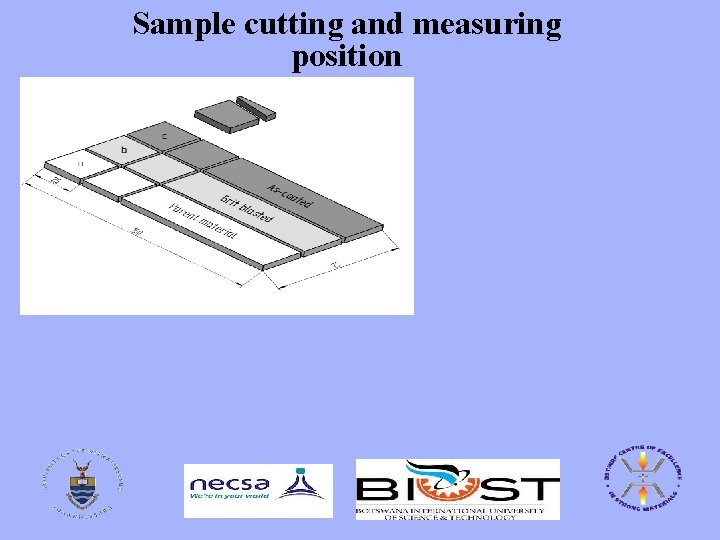
Sample cutting and measuring position
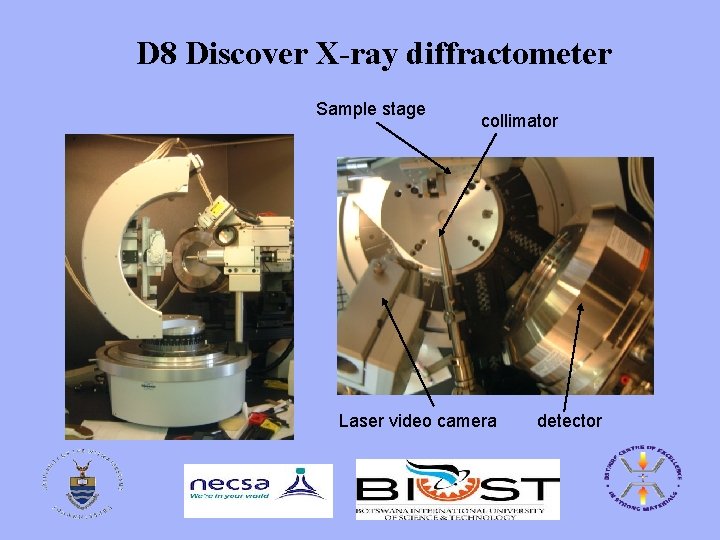
D 8 Discover X-ray diffractometer Sample stage collimator Laser video camera detector
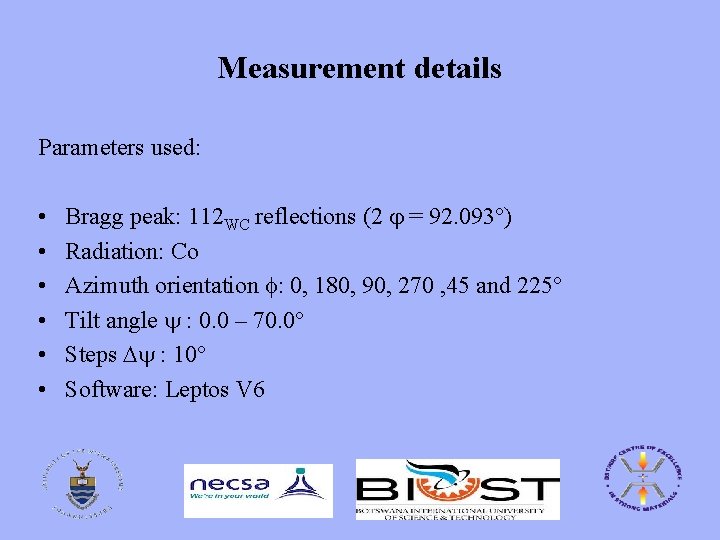
Measurement details Parameters used: • • • Bragg peak: 112 WC reflections (2 = 92. 093°) Radiation: Co Azimuth orientation : 0, 180, 90, 270 , 45 and 225° Tilt angle : 0. 0 – 70. 0° Steps : 10° Software: Leptos V 6
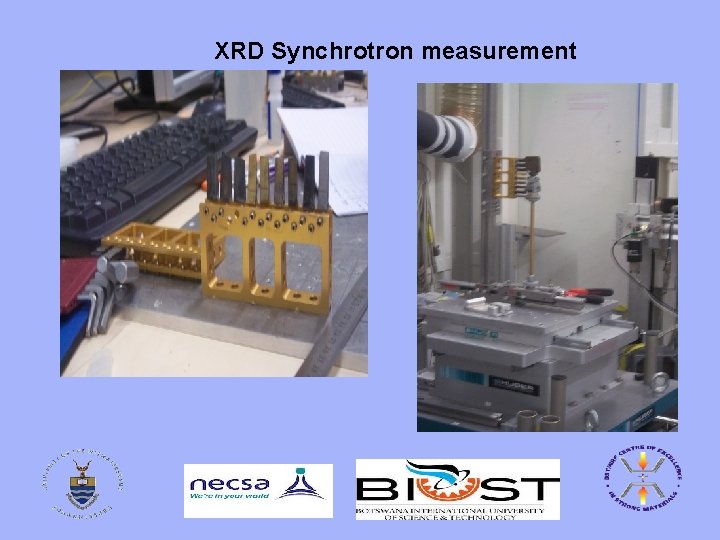
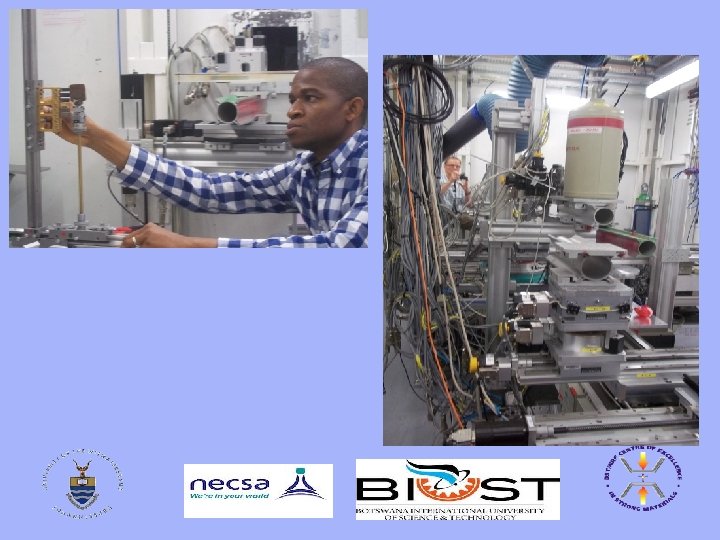
XRD Synchrotron measurement
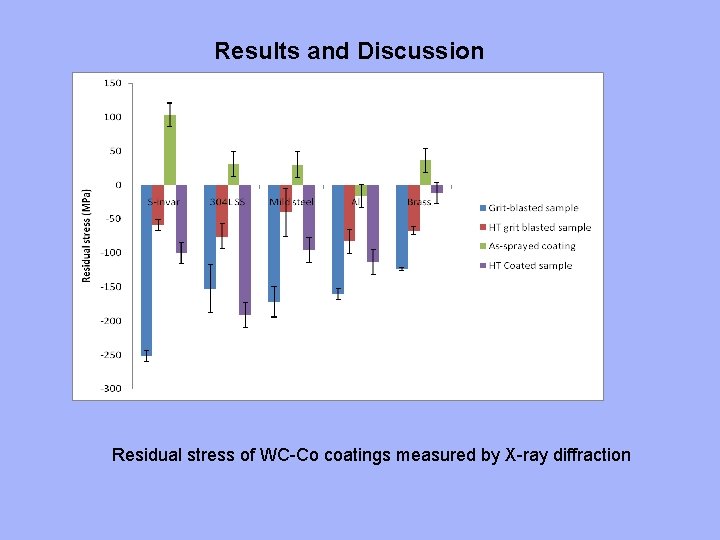
Results and Discussion Residual stress of WC-Co coatings measured by X-ray diffraction
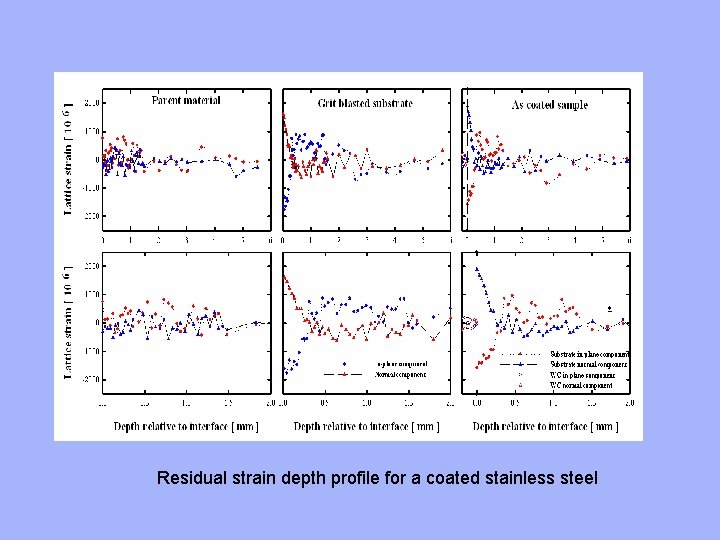
Residual strain depth profile for a coated stainless steel
Residual stain depth profile for the coated brass
Residual strain depth profile of a coated Super-Invar
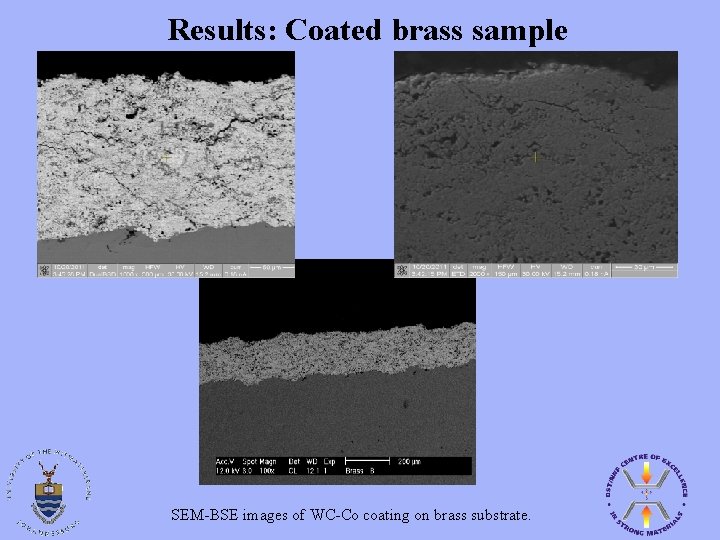
Results: Coated brass sample SEM-BSE images of WC-Co coating on brass substrate.
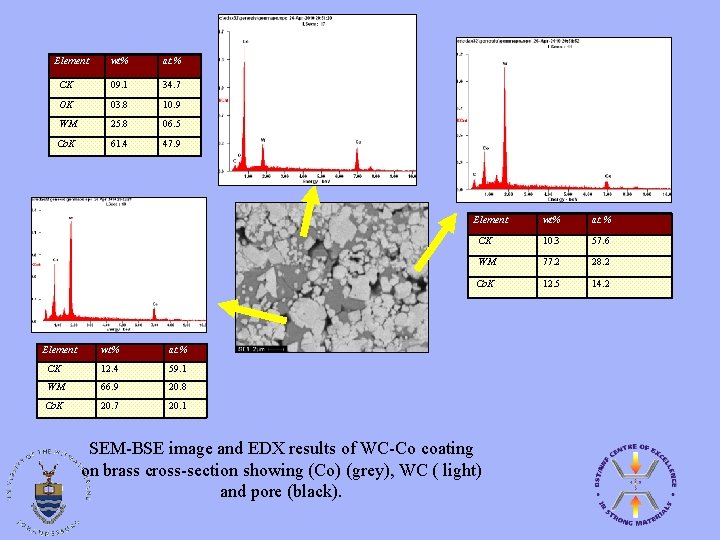
Element wt% at. % CK 09. 1 34. 7 OK 03. 8 10. 9 WM 25. 8 06. 5 Co. K 61. 4 47. 9 Element wt% at. % CK 12. 4 59. 1 WM 66. 9 20. 8 Co. K 20. 7 20. 1 wt% at. % CK 10. 3 57. 6 WM 77. 2 28. 2 Co. K 12. 5 14. 2 SEM-BSE image and EDX results of WC-Co coating on brass cross-section showing (Co) (grey), WC ( light) and pore (black).
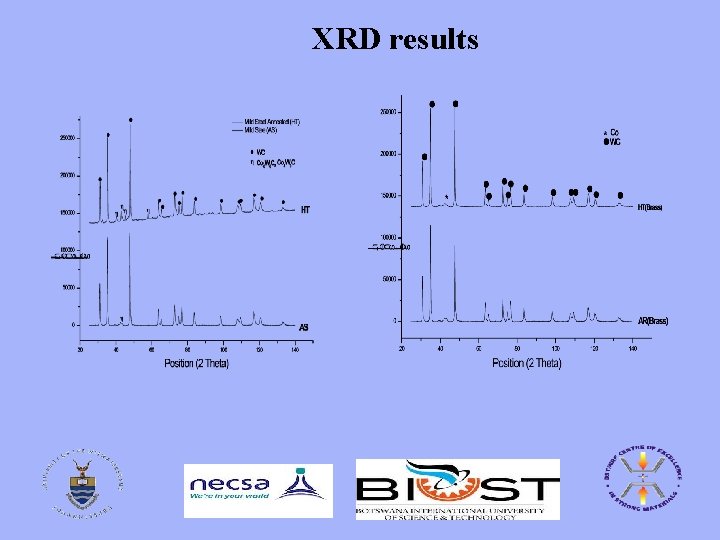
XRD results
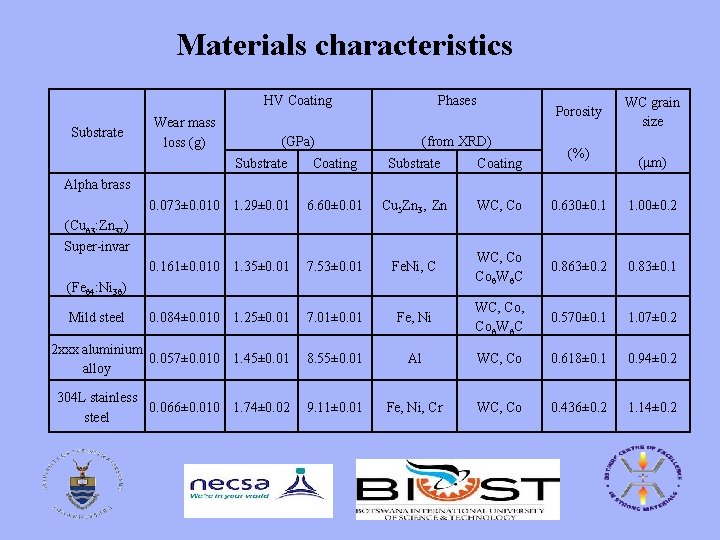
Materials characteristics Substrate Wear mass loss (g) HV Coating Phases (GPa) (from XRD) Substrate Porosity (%) WC grain size (μm) Coating Substrate Coating 0. 073± 0. 010 1. 29± 0. 01 6. 60± 0. 01 Cu 5 Zn 3, Zn WC, Co 0. 630± 0. 1 1. 00± 0. 2 0. 161± 0. 010 1. 35± 0. 01 7. 53± 0. 01 Fe. Ni, C WC, Co Co 6 W 6 C 0. 863± 0. 2 0. 83± 0. 1 0. 084± 0. 010 1. 25± 0. 01 7. 01± 0. 01 Fe, Ni WC, Co 6 W 6 C 0. 570± 0. 1 1. 07± 0. 2 2 xxx aluminium 0. 057± 0. 010 1. 45± 0. 01 alloy 8. 55± 0. 01 Al WC, Co 0. 618± 0. 1 0. 94± 0. 2 304 L stainless 0. 066± 0. 010 1. 74± 0. 02 steel 9. 11± 0. 01 Fe, Ni, Cr WC, Co 0. 436± 0. 2 1. 14± 0. 2 Alpha brass (Cu 63: Zn 37) Super-invar (Fe 64: Ni 36) Mild steel
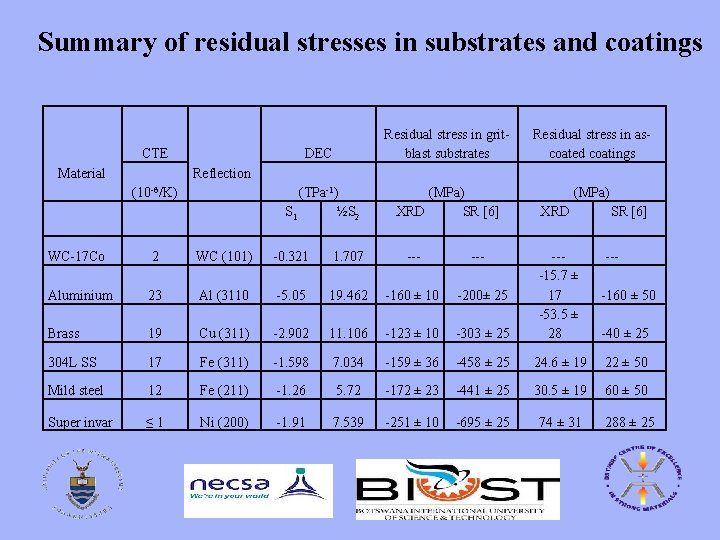
Summary of residual stresses in substrates and coatings CTE Material DEC Residual stress in gritblast substrates Residual stress in ascoated coatings (TPa-1) S 1 ½S 2 (MPa) XRD SR [6] (MPa) Reflection (10 -6/K) WC-17 Co 2 WC (101) -0. 321 1. 707 --- Aluminium 23 Al (3110 -5. 05 19. 462 -160 ± 10 -200± 25 Brass 19 Cu (311) -2. 902 11. 106 -123 ± 10 304 L SS 17 Fe (311) -1. 598 7. 034 Mild steel 12 Fe (211) -1. 26 Super invar ≤ 1 Ni (200) -1. 91 XRD SR [6] -160 ± 50 -303 ± 25 ---15. 7 ± 17 -53. 5 ± 28 --- -159 ± 36 -458 ± 25 24. 6 ± 19 22 ± 50 5. 72 -172 ± 23 -441 ± 25 30. 5 ± 19 60 ± 50 7. 539 -251 ± 10 -695 ± 25 74 ± 31 288 ± 25 -40 ± 25
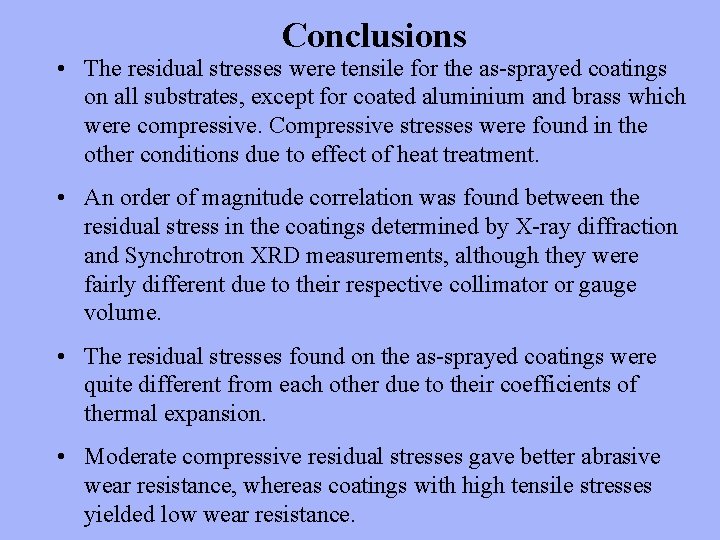
Conclusions • The residual stresses were tensile for the as-sprayed coatings on all substrates, except for coated aluminium and brass which were compressive. Compressive stresses were found in the other conditions due to effect of heat treatment. • An order of magnitude correlation was found between the residual stress in the coatings determined by X-ray diffraction and Synchrotron XRD measurements, although they were fairly different due to their respective collimator or gauge volume. • The residual stresses found on the as-sprayed coatings were quite different from each other due to their coefficients of thermal expansion. • Moderate compressive residual stresses gave better abrasive wear resistance, whereas coatings with high tensile stresses yielded low wear resistance.
References [1] Oladijo O. P. et al. (2012). Surface Coatings Technology, 206, 4725 -4729. [2] Gudge M. et al. (1991). Thermal Spray Research and Applications, ASM International, 331 -337. [3] Kuroda S. et al. (1992). Thermal spray: International Advances in Coatings Technology, ASM International, 903 -909. [4] www. thermaspray. co. za [5] Noyan I. C. and Cohen J. B. (1987) Residual Stress Measurement by Diffraction and Interpretation, New York, Springer-Verlag. [6] Venter A. M. et al. (2012) Surface Coatings Technology, 206, 4011 -4020.
Acknowledgements 1. Mr T. P. Ntsoane, Necsa 2. European Synchrotron Research Facility (ESRF) 3. ANSTO, Australia 4. National Research Foundation