
Use of Diagnosed Conditions for IDEA Part C
- Slides: 43
Use of Diagnosed Conditions for IDEA Part C Early Intervention Program Eligibility 2016 Improving Data, Improving Outcomes Conference New Orleans, LA August 2016
IDEA PART C AND DIAGNOSED CONDITIONS Office of Special Education Programs US Department of Education Julia Martin Eile
Collaborative Project – In collaboration with a diverse group of researchers, policy makers, administrators, coordinators, and TA providers, the series focuses on reviewing current practices related to children with diagnosed conditions and recommendations to improve timely access for children and families to needed EI services and supports.
Presentation l The presentation includes the following: – – – IDEA Part C and Diagnosed Conditions State of the States Future Directions & Recommendations
Diagnosed Conditions Part C of IDEA regulations l Child Find l Eligibility
Child Find l Current Child Find regulations require that States – “ensure that all children with disabilities…are identified, located and evaluated; and a practical method is developed and implemented to determine which children are currently receiving needed special education services and related services” (IDEA, 2004; PL 108 -456)
Eligibility Infants, toddlers and young children are eligible for IDEA Part C are either: – Diagnosed physical or mental condition likely to result in developmental delay – Evidence of a state-defined level of significant development delay in one or more areas of development (IDEA, 2004; PL 108 -466)
Part C of IDEA – Final Regulations – Non-regulatory guidance (2011) l This guidance provides parents, early intervention service (EIS) providers, State lead agencies, and other interested parties with detailed information about the some of the changes made to the Individuals with Disabilities Education Act (IDEA or Act) Part C Regulations in 34 CFR Part 303, as those regulations were published in the Federal Register on September 28, 2011 and made effective on October 28, 2011 (Final Regulations). The Final Regulations can be found at – http: //idea. ed. gov/part-c/search/new.
Child Find l In the 2011 Guidance regarding Child Find – Section 303. 302(c) requires the State to ensure that the child find system is coordinated with specific agencies, including the following State agencies (in addition to those long-referenced in 34 CFR Part 303): the State agency responsible for administering the Child Abuse Prevention and Treatment Act (CAPTA), the State Early Hearing Detection and Intervention (EHDI) system, the Home Visiting program under Maternal and Child Health (MCH-Title V), Child Care programs, and the Children’s Health Insurance Program (CHIP).
Diagnosed Conditions 2011 Guidance – Eligibility of Diagnosed Condition: l Section 303. 21(a)(2) provides the following examples of infants or toddlers with disabilities who have a diagnosed physical or mental condition that has a high probability of resulting in developmental delays: l chromosomal abnormalities; severe attachment disorders; disorders secondary to exposure to toxic substances, including fetal alcohol syndrome; genetic or congenital disorders; sensory impairments; inborn errors of metabolism; congenital infections; and disorders reflecting disturbance of the development of the nervous system.
Optional Classifications l Section 303. 5 adds a definition for at-risk infant or toddler. – An at-risk infant or toddler is a child less than three years of age who would be at risk of experiencing a substantial developmental delay if early intervention services were not provided to the child. A State may expand the definition to include a child who is at risk of experiencing developmental delays because of biological or environmental factors that can be identified.
OSEP Guidance l The 2004 and updated 2011 guidance are to support states in improving their Child Find and Eligibility for infants and toddlers with Diagnosed Conditions.
Thank You Tracie. dickson@ed. gov
DIAGNOSED CONDITIONS Brian Barger, Ph. D. Center for Leadership in Disability Mark Chaffin Center for Healthy Development School of Public Health, Georgia State University bbarger 1@gsu. edu Evelyn Shaw, M. Ed. Early Childhood TA Center Frank Porter Graham Child Development Institute University of North Carolina at Chapel Hill evelyn. shaw@unc. edu
Diagnosed conditions l Diagnosed or established condition l Eligibility l Variability across communities and states
Diagnosed conditions l l l Cleft palate Extreme prematurity Down syndrome Cerebral palsy Muscular dystrophy l l l Fragile X Fetal alcohol syndrome Sensory impairment – l Hearing, vision Low birth weight
Eligibility determination l Definition varies by state l Procedures vary by state l Hospital, doctors, community agencies, Part C
Eligibility determination l Most children identified via delays in physical, cognitive, communication, social/emotional, adaptive areas
Diagnosed conditions l States required to have definition l Vary broadly l Eligibility may vary from community to community and state to state
Diagnosed conditions l States do not have to report specific numbers of children found eligible separate from children with developmental delay l Difficult to evaluate state definitions and service provision
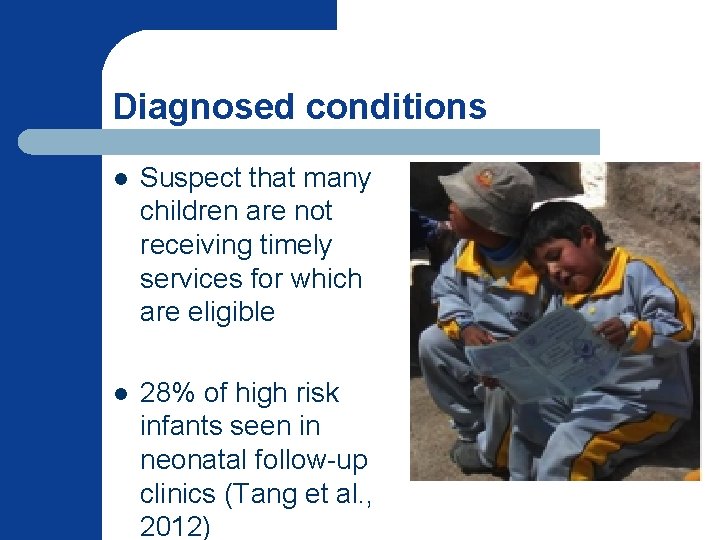
Diagnosed conditions l Suspect that many children are not receiving timely services for which are eligible l 28% of high risk infants seen in neonatal follow-up clinics (Tang et al. , 2012)
Diagnosed conditions l Variability in definitions l Variability in eligibility processes l Through training, transparency of processes, likely improve timely receipt of services
STATE OF THE STATES: DIAGNOSED CONDITIONS Brian Barger, Ph. D. Center for Leadership in Disability Mark Chaffin Center for Healthy Development School of Public Health Georgia State University bbarger 1@gsu. edu
Overview l Little research on how children are identified as eligible for Part C services in their communities – l (Bricker, Macy, Squires, & Marks, 2013; Macy, 2014) Existing focuses primarily on – developmental surveillance l – eligibility evaluation instruments l – (e. g. , Mullens Scale of Early Learning) state definitions of developmental delay for Part C eligibility l – (American Academy of Pediatrics [AAP], 2006; Bricker, et al. , 2013; Rice, Barger, Noyes, & Greer, 2014) (Mc. Manus, Mc. Cormick, Acevedo-Garcia, Ganz, M. , & Hauser. Cram, 2009; Rosenberg, Zhang, & Robinson, 2008 continuity of EI services as children leave Part C and enter pre-school special education services l (Danaher, Shackleford, & Harbin, 2004)
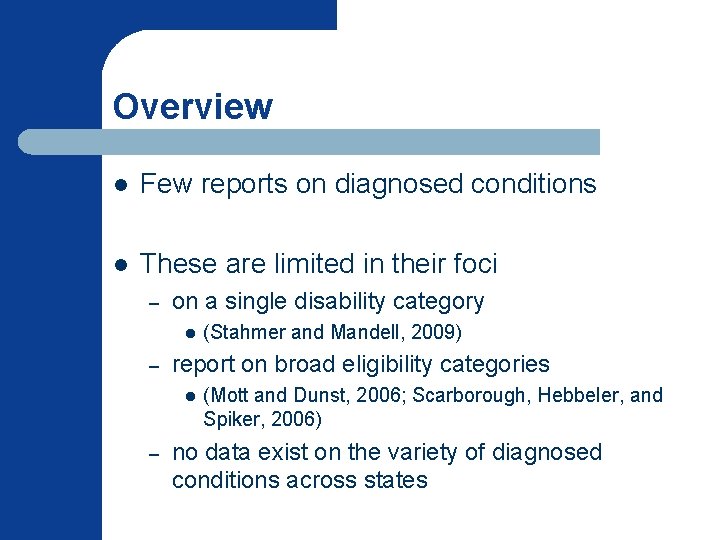
Overview l Few reports on diagnosed conditions l These are limited in their foci – on a single disability category l – report on broad eligibility categories l – (Stahmer and Mandell, 2009) (Mott and Dunst, 2006; Scarborough, Hebbeler, and Spiker, 2006) no data exist on the variety of diagnosed conditions across states
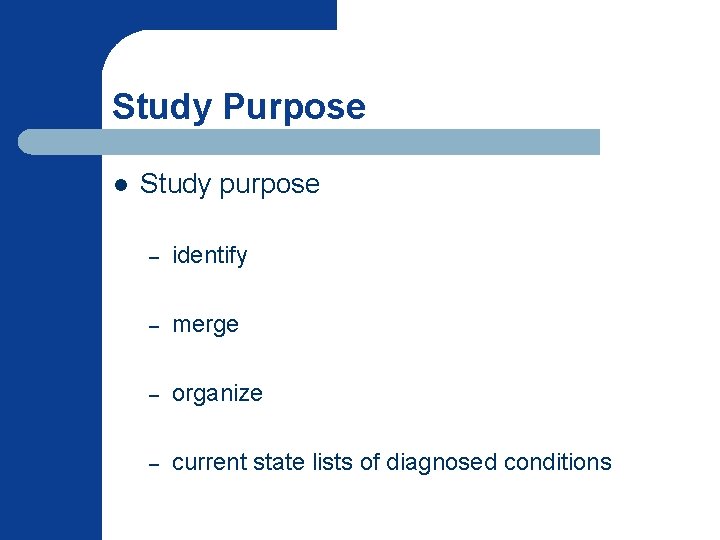
Study Purpose l Study purpose – identify – merge – organize – current state lists of diagnosed conditions
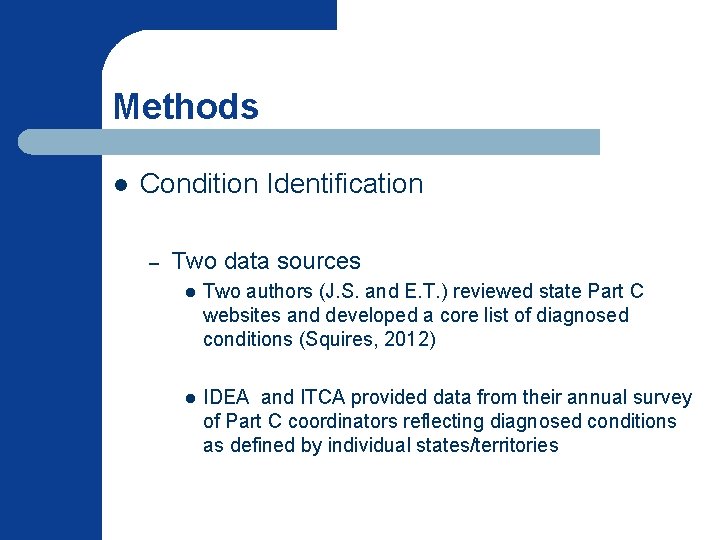
Methods l Condition Identification – Two data sources l Two authors (J. S. and E. T. ) reviewed state Part C websites and developed a core list of diagnosed conditions (Squires, 2012) l IDEA and ITCA provided data from their annual survey of Part C coordinators reflecting diagnosed conditions as defined by individual states/territories
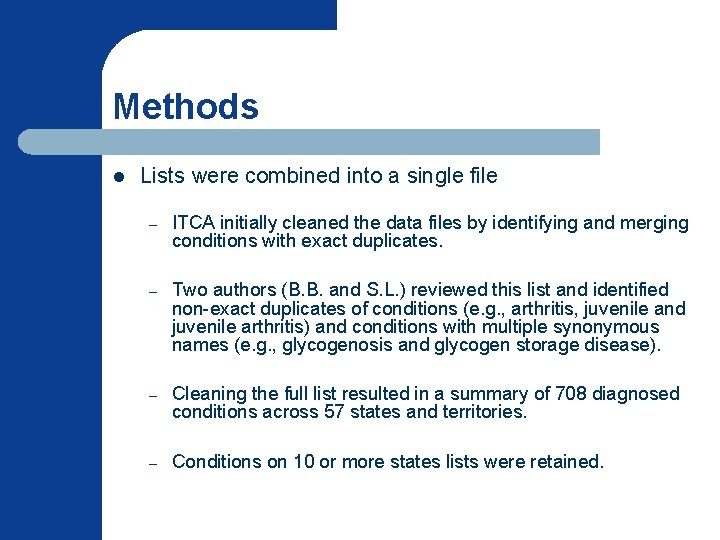
Methods l Lists were combined into a single file – ITCA initially cleaned the data files by identifying and merging conditions with exact duplicates. – Two authors (B. B. and S. L. ) reviewed this list and identified non-exact duplicates of conditions (e. g. , arthritis, juvenile and juvenile arthritis) and conditions with multiple synonymous names (e. g. , glycogenosis and glycogen storage disease). – Cleaning the full list resulted in a summary of 708 diagnosed conditions across 57 states and territories. – Conditions on 10 or more states lists were retained.
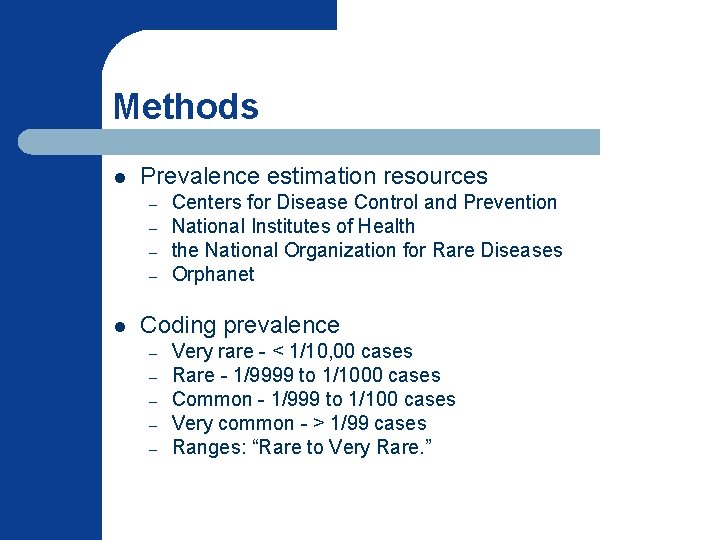
Methods l Prevalence estimation resources – – l Centers for Disease Control and Prevention National Institutes of Health the National Organization for Rare Diseases Orphanet Coding prevalence – – – Very rare - < 1/10, 00 cases Rare - 1/9999 to 1/1000 cases Common - 1/999 to 1/100 cases Very common - > 1/99 cases Ranges: “Rare to Very Rare. ”
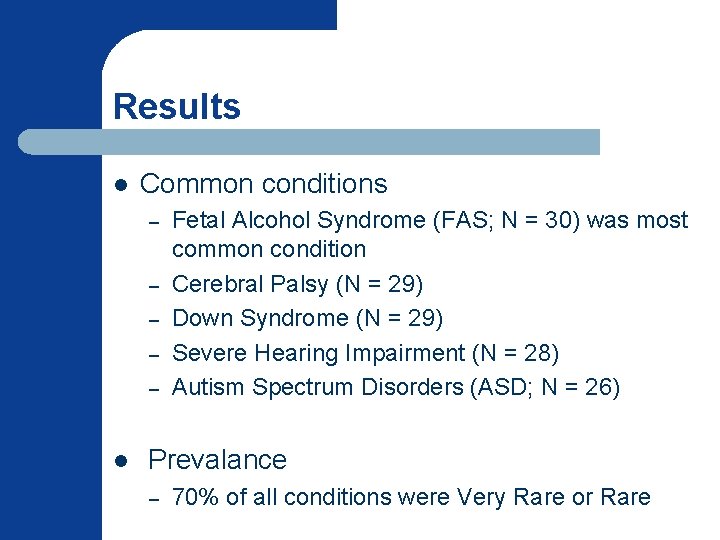
Results l Common conditions – – – l Fetal Alcohol Syndrome (FAS; N = 30) was most common condition Cerebral Palsy (N = 29) Down Syndrome (N = 29) Severe Hearing Impairment (N = 28) Autism Spectrum Disorders (ASD; N = 26) Prevalance – 70% of all conditions were Very Rare or Rare
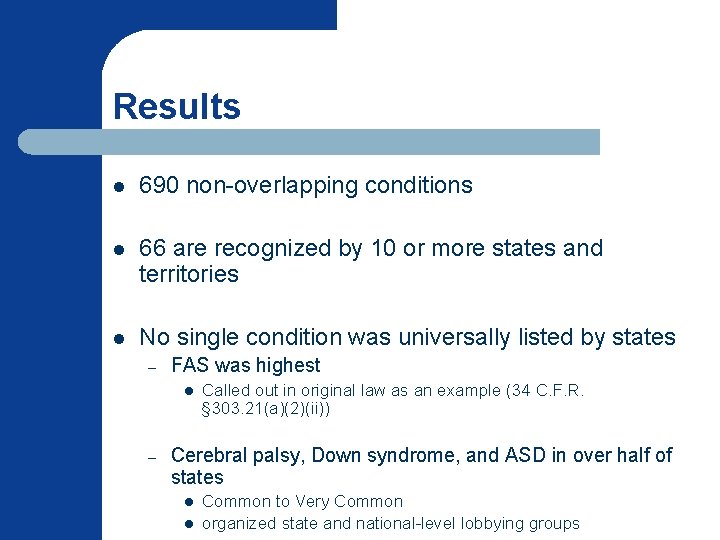
Results l 690 non-overlapping conditions l 66 are recognized by 10 or more states and territories l No single condition was universally listed by states – FAS was highest l – Called out in original law as an example (34 C. F. R. § 303. 21(a)(2)(ii)) Cerebral palsy, Down syndrome, and ASD in over half of states l l Common to Very Common organized state and national-level lobbying groups
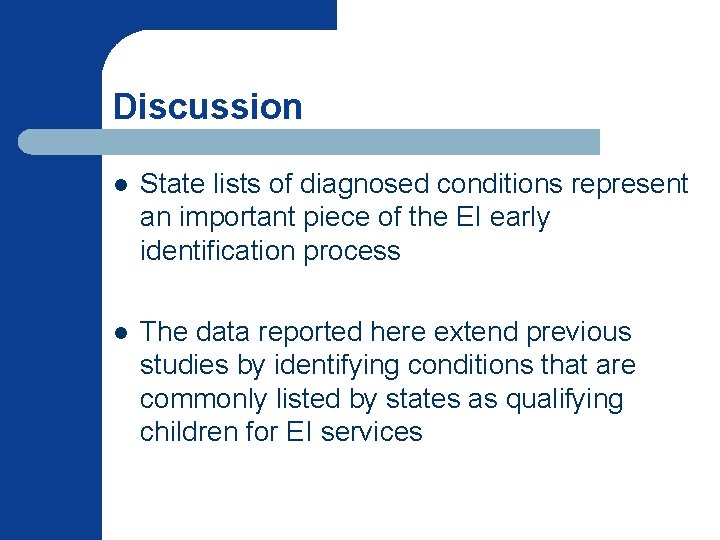
Discussion l State lists of diagnosed conditions represent an important piece of the EI early identification process l The data reported here extend previous studies by identifying conditions that are commonly listed by states as qualifying children for EI services
Contact l l Brian Barger: bbarger 1@gsu. edu Evelyn Shaw: evelyn. shaw@unc. edu
Use of Diagnosed Conditions for IDEA Part C Early Intervention Program Eligibility: Future Directions Maureen Greer Executive Director
IDEA/ITCA Not for Profit Organization designed to: – – – Promote mutual assistance, cooperation, and exchange of information and ideas in the administration of Part C Provide support to state and territory Part C Coordinators 51 states/jurisdictions
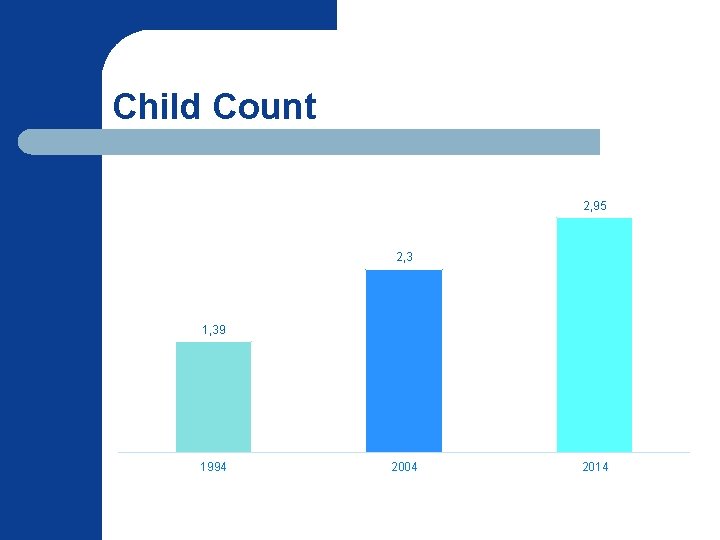
Part C is an important resource for young children and families l Complex and vital system of state-operated early intervention programs l All 50 states and 6 territories voluntarily participate – local flexibility in implementation is important l Entitlement program that has served nearly six million infants & toddlers and their families since full implementation
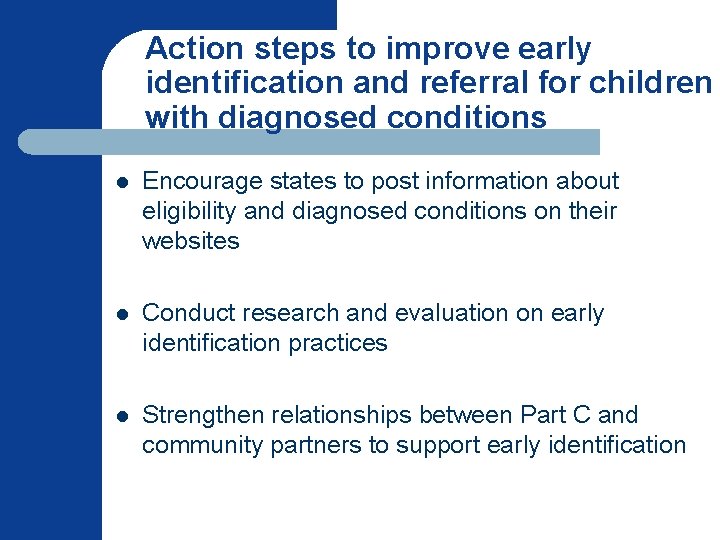
Action steps to improve early identification and referral for children with diagnosed conditions l Encourage states to post information about eligibility and diagnosed conditions on their websites l Conduct research and evaluation on early identification practices l Strengthen relationships between Part C and community partners to support early identification
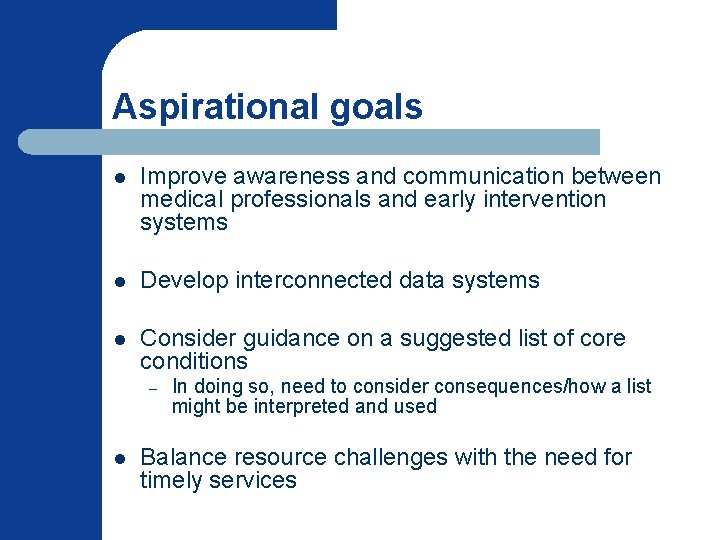
Aspirational goals l Improve awareness and communication between medical professionals and early intervention systems l Develop interconnected data systems l Consider guidance on a suggested list of core conditions – l In doing so, need to consider consequences/how a list might be interpreted and used Balance resource challenges with the need for timely services
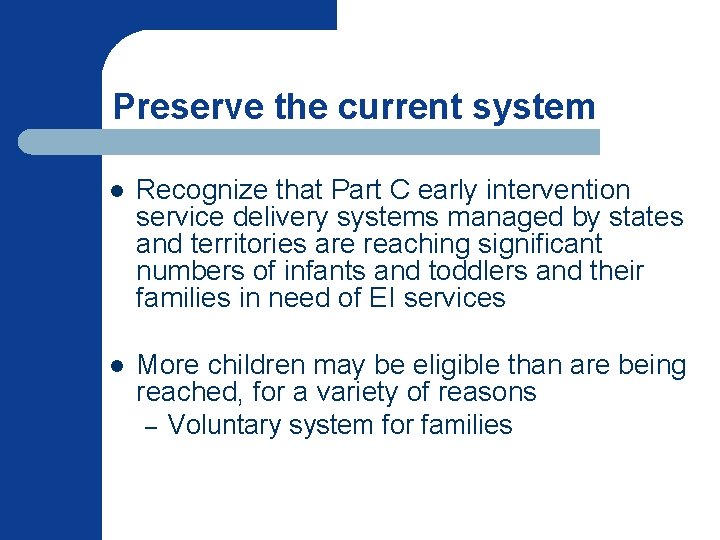
Preserve the current system l Recognize that Part C early intervention service delivery systems managed by states and territories are reaching significant numbers of infants and toddlers and their families in need of EI services l More children may be eligible than are being reached, for a variety of reasons – Voluntary system for families
Child Count 2, 95 2, 3 1, 39 1994 2004 2014
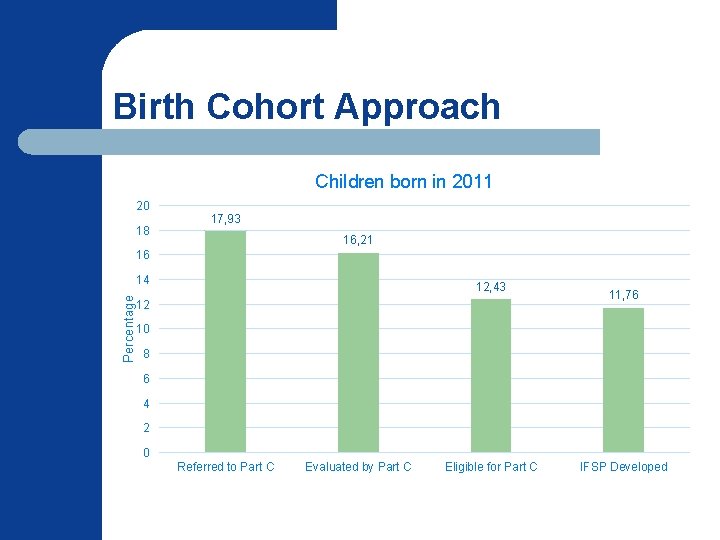
Birth Cohort Approach Children born in 2011 20 18 17, 93 16, 21 16 Percentage 14 12, 43 12 11, 76 10 8 6 4 2 0 Referred to Part C Evaluated by Part C Eligible for Part C IFSP Developed
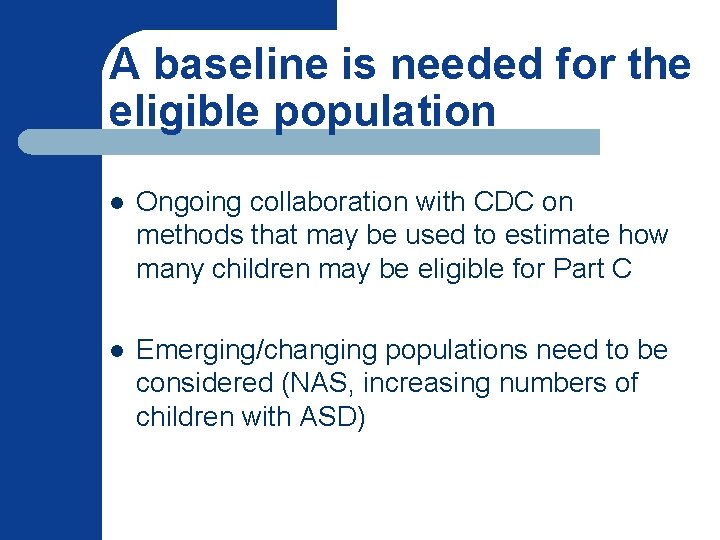
A baseline is needed for the eligible population l Ongoing collaboration with CDC on methods that may be used to estimate how many children may be eligible for Part C l Emerging/changing populations need to be considered (NAS, increasing numbers of children with ASD)
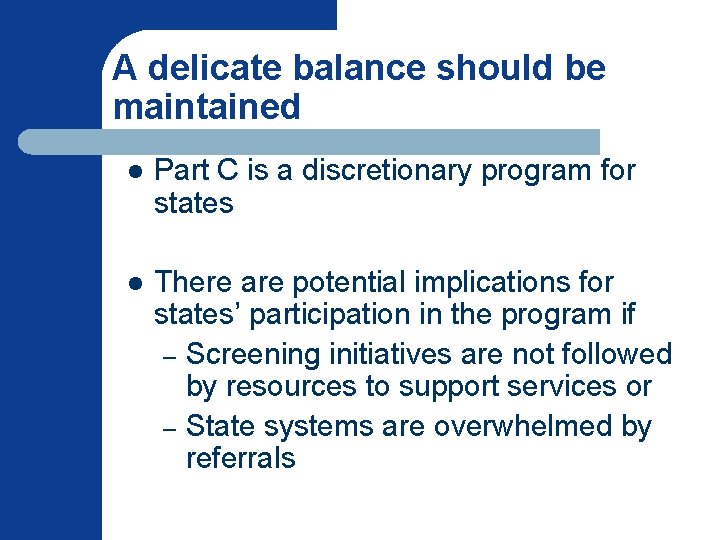
A delicate balance should be maintained l Part C is a discretionary program for states l There are potential implications for states’ participation in the program if – Screening initiatives are not followed by resources to support services or – State systems are overwhelmed by referrals