
Use of computers in chronic aphasia Hunter Region


- Slides: 29
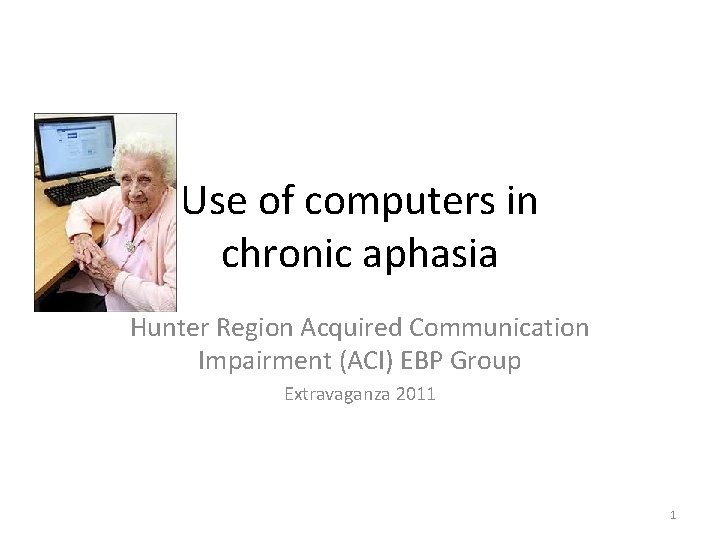
Use of computers in chronic aphasia Hunter Region Acquired Communication Impairment (ACI) EBP Group Extravaganza 2011 1
• • "Technophobia be gone? " "Man versus Machine" "Deus ex Machina" "Rise of the Machines" 2
Who are we? • New clinical EBP group commenced late 2010. • Focus on active member involvement. • SPs from public, private, other government agencies, Newcastle University working in a range of clinical settings in the Newcastle/Hunter Region. • Group Leaders: 2010 - 2011 – Georgi Laney: – Sarah Bell: georgi. laney@hnehealth. nsw. gov. au, sbell@lifetimecare. nsw. gov. au 3
4
5
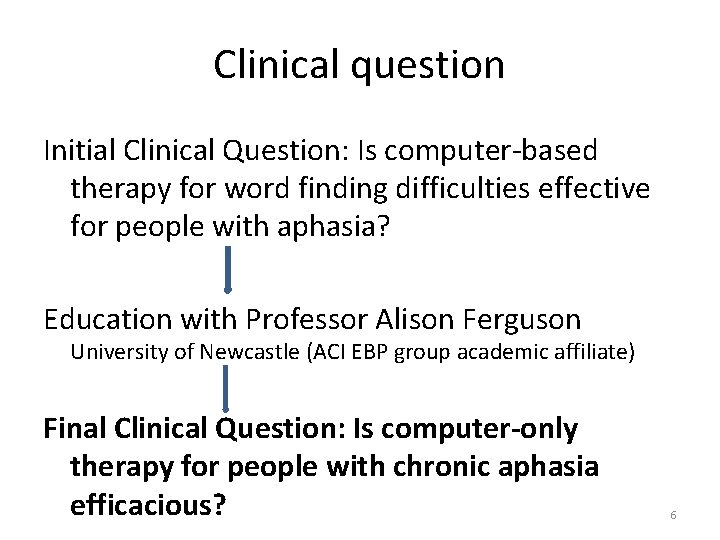
Clinical question Initial Clinical Question: Is computer-based therapy for word finding difficulties effective for people with aphasia? Education with Professor Alison Ferguson University of Newcastle (ACI EBP group academic affiliate) Final Clinical Question: Is computer-only therapy for people with chronic aphasia efficacious? 6
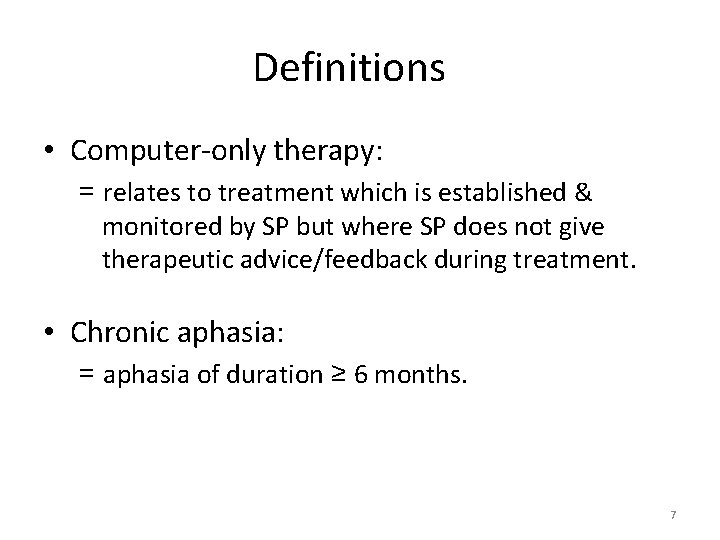
Definitions • Computer-only therapy: = relates to treatment which is established & monitored by SP but where SP does not give therapeutic advice/feedback during treatment. • Chronic aphasia: = aphasia of duration ≥ 6 months. 7
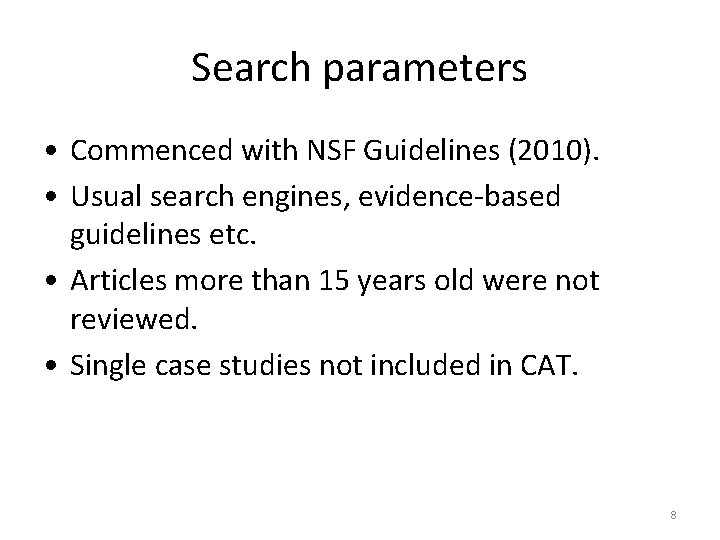
Search parameters • Commenced with NSF Guidelines (2010). • Usual search engines, evidence-based guidelines etc. • Articles more than 15 years old were not reviewed. • Single case studies not included in CAT. 8
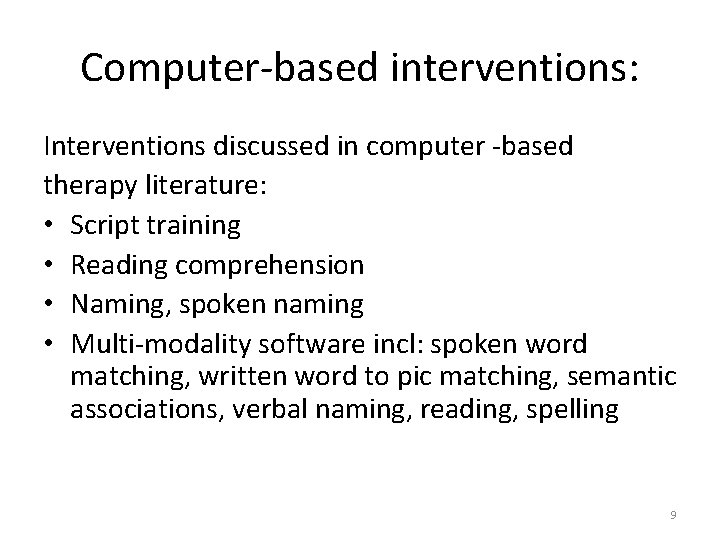
Computer-based interventions: Interventions discussed in computer -based therapy literature: • Script training • Reading comprehension • Naming, spoken naming • Multi-modality software incl: spoken word matching, written word to pic matching, semantic associations, verbal naming, reading, spelling 9
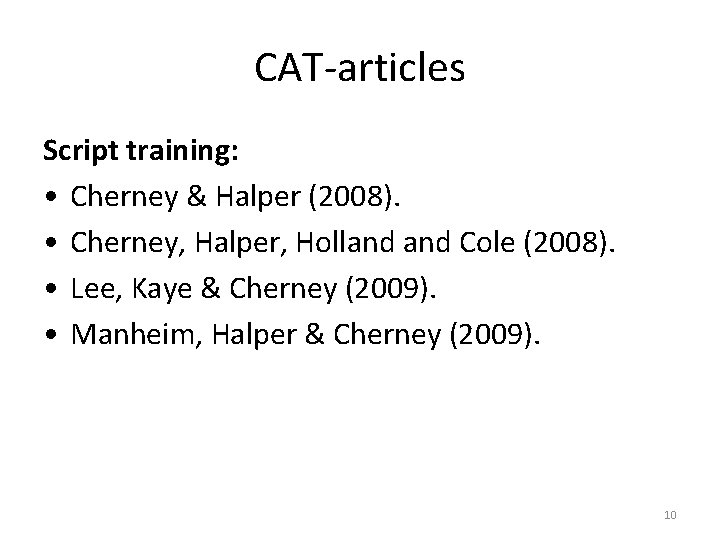
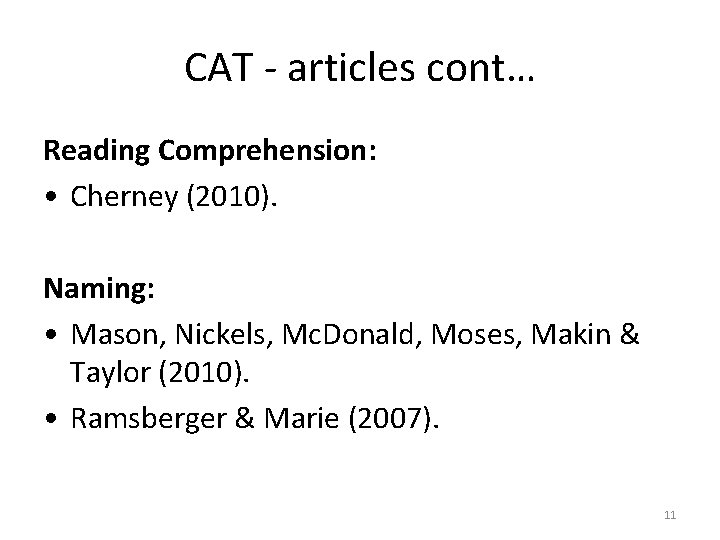
CAT-articles Script training: • Cherney & Halper (2008). • Cherney, Halper, Holland Cole (2008). • Lee, Kaye & Cherney (2009). • Manheim, Halper & Cherney (2009). 10
CAT - articles cont… Reading Comprehension: • Cherney (2010). Naming: • Mason, Nickels, Mc. Donald, Moses, Makin & Taylor (2010). • Ramsberger & Marie (2007). 11
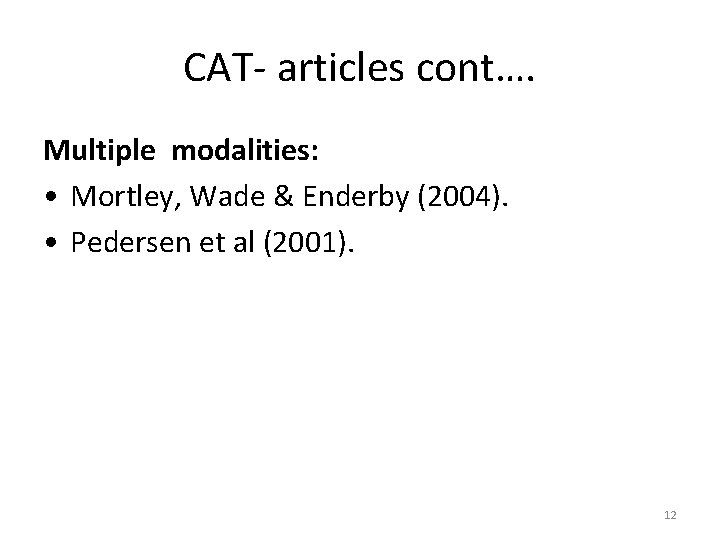
CAT- articles cont…. Multiple modalities: • Mortley, Wade & Enderby (2004). • Pedersen et al (2001). 12
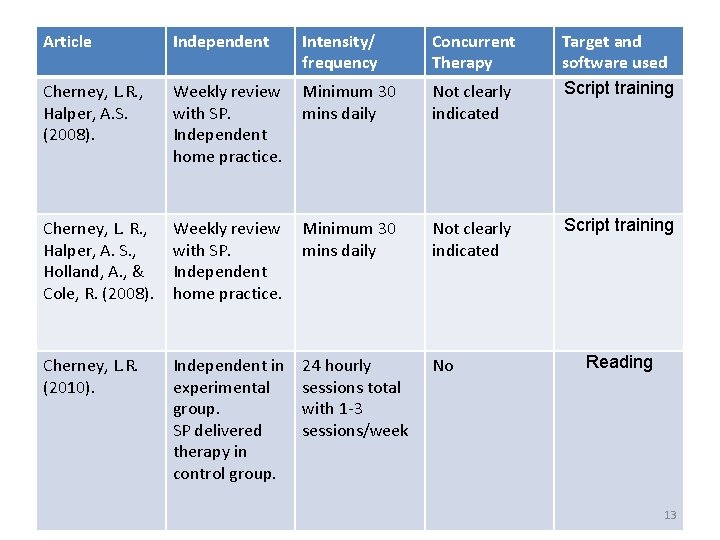
Article Independent Intensity/ frequency Concurrent Therapy Cherney, L. R. , Halper, A. S. (2008). Weekly review with SP. Independent home practice. Minimum 30 mins daily Not clearly indicated Cherney, L. R. , Halper, A. S. , Holland, A. , & Cole, R. (2008). Weekly review with SP. Independent home practice. Minimum 30 mins daily Not clearly indicated Cherney, L. R. (2010). Independent in experimental group. SP delivered therapy in control group. 24 hourly sessions total with 1 -3 sessions/week No Target and software used Script training Reading 13
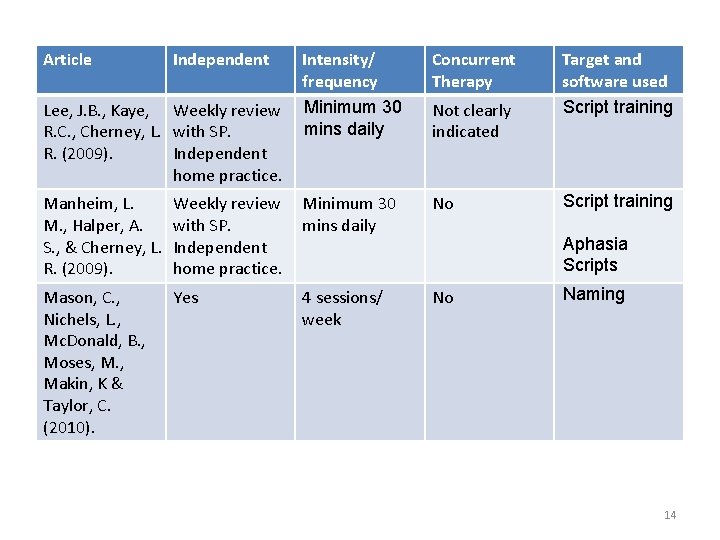
Article Independent Lee, J. B. , Kaye, Weekly review R. C. , Cherney, L. with SP. R. (2009). Independent home practice. Intensity/ frequency Minimum 30 mins daily Concurrent Therapy Not clearly indicated Manheim, L. M. , Halper, A. S. , & Cherney, L. R. (2009). Weekly review with SP. Independent home practice. Minimum 30 mins daily No Mason, C. , Nichels, L. , Mc. Donald, B. , Moses, M. , Makin, K & Taylor, C. (2010). Yes 4 sessions/ week No Target and software used Script training Aphasia Scripts Naming 14
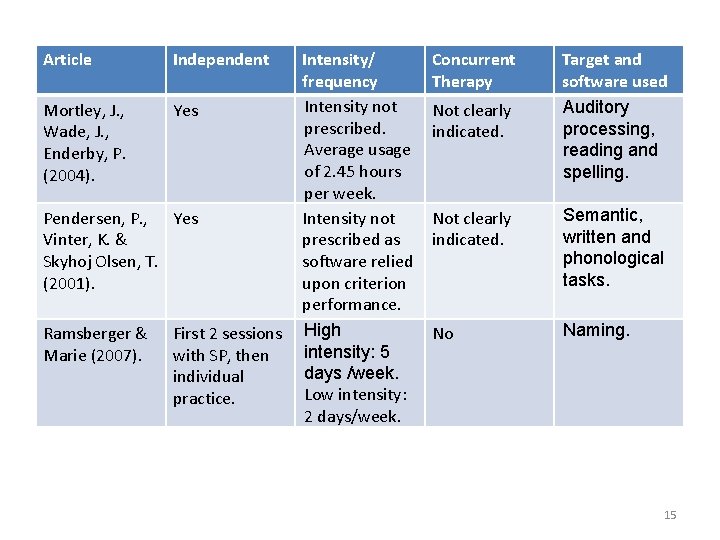
Article Independent Mortley, J. , Wade, J. , Enderby, P. (2004). Yes Pendersen, P. , Yes Vinter, K. & Skyhoj Olsen, T. (2001). Ramsberger & Marie (2007). First 2 sessions with SP, then individual practice. Intensity/ frequency Intensity not prescribed. Average usage of 2. 45 hours per week. Intensity not prescribed as software relied upon criterion performance. High intensity: 5 days /week. Low intensity: 2 days/week. Concurrent Therapy Not clearly indicated. Target and software used Auditory processing, reading and spelling. Not clearly indicated. Semantic, written and phonological tasks. No Naming. 15
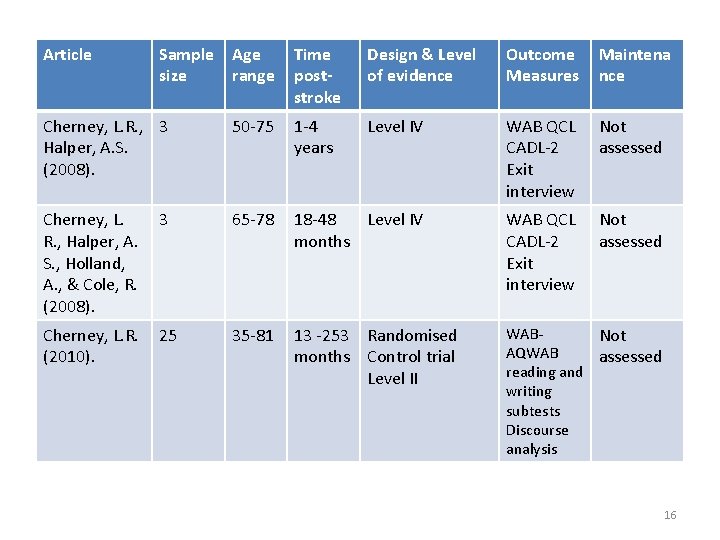
Article Sample size Age range Time poststroke Design & Level of evidence Outcome Measures Maintena nce Cherney, L. R. , 3 Halper, A. S. (2008). 50 -75 1 -4 years Level IV WAB QCL CADL-2 Exit interview Not assessed Cherney, L. R. , Halper, A. S. , Holland, A. , & Cole, R. (2008). 3 65 -78 18 -48 Level IV months WAB QCL CADL-2 Exit interview Not assessed Cherney, L. R. (2010). 25 35 -81 13 -253 Randomised months Control trial Level II WABNot AQWAB assessed reading and writing subtests Discourse analysis 16
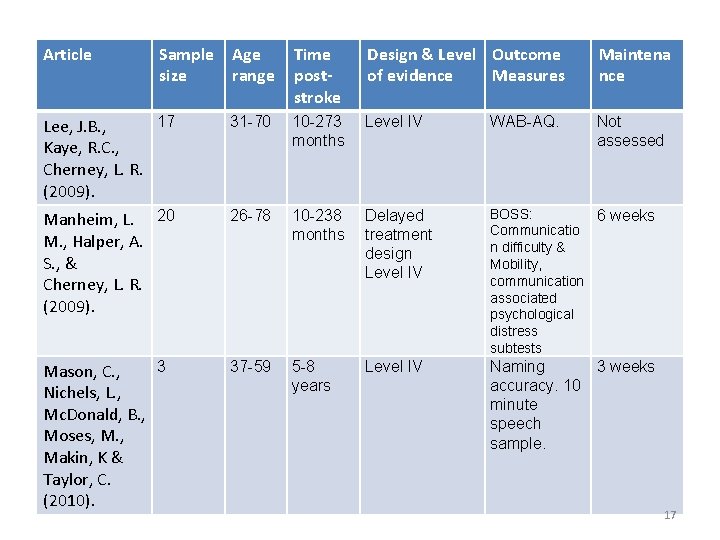
Article Sample size Age range Time poststroke Design & Level Outcome of evidence Measures Maintena nce 17 Lee, J. B. , Kaye, R. C. , Cherney, L. R. (2009). 31 -70 10 -273 months Level IV WAB-AQ. Not assessed Manheim, L. 20 M. , Halper, A. S. , & Cherney, L. R. (2009). 26 -78 10 -238 months Delayed treatment design Level IV BOSS: 6 weeks Communicatio n difficulty & Mobility, communication associated psychological distress subtests 3 Mason, C. , Nichels, L. , Mc. Donald, B. , Moses, M. , Makin, K & Taylor, C. (2010). 37 -59 5 -8 years Level IV Naming 3 weeks accuracy. 10 minute speech sample. 17
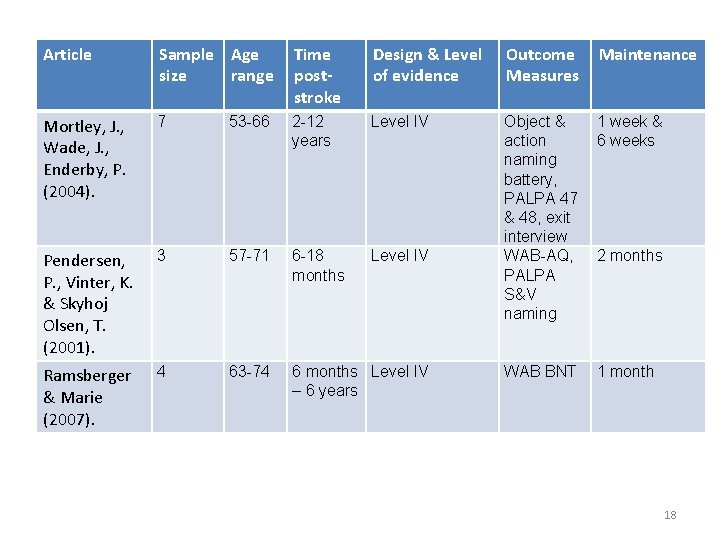
Article Sample Age size range Time poststroke Design & Level of evidence Outcome Measures Maintenance Mortley, J. , Wade, J. , Enderby, P. (2004). 7 53 -66 2 -12 years Level IV 1 week & 6 weeks Pendersen, P. , Vinter, K. & Skyhoj Olsen, T. (2001). 3 57 -71 6 -18 months Level IV Object & action naming battery, PALPA 47 & 48, exit interview WAB-AQ, PALPA S&V naming Ramsberger & Marie (2007). 4 63 -74 6 months Level IV – 6 years WAB BNT 1 month 2 months 18
Clinical bottom line What we think…. • Any person with aphasia (without cognitive impt) can learn to use a computer even if this is a new skill. • Computer-only therapy is worth a go! • Use of computers can increase therapy intensity and we know intensity is good. 19
Clinical bottom line What we don’t know……. • Is it the use of computers or increased intensity that is affecting the change? • Is one particular program more effective than another? • Is there an optimal amount of clinical intervention that should be used in conjunction with computer based therapy? • How long does generalisation last? 20
What next? Clinical implications…. . • Further education on levels of evidence & research design. • Investigate possibility of research or student project focusing on collating information about available computer therapy programs. • Trial in workplace. • Review literature and revise CAT in 12 -18 months. 21
What next? . . . Other…. . • More communication with Adult Language group in Sydney. • Leaders to be more involved in EBP Network Leaders meetings. • Encourage other regional groups to be developed. 22
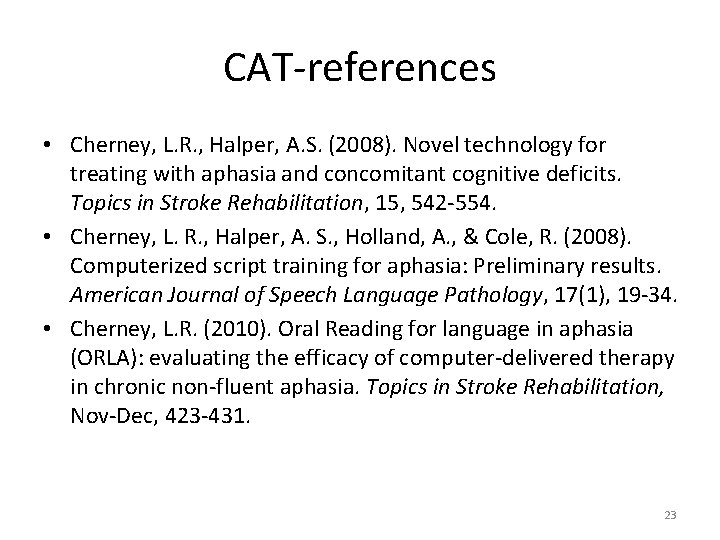
CAT-references • Cherney, L. R. , Halper, A. S. (2008). Novel technology for treating with aphasia and concomitant cognitive deficits. Topics in Stroke Rehabilitation, 15, 542 -554. • Cherney, L. R. , Halper, A. S. , Holland, A. , & Cole, R. (2008). Computerized script training for aphasia: Preliminary results. American Journal of Speech Language Pathology, 17(1), 19 -34. • Cherney, L. R. (2010). Oral Reading for language in aphasia (ORLA): evaluating the efficacy of computer-delivered therapy in chronic non-fluent aphasia. Topics in Stroke Rehabilitation, Nov-Dec, 423 -431. 23
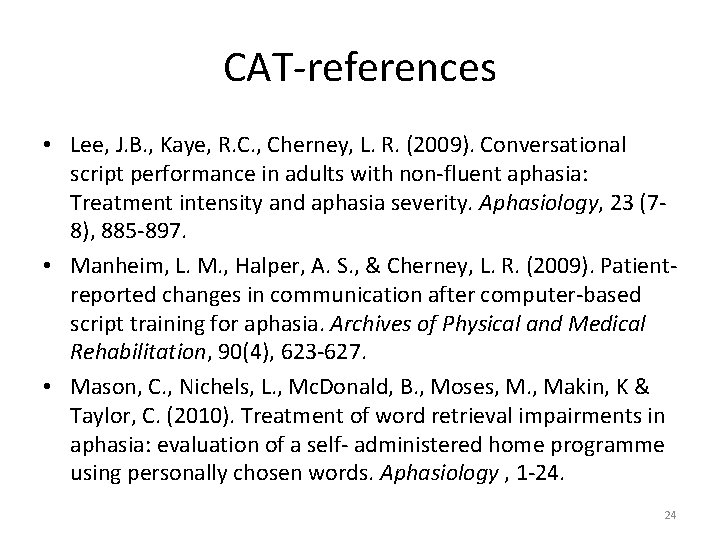
CAT-references • Lee, J. B. , Kaye, R. C. , Cherney, L. R. (2009). Conversational script performance in adults with non-fluent aphasia: Treatment intensity and aphasia severity. Aphasiology, 23 (78), 885 -897. • Manheim, L. M. , Halper, A. S. , & Cherney, L. R. (2009). Patientreported changes in communication after computer-based script training for aphasia. Archives of Physical and Medical Rehabilitation, 90(4), 623 -627. • Mason, C. , Nichels, L. , Mc. Donald, B. , Moses, M. , Makin, K & Taylor, C. (2010). Treatment of word retrieval impairments in aphasia: evaluation of a self- administered home programme using personally chosen words. Aphasiology , 1 -24. 24
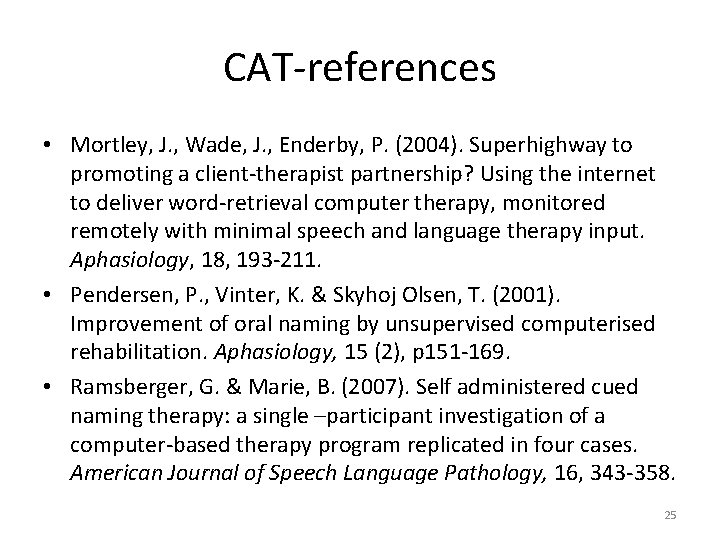
CAT-references • Mortley, J. , Wade, J. , Enderby, P. (2004). Superhighway to promoting a client-therapist partnership? Using the internet to deliver word-retrieval computer therapy, monitored remotely with minimal speech and language therapy input. Aphasiology, 18, 193 -211. • Pendersen, P. , Vinter, K. & Skyhoj Olsen, T. (2001). Improvement of oral naming by unsupervised computerised rehabilitation. Aphasiology, 15 (2), p 151 -169. • Ramsberger, G. & Marie, B. (2007). Self administered cued naming therapy: a single –participant investigation of a computer-based therapy program replicated in four cases. American Journal of Speech Language Pathology, 16, 343 -358. 25
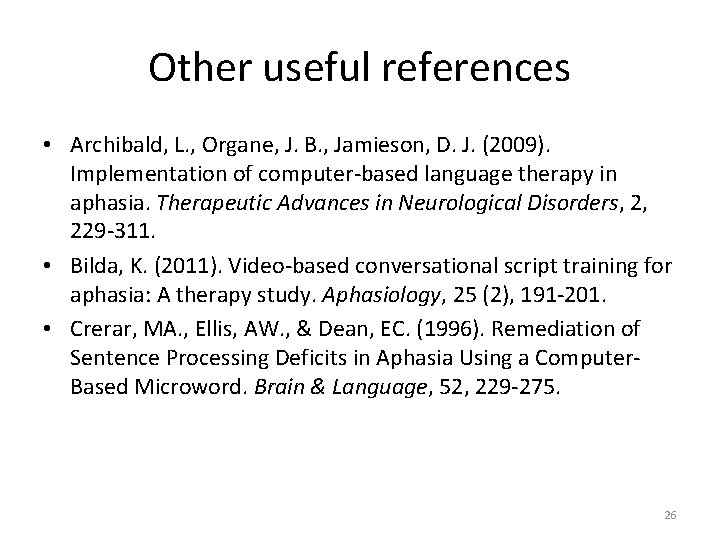
Other useful references • Archibald, L. , Organe, J. B. , Jamieson, D. J. (2009). Implementation of computer-based language therapy in aphasia. Therapeutic Advances in Neurological Disorders, 2, 229 -311. • Bilda, K. (2011). Video-based conversational script training for aphasia: A therapy study. Aphasiology, 25 (2), 191 -201. • Crerar, MA. , Ellis, AW. , & Dean, EC. (1996). Remediation of Sentence Processing Deficits in Aphasia Using a Computer. Based Microword. Brain & Language, 52, 229 -275. 26
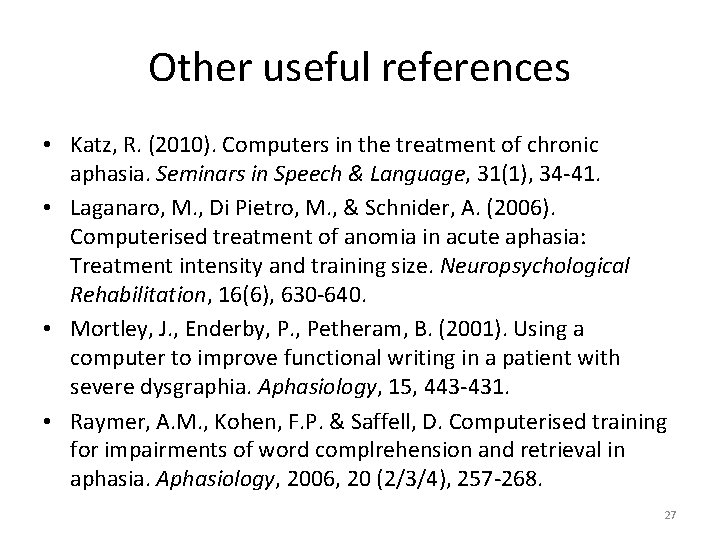
Other useful references • Katz, R. (2010). Computers in the treatment of chronic aphasia. Seminars in Speech & Language, 31(1), 34 -41. • Laganaro, M. , Di Pietro, M. , & Schnider, A. (2006). Computerised treatment of anomia in acute aphasia: Treatment intensity and training size. Neuropsychological Rehabilitation, 16(6), 630 -640. • Mortley, J. , Enderby, P. , Petheram, B. (2001). Using a computer to improve functional writing in a patient with severe dysgraphia. Aphasiology, 15, 443 -431. • Raymer, A. M. , Kohen, F. P. & Saffell, D. Computerised training for impairments of word complrehension and retrieval in aphasia. Aphasiology, 2006, 20 (2/3/4), 257 -268. 27
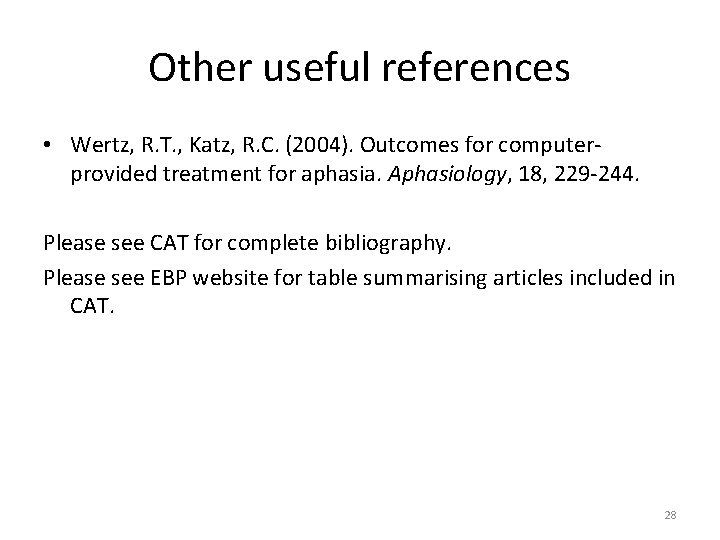
Other useful references • Wertz, R. T. , Katz, R. C. (2004). Outcomes for computerprovided treatment for aphasia. Aphasiology, 18, 229 -244. Please see CAT for complete bibliography. Please see EBP website for table summarising articles included in CAT. 28
Thank you! Hunter Region ACI EBP Group members: • Kerrie Strong • Amanda Freund • Luisa Renna • Sue Sherratt • Megan Alston • Monica Anderson • Renae Mannix • Amanda Schumacher • Nathan Haywood • Alison Ferguson • Jo Steel • Sarah Bell • Paula Machin • Georgi Laney • Danielle Rose 29