
Use of Binax NOW COVID19 Antigen Test Cards
Use of Binax. NOW COVID-19 Antigen Test Cards – Kentucky Critical Access Hospitals Kentucky Department for Public Health and Abbott Laboratories November 24, 2020 3: 00 - 4: 15 P. M. (EST)
Abbott Binax. NOWTM COVID-19 Antigen (Ag) Cards Michelle Moran, Technical Consultant, Abbott Rapid Diagnostics 2
Using the Binax. NOWTM COVID-19 Ag Cards Doug Thoroughman, Ph. D, MS, State Epidemiologist (Acting) CDC Career Epidemiology Field Officer, Kentucky Department for Public Health 3
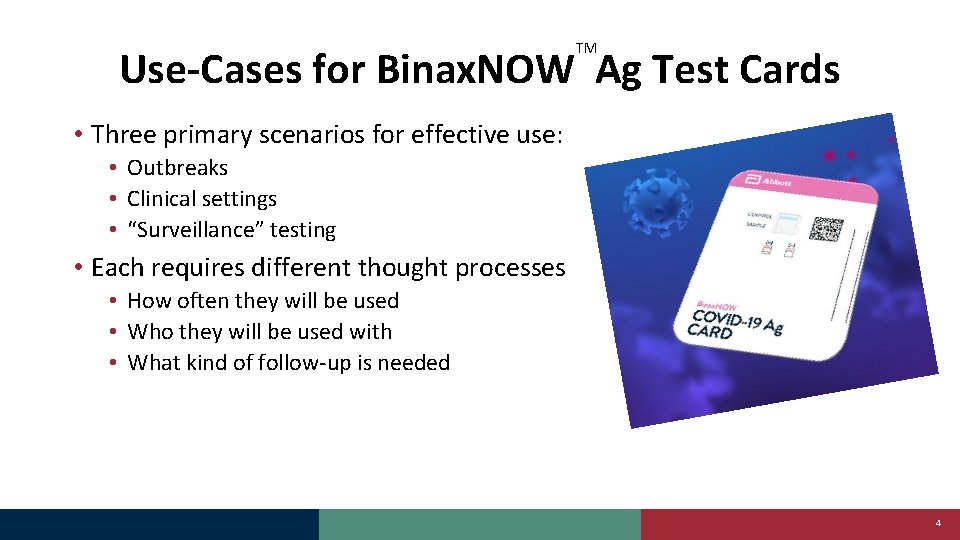
TM Use-Cases for Binax. NOW Ag Test Cards • Three primary scenarios for effective use: • Outbreaks • Clinical settings • “Surveillance” testing • Each requires different thought processes • How often they will be used • Who they will be used with • What kind of follow-up is needed 4
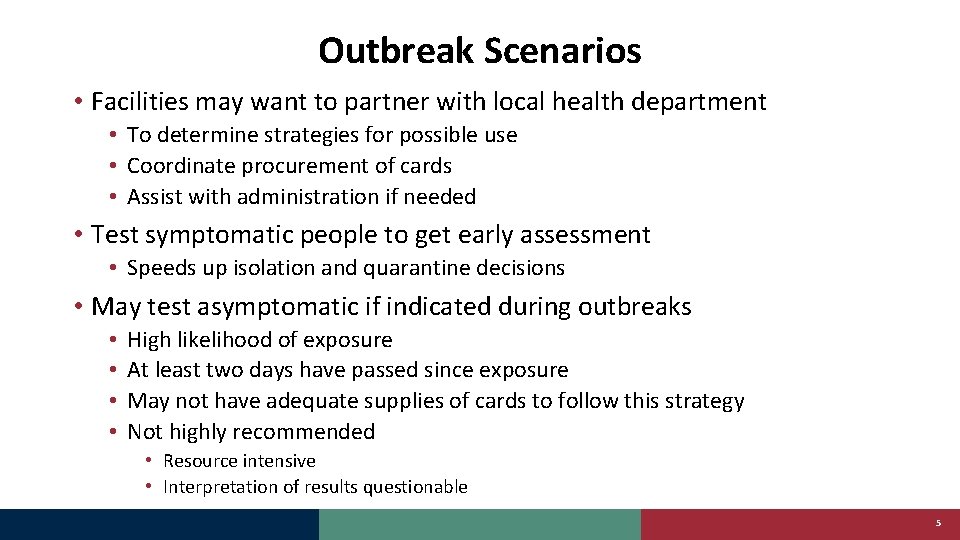
Outbreak Scenarios • Facilities may want to partner with local health department • To determine strategies for possible use • Coordinate procurement of cards • Assist with administration if needed • Test symptomatic people to get early assessment • Speeds up isolation and quarantine decisions • May test asymptomatic if indicated during outbreaks • • High likelihood of exposure At least two days have passed since exposure May not have adequate supplies of cards to follow this strategy Not highly recommended • Resource intensive • Interpretation of results questionable 5
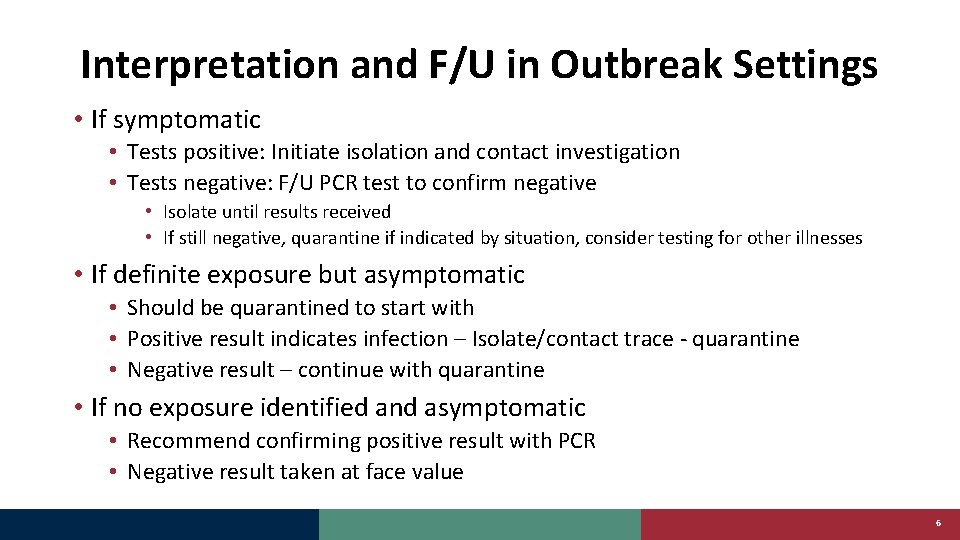
Interpretation and F/U in Outbreak Settings • If symptomatic • Tests positive: Initiate isolation and contact investigation • Tests negative: F/U PCR test to confirm negative • Isolate until results received • If still negative, quarantine if indicated by situation, consider testing for other illnesses • If definite exposure but asymptomatic • Should be quarantined to start with • Positive result indicates infection – Isolate/contact trace - quarantine • Negative result – continue with quarantine • If no exposure identified and asymptomatic • Recommend confirming positive result with PCR • Negative result taken at face value 6
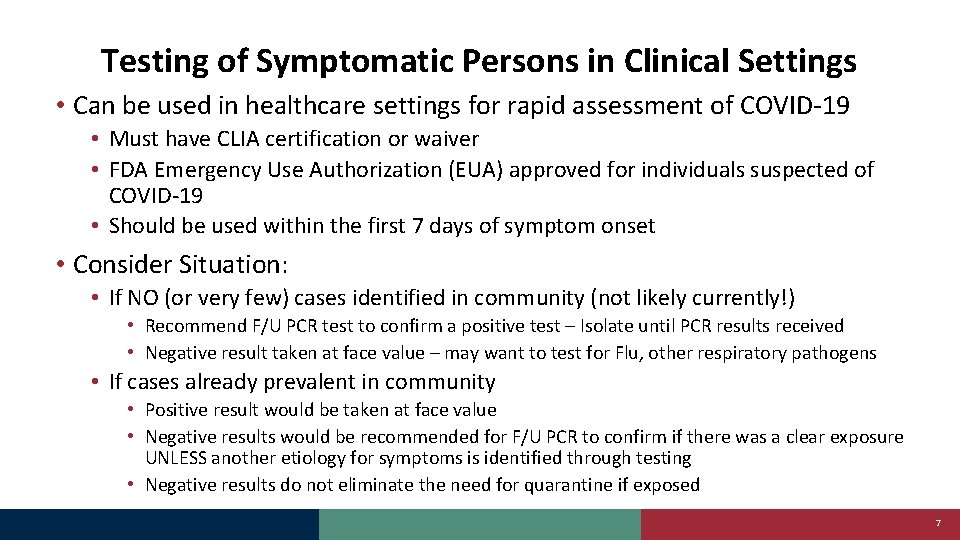
Testing of Symptomatic Persons in Clinical Settings • Can be used in healthcare settings for rapid assessment of COVID-19 • Must have CLIA certification or waiver • FDA Emergency Use Authorization (EUA) approved for individuals suspected of COVID-19 • Should be used within the first 7 days of symptom onset • Consider Situation: • If NO (or very few) cases identified in community (not likely currently!) • Recommend F/U PCR test to confirm a positive test – Isolate until PCR results received • Negative result taken at face value – may want to test for Flu, other respiratory pathogens • If cases already prevalent in community • Positive result would be taken at face value • Negative results would be recommended for F/U PCR to confirm if there was a clear exposure UNLESS another etiology for symptoms is identified through testing • Negative results do not eliminate the need for quarantine if exposed 7
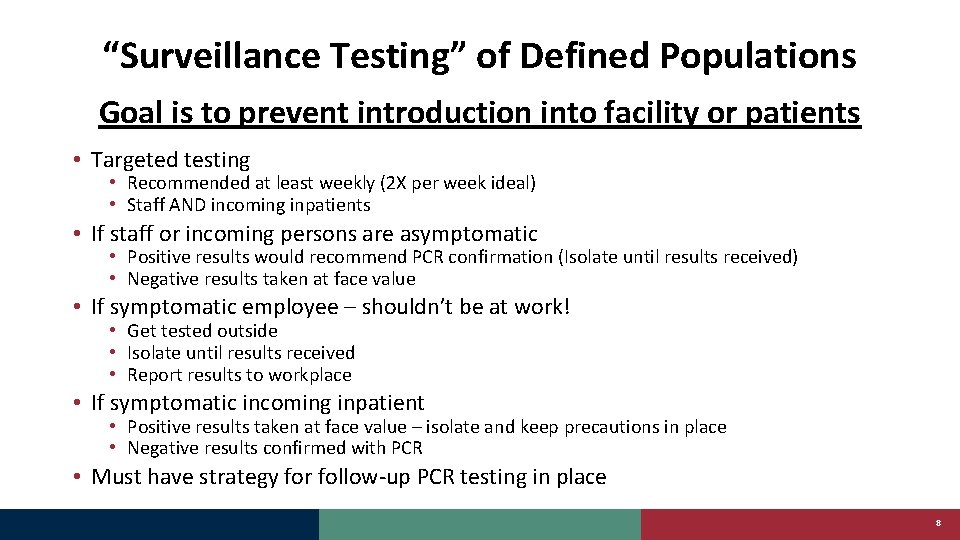
“Surveillance Testing” of Defined Populations Goal is to prevent introduction into facility or patients • Targeted testing • Recommended at least weekly (2 X per week ideal) • Staff AND incoming inpatients • If staff or incoming persons are asymptomatic • Positive results would recommend PCR confirmation (Isolate until results received) • Negative results taken at face value • If symptomatic employee – shouldn’t be at work! • Get tested outside • Isolate until results received • Report results to workplace • If symptomatic incoming inpatient • Positive results taken at face value – isolate and keep precautions in place • Negative results confirmed with PCR • Must have strategy for follow-up PCR testing in place 8
Requesting Binax. NOW Ag Test Cards TM • For additional test cards, complete and submit a Resource Request Form at: https: //ky. readyop. com/fs/4 i. R 3/11 ea • KDPH staff will review and process resource requests daily. • KDPH will distribute test cards from the state warehouse and/or through UPS KDPH Points of Contact James R. House, Master Exercise Practitioner State Health Operations Center Community Testing Operations Section Chief Work Cell: (502) 330 -5950 Email: jamesr. house@ky. gov Robbie Hume State Health Operations Center Logistics Section Chief Work Cell: (502) 892 -8899 Email: robbie. hume@ky. gov 9

Kentucky Health Information Exchange (KHIE) Portal https: //khie. ky. gov/COVID-19/Pages/Direct. Lab. aspx Charlese Blair, Project Coordinator, Office of Health Data and Analytics, Kentucky Health Information Exchange (KHIE) 10
Reporting Requirements Doug Thoroughman, Ph. D, MS, State Epidemiologist (Acting) CDC Career Epidemiology Field Officer, Kentucky Department for Public Health 11
Reporting Requirements • All positive test results need to be reported • KHIE Portal or KHIE Electronic Lab Report feed • Clinical information reported separately • KDPH COVID-19 Case Investigation Form (Fillable) • https: //khie. ky. gov/COVID-19/Pages/Direct-Lab. aspx • All Binax. NOW Ag Test Cards utilized • Need to be reported in aggregate • Total tests performed each day • Total positive results each day • Online survey for this purpose • https: //tinyurl. com/Ky. Lab. Covid. Agg. Rpt • Who reports may vary depending on facility and scenario 12
Q/A and Points of Contact Surveillance, Testing and Reporting Logistics and Request Process Doug Thoroughman, Ph. D, MS, State Epidemiologist (Acting), CDC Career Epidemiology Field Officer, KDPH Phone: (502) 564 -3418 x 4315 Email: douglas. thoroughman@ky. gov James R. House, MEP, State Health Operations Center Community Testing Operations Section Chief, KDPH Work Cell: (502) 330 -5950 Email: jamesr. house@ky. gov Kevin B. Spicer, MD, Ph. D, MPH, Medical Officer (CDC) Robbie Hume, State Health Operations Center Antibiotic Resistance Coordinator, HAI/AR Prevention Logistics Chief, KDPH Program, KDPH Work Cell: (502) 892 -8899 Phone: (502) 564 -3261 x 4468 Email: robbie. hume@ky. gov Email: kevin. spicer@ky. gov Abbott Michelle Moran, Technical Consultant, Abbott Rapid Diagnostics Cell: (502) 693 -8829 Email: michelle. moran@abbott. com 13
- Slides: 13