
Use of AgentBased Service Discovery for Resource Management
Use of Agent-Based Service Discovery for Resource Management in Metacomputing Environment Junwei Cao Darren J. Kerbyson Graham R. Nudd Department of Computer Science University of Warwick
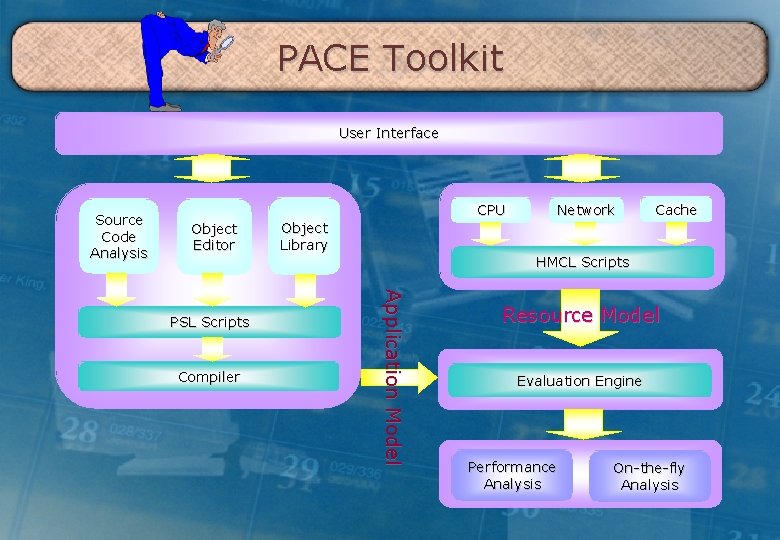
PACE Toolkit User. Interface User Source Code Analysis CPU Object Editor Object Library PSL Scripts Compiler Cache Resource Tools HMCL Scripts A ppl i c a ti o n M o de l Application Tools Network Resource Model Evaluation Engine Performance On-the-fly Performance Analysis

The Question Is …
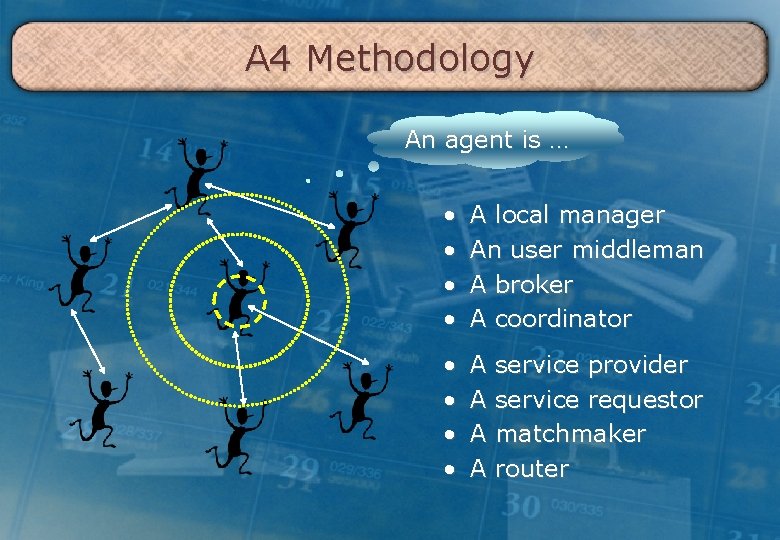
A 4 Methodology An agent is … • • A local manager An user middleman A broker A coordinator • • A A service provider service requestor matchmaker router
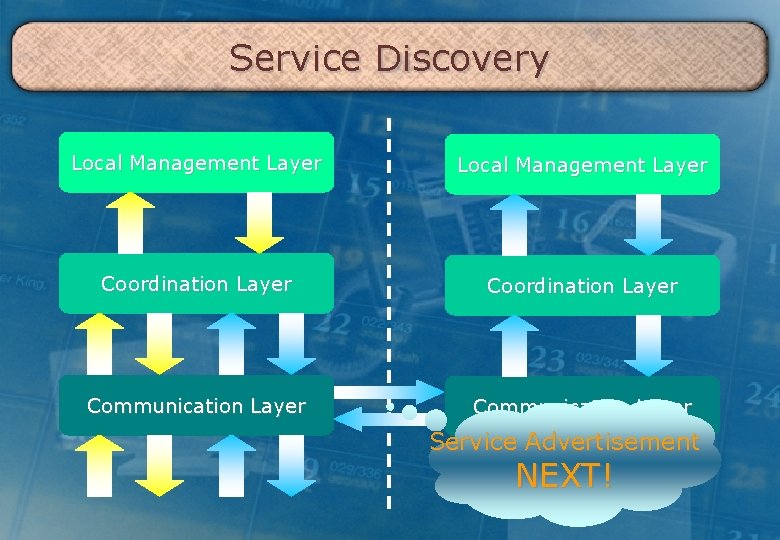
Service Discovery Local Management Layer Coordination Layer Communication Layer Service Advertisement NEXT!
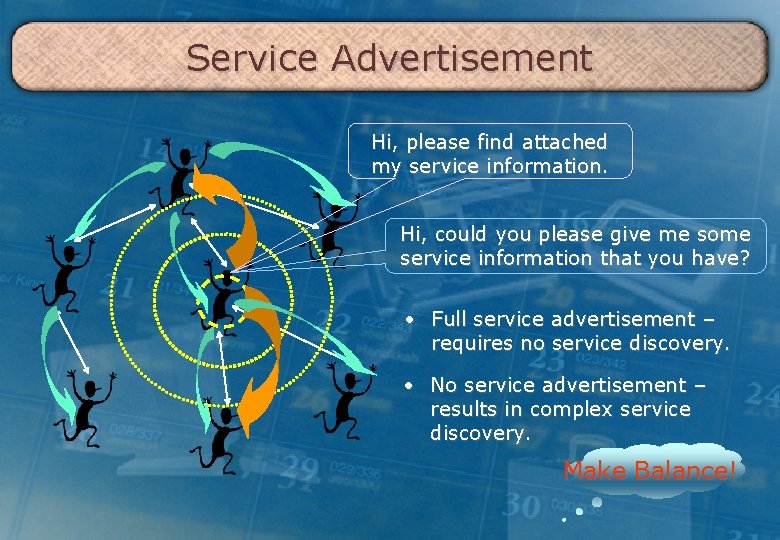
Service Advertisement Hi, please find attached my service information. Hi, could you please give me some service information that you have? • Full service advertisement – requires no service discovery. • No service advertisement – results in complex service discovery. Make Balance!
Agent Capability Tables The process of the service advertisement and discovery corresponds to the maintenance and lookup of the ACTs. Vary by source: • T_ACT: contains service info of local resources • L_ACT: contains service info coming from lower agents • G_ACT: contains service info coming from upper agent • C_ACT: contains cached service info during discovery Strategies: • Data-push: submit service info to other agents • Data-pull: ask for service info from other agents • Periodical: Periodical ACT maintenance • Event-driven: ACT maintenance driven by system events
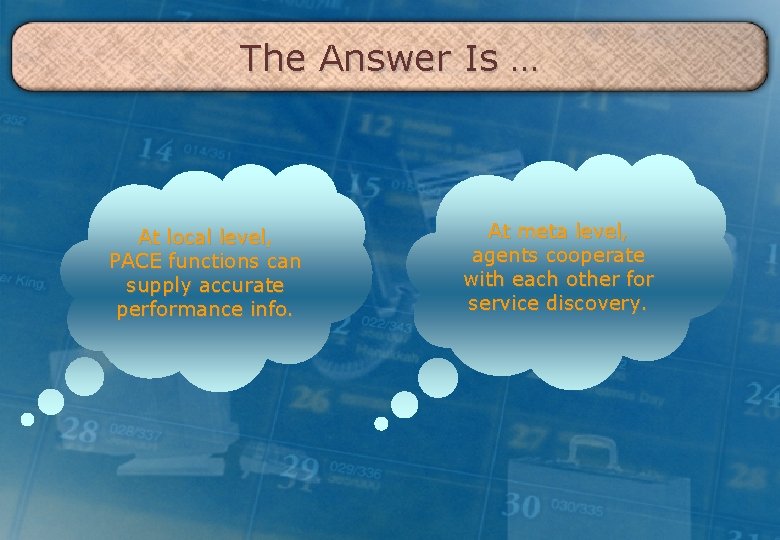
The Answer Is … At local level, PACE functions can supply accurate performance info. At meta level, agents cooperate with each other for service discovery.
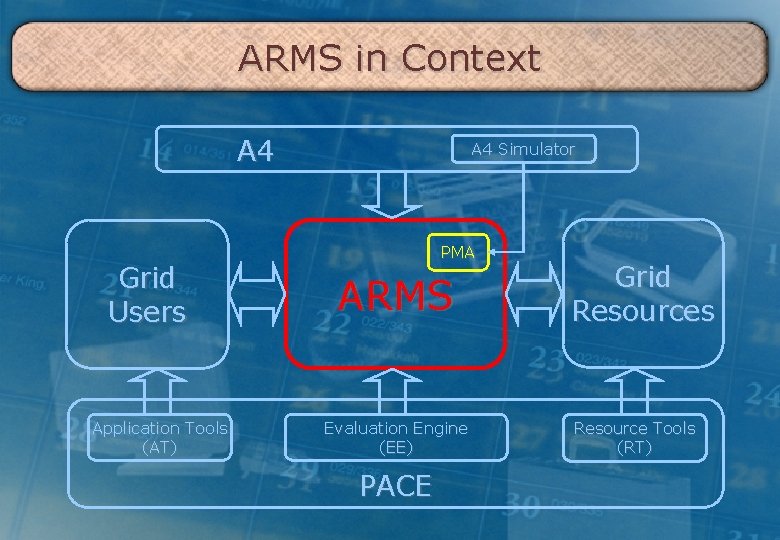
ARMS in Context A 4 Grid Users Application Tools (AT) A 4 Simulator PMA ARMS Evaluation Engine (EE) PACE Grid Resources Resource Tools (RT)
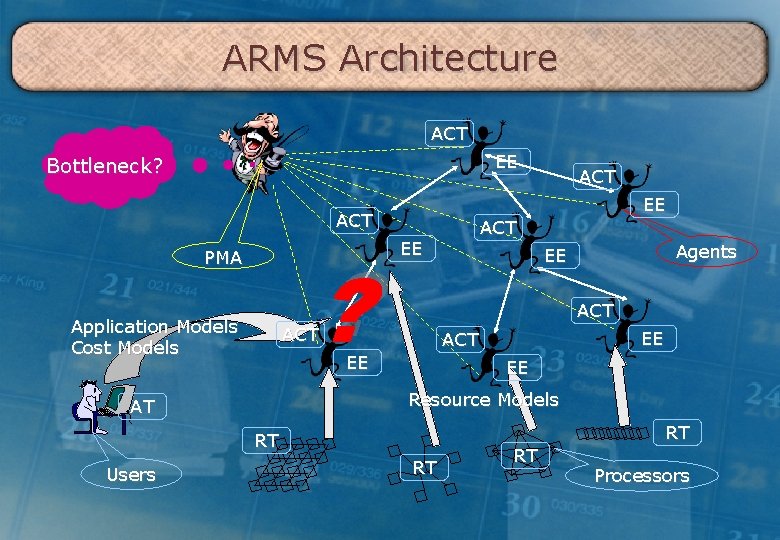
ARMS Architecture ACT EE Bottleneck? EE ACT Agents EE ACT Application Models Cost Models ACT EE EE Resource Models AT RT RT Users ACT EE PMA ACT RT RT Processors
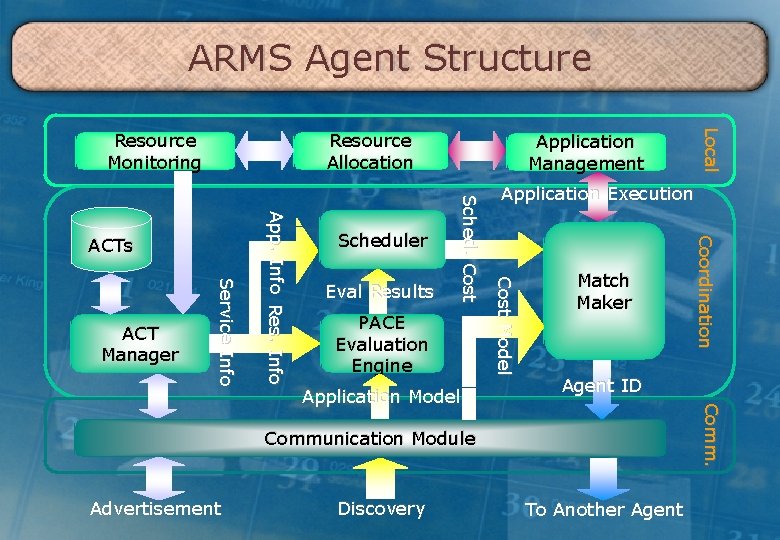
ARMS Agent Structure Resource Allocation PACE Evaluation Engine Match Maker Agent ID Co m m. Application Model C o s t M o de l Eval Results Application Execution Communication Module Advertisement Discovery C o o r di n a ti o n Scheduler Application Management S c h e d. C o s t S e r v ic e I n f o ACT Manager A pp. I n f o R e s. I n f o ACTs Lo c al Resource Monitoring To Another Agent
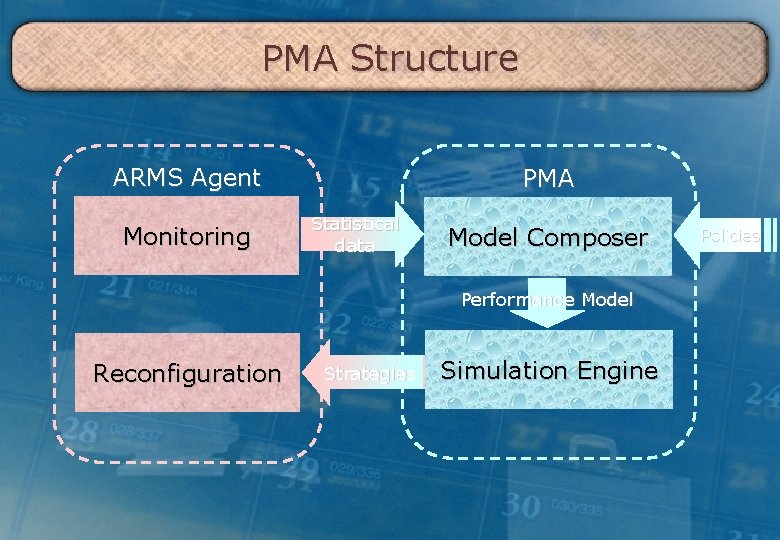
PMA Structure ARMS Agent M o n i to r i n g PMA Statistical data M o de l C o m po s e r Pe r f o r m a n c e M o d e l R e c o n f i gu r a ti o n Strategies S i m u l a ti o n E n gi n e Policies
Conclusions • Performance prediction driven for Qo. S support of grid resource management • Agent based hierarchical model for grid resource advertisement and discovery • Simulation based performance optimisation and steering of service discovery in large scale multiagent systems In summary, all of above go together to provides an available methodology and prototype implementation of agent-based resource management for grid computing, which can be used as a fundamental framework for further improvement and refinement.
- Slides: 13