
Use of a Scalable Lentiviral Vector Production System
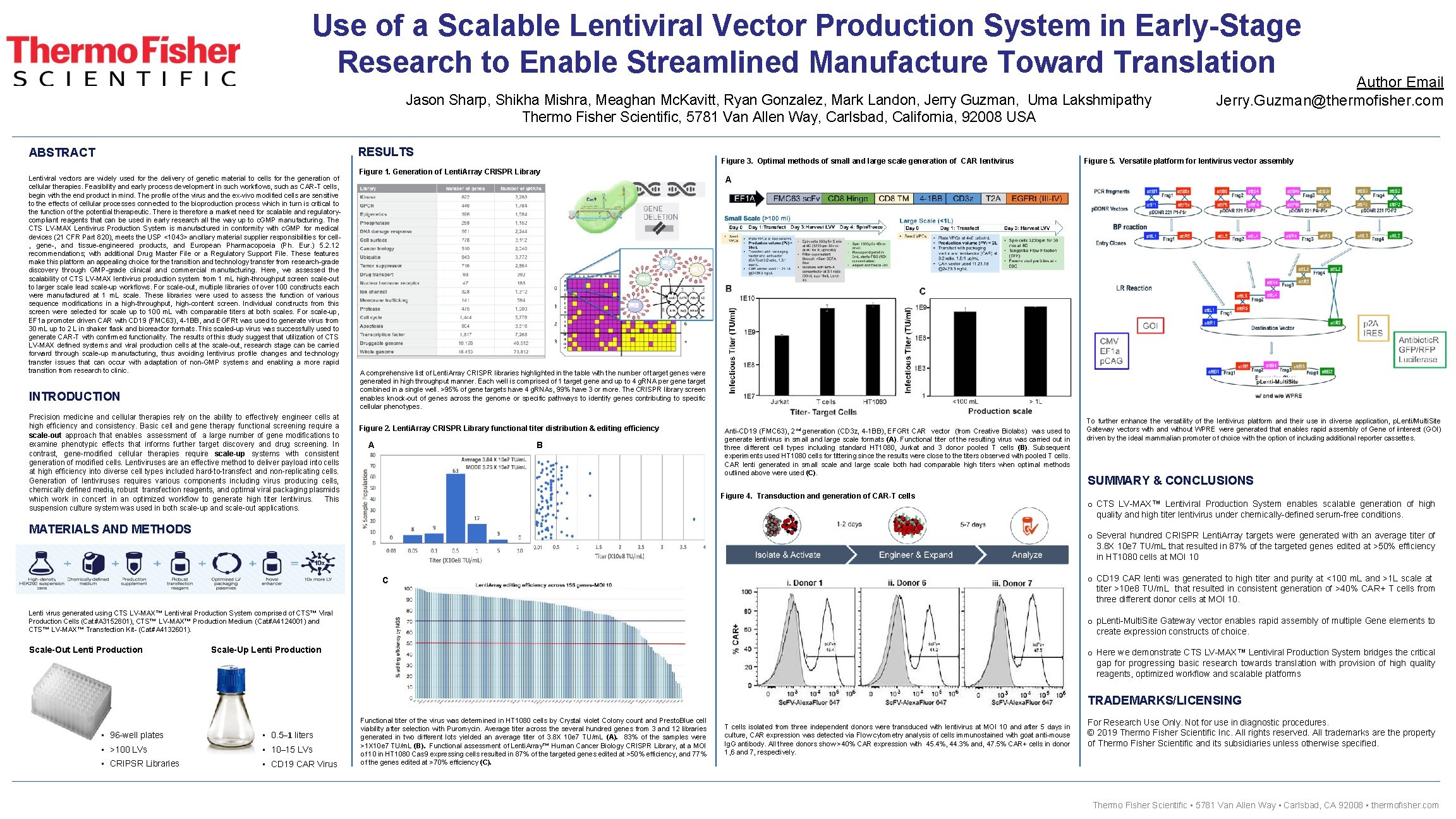
Use of a Scalable Lentiviral Vector Production System in Early-Stage Research to Enable Streamlined Manufacture Toward Translation Jason Sharp, Shikha Mishra, Meaghan Mc. Kavitt, Ryan Gonzalez, Mark Landon, Jerry Guzman, Uma Lakshmipathy Thermo Fisher Scientific, 5781 Van Allen Way, Carlsbad, California, 92008 USA RESULTS ABSTRACT Lentiviral vectors are widely used for the delivery of genetic material to cells for the generation of cellular therapies. Feasibility and early process development in such workflows, such as CAR-T cells, begin with the end product in mind. The profile of the virus and the ex-vivo modified cells are sensitive to the effects of cellular processes connected to the bioproduction process which in turn is critical to the function of the potential therapeutic. There is therefore a market need for scalable and regulatorycompliant reagents that can be used in early research all the way up to c. GMP manufacturing. The CTS LV-MAX Lentivirus Production System is manufactured in conformity with c. GMP for medical devices (21 CFR Part 820), meets the USP <1043> ancillary material supplier responsibilities for cell, gene-, and tissue-engineered products, and European Pharmacopoeia (Ph. Eur. ) 5. 2. 12 recommendations; with additional Drug Master File or a Regulatory Support File. These features make this platform an appealing choice for the transition and technology transfer from research-grade discovery through GMP-grade clinical and commercial manufacturing. Here, we assessed the scalability of CTS LV-MAX lentivirus production system from 1 m. L high-throughput screen scale-out to larger scale lead scale-up workflows. For scale-out, multiple libraries of over 100 constructs each were manufactured at 1 m. L scale. These libraries were used to assess the function of various sequence modifications in a high-throughput, high-content screen. Individual constructs from this screen were selected for scale up to 100 m. L with comparable titers at both scales. For scale-up, EF 1 a promoter driven CAR with CD 19 (FMC 63), 4 -1 BB, and EGFRt was used to generate virus from 30 m. L up to 2 L in shaker flask and bioreactor formats. This scaled-up virus was successfully used to generate CAR-T with confirmed functionality. The results of this study suggest that utilization of CTS LV-MAX defined systems and viral production cells at the scale-out, research stage can be carried forward through scale-up manufacturing, thus avoiding lentivirus profile changes and technology transfer issues that can occur with adaptation of non-GMP systems and enabling a more rapid transition from research to clinic. INTRODUCTION Precision medicine and cellular therapies rely on the ability to effectively engineer cells at high efficiency and consistency. Basic cell and gene therapy functional screening require a scale-out approach that enables assessment of a large number of gene modifications to examine phenotypic effects that informs further target discovery and drug screening. In contrast, gene-modified cellular therapies require scale-up systems with consistent generation of modified cells. Lentiviruses are an effective method to deliver payload into cells at high efficiency into diverse cell types included hard-to-transfect and non-replicating cells. Generation of lentiviruses requires various components including virus producing cells, chemically defined media, robust transfection reagents, and optimal viral packaging plasmids which work in concert in an optimized workflow to generate high titer lentivirus. This suspension culture system was used in both scale-up and scale-out applications. Figure 3. Optimal methods of small and large scale generation of CAR lentivirus Figure 1. Generation of Lenti. Array CRISPR Library Figure 5. Versatile platform for lentivirus vector assembly A A comprehensive list of Lenti. Array CRISPR libraries highlighted in the table with the number of target genes were generated in high throughput manner. Each well is comprised of 1 target gene and up to 4 g. RNA per gene target combined in a single well. >95% of gene targets have 4 g. RNAs, 99% have 3 or more. The CRISPR library screen enables knock-out of genes across the genome or specific pathways to identify genes contributing to specific cellular phenotypes. Figure 2. Lenti. Array CRISPR Library functional titer distribution & editing efficiency A B 2 nd Anti-CD 19 (FMC 63), generation (CD 3 z, 4 -1 BB), EFGRt CAR vector (from Creative Biolabs) was used to generate lentivirus in small and large scale formats (A). Functional titer of the resulting virus was carried out in three different cell types including standard HT 1080, Jurkat and 3 donor pooled T cells (B). Subsequent experiments used HT 1080 cells for tittering since the results were close to the titers observed with pooled T cells. CAR lenti generated in small scale and large scale both had comparable high titers when optimal methods outlined above were used (C). Figure 4. Transduction and generation of CAR-T cells MATERIALS AND METHODS To further enhance the versatility of the lentivirus platform and their use in diverse application, p. Lenti/Multi. Site Gateway vectors with and without WPRE were generated that enables rapid assembly of Gene of iinterest (GOI) driven by the ideal mammalian promoter of choice with the option of including additional reporter cassettes. SUMMARY & CONCLUSIONS o CTS LV-MAX™ Lentiviral Production System enables scalable generation of high quality and high titer lentivirus under chemically-defined serum-free conditions. o Several hundred CRISPR Lenti. Array targets were generated with an average titer of 3. 8 X 10 e 7 TU/m. L that resulted in 87% of the targeted genes edited at >50% efficiency in HT 1080 cells at MOI 10 o CD 19 CAR lenti was generated to high titer and purity at <100 m. L and >1 L scale at titer >10 e 8 TU/m. L that resulted in consistent generation of >40% CAR+ T cells from three different donor cells at MOI 10. C Lenti virus generated using CTS LV-MAX™ Lentiviral Production System comprised of CTS™ Viral Production Cells (Cat#A 3152801), CTS™ LV-MAX™ Production Medium (Cat#A 4124001) and CTS™ LV-MAX™ Transfection Kit- (Cat#A 4132601). Scale-Out Lenti Production Author Email Jerry. Guzman@thermofisher. com o p. Lenti-Multi. Site Gateway vector enables rapid assembly of multiple Gene elements to create expression constructs of choice. Scale-Up Lenti Production o Here we demonstrate CTS LV-MAX™ Lentiviral Production System bridges the critical gap for progressing basic research towards translation with provision of high quality reagents, optimized workflow and scalable platforms TRADEMARKS/LICENSING • 96 -well plates • 0. 5– 1 liters • >100 LVs • 10– 15 LVs • CRIPSR Libraries • CD 19 CAR Virus Functional titer of the virus was determined in HT 1080 cells by Crystal violet Colony count and Presto. Blue cell viability after selection with Puromycin. Average titer across the several hundred genes from 3 and 12 libraries generated in two different lots yielded an average titer of 3. 8 X 10 e 7 TU/m. L (A). 83% of the samples were >1 X 10 e 7 TU/m. L (B). Functional assessment of Lenti. Array™ Human Cancer Biology CRISPR Library, at a MOI of 10 in HT 1080 Cas 9 expressing cells resulted in 87% of the targeted genes edited at >50% efficiency, and 77% of the genes edited at >70% efficiency (C). T cells isolated from three independent donors were transduced with lentivirus at MOI 10 and after 5 days in culture, CAR expression was detected via Flow cytometry analysis of cells immunostained with goat anti-mouse Ig. G antibody. All three donors show >40% CAR expression with 45. 4%, 44. 3% and, 47. 5% CAR+ cells in donor 1, 6 and 7, respectively. For Research Use Only. Not for use in diagnostic procedures. © 2019 Thermo Fisher Scientific Inc. All rights reserved. All trademarks are the property of Thermo Fisher Scientific and its subsidiaries unless otherwise specified. Thermo Fisher Scientific • 5781 Van Allen Way • Carlsbad, CA 92008 • thermofisher. com
- Slides: 1