
Use Commas to separate items in a series
- Slides: 7
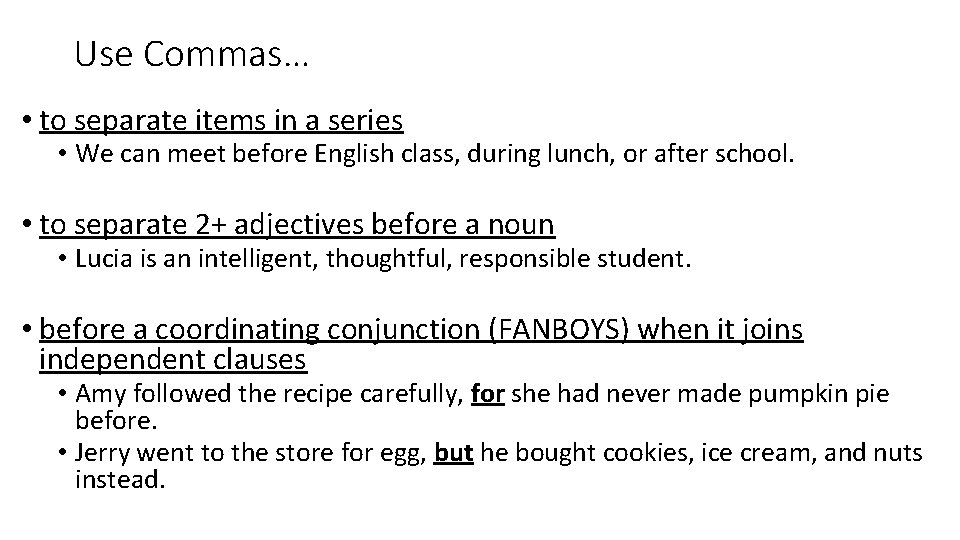
Use Commas… • to separate items in a series • We can meet before English class, during lunch, or after school. • to separate 2+ adjectives before a noun • Lucia is an intelligent, thoughtful, responsible student. • before a coordinating conjunction (FANBOYS) when it joins independent clauses • Amy followed the recipe carefully, for she had never made pumpkin pie before. • Jerry went to the store for egg, but he bought cookies, ice cream, and nuts instead.
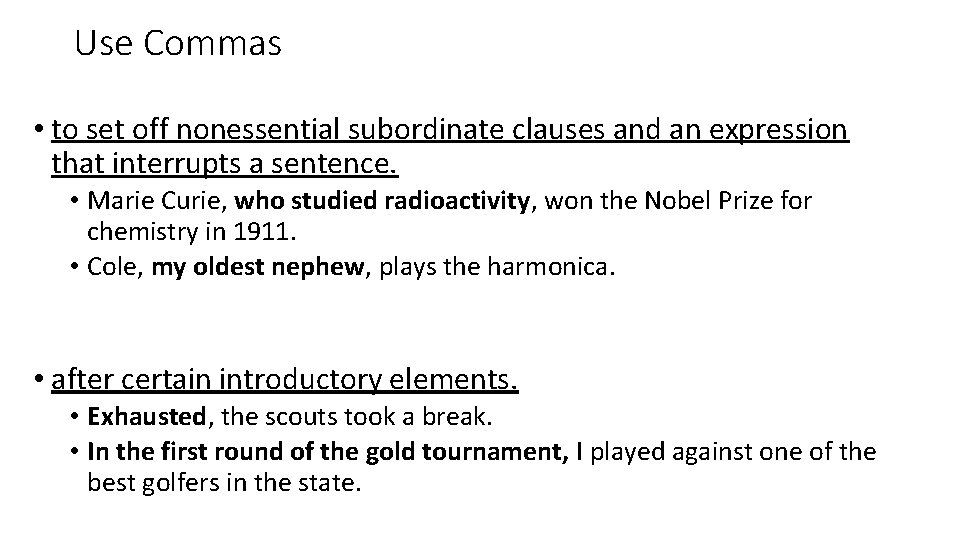
Use Commas • to set off nonessential subordinate clauses and an expression that interrupts a sentence. • Marie Curie, who studied radioactivity, won the Nobel Prize for chemistry in 1911. • Cole, my oldest nephew, plays the harmonica. • after certain introductory elements. • Exhausted, the scouts took a break. • In the first round of the gold tournament, I played against one of the best golfers in the state.
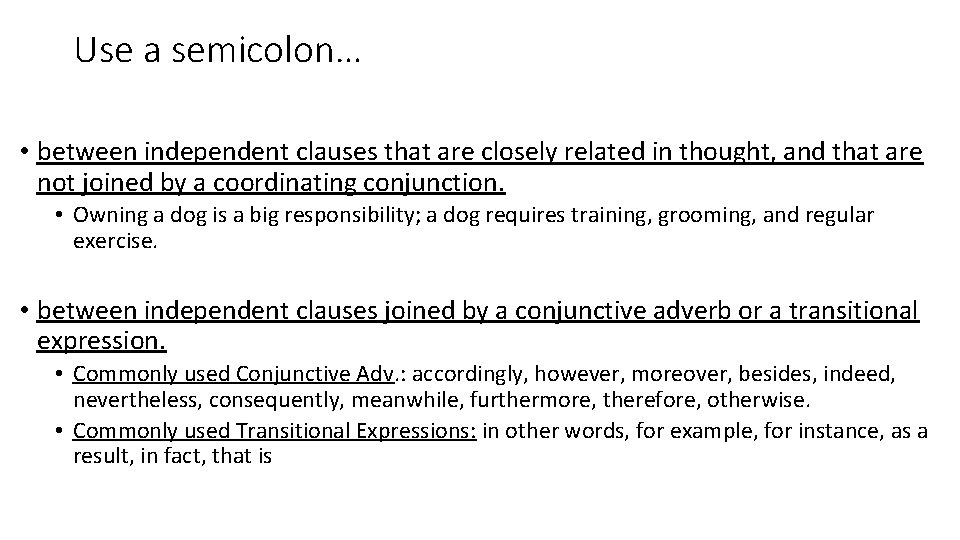
Use a semicolon… • between independent clauses that are closely related in thought, and that are not joined by a coordinating conjunction. • Owning a dog is a big responsibility; a dog requires training, grooming, and regular exercise. • between independent clauses joined by a conjunctive adverb or a transitional expression. • Commonly used Conjunctive Adv. : accordingly, however, moreover, besides, indeed, nevertheless, consequently, meanwhile, furthermore, therefore, otherwise. • Commonly used Transitional Expressions: in other words, for example, for instance, as a result, in fact, that is
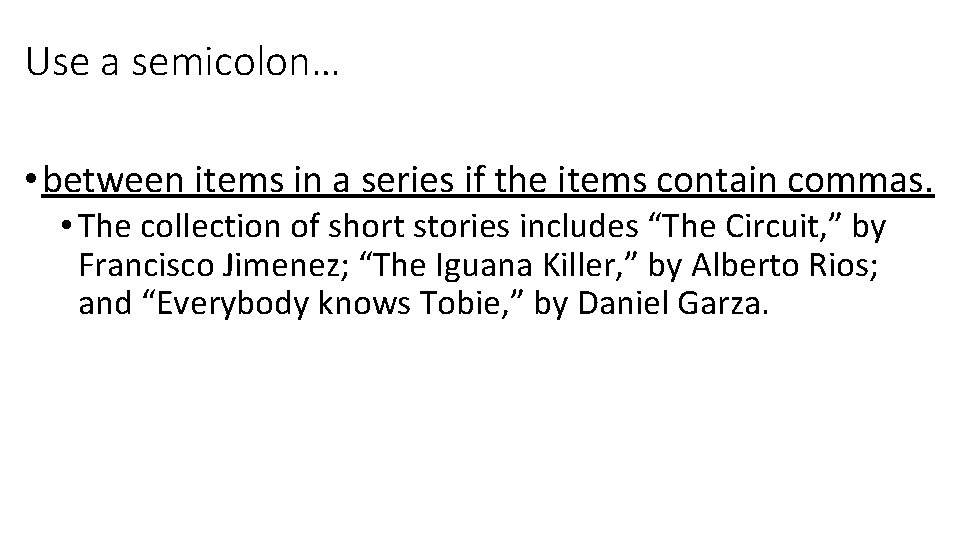
Use a semicolon… • between items in a series if the items contain commas. • The collection of short stories includes “The Circuit, ” by Francisco Jimenez; “The Iguana Killer, ” by Alberto Rios; and “Everybody knows Tobie, ” by Daniel Garza.
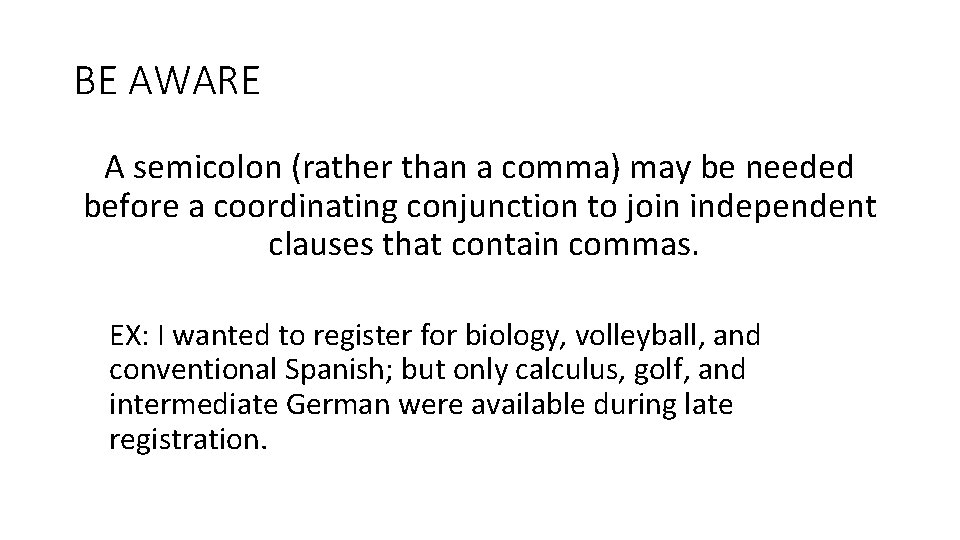
BE AWARE A semicolon (rather than a comma) may be needed before a coordinating conjunction to join independent clauses that contain commas. EX: I wanted to register for biology, volleyball, and conventional Spanish; but only calculus, golf, and intermediate German were available during late registration.
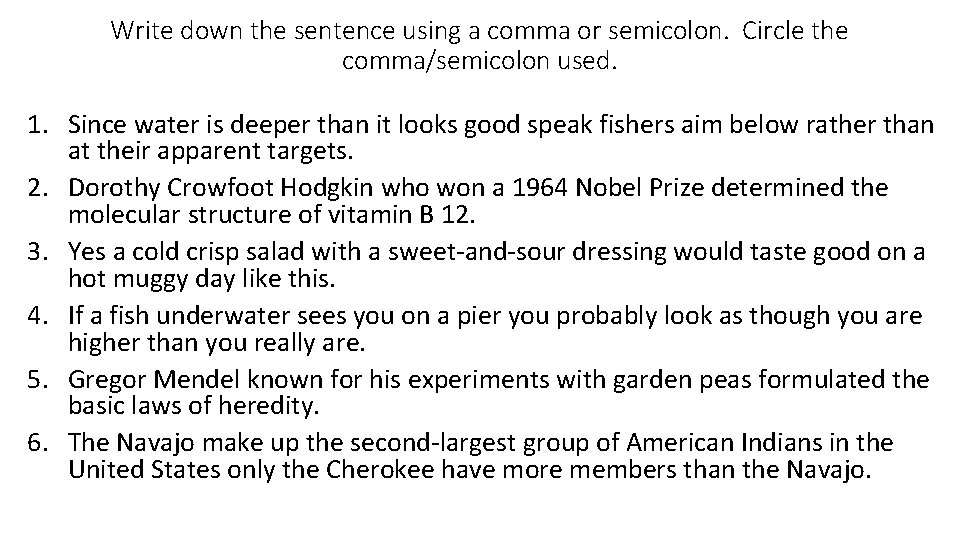
Write down the sentence using a comma or semicolon. Circle the comma/semicolon used. 1. Since water is deeper than it looks good speak fishers aim below rather than at their apparent targets. 2. Dorothy Crowfoot Hodgkin who won a 1964 Nobel Prize determined the molecular structure of vitamin B 12. 3. Yes a cold crisp salad with a sweet-and-sour dressing would taste good on a hot muggy day like this. 4. If a fish underwater sees you on a pier you probably look as though you are higher than you really are. 5. Gregor Mendel known for his experiments with garden peas formulated the basic laws of heredity. 6. The Navajo make up the second-largest group of American Indians in the United States only the Cherokee have more members than the Navajo.
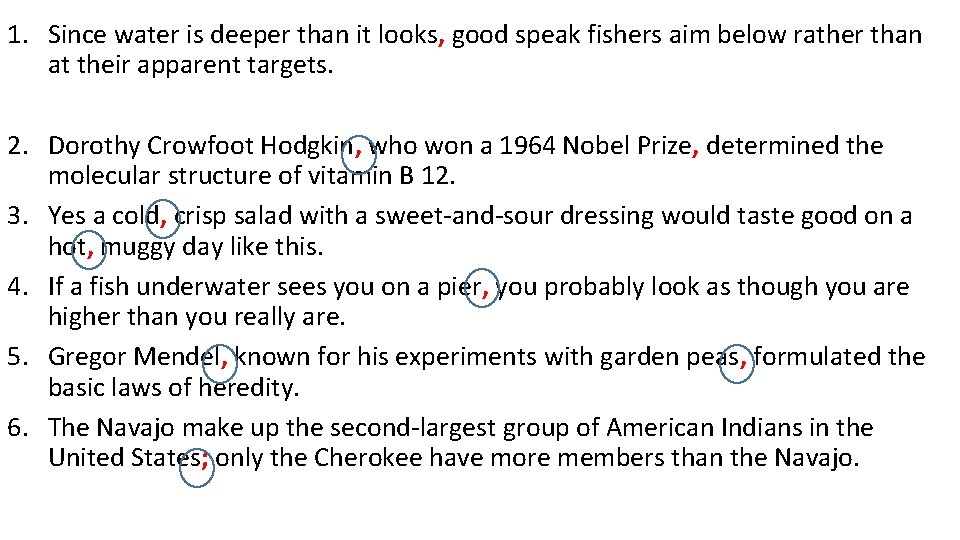
1. Since water is deeper than it looks, good speak fishers aim below rather than at their apparent targets. 2. Dorothy Crowfoot Hodgkin, who won a 1964 Nobel Prize, determined the molecular structure of vitamin B 12. 3. Yes a cold, crisp salad with a sweet-and-sour dressing would taste good on a hot, muggy day like this. 4. If a fish underwater sees you on a pier, you probably look as though you are higher than you really are. 5. Gregor Mendel, known for his experiments with garden peas, formulated the basic laws of heredity. 6. The Navajo make up the second-largest group of American Indians in the United States; only the Cherokee have more members than the Navajo.