
Use Classes with Object Oriented Programming in C
Use Classes with Object -Oriented Programming in C++ By Wayne Cheng
Object-Oriented Programming Introduction Five Tenets Terminology The foundation of C++: Classes
Introduction It is the name given to a specific paradigm in the field of programming. With objects we are creating pieces of code that can stand alone. You know the box has inputs and outputs but you don’t know what is inside it.
Five Tenets Encapsulation Data Abstraction Information Hiding Inheritance Polymorphism

Encapsulation The goal is to bind data and the functions that operate on that data together in one “object”. The functions will be our interface while the data will be hidden in the black box. Classes in C++ bind data and functions together in objects.
Data Abstraction The goal is to force users to interface with the object’s functions rather than accessing data directly. Data is in the box. The user can not access the data, he/she must use the defined interface functions to manipulate the data. Public: elements of class are accessible from outside of class. Private: restricts access to these functions and data members to this class alone. (as default) Protected: restricts access to these functions and data member to this class and its children. (Children are classes derived from the current class)
Information Hiding The goal is to prevent the user from seeing how our functions are implemented and exactly what they do. All the user will see are function prototypes, but no actual implementation. Multiple file projects: by storing each class implementation in its own file, we can compile and distribute them without allowing users to see the internals of functions.
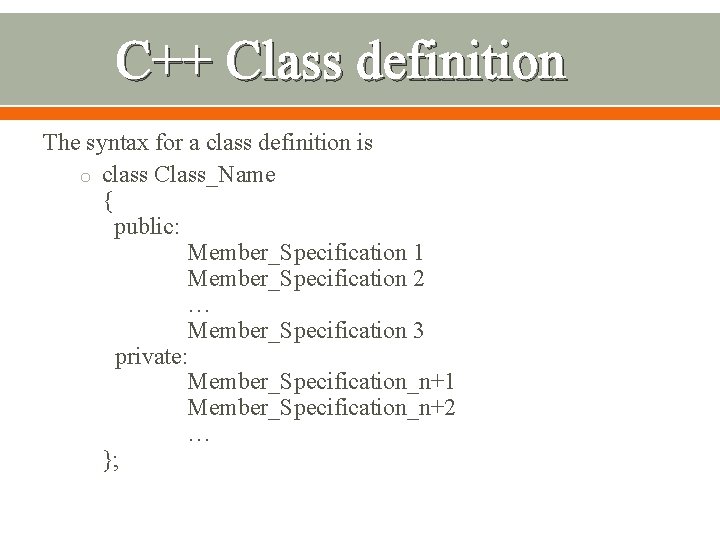
C++ Class definition The syntax for a class definition is o class Class_Name { public: Member_Specification 1 Member_Specification 2 … Member_Specification 3 private: Member_Specification_n+1 Member_Specification_n+2 … };
Inheritance It is a mechanism that allows us to include “Parent” class into a “Child” class. It just another name for the topic of derived classes. The goal is code reusability and extensibility. With it we can reuse code without having to cut and paste it out of our old programs. It is a major stepping stone on the path to polymorphism.
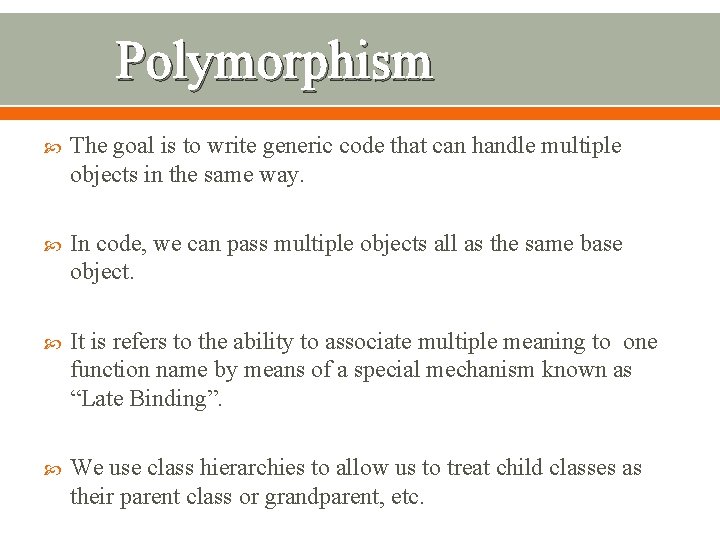
Polymorphism The goal is to write generic code that can handle multiple objects in the same way. In code, we can pass multiple objects all as the same base object. It is refers to the ability to associate multiple meaning to one function name by means of a special mechanism known as “Late Binding”. We use class hierarchies to allow us to treat child classes as their parent class or grandparent, etc.
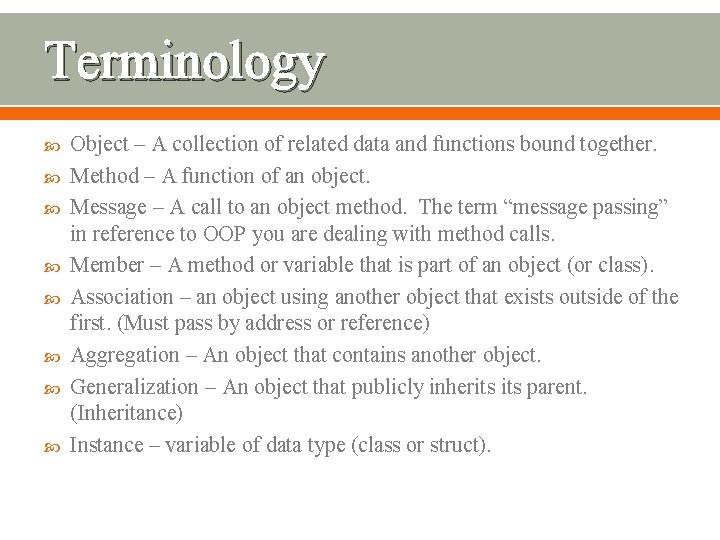
Terminology Object – A collection of related data and functions bound together. Method – A function of an object. Message – A call to an object method. The term “message passing” in reference to OOP you are dealing with method calls. Member – A method or variable that is part of an object (or class). Association – an object using another object that exists outside of the first. (Must pass by address or reference) Aggregation – An object that contains another object. Generalization – An object that publicly inherits parent. (Inheritance) Instance – variable of data type (class or struct).
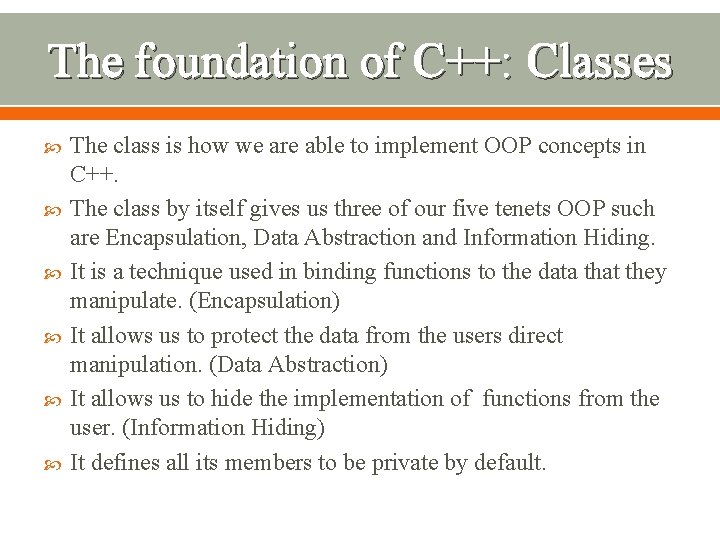
The foundation of C++: Classes The class is how we are able to implement OOP concepts in C++. The class by itself gives us three of our five tenets OOP such are Encapsulation, Data Abstraction and Information Hiding. It is a technique used in binding functions to the data that they manipulate. (Encapsulation) It allows us to protect the data from the users direct manipulation. (Data Abstraction) It allows us to hide the implementation of functions from the user. (Information Hiding) It defines all its members to be private by default.
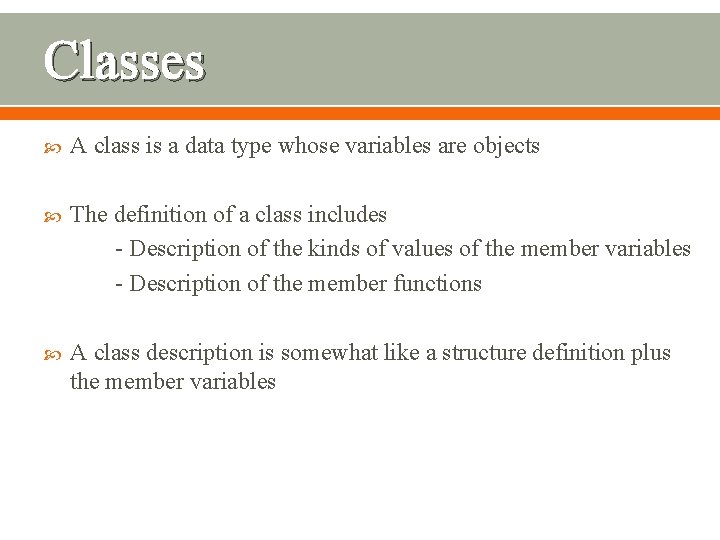
Classes A class is a data type whose variables are objects The definition of a class includes - Description of the kinds of values of the member variables - Description of the member functions A class description is somewhat like a structure definition plus the member variables
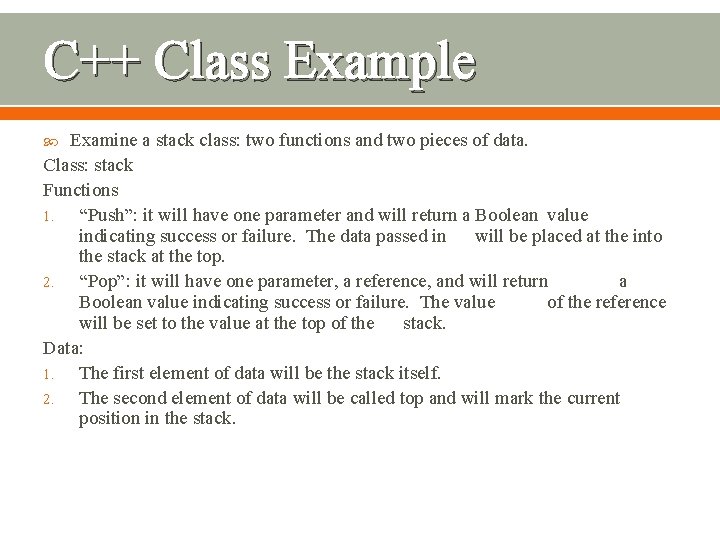
C++ Class Example Examine a stack class: two functions and two pieces of data. Class: stack Functions 1. “Push”: it will have one parameter and will return a Boolean value indicating success or failure. The data passed in will be placed at the into the stack at the top. 2. “Pop”: it will have one parameter, a reference, and will return a Boolean value indicating success or failure. The value of the reference will be set to the value at the top of the stack. Data: 1. The first element of data will be the stack itself. 2. The second element of data will be called top and will mark the current position in the stack.
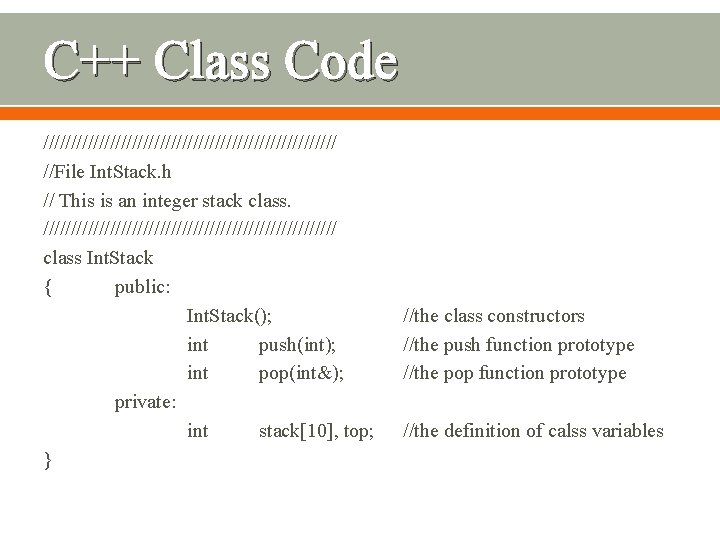
C++ Class Code /////////////////////////// //File Int. Stack. h // This is an integer stack class. /////////////////////////// class Int. Stack { public: Int. Stack(); int push(int); int pop(int&); private: int stack[10], top; } //the class constructors //the push function prototype //the pop function prototype //the definition of calss variables
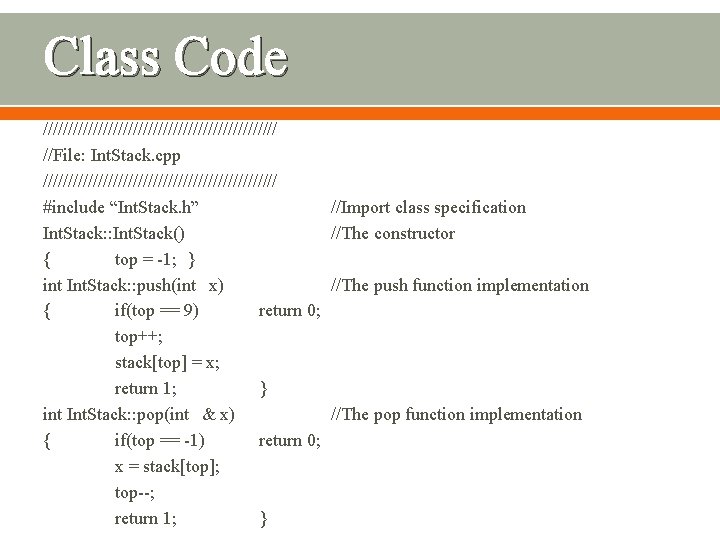
Class Code //////////////////////// //File: Int. Stack. cpp //////////////////////// #include “Int. Stack. h” Int. Stack: : Int. Stack() { top = -1; } int Int. Stack: : push(int x) { if(top == 9) return 0; top++; stack[top] = x; return 1; } int Int. Stack: : pop(int & x) { if(top == -1) return 0; x = stack[top]; top--; return 1; } //Import class specification //The constructor //The push function implementation //The pop function implementation
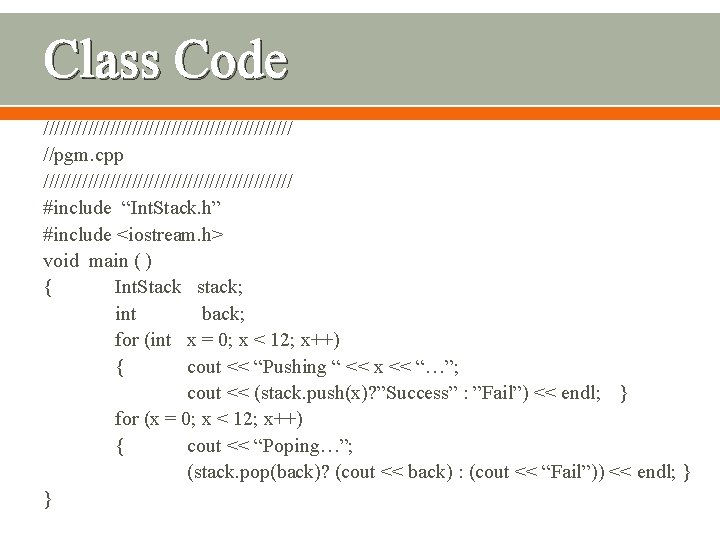
Class Code /////////////////////// //pgm. cpp /////////////////////// #include “Int. Stack. h” #include <iostream. h> void main ( ) { Int. Stack stack; int back; for (int x = 0; x < 12; x++) { cout << “Pushing “ << x << “…”; cout << (stack. push(x)? ”Success” : ”Fail”) << endl; } for (x = 0; x < 12; x++) { cout << “Poping…”; (stack. pop(back)? (cout << back) : (cout << “Fail”)) << endl; } }

Questions ?
- Slides: 18