
Use cases for implementation of the NSI interface
- Slides: 13
Use cases for implementation of the NSI interface Takahiro Miyamoto, Nobutaka Matsumoto KDDI R&D Laboratories Inc. This work is partially supported by NICT (National Institute of Information and Communications Technology), Japan.
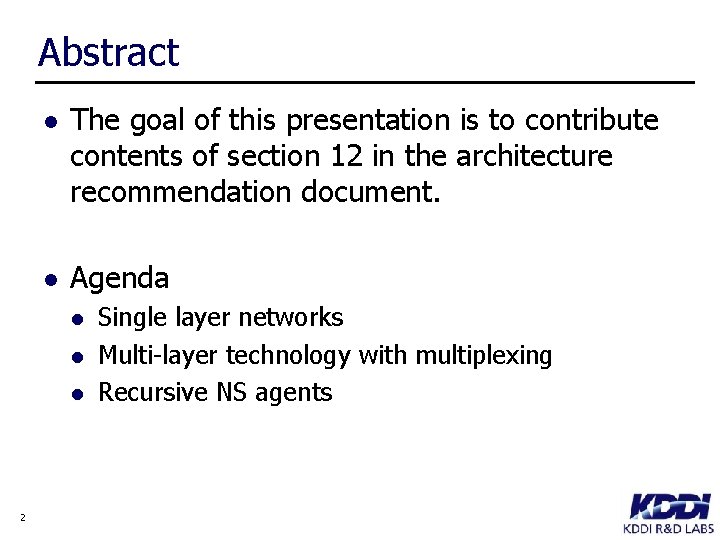
Abstract l The goal of this presentation is to contribute contents of section 12 in the architecture recommendation document. l Agenda l l l 2 Single layer networks Multi-layer technology with multiplexing Recursive NS agents
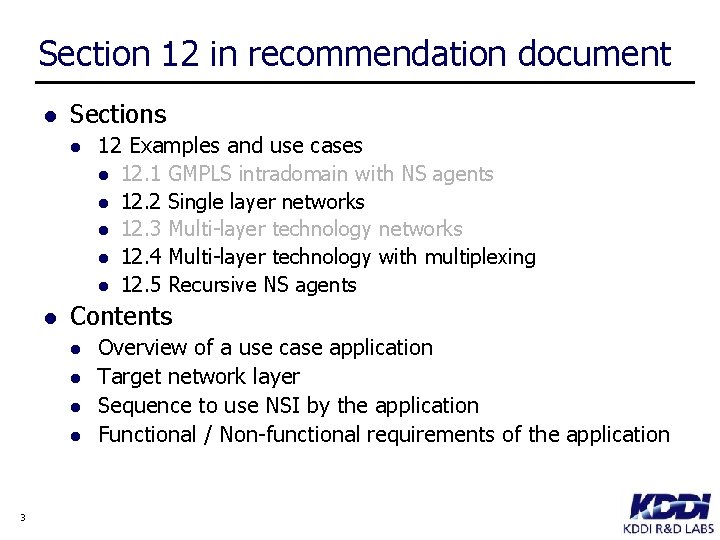
Section 12 in recommendation document l Sections l l Contents l l 3 12 Examples and use cases l 12. 1 GMPLS intradomain with NS agents l 12. 2 Single layer networks l 12. 3 Multi-layer technology networks l 12. 4 Multi-layer technology with multiplexing l 12. 5 Recursive NS agents Overview of a use case application Target network layer Sequence to use NSI by the application Functional / Non-functional requirements of the application
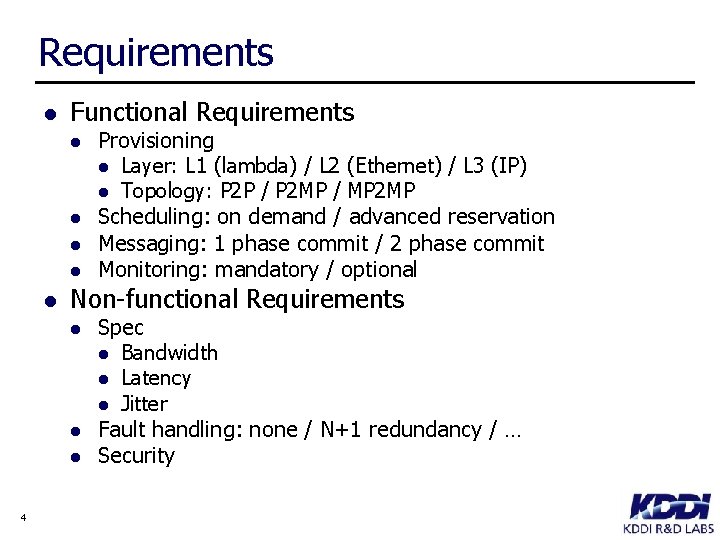
Requirements l Functional Requirements l l l Non-functional Requirements l l l 4 Provisioning l Layer: L 1 (lambda) / L 2 (Ethernet) / L 3 (IP) l Topology: P 2 P / P 2 MP / MP 2 MP Scheduling: on demand / advanced reservation Messaging: 1 phase commit / 2 phase commit Monitoring: mandatory / optional Spec l Bandwidth l Latency l Jitter Fault handling: none / N+1 redundancy / … Security
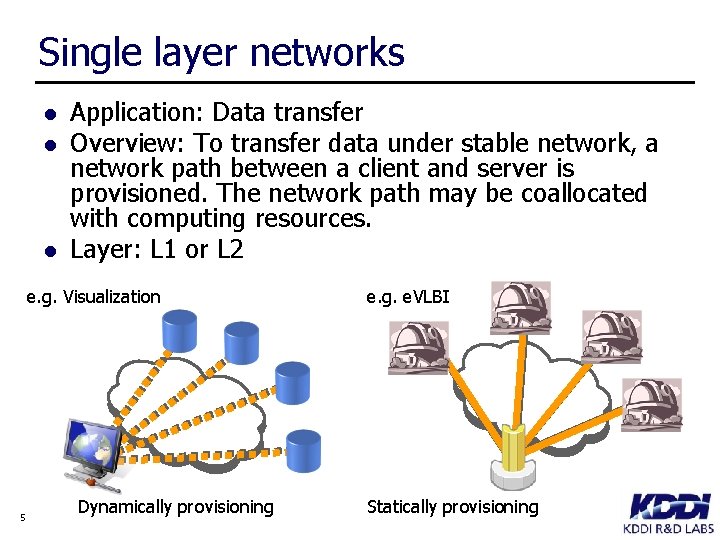
Single layer networks l l l Application: Data transfer Overview: To transfer data under stable network, a network path between a client and server is provisioned. The network path may be coallocated with computing resources. Layer: L 1 or L 2 e. g. Visualization 5 Dynamically provisioning e. g. e. VLBI Statically provisioning
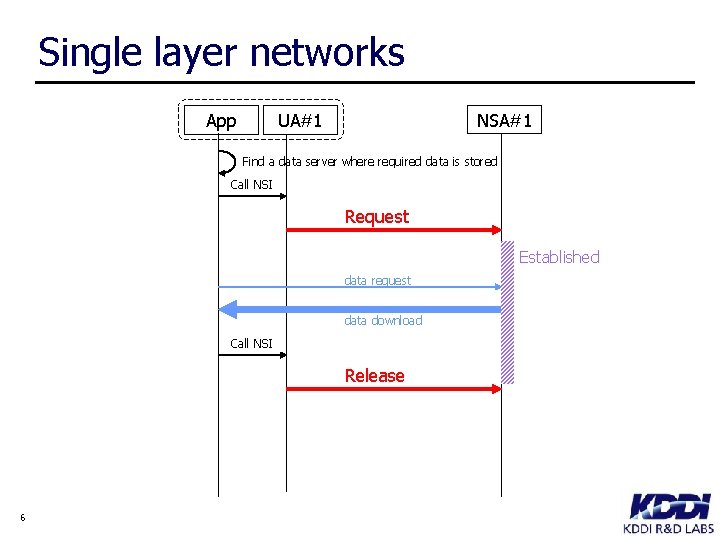
Single layer networks App NSA#1 UA#1 Find a data server where required data is stored Call NSI Request Established data request data download Call NSI Release 6
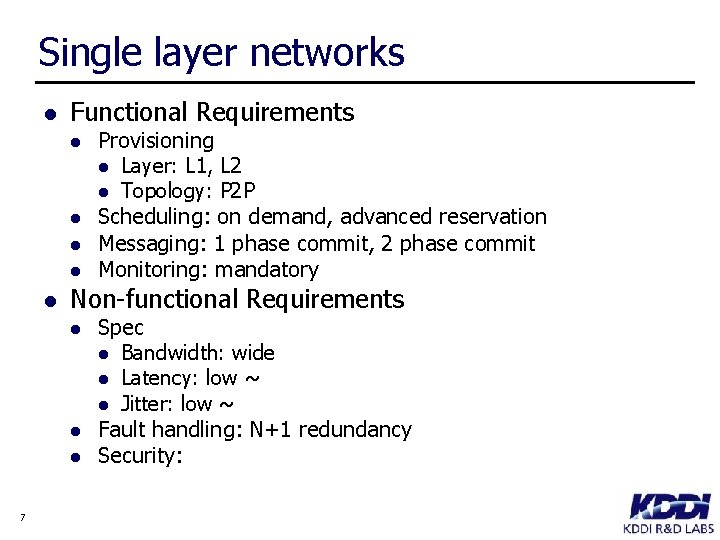
Single layer networks l Functional Requirements l l l Non-functional Requirements l l l 7 Provisioning l Layer: L 1, L 2 l Topology: P 2 P Scheduling: on demand, advanced reservation Messaging: 1 phase commit, 2 phase commit Monitoring: mandatory Spec l Bandwidth: wide l Latency: low ~ l Jitter: low ~ Fault handling: N+1 redundancy Security:
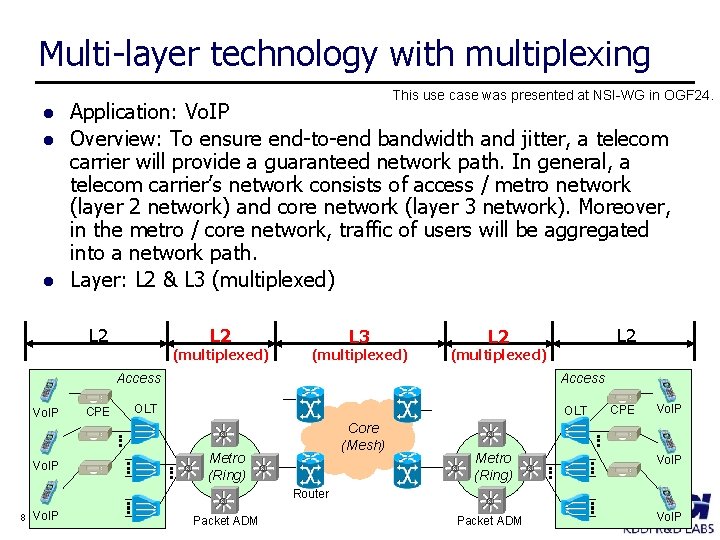
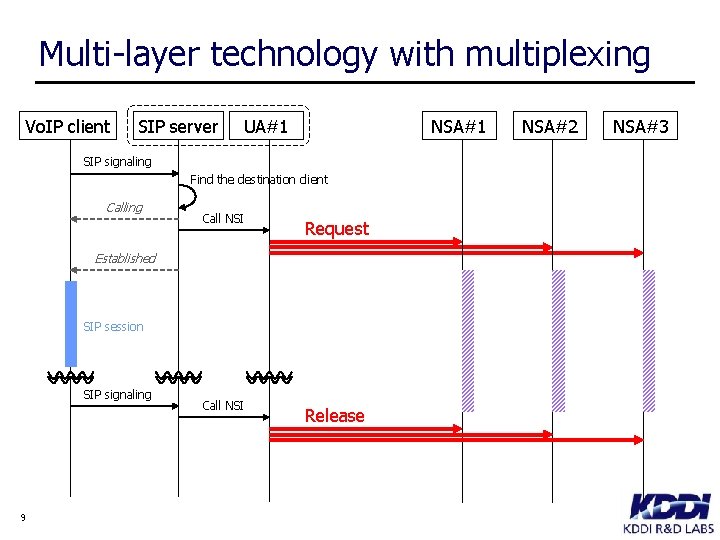
Multi-layer technology with multiplexing This use case was presented at NSI-WG in OGF 24. l l l Application: Vo. IP Overview: To ensure end-to-end bandwidth and jitter, a telecom carrier will provide a guaranteed network path. In general, a telecom carrier’s network consists of access / metro network (layer 2 network) and core network (layer 3 network). Moreover, in the metro / core network, traffic of users will be aggregated into a network path. Layer: L 2 & L 3 (multiplexed) L 2 (multiplexed) L 3 (multiplexed) Access Vo. IP CPE L 2 Access OLT Core (Mesh) Metro (Ring) CPE Vo. IP Metro (Ring) Vo. IP Packet ADM Vo. IP Router 8 Vo. IP Packet ADM
Multi-layer technology with multiplexing Vo. IP client SIP server NSA#1 UA#1 SIP signaling Find the destination client Calling Call NSI Request Call NSI Release Established SIP session SIP signaling 9 NSA#2 NSA#3
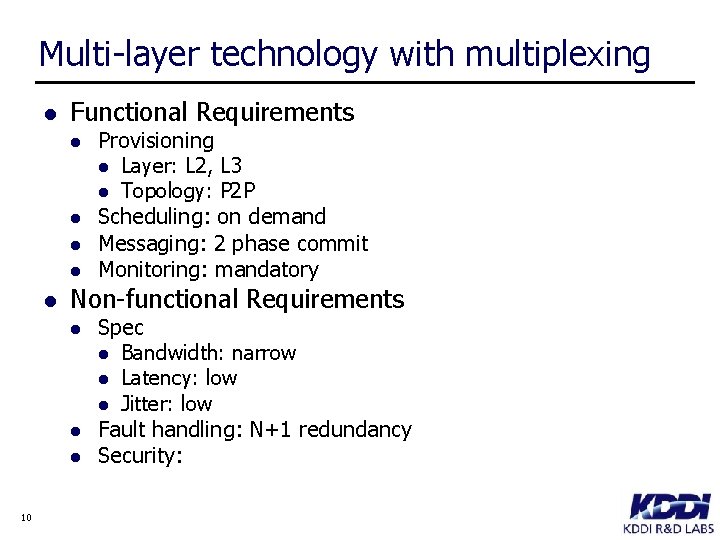
Multi-layer technology with multiplexing l Functional Requirements l l l Non-functional Requirements l l l 10 Provisioning l Layer: L 2, L 3 l Topology: P 2 P Scheduling: on demand Messaging: 2 phase commit Monitoring: mandatory Spec l Bandwidth: narrow l Latency: low l Jitter: low Fault handling: N+1 redundancy Security:
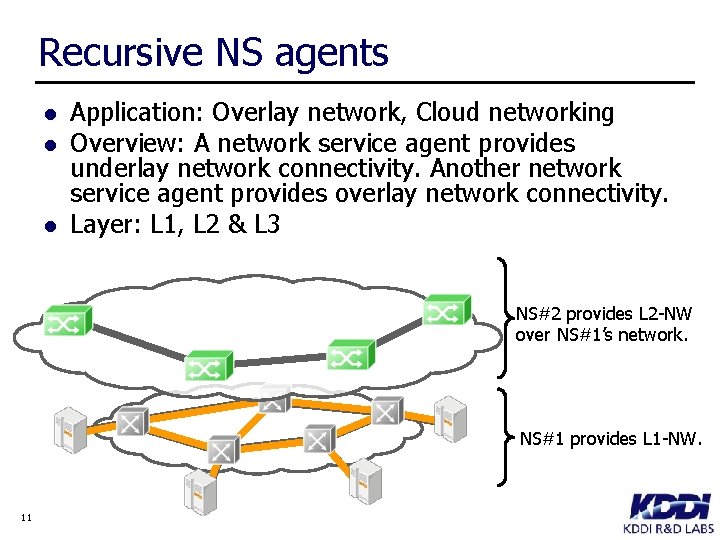
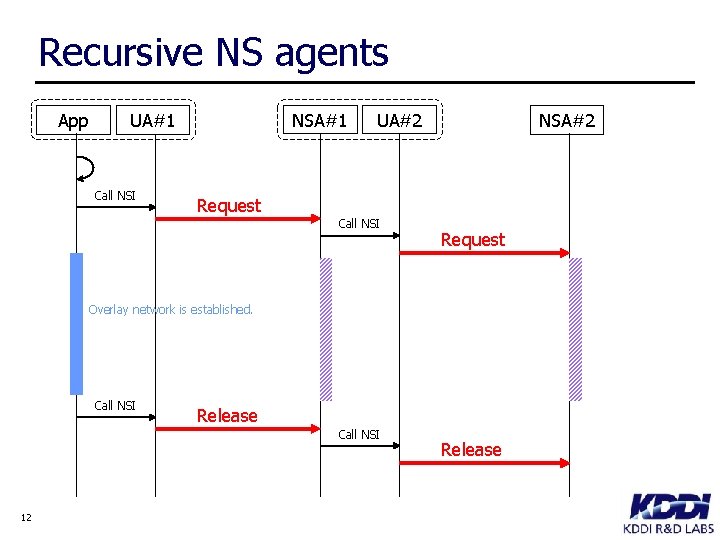
Recursive NS agents l l l Application: Overlay network, Cloud networking Overview: A network service agent provides underlay network connectivity. Another network service agent provides overlay network connectivity. Layer: L 1, L 2 & L 3 NS#2 provides L 2 -NW over NS#1’s network. NS#1 provides L 1 -NW. 11
Recursive NS agents App NSA#1 UA#1 Call NSI UA#2 NSA#2 Request Call NSI Request Overlay network is established. Call NSI Release Call NSI 12 Release
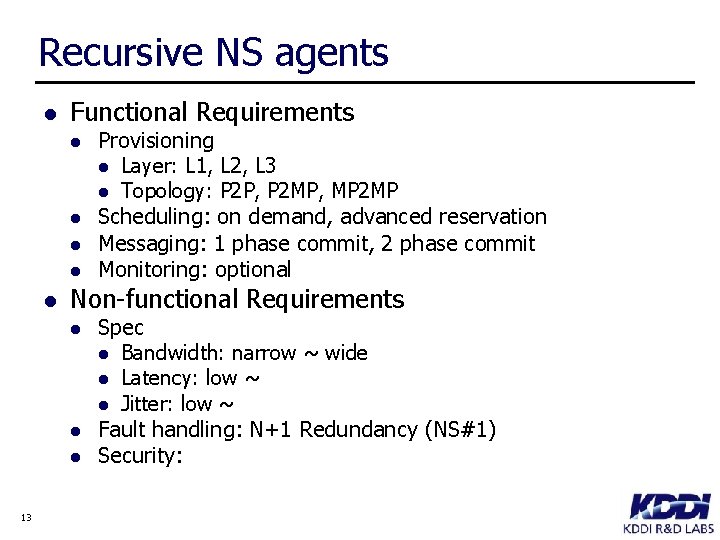
Recursive NS agents l Functional Requirements l l l Non-functional Requirements l l l 13 Provisioning l Layer: L 1, L 2, L 3 l Topology: P 2 P, P 2 MP, MP 2 MP Scheduling: on demand, advanced reservation Messaging: 1 phase commit, 2 phase commit Monitoring: optional Spec l Bandwidth: narrow ~ wide l Latency: low ~ l Jitter: low ~ Fault handling: N+1 Redundancy (NS#1) Security: