
Use Case Modeling SWE 621 Spring 2014 Reference
- Slides: 28
Use Case Modeling SWE 621 Spring 2014 Reference: Gomaa, Chapter 6 Copyright © 2014 Rob Pettit All rights reserved. No part of this document may be reproduced in any form or by any means, without the prior written permission of the author. Copyright © 2014 R. Pettit 1
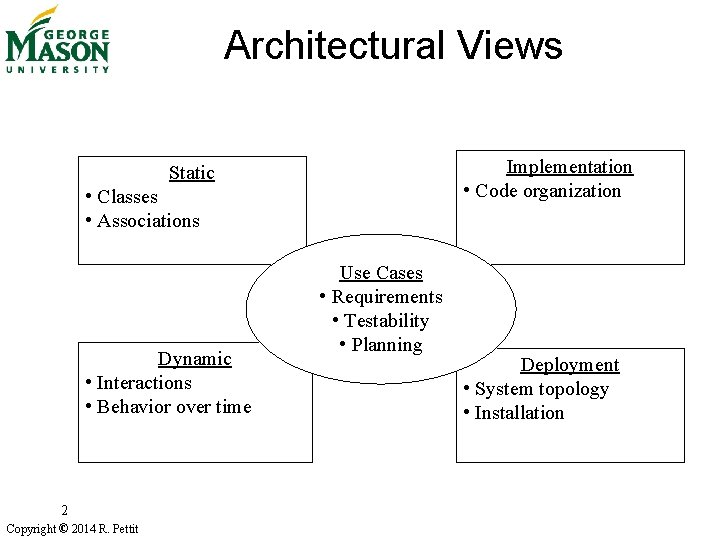
Architectural Views Implementation • Code organization Static • Classes • Associations Dynamic • Interactions • Behavior over time 2 Copyright © 2014 R. Pettit Use Cases • Requirements • Testability • Planning Deployment • System topology • Installation
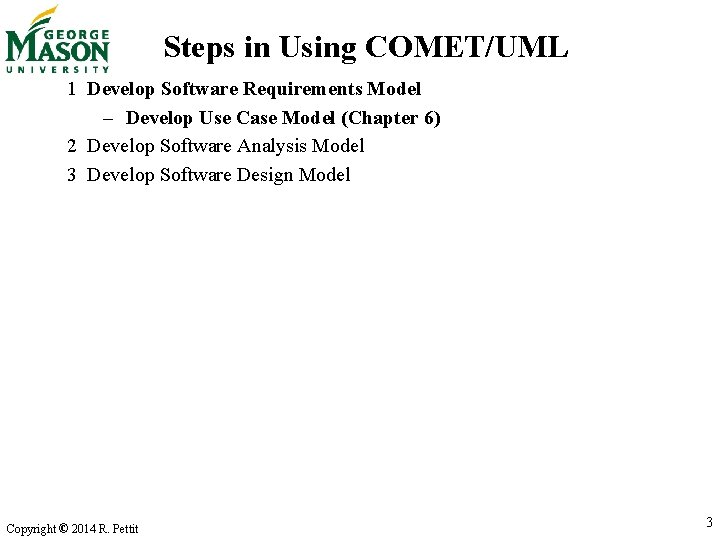
Steps in Using COMET/UML 1 Develop Software Requirements Model – Develop Use Case Model (Chapter 6) 2 Develop Software Analysis Model 3 Develop Software Design Model Copyright © 2014 R. Pettit 3
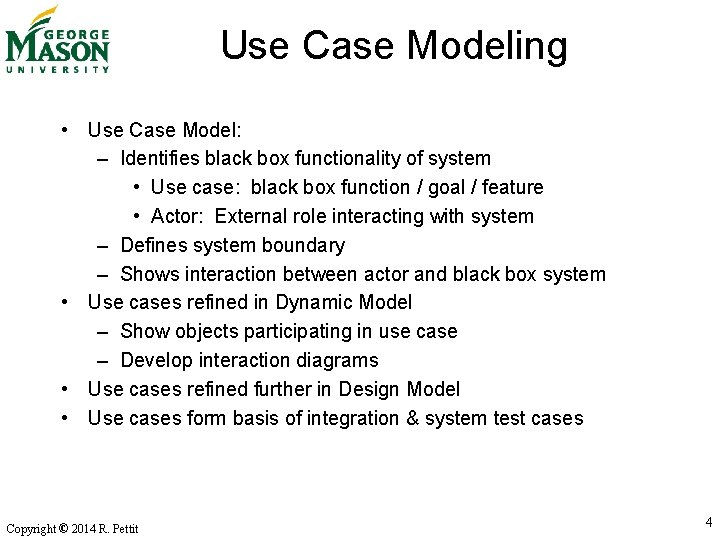
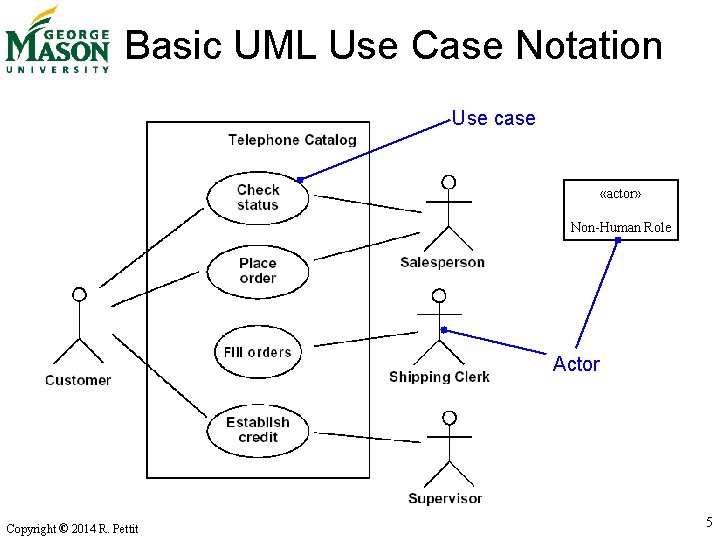
Use Case Modeling • Use Case Model: – Identifies black box functionality of system • Use case: black box function / goal / feature • Actor: External role interacting with system – Defines system boundary – Shows interaction between actor and black box system • Use cases refined in Dynamic Model – Show objects participating in use case – Develop interaction diagrams • Use cases refined further in Design Model • Use cases form basis of integration & system test cases Copyright © 2014 R. Pettit 4
Basic UML Use Case Notation Use case «actor» Non-Human Role Actor Copyright © 2014 R. Pettit 5
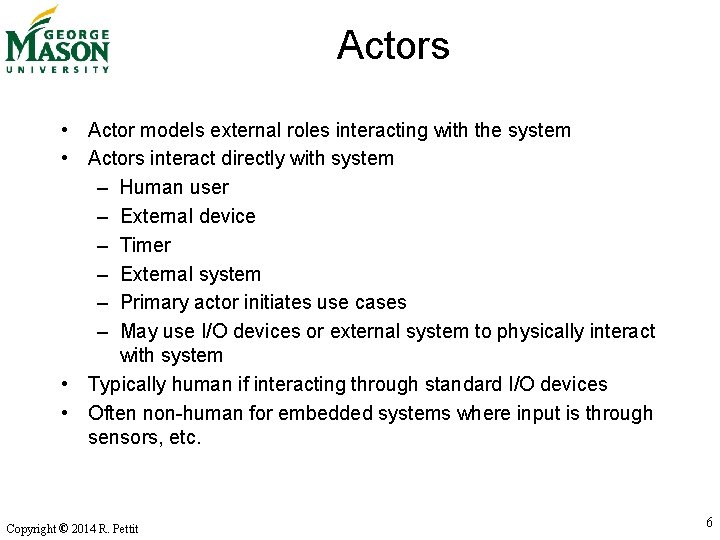
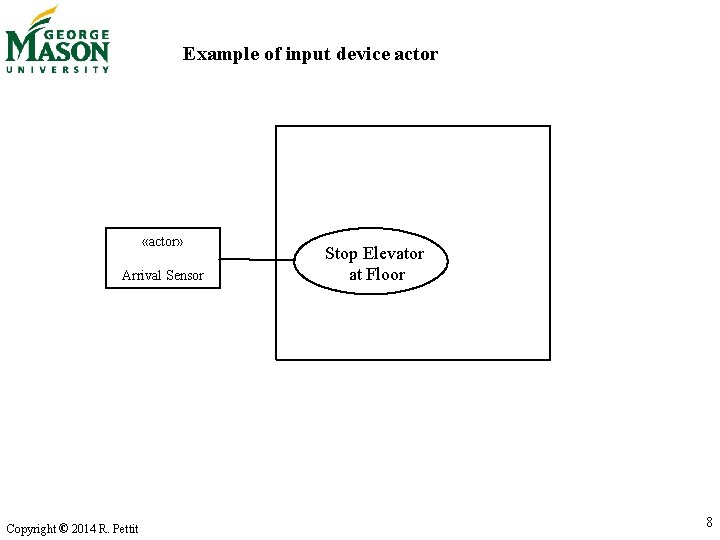
Actors • Actor models external roles interacting with the system • Actors interact directly with system – Human user – External device – Timer – External system – Primary actor initiates use cases – May use I/O devices or external system to physically interact with system • Typically human if interacting through standard I/O devices • Often non-human for embedded systems where input is through sensors, etc. Copyright © 2014 R. Pettit 6
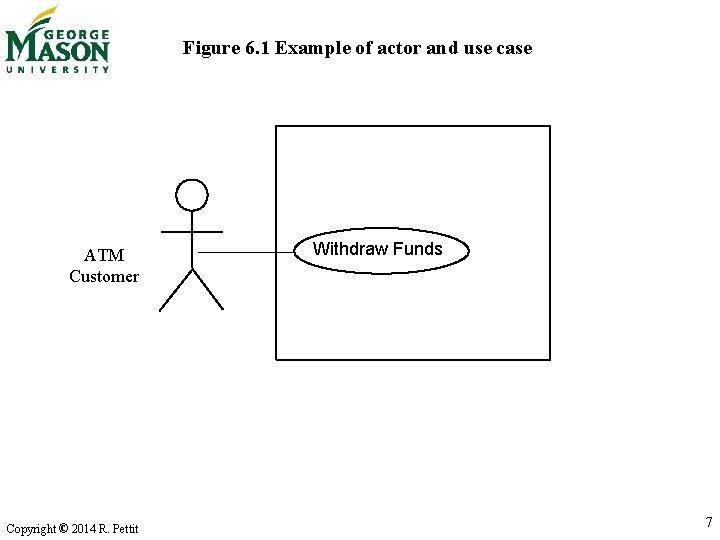
Figure 6. 1 Example of actor and use case ATM Customer Copyright © 2014 R. Pettit Withdraw Funds 7
Example of input device actor «actor» Arrival Sensor Copyright © 2014 R. Pettit Stop Elevator at Floor 8
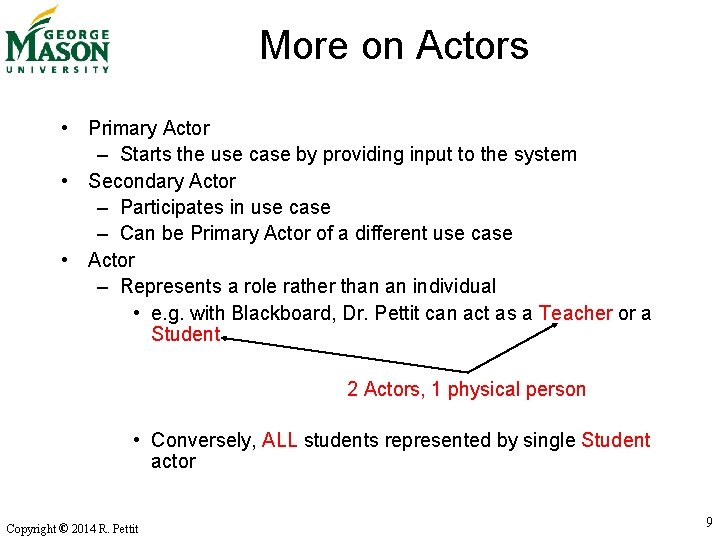
More on Actors • Primary Actor – Starts the use case by providing input to the system • Secondary Actor – Participates in use case – Can be Primary Actor of a different use case • Actor – Represents a role rather than an individual • e. g. with Blackboard, Dr. Pettit can act as a Teacher or a Student 2 Actors, 1 physical person • Conversely, ALL students represented by single Student actor Copyright © 2014 R. Pettit 9
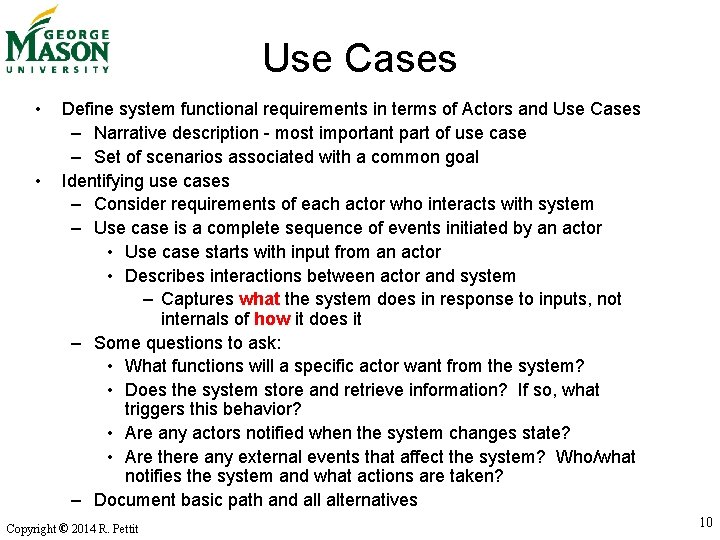
Use Cases • • Define system functional requirements in terms of Actors and Use Cases – Narrative description - most important part of use case – Set of scenarios associated with a common goal Identifying use cases – Consider requirements of each actor who interacts with system – Use case is a complete sequence of events initiated by an actor • Use case starts with input from an actor • Describes interactions between actor and system – Captures what the system does in response to inputs, not internals of how it does it – Some questions to ask: • What functions will a specific actor want from the system? • Does the system store and retrieve information? If so, what triggers this behavior? • Are any actors notified when the system changes state? • Are there any external events that affect the system? Who/what notifies the system and what actions are taken? – Document basic path and all alternatives Copyright © 2014 R. Pettit 10
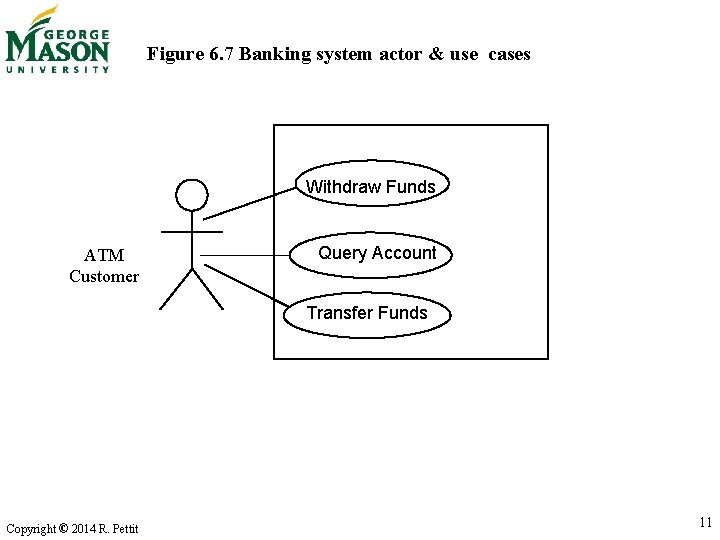
Figure 6. 7 Banking system actor & use cases Withdraw Funds ATM Customer Query Account Transfer Funds Copyright © 2014 R. Pettit 11
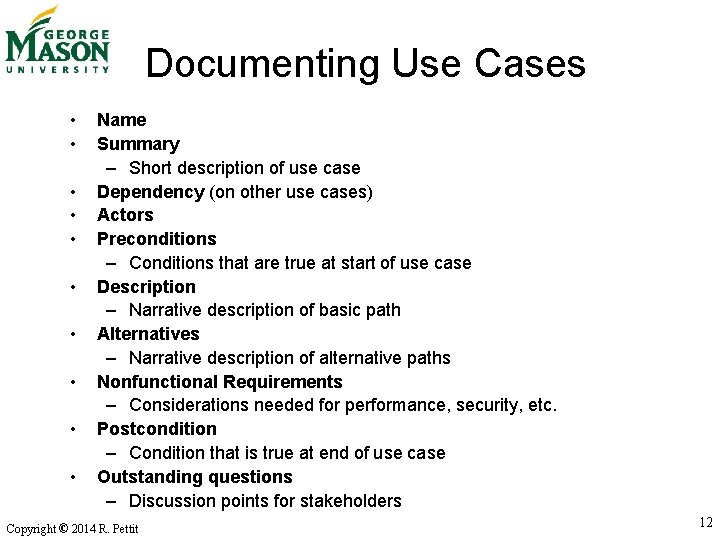
Documenting Use Cases • • • Name Summary – Short description of use case Dependency (on other use cases) Actors Preconditions – Conditions that are true at start of use case Description – Narrative description of basic path Alternatives – Narrative description of alternative paths Nonfunctional Requirements – Considerations needed for performance, security, etc. Postcondition – Condition that is true at end of use case Outstanding questions – Discussion points for stakeholders Copyright © 2014 R. Pettit 12
Example of Use Case Copyright © 2014 R. Pettit 13
Example of Use Case (continued) Copyright © 2014 R. Pettit 14
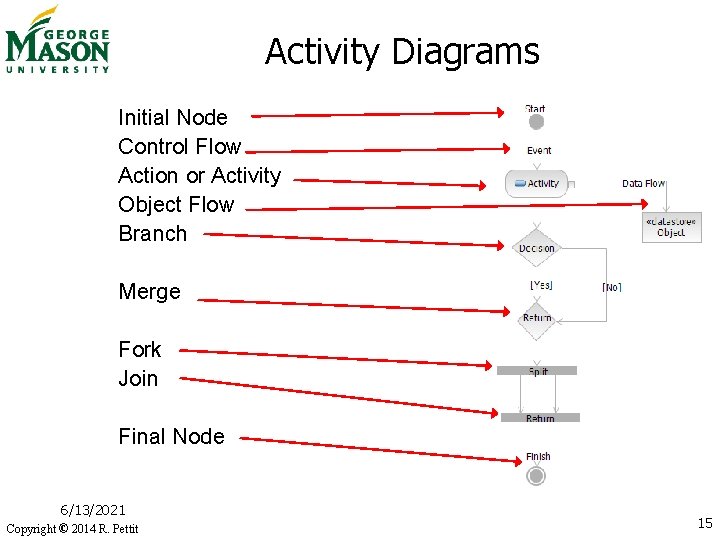
Activity Diagrams Initial Node Control Flow Action or Activity Object Flow Branch Merge Fork Join Final Node 6/13/2021 Copyright © 2014 R. Pettit 15
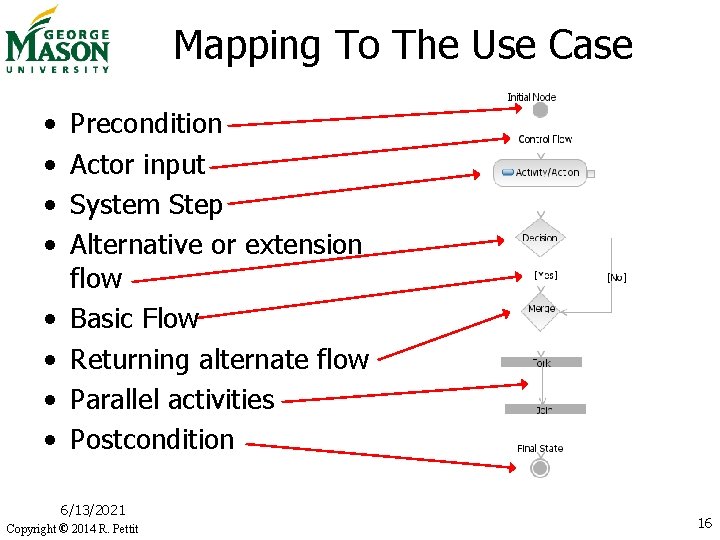
Mapping To The Use Case • • Precondition Actor input System Step Alternative or extension flow Basic Flow Returning alternate flow Parallel activities Postcondition 6/13/2021 Copyright © 2014 R. Pettit 16
Advanced Use Case Modeling • Most industrial applications contain a large number of use cases and actors • Advanced use case modeling can help simplify the overall model by: – Factoring common use case functionality and actor roles – Providing extension mechanisms for use case variations • Two basic relationships for use cases: – «include» – «extends» Copyright © 2014 R. Pettit 17
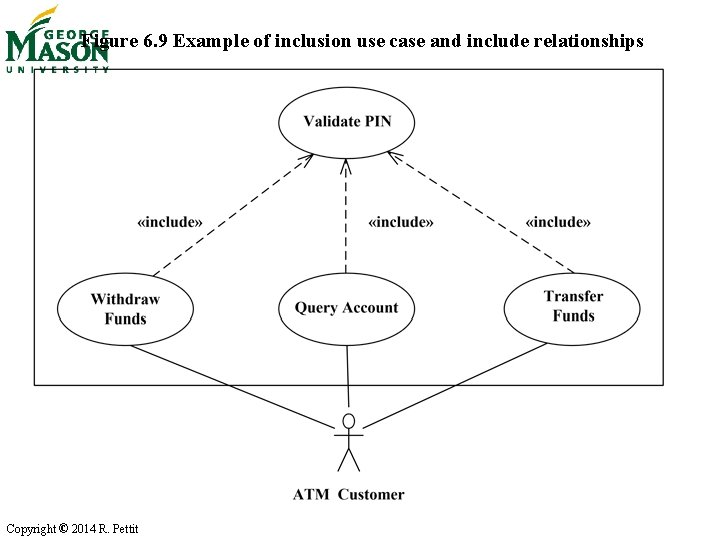
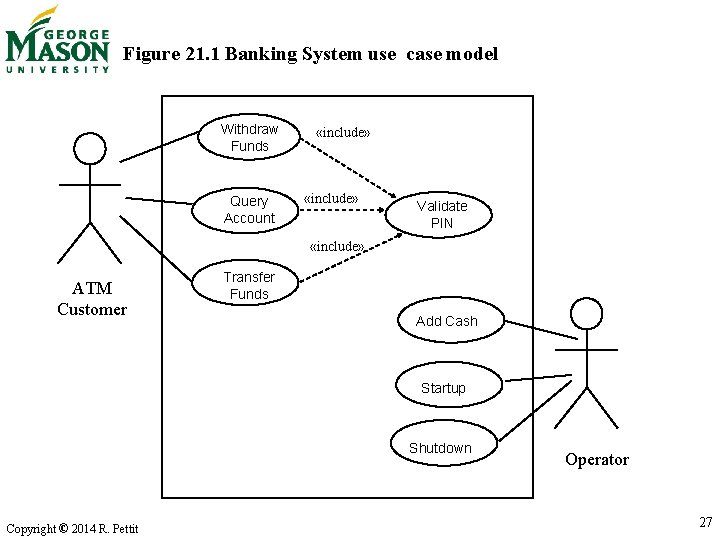
Use Case Relationships • Include relationship – Factor common repetitive patterns (sequences) in several use cases – Separate more complicated steps or steps that are more likely to change – Use case specification for «include» is similar to a function call – Included use case may or may not be complete – Base use case is not complete without the included use cases • Example – Withdraw Funds use case includes Validate PIN use case Copyright © 2014 R. Pettit 18
Figure 6. 9 Example of inclusion use case and include relationships Copyright © 2014 R. Pettit
Example of Inclusion Use Case Copyright © 2014 R. Pettit 20
Example of Base Use Case Copyright © 2014 R. Pettit 21
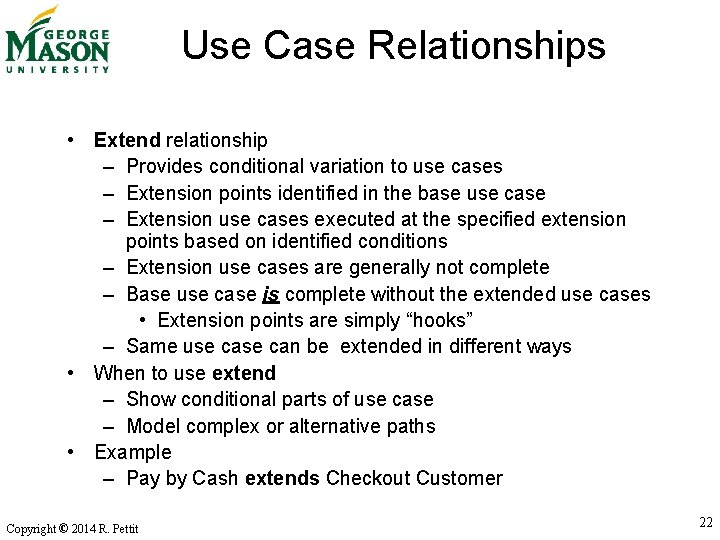
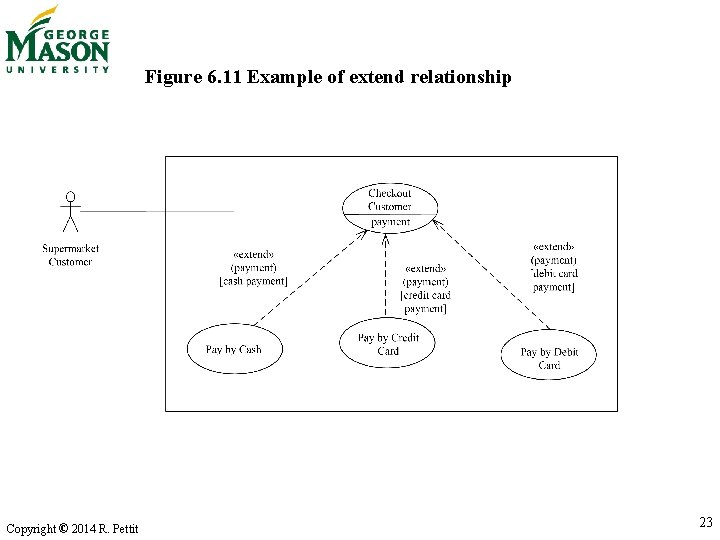
Use Case Relationships • Extend relationship – Provides conditional variation to use cases – Extension points identified in the base use case – Extension use cases executed at the specified extension points based on identified conditions – Extension use cases are generally not complete – Base use case is complete without the extended use cases • Extension points are simply “hooks” – Same use can be extended in different ways • When to use extend – Show conditional parts of use case – Model complex or alternative paths • Example – Pay by Cash extends Checkout Customer Copyright © 2014 R. Pettit 22
Figure 6. 11 Example of extend relationship Copyright © 2014 R. Pettit 23
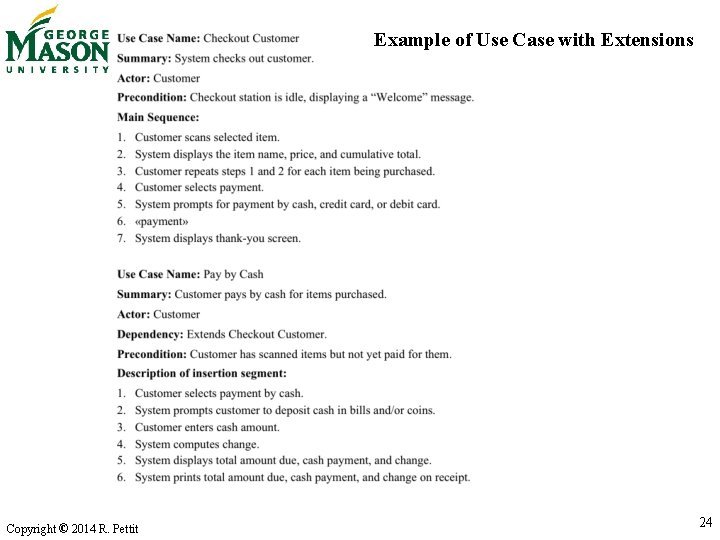
Example of Use Case with Extensions Copyright © 2014 R. Pettit 24
Additional Use Case Options • Dealing with large number of use cases – Can structure use cases in packages • Related functionality • Related actors • Can use graphical modeling to document steps within use case – Modeled with (subset of) UML activity diagrams • Similar to flow chart Copyright © 2014 R. Pettit 25
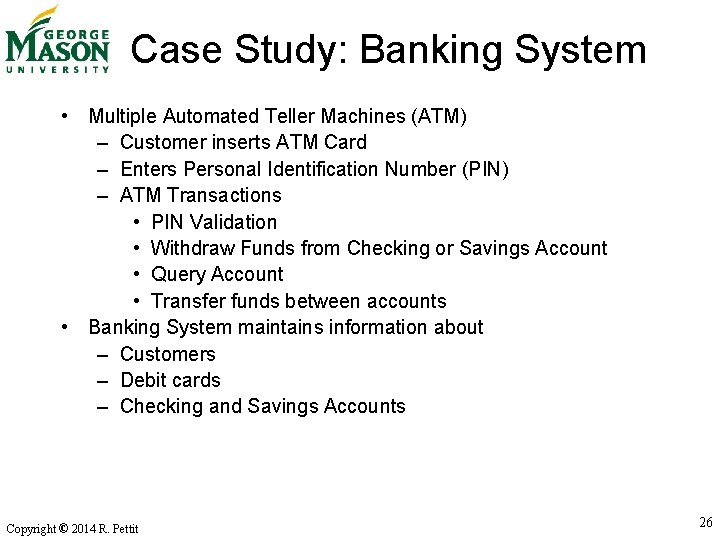
Case Study: Banking System • Multiple Automated Teller Machines (ATM) – Customer inserts ATM Card – Enters Personal Identification Number (PIN) – ATM Transactions • PIN Validation • Withdraw Funds from Checking or Savings Account • Query Account • Transfer funds between accounts • Banking System maintains information about – Customers – Debit cards – Checking and Savings Accounts Copyright © 2014 R. Pettit 26
Figure 21. 1 Banking System use case model Withdraw Funds Query Account «include» Validate PIN «include» ATM Customer Transfer Funds Add Cash Startup Shutdown Copyright © 2014 R. Pettit Operator 27
Use Case Summary • Use case models provide the transition between software/system requirements specifications and software design – Actors: identify external roles (human, system, or device) – Use cases: identify black-box functionality assigned to the software system • Must involve stakeholders when constructing use case models – In general, stakeholders can understand actors and use cases • Must have well-written specifications, not just drawings Copyright © 2014 R. Pettit 28