
Use Case Diagram Based Scenarios Design for a
Use Case Diagram Based Scenarios Design for a Biomedical Time-Series Analysis Web Platform Alan Jovic 1, Davor Kukolja 1, Kresimir Jozic 2, Mario Cifrek 1 1 University E-mail to: alan. jovic@fer. hr of Zagreb, Faculty of Electrical Engineering and Computing, Zagreb, Croatia 2 INA - industrija nafte, d. d. , Zagreb, Croatia
CONTENT �Motivation & goal �Methodology A. System requirements B. UML use case based modeling C. System architecture �Conclusion �Current progress 2/11
Motivation & goal �In recent years, the field of web-based telemedicine, has been rapidly evolving: 1) 2) The need to reduce the cost of healthcare expenditure in developed countries To facilitate access to a better healthcare �Hard problem of efficient time-series features identification 1, 2 �Goal: development of a web-based system for automatic classification of human body disorders based on the analysis of biomedical signals B. D. Fulcher, M. A. Little, and N. S. Jones, “Highly comparative time-series analysis: the empirical structure of time series and their methods, ” J. Roy. Soc. Interface, vol. 10, p. 20130048, April 2013. 2 A. Jovic and N. Bogunovic, “Evaluating and Comparing Performance of Feature Combinations of Heart Rate Variability Measures for Cardiac Rhythm Classification, ” Biomed. Signal Process. Control, vol. 7 no. 3, pp. 245– 255, May 2012 1 3/11
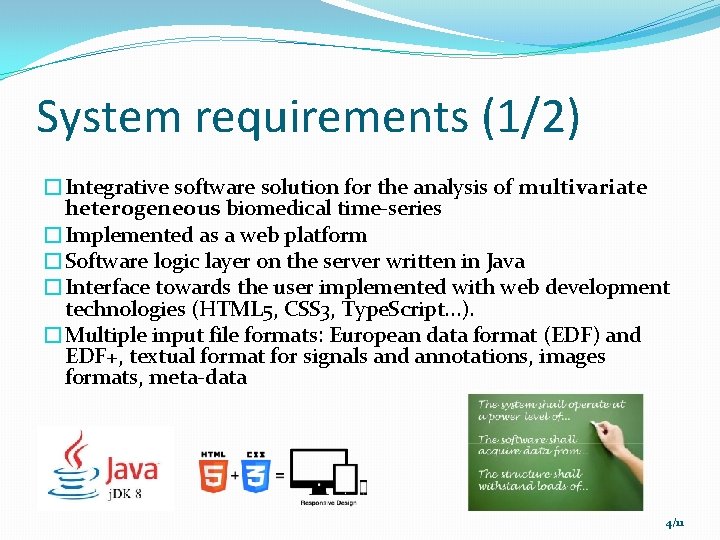
System requirements (1/2) �Integrative software solution for the analysis of multivariate heterogeneous biomedical time-series �Implemented as a web platform �Software logic layer on the server written in Java �Interface towards the user implemented with web development technologies (HTML 5, CSS 3, Type. Script. . . ). �Multiple input file formats: European data format (EDF) and EDF+, textual format for signals and annotations, images formats, meta-data 4/11

System requirements (2/2) � Visualization of signals in 2 D (records inspection) and specific body disorders in 3 D using graphical hardware � Time-series preprocessing, such as signal filtering and data transformations � Feature extraction – features chosen by: 1) a medical expert system implemented in the platform, 2) an expert user; � A large number of features need to be supported by the platform, general and domain-specific � Machine learning: feature selection, classification, regression, and prediction algorithms � Results reporting in contemporary formats (e. g. PDF). Input data Visualization Preprocessing Feature extraction Machine learning parallelization Reporting 5/11

UML use case based modeling (1/2) �The analysis process in the web platform is divided into 8 steps: 1. 2. 3. 4. 5. 6. 7. 8. Analysis type selection Scenario selection Input data selection Records inspection Records preprocessing Feature extraction Model construction Reporting � We also consider platform administration and user accounts use case diagrams 1. Analysis type selection 6/11
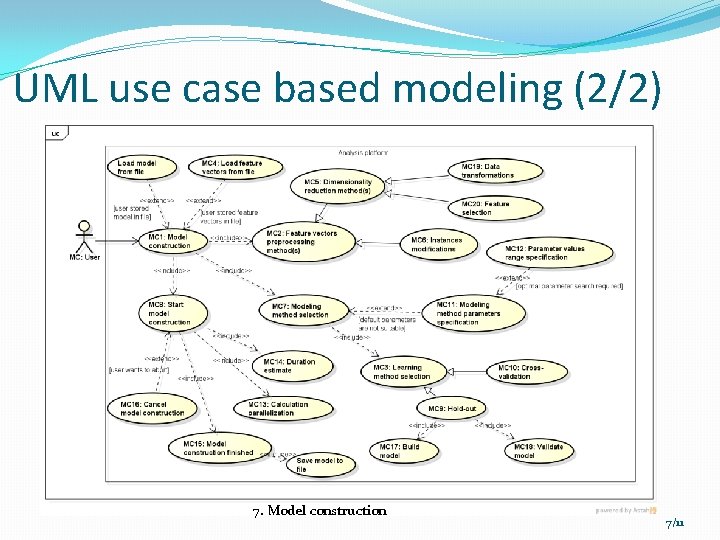
UML use case based modeling (2/2) 7. Model construction 7/11
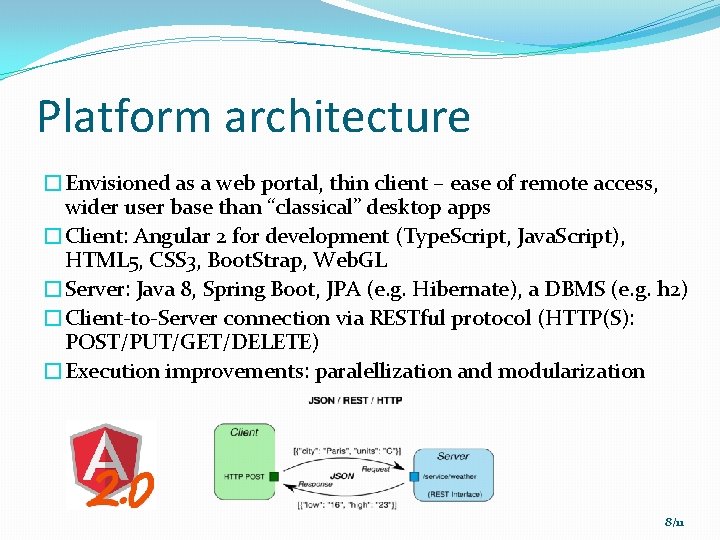
Platform architecture �Envisioned as a web portal, thin client – ease of remote access, wider user base than “classical” desktop apps �Client: Angular 2 for development (Type. Script, Java. Script), HTML 5, CSS 3, Boot. Strap, Web. GL �Server: Java 8, Spring Boot, JPA (e. g. Hibernate), a DBMS (e. g. h 2) �Client-to-Server connection via RESTful protocol (HTTP(S): POST/PUT/GET/DELETE) �Execution improvements: paralellization and modularization 8/11
Conclusion �Early stage report of the work on an innovative web platform for biomedical time-series analysis �We have shown the requirements and architecture needed to support the development �The near-future focus will be the implementation of simple analysis scenarios, probably for a single biomedical time-series (e. g. ECG or EEG) 9/11
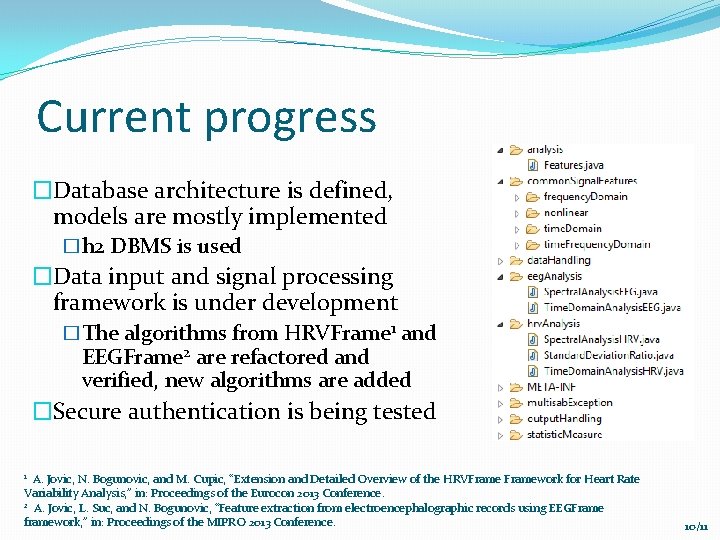
Current progress �Database architecture is defined, models are mostly implemented �h 2 DBMS is used �Data input and signal processing framework is under development �The algorithms from HRVFrame 1 and EEGFrame 2 are refactored and verified, new algorithms are added �Secure authentication is being tested A. Jovic, N. Bogunovic, and M. Cupic, “Extension and Detailed Overview of the HRVFramework for Heart Rate Variability Analysis, ” in: Proceedings of the Eurocon 2013 Conference. 2 A. Jovic, L. Suc, and N. Bogunovic, “Feature extraction from electroencephalographic records using EEGFrame framework, ” in: Proceedings of the MIPRO 2013 Conference. 1 10/11
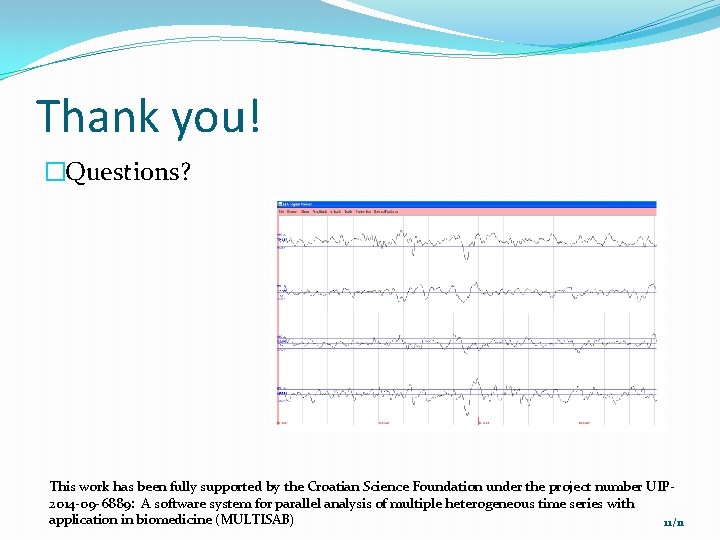
Thank you! �Questions? This work has been fully supported by the Croatian Science Foundation under the project number UIP 2014 -09 -6889: A software system for parallel analysis of multiple heterogeneous time series with application in biomedicine (MULTISAB) 11/11
- Slides: 11