
USDA NonDairy Milk Substitutes September 2015 Agenda Introduce
USDA Non-Dairy Milk Substitutes September 2015
Agenda • Introduce Cow’s Milk and Soy Milk • USDA CACFP regulation for serving milk – School regulation • • Food allergy vs. intolerance; brief overview USDA regulation for making substitutions What is an approved substitute Best practices and Questions 2
Cow’s Milk Cow’s milk • First the cream is removed leaving all liquid fat free (little to no fat). • Different amounts cream (fat) is added back in – Depending on 1%, 2%, . . etc • All milk served in program must be pasteurized – Various time and temperature exposure to heat and kill bacteria, can produce a shelf stable product if time and temp is right. • Most milk is homogenized, and often fortified (vit D) as heat treatment destroys some vitamins and minerals. 3
Soy Milk • Soy Beans are soaked • Ground with water • Heated and than filtered 4
USDA Regulation for Milk • CACFP meal pattern regulation states “fluid milk as a beverage” must be served as part of breakfast, lunch and supper, and is an optional component for snack (am/pm). – Snack could also include 100% fruit juice or water (as long as two other meal componets are served). • Regardless of meal service the portion size remains the same depending on the child’s age. 5
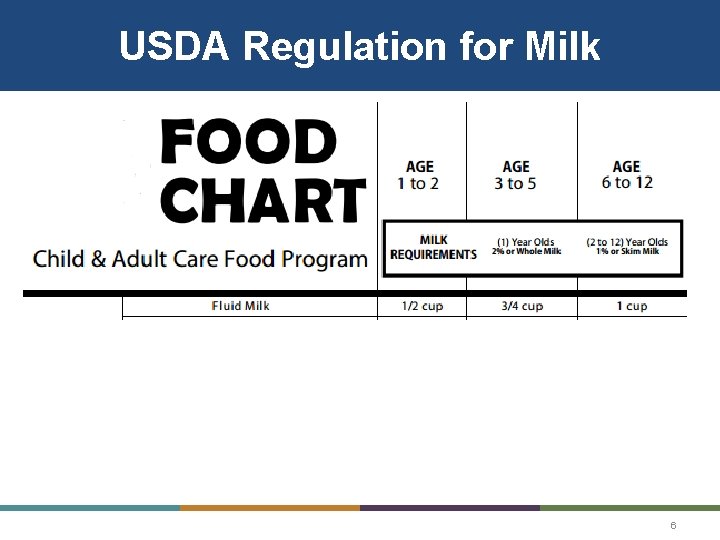
USDA Regulation for Milk 6
Food allergy vs. intolerance Allergy: • “A true food allergy causes an immune system reaction that affects numerous organs in the body. ” • • “A food allergy may be considered a disability under federal laws, such as Section 504 of the Rehabilitation Act of 1973 and the Americans with Disabilities Act (ADA). ” Law requires institutions and organizations to make reasonable accommodations. • “Food intolerance symptoms are generally less serious and often limited to digestive problems. ” "Food Allergy. " Vs. Food Intolerance: What's the Difference? Web. http: //www. mayoclinic. org/diseases-conditions/food-allergy/expertanswers/food-allergy/faq-20058538. 25 Aug. 2015. Advocacy - Disability - Food Allergy Research & Education. " Advocacy - Disability - Food Allergy Research & Education. Web. http: //www. foodallergy. org/advocacy/disability. 25 Aug. 2015. 7
Regulations Covering this Population CACFP: 7 CFR 226. 20 “Institutions may make menu substitutions for children or adults with a medical or other special dietary need, when indicated on a note signed by a licensed physician or recognized medical authority. ” - ADA requires that reasonable accommodations must be made for food allergies documented by a medical authority. The Healthy Hunger-Free Kids Act of 2010: “non-dairy milk substitutions may be made for non-disabled children and adults in the Child and Adult Care food Program (CACFP), according to section 221 part 3 of the law. ” 8
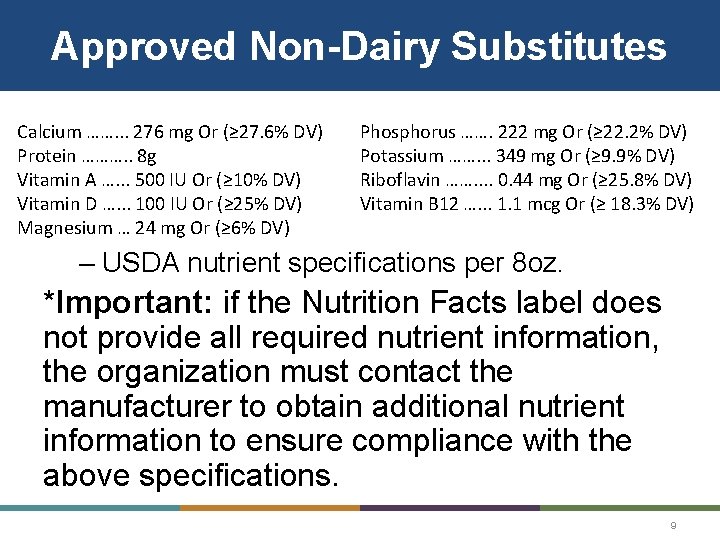
Approved Non-Dairy Substitutes Calcium ……. . . 276 mg Or (≥ 27. 6% DV) Protein ………. . 8 g Vitamin A …. . . 500 IU Or (≥ 10% DV) Vitamin D …. . . 100 IU Or (≥ 25% DV) Magnesium … 24 mg Or (≥ 6% DV) Phosphorus ……. 222 mg Or (≥ 22. 2% DV) Potassium ……. . . 349 mg Or (≥ 9. 9% DV) Riboflavin ……. . 0. 44 mg Or (≥ 25. 8% DV) Vitamin B 12 …. . . 1. 1 mcg Or (≥ 18. 3% DV) – USDA nutrient specifications per 8 oz. *Important: if the Nutrition Facts label does not provide all required nutrient information, the organization must contact the manufacturer to obtain additional nutrient information to ensure compliance with the above specifications. 9
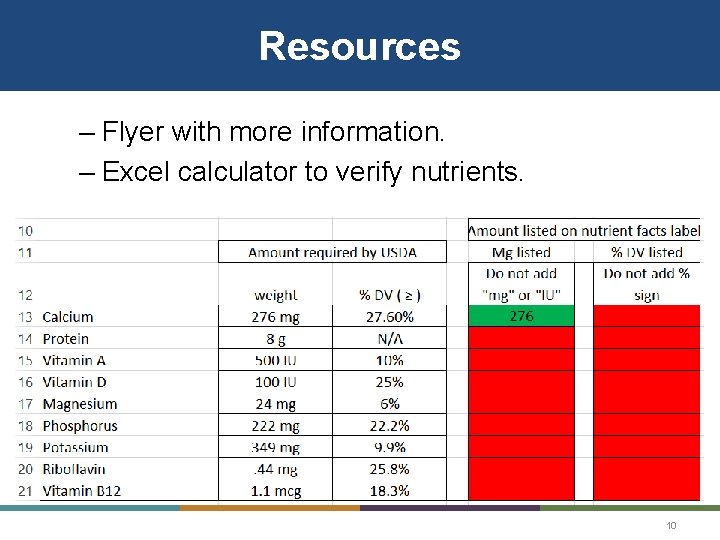
Resources – Flyer with more information. – Excel calculator to verify nutrients. 10
Questions Delaware Department of Education Nutrition Programs 35 Commerce Way Dover DE, 19904 302. 857. 3356 (office) 302. 739. 6397 (fax) Jason. Brown@doe. k 12. de. us 11
- Slides: 11