
USDA Forest Service Forest Inventory and Analysis FIA
- Slides: 37
USDA Forest Service Forest Inventory and Analysis (FIA) MRLC Land Characterization Partners Meeting Nov. 7 -8, 2000
OUTLINE • Federal mandates that FIA more effectively use remote sensing • FIA Business needs from satellite data • Classification detail • Classification accuracy • Geographic priorities • Information needed by FIA Management Team
Federal mandates that FIA more effectively use remote sensing • 1998 Farm Bill • White House Office of Science and Technology, Committee on the Environment and Natural Resources • RAND Corporation review of forest monitoring conducted by federal agencies • FIA Staff Director Rich Guldin http: //fia. fs. fed. us/library. htm - Papers
Improve consistency of data and process using a top down approach • Consistent data is like a common language • Centralized data collection, documentation and dissemination • Decentralized analyses and decision making • Economies of scale
FIA Business needs from satellite data • Stable, dependable and economical production of accurate and consistent forest cover and land use maps • Cover entire USA every 3 to 10 years • Adherence to Federal Geographic Data Committee (FGDC) standards
FIA Business needs from satellite data • Automated image processing algorithms that require little human intervention – Product consistency and accuracy – Cost reduction – Timeliness – Diversity of geospatial products – Henry Ford analogy
FIA Business needs from satellite data • Improve accuracy of FIA statistics – Improve statistical efficiency through stratification on forest v. nonforest cover – Improve statistical estimates for small geographic areas (e. g. , counties) using remotely sensed ancillary data
FIA Business needs from satellite data • Improve timeliness of statistics in annualized FIA – 10% - 15% of field plots re-measured each year – Remotely sensed data “refreshed” every 3 to 5 years – This is a goal, not an absolute design requirement – Could use change detection to update forest/nonforest in a 10 -year MRLC product
FIA Business needs from satellite data • Change detection – Keep forest/nonforest map current to maintain FIA statistical efficiency through stratification • 2005 update to 2000 landcover map – Better identify spatial patterns of change in broad landscapes
FIA Business needs from satellite data • Change detection – Improve accuracy of FIA statistical estimates for • Timber removals • Reforestation • Afforestation
FIA Business needs from satellite data • Help provide 30 -m/1: 24, 000 products to FIA customers – User-friendly data base for GIS analyses – Attractive maps for distribution – Spatial analysis tool box (internal and external users)
FIA Business needs from satellite data • Characterize context surrounding each FIA field plot that are not easily measured in field – Landscape fragmentation – Size and shape of forest stand – Distance to roads, surface waters, other land uses (important components of wildlife habitat)
FIA Business needs from satellite data • Substitute satellite data for 1: 40, 000 NAPP – Reduce cost of FIA stratification with Phase 1 plots (1 -km grid) – Continue to provide imagery for navigation by field crews – 15 -m pan-sharpened Landsat 7 – 10 -m pan-sharpened SPOT – Superimpose ancillary geospatial data (DLG, DEM, topos. , etc. ) – Downloadable to field crews (federal, state, contractors)
FIA Business needs from satellite data • Implementation schedule – Prototype products available for 10% -20% of USA by September 2002 – Production system functional by September, 2003
FIA Business needs from satellite data • New remotely sensed products in the future – Net primary productivity or photosynthesis rates – Tree mortality – Indicators of drought, acidic deposition, or pest attack – Boundaries between different forest stands – Indicators of human infrastructure (e. g. , individual buildings)
FIA Business needs from satellite data • Developers’ tools to implement a variety of spatial models with centralized database – Linkages to other geospatial databases (e. g. , Census Bureau) – Sharing geomatic models – Facilitate local improvements to national map products • Accuracy • Classification detail
Minimum spatial resolution • • 1 -km pixel for global/national assessments 250 -m to 30 -m pixel for regional assessments FIA definition of forest requires 30 -m scale Special assessment needs require 30 -m scale (e. g. , riparian management zones) • Functionality request: – change spatial scale of data to balance assessment needs with technology
Classification detail • Might need separate MRLC products forest cover and timberland use • Forest v. nonforest (most valuable for statistical efficiency through stratification)
Classification detail • FIA definition forest uses – 10% stocking, which can be applied with field data but not directly with remotely sensed data – At least 1 -acre and 120 -foot wide – Includes non-stocked clearcuts and seedling/sapling stands – Accuracy of remotely sensed classifications need to be high, but not necessarily 100%
Classification detail • FIA definition for nonforested land use includes – Urban and suburban areas with tree cover – tree stocking less than 10% • Pasture with tree cover • Rangeland
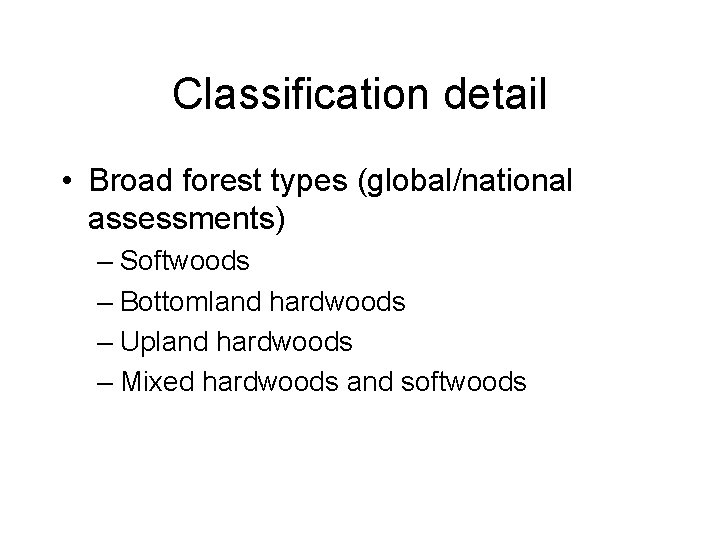
Classification detail • Broad forest types (global/national assessments) – Softwoods – Bottomland hardwoods – Upland hardwoods – Mixed hardwoods and softwoods
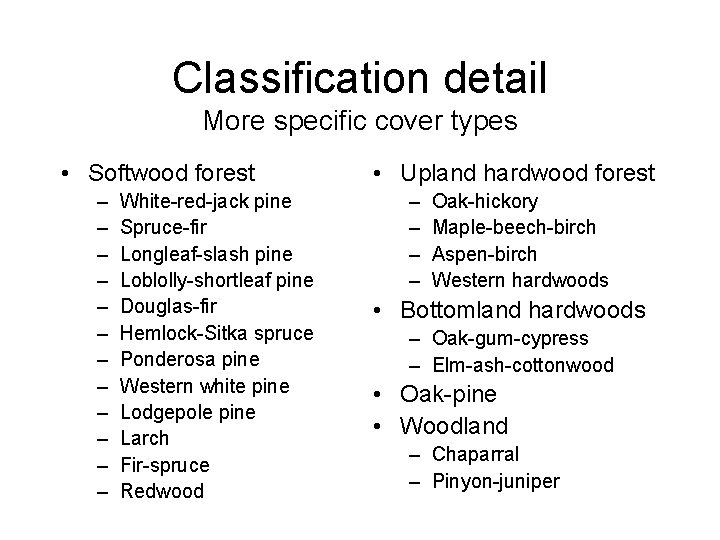
Classification detail More specific cover types • Softwood forest – – – White-red-jack pine Spruce-fir Longleaf-slash pine Loblolly-shortleaf pine Douglas-fir Hemlock-Sitka spruce Ponderosa pine Western white pine Lodgepole pine Larch Fir-spruce Redwood • Upland hardwood forest – – Oak-hickory Maple-beech-birch Aspen-birch Western hardwoods • Bottomland hardwoods – Oak-gum-cypress – Elm-ash-cottonwood • Oak-pine • Woodland – Chaparral – Pinyon-juniper
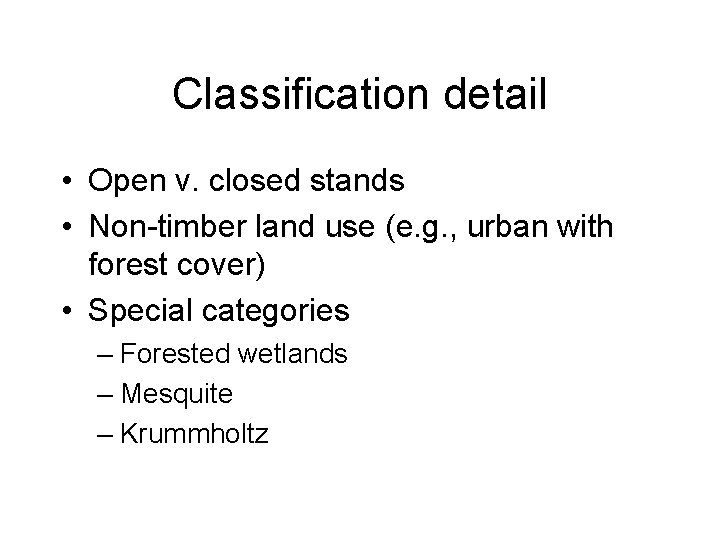
Classification detail • Open v. closed stands • Non-timber land use (e. g. , urban with forest cover) • Special categories – Forested wetlands – Mesquite – Krummholtz
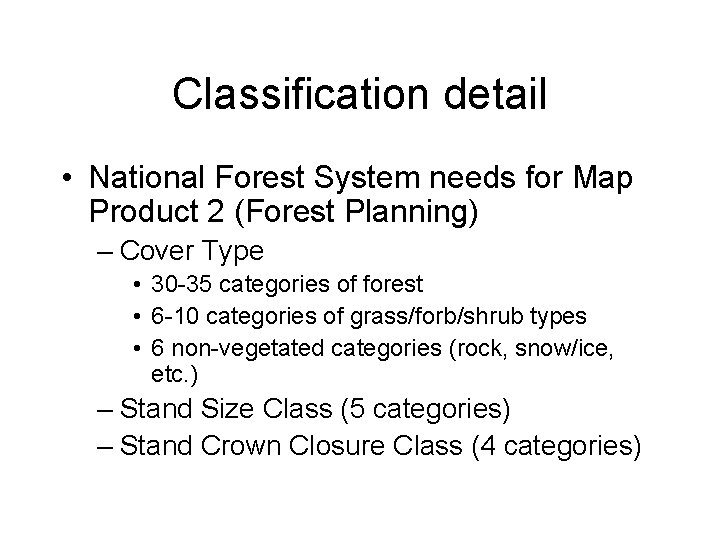
Classification detail • National Forest System needs for Map Product 2 (Forest Planning) – Cover Type • 30 -35 categories of forest • 6 -10 categories of grass/forb/shrub types • 6 non-vegetated categories (rock, snow/ice, etc. ) – Stand Size Class (5 categories) – Stand Crown Closure Class (4 categories)
Classification detail • National Forest System needs for Map Product 2 (less detailed ) – Cover Type • 9 categories of forest • 4 categories of grass/forb/shrub types • 5 non-vegetated categories (rock, snow/ice, etc. ) – Stand Size Class (2 categories) – Stand Crown Closure Class (3 categories)
Classification detail • Need to agree on detailed description – Classification rules for each category – Devil is in the details
Classification Accuracy • Forest v. nonforest 90% to 99% accuracy – Needed for stratification efficiency – Inaccuracies caused by FIA field-definition of forest included with usual classification error – No formal FIA accuracy standards for more detailed categorizations – Known accuracy relative to FIA field data
Classification Accuracy • National Forest System (Montana, Idaho) Map Product 2 (most detailed) – 60 -65% overall for cover types • at least 40% for any individual class – 40% overall for stand size class – 60%-70% for stand density classes
Classification Accuracy • National Forest System (Montana, Idaho) Map Product 3 (less detailed) – 75% overall for cover types • at least 65% for any individual class – 75% overall for stand size class – 75% for stand density classes
Timeliness • Less than 5% net change in forest cover since date of imagery – stratification efficiency • Less than 5 years old is desirable
Registration Accuracy • Sufficient to link 1 -acre FIA field plots to 30 -m pixels
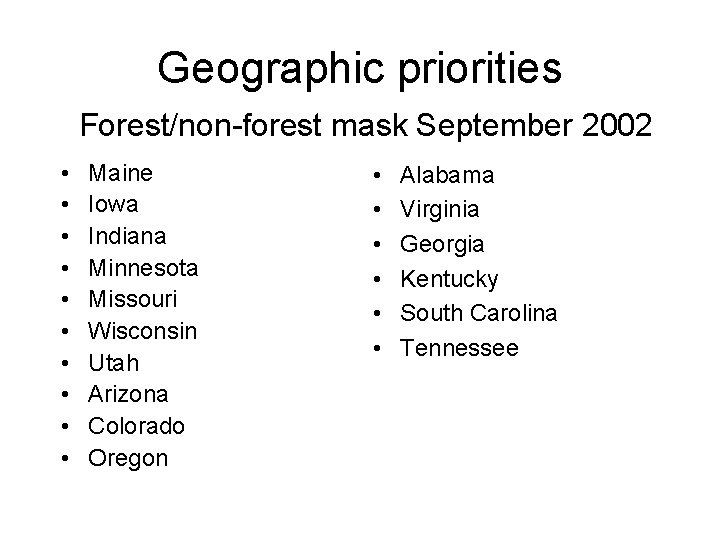
Geographic priorities Forest/non-forest mask September 2002
Geographic priorities Forest/non-forest mask September 2002 • • • Maine Iowa Indiana Minnesota Missouri Wisconsin Utah Arizona Colorado Oregon • • • Alabama Virginia Georgia Kentucky South Carolina Tennessee
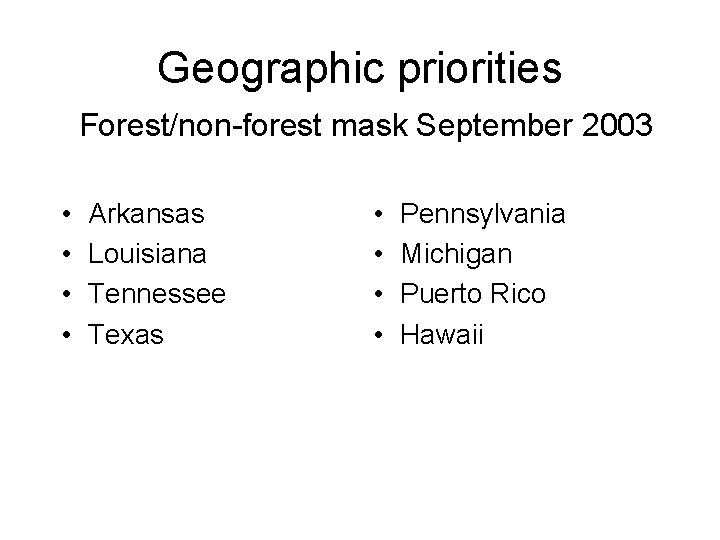
Geographic priorities Forest/non-forest mask September 2003 • • Arkansas Louisiana Tennessee Texas • • Pennsylvania Michigan Puerto Rico Hawaii
Information needed by FIA • Cost to FIA for Part II of MRLC
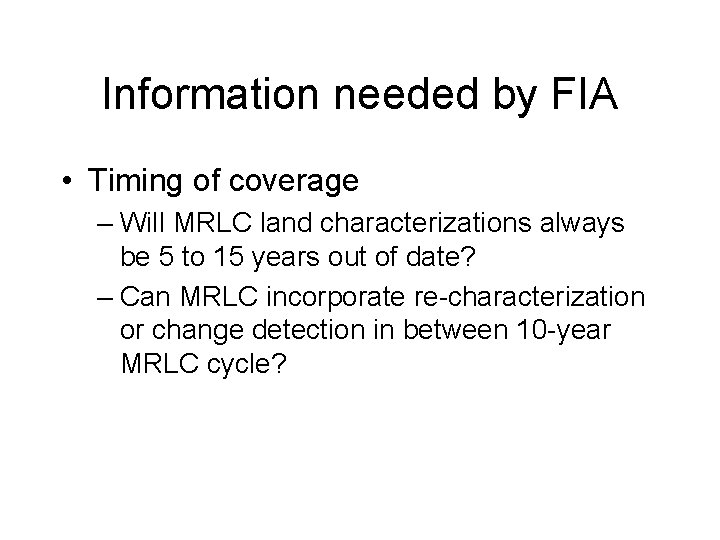
Information needed by FIA • Timing of coverage – Will MRLC land characterizations always be 5 to 15 years out of date? – Can MRLC incorporate re-characterization or change detection in between 10 -year MRLC cycle?
Information needed by FIA • Classification detail – Potential role of FIA in determining detail of classification system – What decisions have already been made – What is on the table? – Need a thorough review of detailed classification descriptions and rules – Can MRLC produce map of forest cover optimized to FIA definitions of forest land use? – Consistency of MRLC and FGDC standards?