
USB Universal Serial Bus Need for Plug and
USB (Universal Serial Bus) • Need for “Plug and Play” capability for PC peripherals outside of PC • Supports hot plugging • Inexpensive solution for low to medium speed applications (v. 2. 0 480 Mbps) • Tiered star topology (hubs) – Expands to 127 peripherals • Supports 2 kinds of transfer – Asynchronous (delay between packets) – Isochronous (planned delivery of data, e. g. , multimedia applications) Winter 2003 EE EE 766 Computer Interfacing and Protocols 18 - 1
USB • Need for peripherals expansion outside of PC – Want to connect new device without opening the case – Do not want to use PC serial or parallel ports – Want to be able to “hot swap” devices without power off or rebooting – Want to be able to service low, medium (full), and high speed devices (1. 5 -12 -480 Mbps) – Want a lot of extension capability (127) – Want the device end interface simple and cheap – Want interface to supply some power Winter 2003 EE EE 766 Computer Interfacing and Protocols 18 - 2
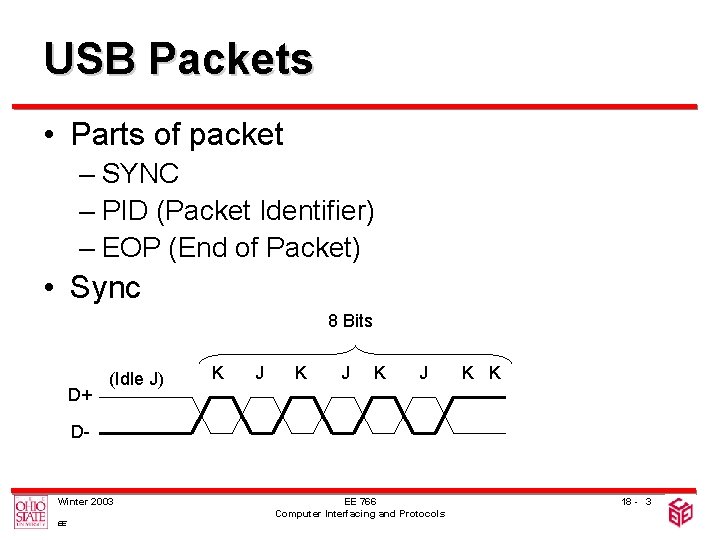
USB Packets • Parts of packet – SYNC – PID (Packet Identifier) – EOP (End of Packet) • Sync 8 Bits D+ (Idle J) K J K J K K D- Winter 2003 EE EE 766 Computer Interfacing and Protocols 18 - 3
USB Signaling • Differential Encoding used – NRZ-I • 0 Transition • 1 No transition – Bit stuffing used • 0 stuffed after 6 consecutive 1 s • Note the difference from HDLC Winter 2003 EE EE 766 Computer Interfacing and Protocols 18 - 4
USB Features • Serial • Half duplex medium • All control originates from PC (Access not distributed) • Operating system must recognize new devices at any time • Information sent in packets • Information types – – Control Interrupt (polling) Bulk (good delivery) Isochronous (guaranteed rate) Winter 2003 EE EE 766 Computer Interfacing and Protocols 18 - 5
USB Signaling • Differential voltage signaling • Bus states – D+ high, D- low J (Idle) – D+ low, D- high K • Bus can float if neither end drives • SE 0 (single ended zero) – D+, D- low • SE 1 (single ended one) – D+, D- high Winter 2003 EE EE 766 Computer Interfacing and Protocols 18 - 6
USB Mechanical Aspects • Cable length limited to 5 m • Interface is serial, differential • Host or hub supplies up to 500 m. A at 5 V downstream – Cable has 4 wires VCC, GND, D+, D- • V. 1. 1: Cable must be shielded for 12 Mbps • V. 2. 0: Max speed 480 Mbps • Automatic speed sensing Winter 2003 EE EE 766 Computer Interfacing and Protocols 18 - 7
USB Mechanical Aspects • Cable ends distinctive – Flat vs. square • Power pins longer so power is stable when data is connected • Up to 5 levels of hub hierarchy – Speed degradation if all devices are active together Winter 2003 EE EE 766 Computer Interfacing and Protocols 18 - 8
- Slides: 8