
USB 3 0 UNIVERSAL SERIAL BUS Cory Koby
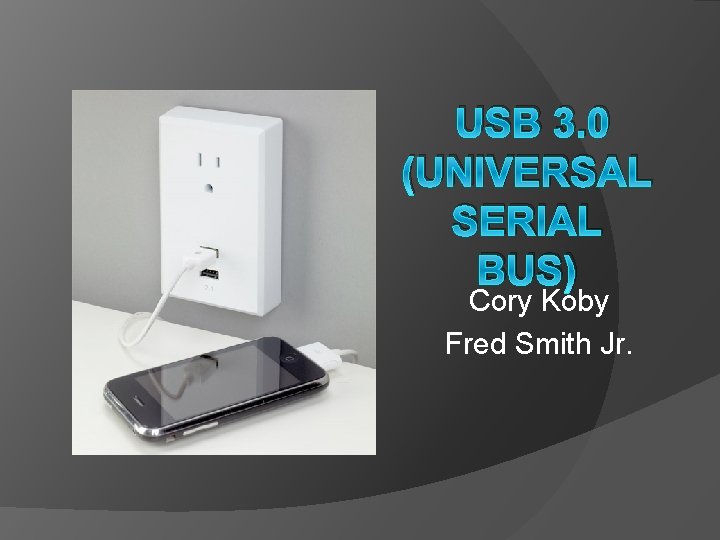
USB 3. 0 (UNIVERSAL SERIAL BUS) Cory Koby Fred Smith Jr.
Table of Contents � Review of USB 1. 0/1. 1 – 3. 0 � Developmental � Technical Intentions Benefits and Capabilities � Charging � Issues � Conclusion � References
Why USB ? �Developed due to problems and complications caused by having so many connections for peripheral devices on computer systems. �Too many different types of ports with limited uses ○ Serial, Parallel, PS/2, Etc �USB solved this limitation by limiting the number of different types of ports needed to connect to a computer. USB is specifically designed to allow easy connection of a wide variety of devices. It is intended to be user friendly.
USB 3. 0: Superspeed � Certified under the name ‘Super. Speed’ �New Theoretical Max = 5 Gbits/s � Upgraded from Half-Duplex (1. 0/1. 1/2. 0) to Full-Duplex communication with Peripherals �No longer uses Polling, technology upgraded to packet-routing. � Lower Power Consumption �Reduced by 85%
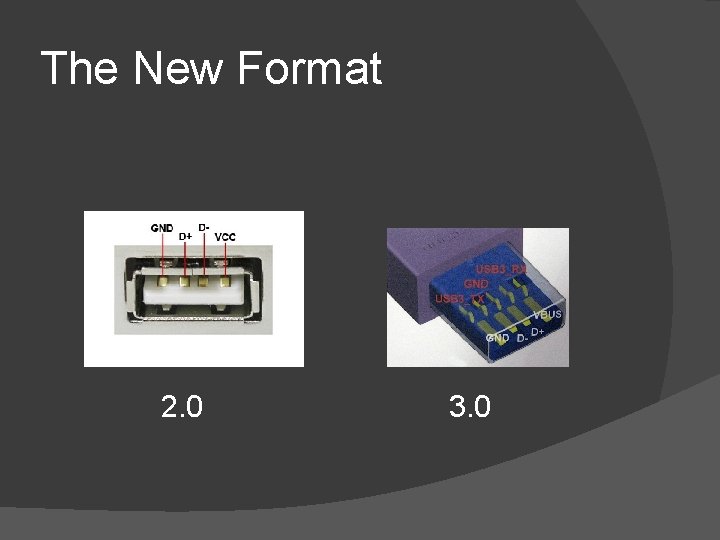
The New Format 2. 0 3. 0
Potential Intent for 3. 0 � Offers 900 m. A of Power (4. 5 Watts constant power) � The possibility of a universal charger for various platforms ○ Laptops ○ Printers ○ Scanners ○ Cellphones
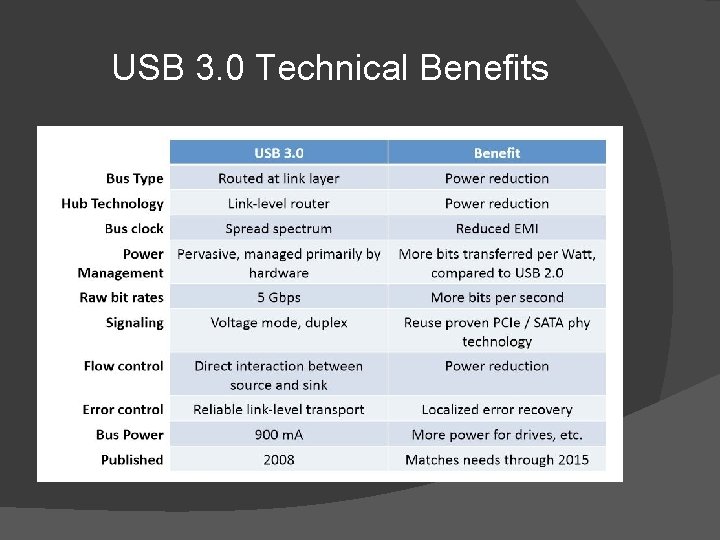
USB 3. 0 Technical Benefits
USB 3. 0 Power Ability USB Power Delivery is the next big step in the USB evolution to provide high bandwidth data and intelligent power over a simple, single, ubiquitous cable.
USB 3. 0 Consortium � Intel, HP, Microsoft an ST-Erricson � Together have announced the new USB Power Delivery specification which includes the ability to transfer up to 100 Watts (W) through the familiar socket.
Brad Saunders: USB 3. 0 Promoter Group chairman “USB Power Delivery enables a path to greatly reduce electronic waste by eliminating proprietary, platform-specific chargers. ” “We envision a significant move toward universal charging based on this specification, most notably for charging notebook PCs using standardized USB power bricks or when connected to USB hubs and desktop displays that integrate USB Power Delivery capabilities. ”
� The new standard will enable convenient charging of laptops and other powerhungry devices. � The new USB 3. 0 cables will help eliminate device-specific chargers, and result in less e-waste.
USB 3. 0 Charging Specification � There are currently three types of modes for charging. 1. Host charger: A host charger is a USB 2. 0 host that provides up to 500 m. A to a downstream port and implements charger detection. A Hi-Speed device may draw only up to 900 m. A from the host charger.
USB 3. 0 Charging Specification (Continued) 2. Hub charger: A hub charger is a USB 2. 0 hub that provides up to 500 m. A to a downstream port and supports charger detection. The charging functionality is very similar to a host charger. 3. Dedicated charger: A dedicated charger provides power over the USB interface but does not enumerate the device. The charging current is limited to 1. 5 A.
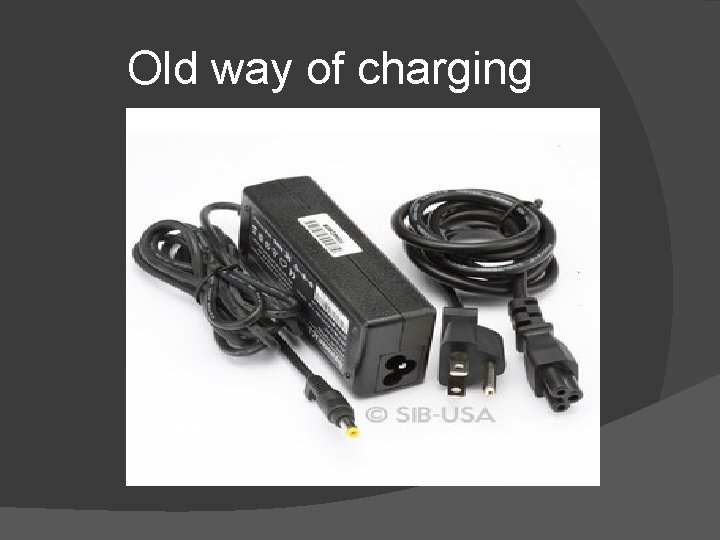
Old way of charging
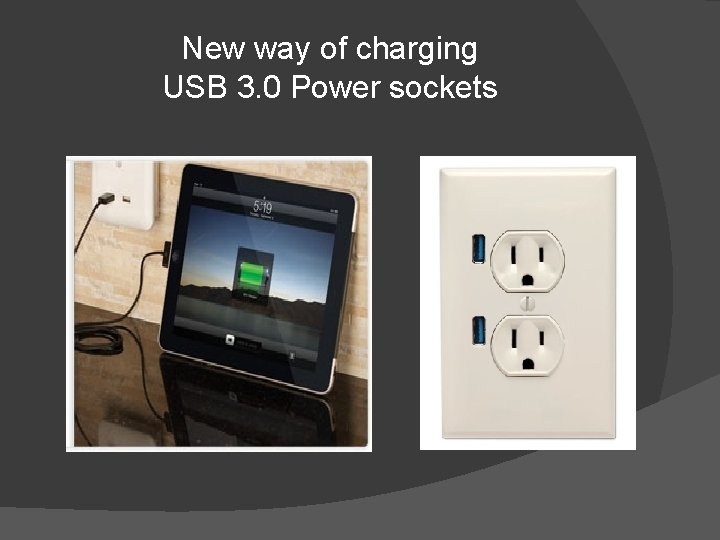
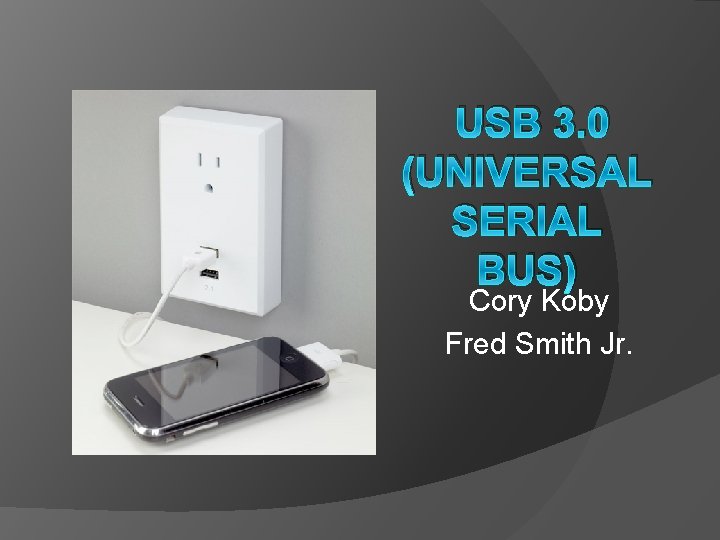
New way of charging USB 3. 0 Power sockets
Problems and Issues � Radio frequency Interference �Bluetooth � 2. 4 GHz wireless band devices � Data transfer at 2. 0 speeds (480 mbps) �Driver compatibility �Cable types
Conclusion � Charging over USB has inherent benefits. �Lower manufacturing cost �Saves the environment �Customers will not have to carry around separate cables for every device. �Saves you money
References � Jia-na Lou; Xiao-Bo Wu; Meng-lian Zhao, "Switch-mode multi-power-supply Li-ion battery charger with power-path management, " Solid-State and Integrated Circuit Technology (ICSICT), 2010 10 th IEEE International Conference on , vol. , no. , pp. 527, 529, 1 -4 Nov. 2010 doi: 10. 1109/ICSICT. 2010. 5667349 � Lan Dai; Ke-Qing Ning; Yan-Feng Jiang, "Design of a multi-mode and high-stability linear charger for Lithiumion batteries, " Solid-State and Integrated Circuit Technology (ICSICT), 2010 10 th IEEE International Conference on , vol. , no. , pp. 345, 347, 1 -4 Nov. 2010 doi: 10. 1109/ICSICT. 2010. 5667724 � White Paper. “USB 3. 0* Radio Frequency Interference Impact on 2. 4 GHz Wireless Devices” Intel, N. D. pp 1 -14. Nov 2011.
USB 3. 0 (UNIVERSAL SERIAL BUS) Cory Koby Fred Smith Jr.
- Slides: 19