
USAID PRIORITAS Mengutamakan Pembaharuan Inovasi dan Kesempatan bagi
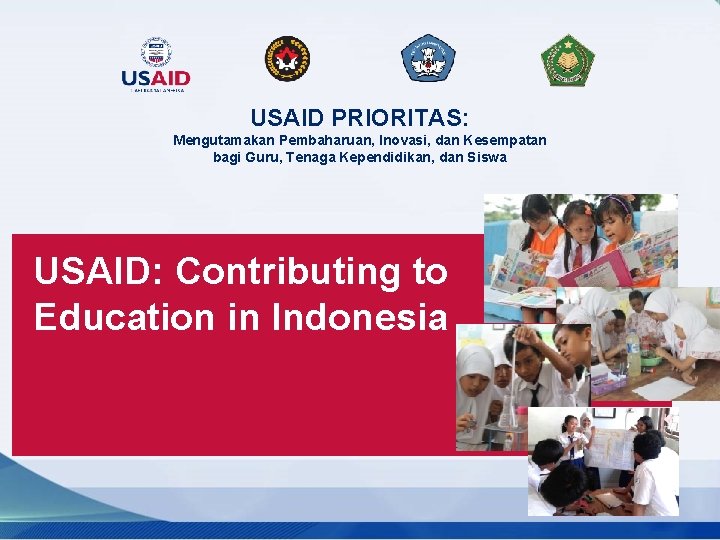
USAID PRIORITAS: Mengutamakan Pembaharuan, Inovasi, dan Kesempatan bagi Guru, Tenaga Kependidikan, dan Siswa USAID: Contributing to Education in Indonesia
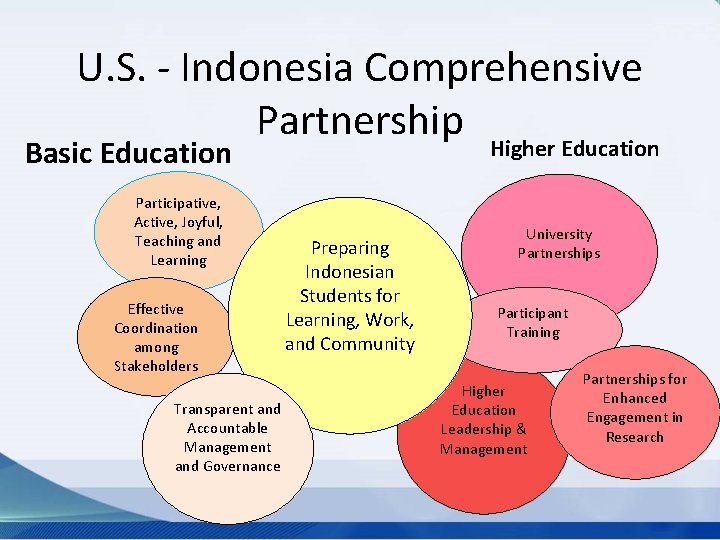
U. S. - Indonesia Comprehensive Partnership Basic Education Participative, Active, Joyful, Teaching and Learning Effective Coordination among Stakeholders Transparent and Accountable Management and Governance Higher Education Preparing Indonesian Students for Learning, Work, and Community University Partnerships Participant Training Higher Education Leadership & Management Partnerships for Enhanced Engagement in Research
Current USAID programs • Higher Education Leadership and Management ( HELM) 20112016 • Partnerships for Enhanced Engagement in Research ( PEER) ( USAID and National Science Foundation) 2011 -2016 • University Partnerships 2009 -2016 – Partners: 18 U. S. Institutions and 19 Indonesian Institutions – Currently 11 partnerships active through 2016 Partnerships to Extend Scholarships & Training to Achieve Sustainable Impacts ( PRESTASI) 2012 - 2017; 2014 -2019 • Prioritizing Reform, Innovation, Opportunities for Reaching Indonesia’s Teachers, Administrators and Students ( PRIORITAS) 2012 - 2017 3
• USAID PRIORITAS is five year program developed by USAID and the Indonesian Government to improve access to quality education for children in Indonesia. • Project dates: Start 1 May 2012; Finish 30 April 2017 • PRIORITAS = Prioritizing Reform Innovation, and Opportunities for Reaching Indonesia’s Teachers, Administrators, and Students 4
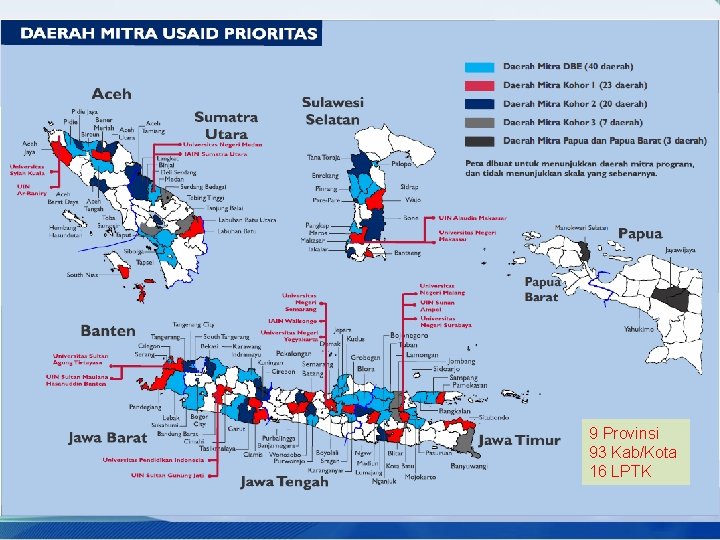
9 Provinsi 93 Kab/Kota 16 LPTK
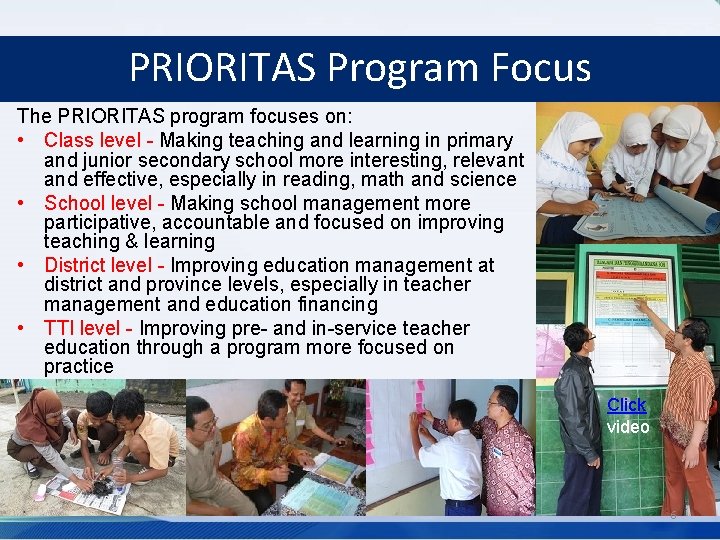
PRIORITAS Program Focus The PRIORITAS program focuses on: • Class level - Making teaching and learning in primary and junior secondary school more interesting, relevant and effective, especially in reading, math and science • School level - Making school management more participative, accountable and focused on improving teaching & learning • District level - Improving education management at district and province levels, especially in teacher management and education financing • TTI level - Improving pre- and in-service teacher education through a program more focused on practice Click video 6
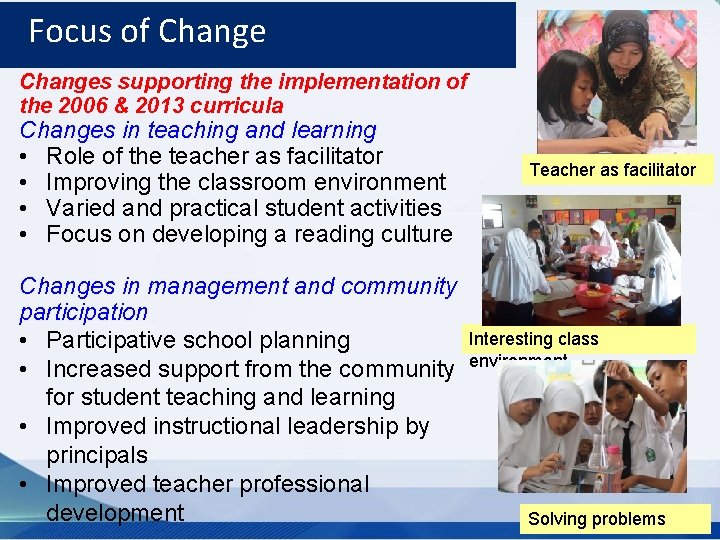
Focus of of Change Focus Changes supporting the implementation of the 2006 & 2013 curricula Changes in teaching and learning • Role of the teacher as facilitator • Improving the classroom environment • Varied and practical student activities • Focus on developing a reading culture Changes in management and community participation • Participative school planning • Increased support from the community for student teaching and learning • Improved instructional leadership by principals • Improved teacher professional development Teacher as facilitator Interesting class environment Solving problems
Results 2012 -2015 • Training modules developed to support Active and Contextual Teaching and Learning, School Based Management, Early Grade Reading, Mathematics and Science • Over 1, 280 lecturers from 48 TTIs trained in teaching methodologies with an emphasis on Early Grade Reading, Science and Mathematics and in School Based Management • Over 3, 100 training facilitators trained from 96 districts • Over 4, 200 school principals, committee members and other government officials from over 1, 270 district and TTI partner schools trained directly by the project in school management and community participation • Nearly 9, 500 teachers from the partner schools trained directly by the project in Active and Contextual Teaching and Learning, benefitting 390, 000 students in those school 8
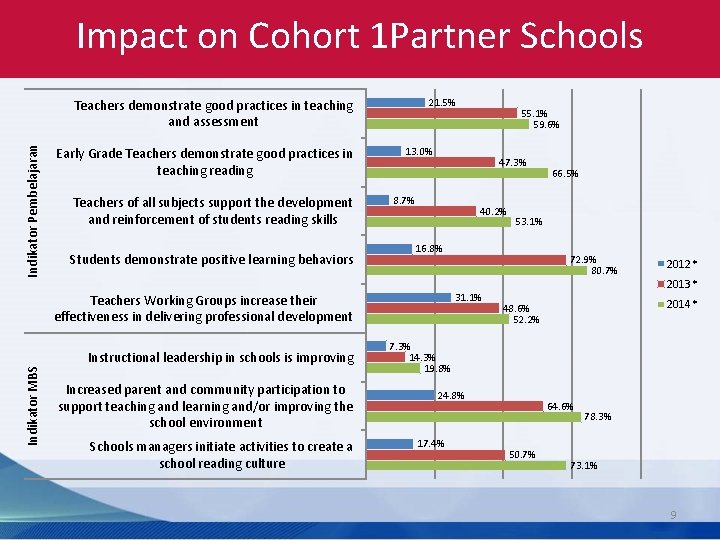
Impact on Cohort 1 Partner Schools 21. 5% Indikator Pembelajaran Teachers demonstrate good practices in teaching and assessment Early Grade Teachers demonstrate good practices in teaching reading Teachers of all subjects support the development and reinforcement of students reading skills Students demonstrate positive learning behaviors 13. 0% 47. 3% 8. 7% 40. 2% Indikator MBS Increased parent and community participation to support teaching and learning and/or improving the school environment Schools managers initiate activities to create a school reading culture 66. 5% 53. 1% 16. 8% 72. 9% 80. 7% 31. 1% Teachers Working Groups increase their effectiveness in delivering professional development Instructional leadership in schools is improving 55. 1% 59. 6% 2012* 2013* 2014* 48. 6% 52. 2% 7. 3% 14. 3% 19. 8% 24. 8% 17. 4% 64. 6% 50. 7% 78. 3% 73. 1% 9
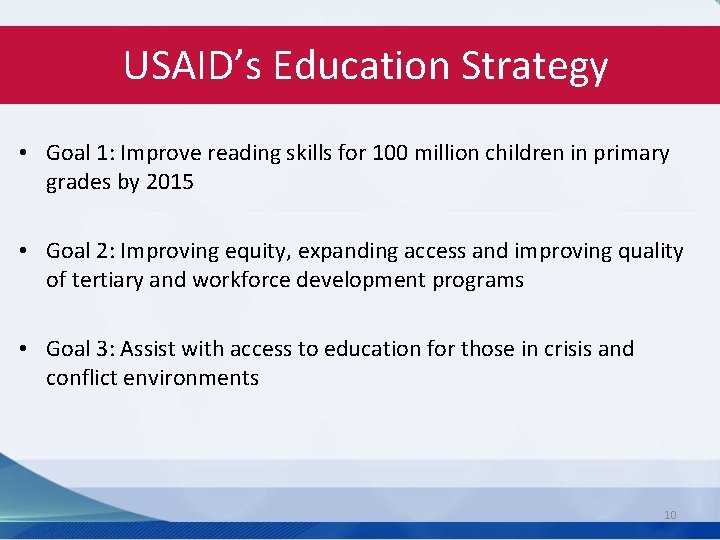
USAID’s Education Strategy • Goal 1: Improve reading skills for 100 million children in primary grades by 2015 • Goal 2: Improving equity, expanding access and improving quality of tertiary and workforce development programs • Goal 3: Assist with access to education for those in crisis and conflict environments 10
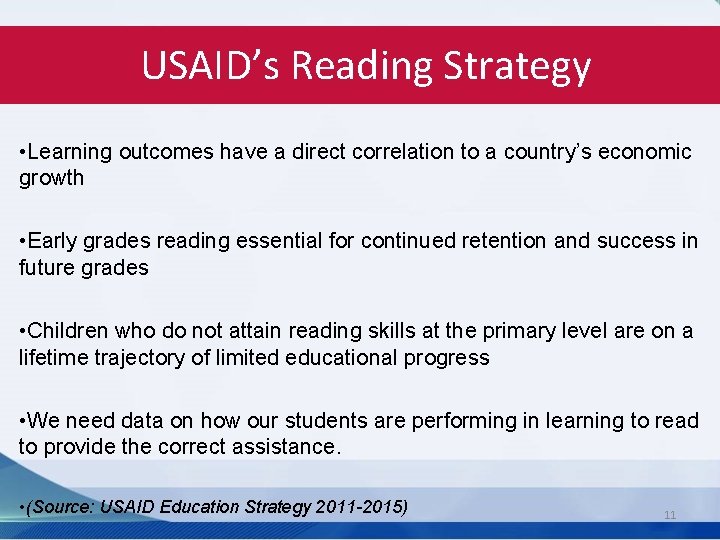
USAID’s Reading Strategy • Learning outcomes have a direct correlation to a country’s economic growth • Early grades reading essential for continued retention and success in future grades • Children who do not attain reading skills at the primary level are on a lifetime trajectory of limited educational progress • We need data on how our students are performing in learning to read to provide the correct assistance. • (Source: USAID Education Strategy 2011 -2015) 11
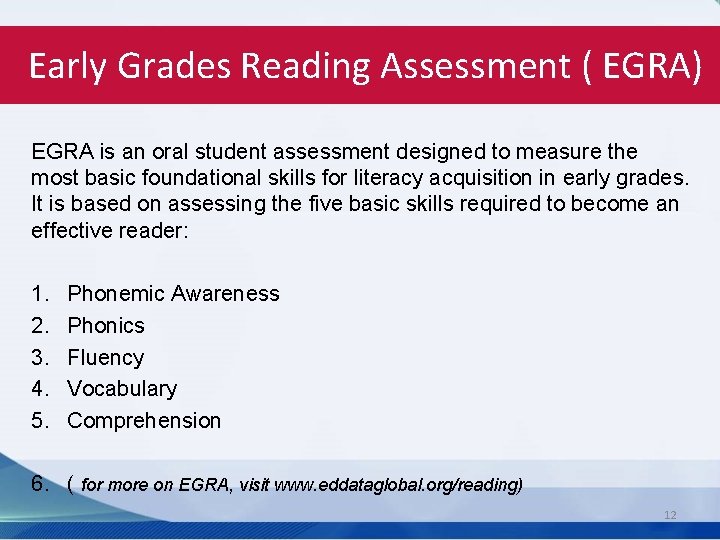
Early Grades Reading Assessment ( EGRA) EGRA is an oral student assessment designed to measure the most basic foundational skills for literacy acquisition in early grades. It is based on assessing the five basic skills required to become an effective reader: 1. 2. 3. 4. 5. Phonemic Awareness Phonics Fluency Vocabulary Comprehension 6. ( for more on EGRA, visit www. eddataglobal. org/reading) 12
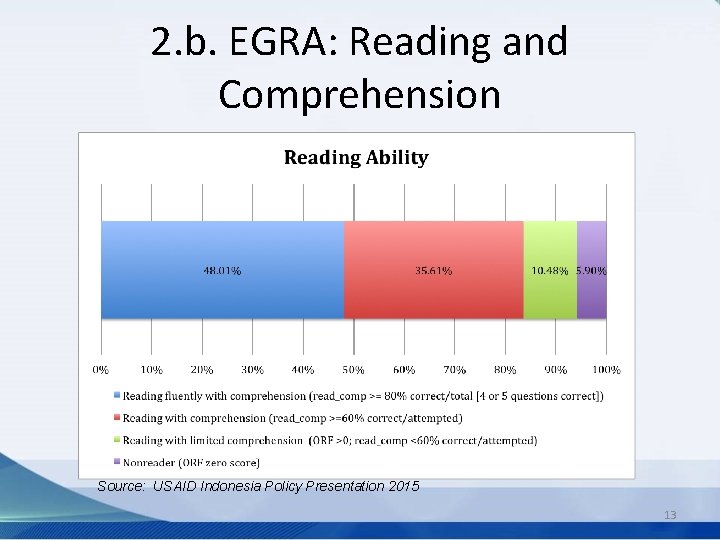
2. b. EGRA: Reading and Comprehension Source: USAID Indonesia Policy Presentation 2015 13
Project monitoring findings • Early grades teachers are limited in their understandings of how children learn to read and use of reading strategies • EG students have limited oral language proficiency • EG students show a limited ability to attach meaning to what they are reading • Reading is taught as an isolated decoding exercise • Teachers do not teach all the necessary components of literacy • Teachers fail to address the needs of individuals and groups in their class. • Teachers have limited strategies to assess reading, especially oral reading. 14
How do we improve the teaching of reading? • Learning to read is developmental. Not everyone in the class has reached the same level of development. • There are particular stages of reading development that readers pass through and different reading materials and teaching strategies are required at each stage of development 15
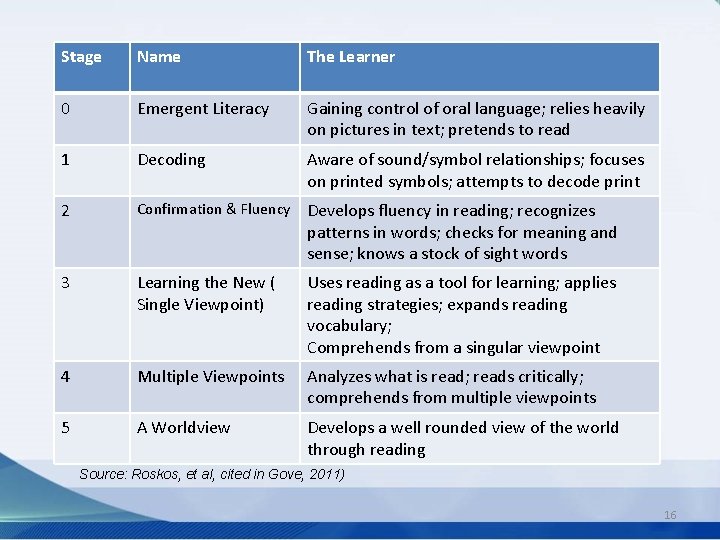
Stage Name The Learner 0 Emergent Literacy Gaining control of oral language; relies heavily on pictures in text; pretends to read 1 Decoding Aware of sound/symbol relationships; focuses on printed symbols; attempts to decode print 2 Confirmation & Fluency Develops fluency in reading; recognizes patterns in words; checks for meaning and sense; knows a stock of sight words 3 Learning the New ( Single Viewpoint) Uses reading as a tool for learning; applies reading strategies; expands reading vocabulary; Comprehends from a singular viewpoint 4 Multiple Viewpoints Analyzes what is read; reads critically; comprehends from multiple viewpoints 5 A Worldview Develops a well rounded view of the world through reading Source: Roskos, et al, cited in Gove, 2011) 16
How do we improve the teaching of reading? Best practice reading programs throughout the world used specifically designed reading programs that introduce skills in a controlled and sequential way. ‘Leveled readers’ Teachers use these readers to teach specific reading strategies which consider the level of reading development. 17
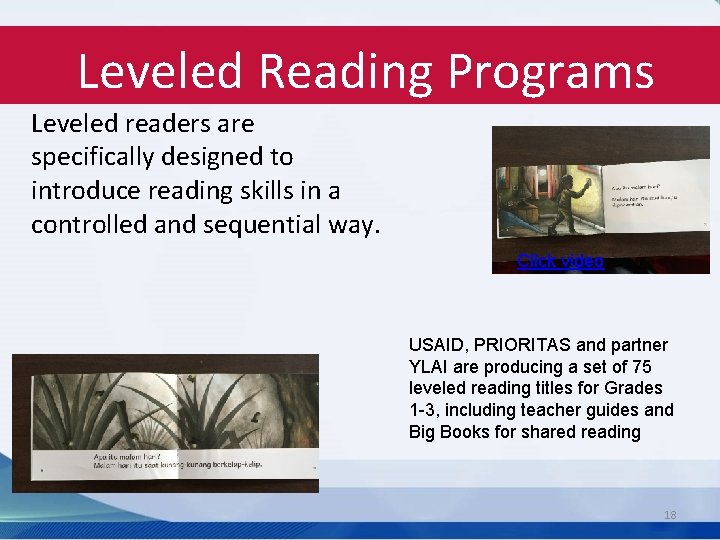
Leveled Reading Programs Leveled readers are specifically designed to introduce reading skills in a controlled and sequential way. Click video USAID, PRIORITAS and partner YLAI are producing a set of 75 leveled reading titles for Grades 1 -3, including teacher guides and Big Books for shared reading 18
How do we improve the teaching of reading? • Reading for enjoyment and developing a culture of reading is also a key focus of the PRIORITAS program. • Parent support and interesting reading material needed to improve reading habits • Packages of 150 high interest books have been provided to each project school. 19
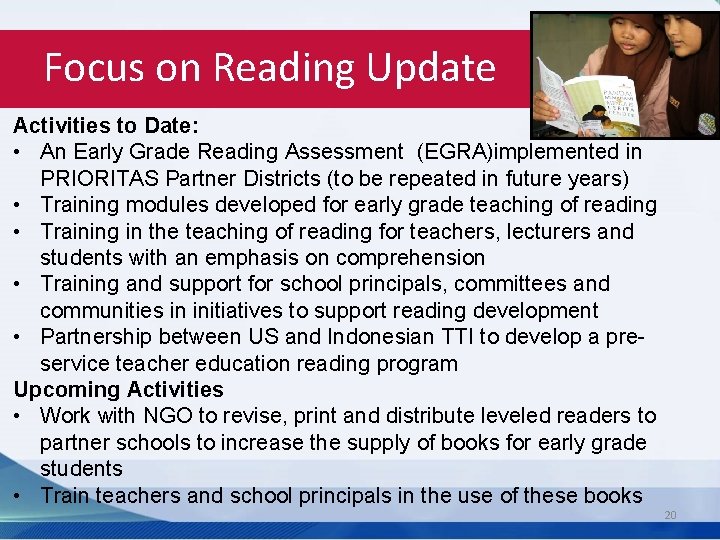
Focus on Reading Update Activities to Date: • An Early Grade Reading Assessment (EGRA)implemented in PRIORITAS Partner Districts (to be repeated in future years) • Training modules developed for early grade teaching of reading • Training in the teaching of reading for teachers, lecturers and students with an emphasis on comprehension • Training and support for school principals, committees and communities in initiatives to support reading development • Partnership between US and Indonesian TTI to develop a preservice teacher education reading program Upcoming Activities • Work with NGO to revise, print and distribute leveled readers to partner schools to increase the supply of books for early grade students • Train teachers and school principals in the use of these books 20
USAID PRIORITAS INFORMATION Jakarta Office: Ratu Plaza Office Tower, 25 th Floor, Jl. Jenderal Sudirman Kav 9, Jakarta 10270 Phone: +6221 -7227998, Fax: +6221 -7227879 Mobile: +628113408575 Email: usaidprioritas@prioritas. or. id www. prioritaspendidikan. org 21
- Slides: 21