
USAID COOPERATION FOR GROWTH PROJECT FROM CHANGING REGULATION

- Slides: 12
USAID COOPERATION FOR GROWTH PROJECT: FROM CHANGING REGULATION TO CHANGING BEHAVIORS 1
USAID COOPERATION FOR GROWTH PROJECT INTRODUCTION • A four year project (2018 -2022) dedicated to assisting the Government and inspections in the implementation of reforms in the business environment and access to finance • Continuance of USAID Business Enabling Project (BEP) 2011 -2017, that helped development and adoption of the Law on Inspection Oversight • Focus on outcomes and the impact of reforms on SME growth throughout Serbia • Reform initiatives will serve as the platform for seeking a broader change in attitudes and behaviors among public and private stakeholders in order to achieve a higher level of trust and cooperation. • Communication, promoting cooperation, creating incentives and monitoring outcomes will play a primary role in generating and reporting results • Key for success are the efforts and devotion of the ministries, governmental bodies and inspections to achieve reform goals! 10/23/2021 2
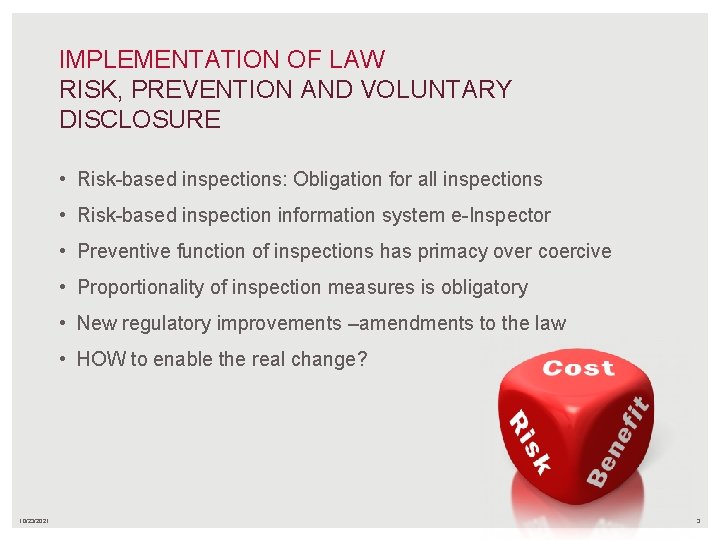
IMPLEMENTATION OF LAW RISK, PREVENTION AND VOLUNTARY DISCLOSURE • Risk-based inspections: Obligation for all inspections • Risk-based inspection information system e-Inspector • Preventive function of inspections has primacy over coercive • Proportionality of inspection measures is obligatory • New regulatory improvements –amendments to the law • HOW to enable the real change? 10/23/2021 3
IMPLEMENTATION TO DATE SURVEY 2018 • Survey 2018: 111 inspectors in 8 municipalities: sanitary, market, agriculture and labor: – 78% of inspectors claim that they conduct risk based inspections – 58% of trained inspectors claim improvements due to the new regulation, versus 20% of those who did not receive any training – Vast majority-over 80% - complains that they have “more work to do” and that it did not simplify their work – Average number of inspections per inspector is still 196 – More than half interviewed inspectors stated that businesses are more cooperative and that small businesses are viewing inspections more favorably – Only 1. 8% inspectors have conducted advisory visits 10/23/2021 4
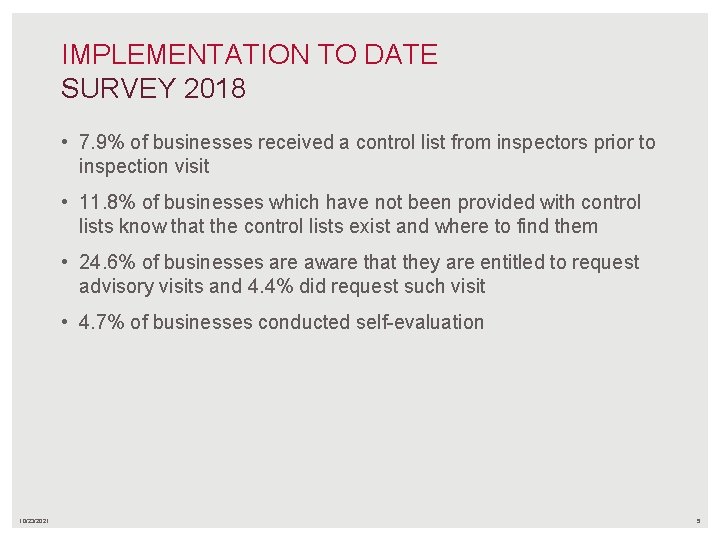
IMPLEMENTATION TO DATE SURVEY 2018 • 7. 9% of businesses received a control list from inspectors prior to inspection visit • 11. 8% of businesses which have not been provided with control lists know that the control lists exist and where to find them • 24. 6% of businesses are aware that they are entitled to request advisory visits and 4. 4% did request such visit • 4. 7% of businesses conducted self-evaluation 10/23/2021 5
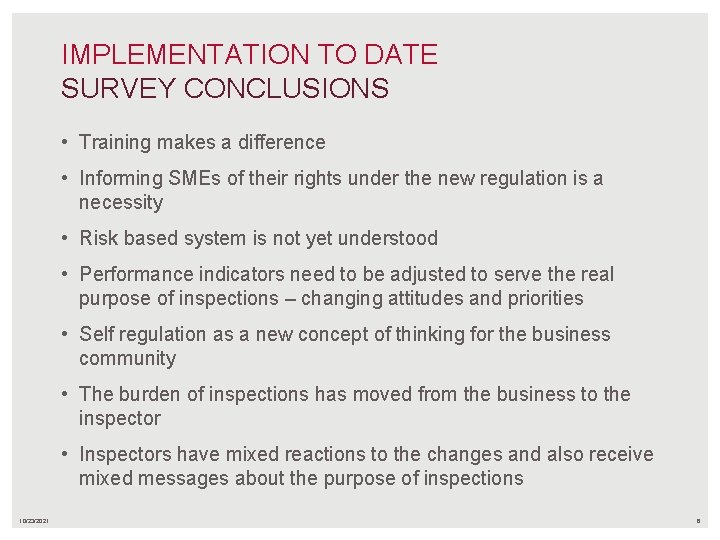
IMPLEMENTATION TO DATE SURVEY CONCLUSIONS • Training makes a difference • Informing SMEs of their rights under the new regulation is a necessity • Risk based system is not yet understood • Performance indicators need to be adjusted to serve the real purpose of inspections – changing attitudes and priorities • Self regulation as a new concept of thinking for the business community • The burden of inspections has moved from the business to the inspector • Inspectors have mixed reactions to the changes and also receive mixed messages about the purpose of inspections 10/23/2021 6
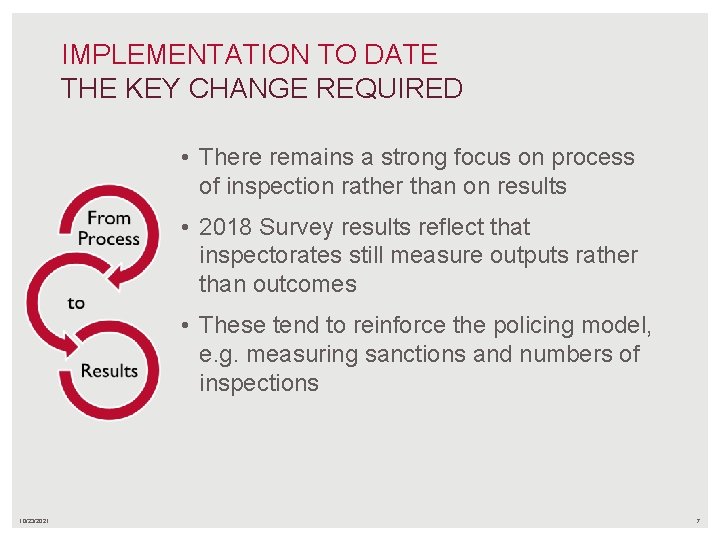
IMPLEMENTATION TO DATE THE KEY CHANGE REQUIRED • There remains a strong focus on process of inspection rather than on results • 2018 Survey results reflect that inspectorates still measure outputs rather than outcomes • These tend to reinforce the policing model, e. g. measuring sanctions and numbers of inspections 10/23/2021 7
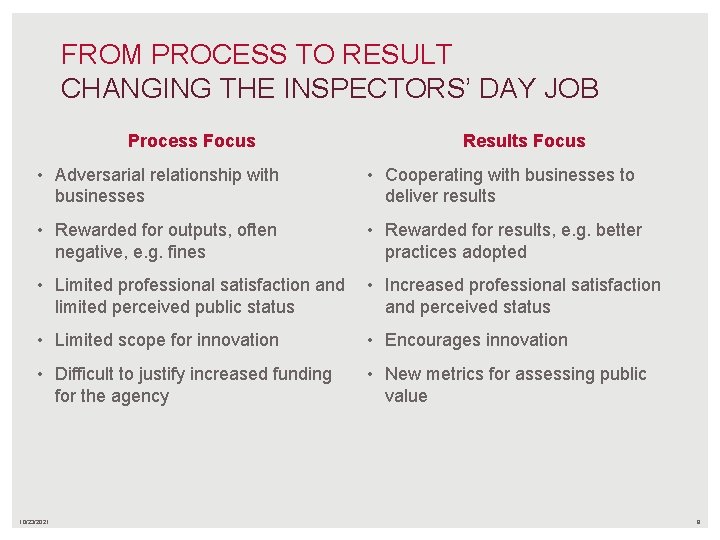
FROM PROCESS TO RESULT CHANGING THE INSPECTORS’ DAY JOB Process Focus Results Focus • Adversarial relationship with businesses • Cooperating with businesses to deliver results • Rewarded for outputs, often negative, e. g. fines • Rewarded for results, e. g. better practices adopted • Limited professional satisfaction and limited perceived public status • Increased professional satisfaction and perceived status • Limited scope for innovation • Encourages innovation • Difficult to justify increased funding for the agency • New metrics for assessing public value 10/23/2021 8
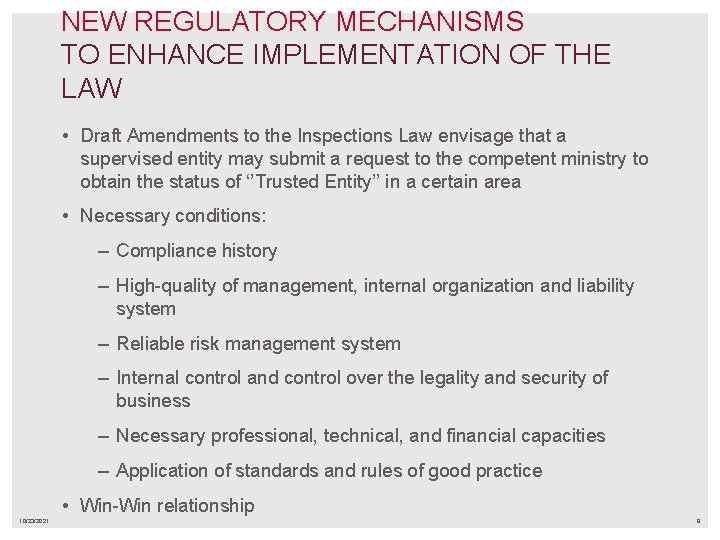
NEW REGULATORY MECHANISMS TO ENHANCE IMPLEMENTATION OF THE LAW • Draft Amendments to the Inspections Law envisage that a supervised entity may submit a request to the competent ministry to obtain the status of ‘’Trusted Entity’’ in a certain area • Necessary conditions: – Compliance history – High-quality of management, internal organization and liability system – Reliable risk management system – Internal control and control over the legality and security of business – Necessary professional, technical, and financial capacities – Application of standards and rules of good practice • Win-Win relationship 10/23/2021 9
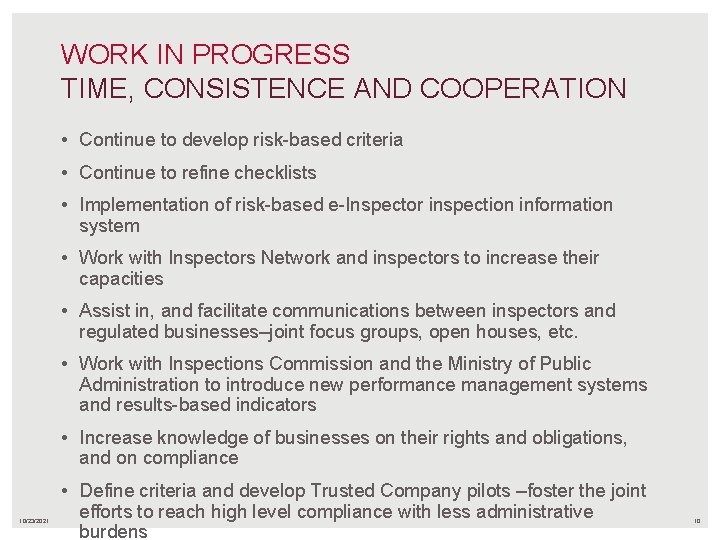
WORK IN PROGRESS TIME, CONSISTENCE AND COOPERATION • Continue to develop risk-based criteria • Continue to refine checklists • Implementation of risk-based e-Inspector inspection information system • Work with Inspectors Network and inspectors to increase their capacities • Assist in, and facilitate communications between inspectors and regulated businesses–joint focus groups, open houses, etc. • Work with Inspections Commission and the Ministry of Public Administration to introduce new performance management systems and results-based indicators • Increase knowledge of businesses on their rights and obligations, and on compliance 10/23/2021 • Define criteria and develop Trusted Company pilots –foster the joint efforts to reach high level compliance with less administrative burdens 10
USAID COOPERATION FOR GROWTH PROJECT QUESTIONS? dstanojevic@saradnja. rs azaric@saradnja. rs 10/23/2021 11
THANK YOU FOR YOUR ATTENTION The Serbian delegation 12