
Usability testing and field studies Text p 429
Usability testing and field studies Text p 429 - 447 Text p 646 - 683
Usability testing • Involves recording performance of typical users doing typical tasks. • Controlled environmental settings. • Users are observed and timed. • Data is recorded on video & key presses are logged. • The data is used to calculate performance times, and to identify & explain errors. • User satisfaction is evaluated using questionnaires & interviews. • Field observations may be used to provide contextual understanding.
Experiments & usability testing • Experiments test hypotheses to discover new knowledge by investigating the relationship between two or more things – i. e. , variables. • Usability testing is applied experimentation. • Developers check that the system is usable by the intended user population for their tasks. • Experiments may also be done in usability testing.
Usability testing & research Usability testing • • Improve products Few participants Results inform design Usually not completely replicable • Conditions controlled as much as possible • Procedure planned • Results reported to developers • • Experiments for research Discover knowledge Many participants Results validated statistically Must be replicable Strongly controlled conditions Experimental design Scientific reported to scientific community
Usability testing • Goals & questions focus on how well users perform tasks with the product. • Comparison of products or prototypes common. • Focus is on time to complete task & number & type of errors. • Data collected by video & interaction logging. • Testing is central. • User satisfaction questionnaires & interviews provide data about users’ opinions.
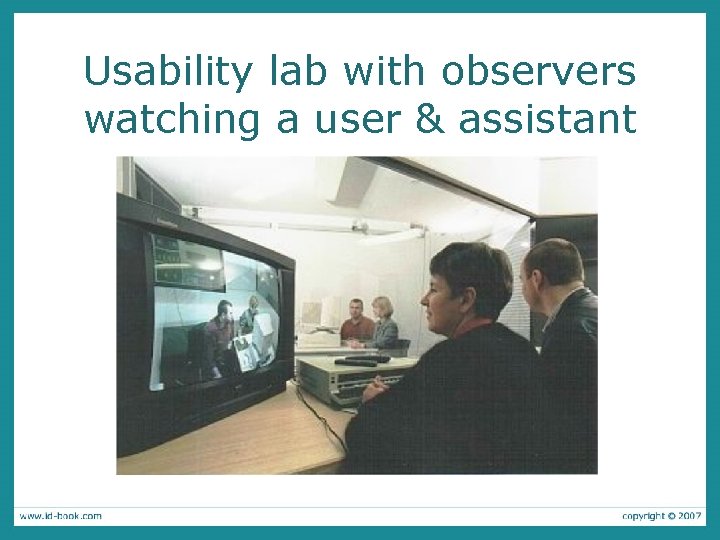
Usability lab with observers watching a user & assistant
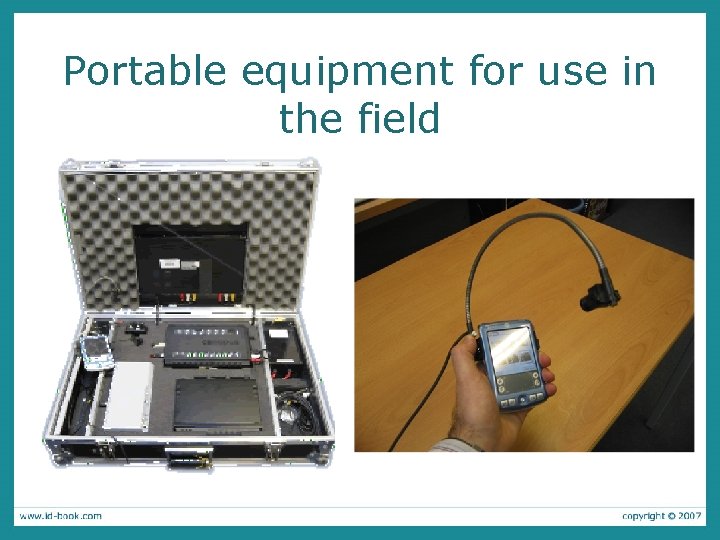
Portable equipment for use in the field
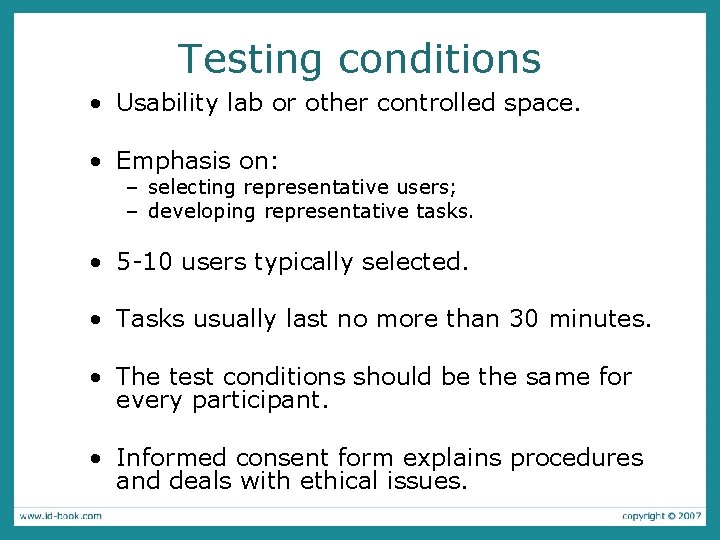
Testing conditions • Usability lab or other controlled space. • Emphasis on: – selecting representative users; – developing representative tasks. • 5 -10 users typically selected. • Tasks usually last no more than 30 minutes. • The test conditions should be the same for every participant. • Informed consent form explains procedures and deals with ethical issues.
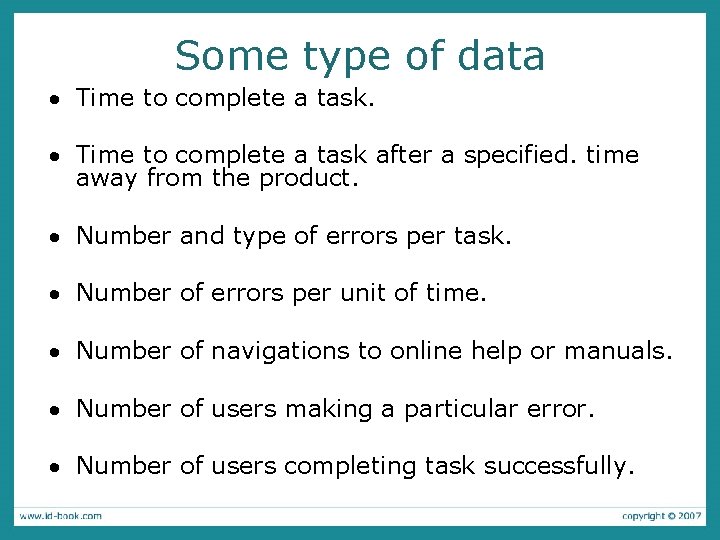
Some type of data · Time to complete a task after a specified. time away from the product. · Number and type of errors per task. · Number of errors per unit of time. · Number of navigations to online help or manuals. · Number of users making a particular error. · Number of users completing task successfully.
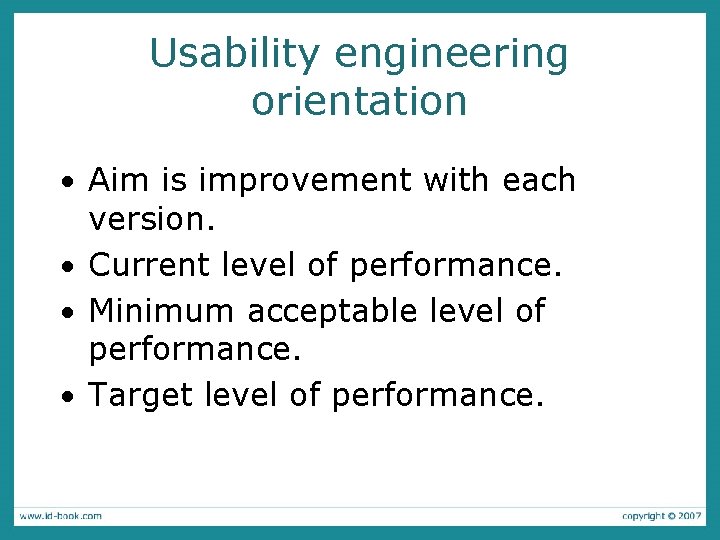
Usability engineering orientation · Aim is improvement with each version. · Current level of performance. · Minimum acceptable level of performance. · Target level of performance.
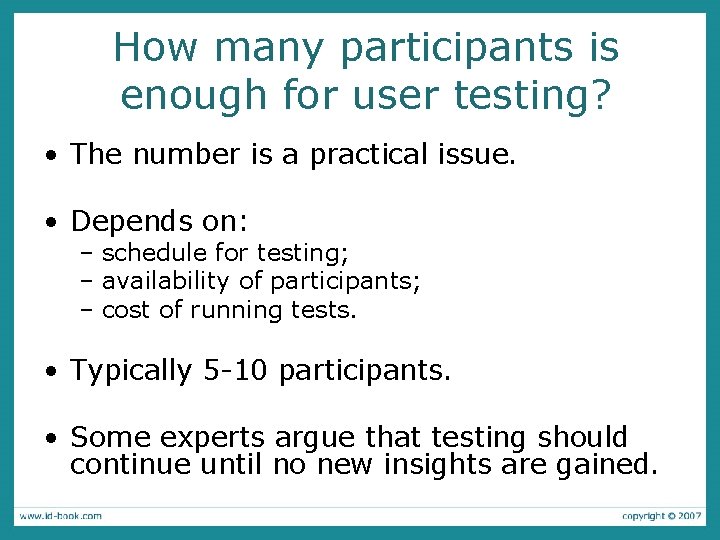
How many participants is enough for user testing? • The number is a practical issue. • Depends on: – schedule for testing; – availability of participants; – cost of running tests. • Typically 5 -10 participants. • Some experts argue that testing should continue until no new insights are gained.
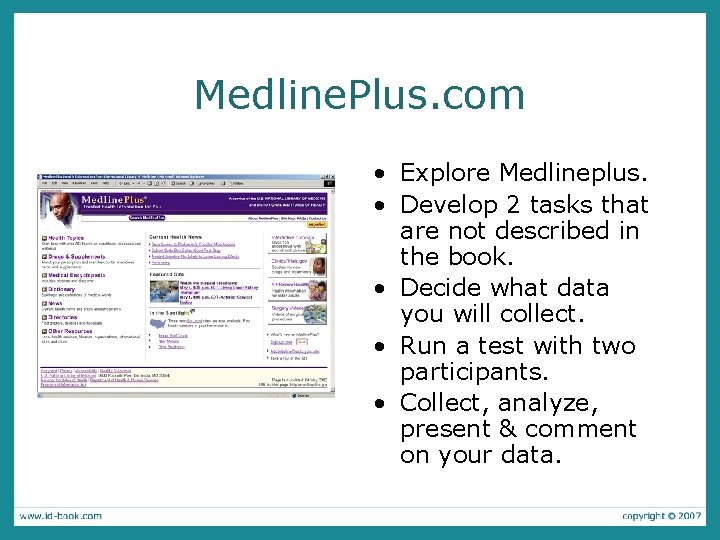
Medline. Plus. com • Explore Medlineplus. • Develop 2 tasks that are not described in the book. • Decide what data you will collect. • Run a test with two participants. • Collect, analyze, present & comment on your data.
Experiments • Predict the relationship between two or more variables. • Independent variable is manipulated by the researcher. • Dependent variable depends on the independent variable. • Typical experimental designs have one or two independent variable.
Experimental designs • Different participants - single group of participants is allocated randomly to the experimental conditions. • Same participants - all participants appear in both conditions. • Matched participants - participants are matched in pairs, e. g. , based on expertise, gender, etc.
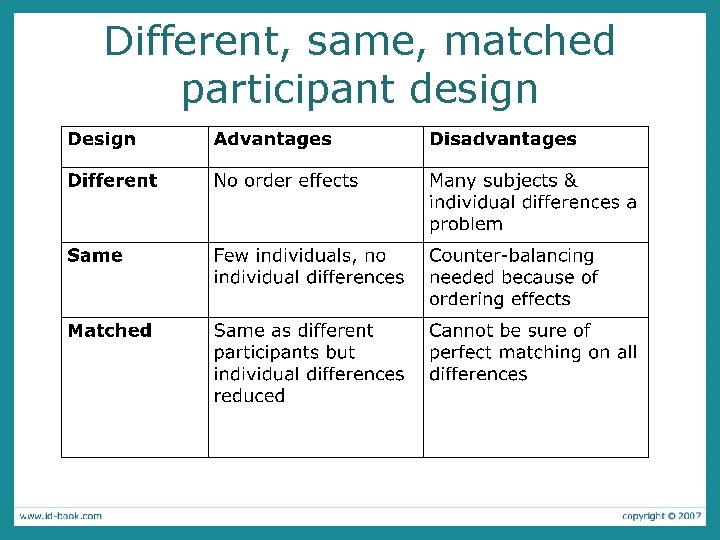
Different, same, matched participant design
Field studies • Field studies are done in natural settings. • The aim is to understand what users do naturally and how technology impacts them. • Field studies can be used in product design to: - identify opportunities for new technology; - determine design requirements; - decide how best to introduce new technology; - evaluate technology in use.
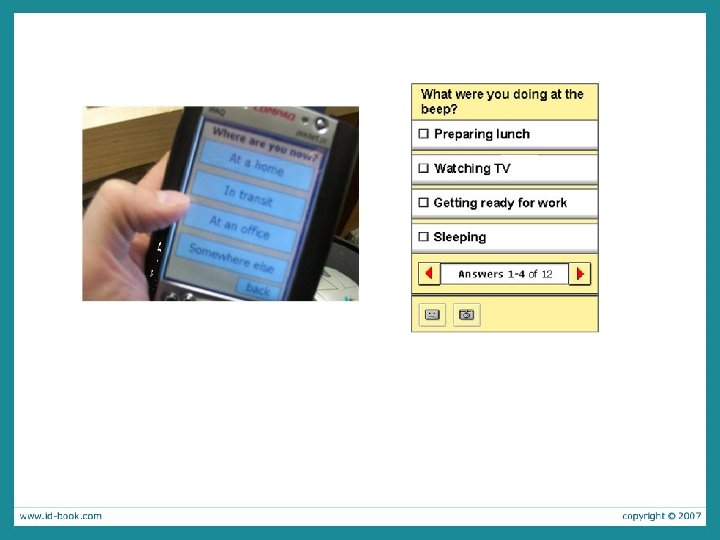
Data collection & analysis • Observation & interviews – Notes, pictures, recordings – Video – Logging • Analyses – Categorized – Categories can be provided by theory • Grounded theory • Activity theory
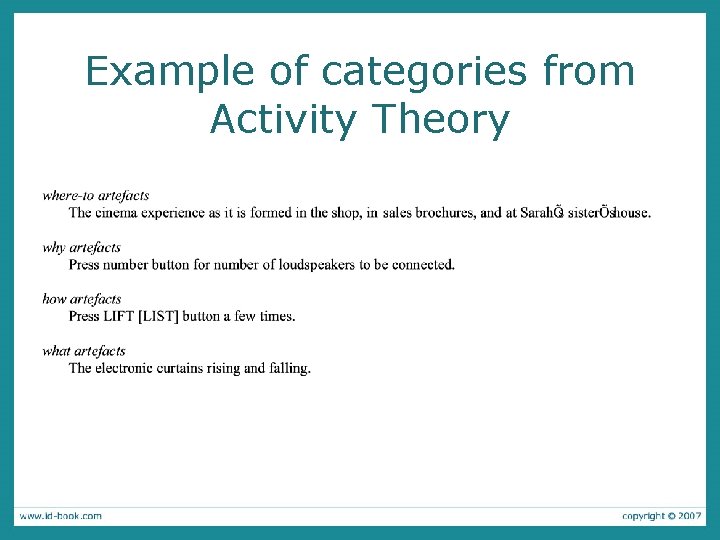
Example of categories from Activity Theory
Key points · Testing is a central part of usability testing. · Usability testing is done in controlled conditions. · Usability testing is an adapted form of experimentation. · Experiments aim to test hypotheses by manipulating certain variables while keeping others constant. · The experimenter controls the independent variable(s) but not the dependent variable(s). · There are three types of experimental design: differentparticipants, same- participants, & matched participants. · Field studies are done in natural environments. · Typically observation and interviews are used to collect field studies data. · Categorization and theory-based techniques are used to analyze the data.
- Slides: 21