
US InCountry National Adaptation Plan Support Program DRAFT


- Slides: 30
US In-Country National Adaptation Plan Support Program DRAFT NCCAS Resource Mobilisation Strategy Workshop 17 July 2020
Agenda ● ● Welcome - Sibonelo Mbanjwa Presentation of the draft Resource Mobilisation Strategy Comments and Discussion Closure and Thanks - Sibonelo Mbanjwa
Welcome
Introductions
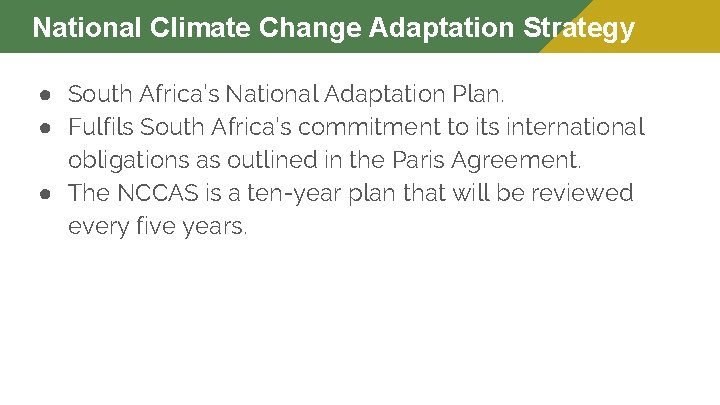
National Climate Change Adaptation Strategy ● South Africa’s National Adaptation Plan. ● Fulfils South Africa’s commitment to its international obligations as outlined in the Paris Agreement. ● The NCCAS is a ten-year plan that will be reviewed every five years.
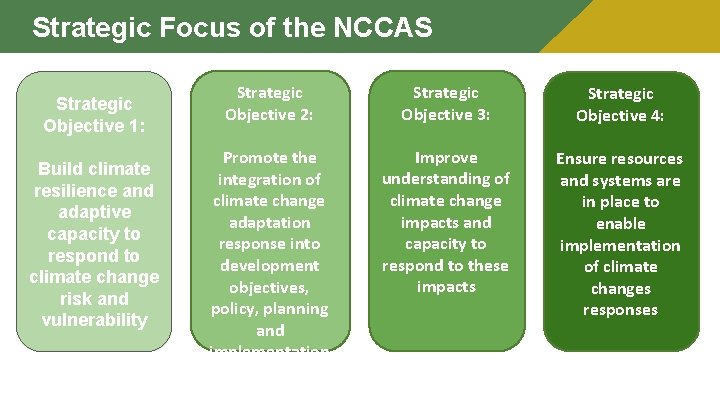
Strategic Focus of the NCCAS Strategic Objective 1: Build climate resilience and adaptive capacity to respond to climate change risk and vulnerability Strategic Objective 2: Strategic Objective 3: Strategic Objective 4: Promote the integration of climate change adaptation response into development objectives, policy, planning and implementation Improve understanding of climate change impacts and capacity to respond to these impacts Ensure resources and systems are in place to enable implementation of climate changes responses
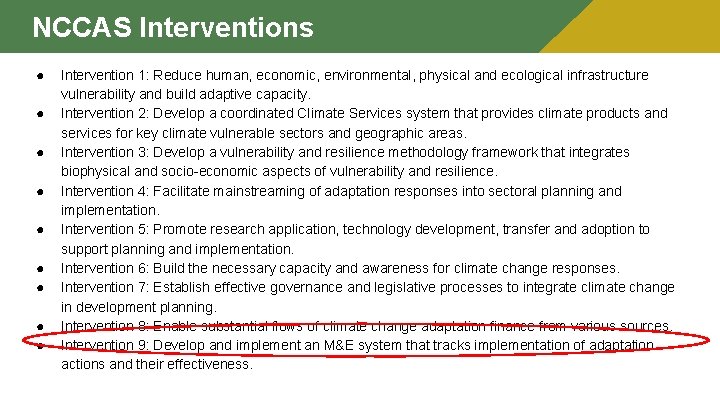
NCCAS Interventions ● ● ● ● ● Intervention 1: Reduce human, economic, environmental, physical and ecological infrastructure vulnerability and build adaptive capacity. Intervention 2: Develop a coordinated Climate Services system that provides climate products and services for key climate vulnerable sectors and geographic areas. Intervention 3: Develop a vulnerability and resilience methodology framework that integrates biophysical and socio-economic aspects of vulnerability and resilience. Intervention 4: Facilitate mainstreaming of adaptation responses into sectoral planning and implementation. Intervention 5: Promote research application, technology development, transfer and adoption to support planning and implementation. Intervention 6: Build the necessary capacity and awareness for climate change responses. Intervention 7: Establish effective governance and legislative processes to integrate climate change in development planning. Intervention 8: Enable substantial flows of climate change adaptation finance from various sources. Intervention 9: Develop and implement an M&E system that tracks implementation of adaptation actions and their effectiveness.
Aim of the Resource Mobilisation Strategy ● Summarise the different options for financing the implementation of the NACCS ● Provide recommendations to mobilise different sources of finance to implement the NACCS between now and 2030
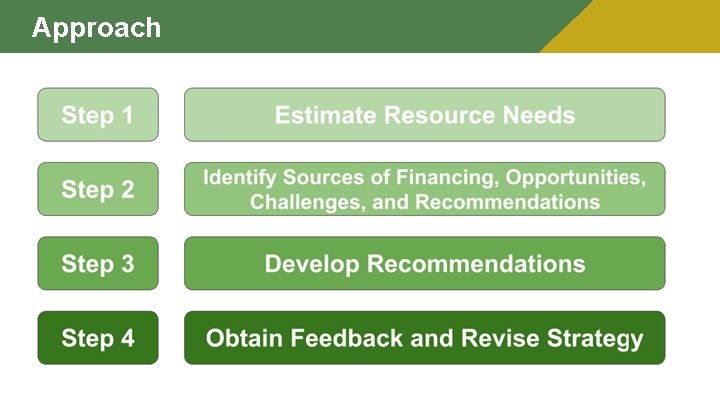
Approach
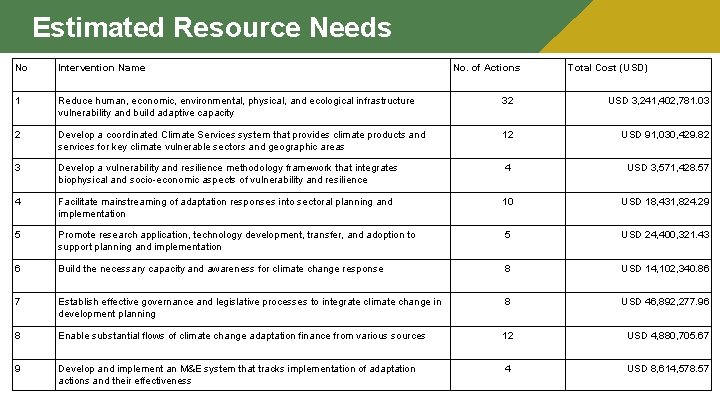
Estimated Resource Needs Initial Cost Estimate for Implementation of the National Climate Change Adaptation Strategy- Republic of South Africa was completed last year. The total cost estimate for the implementation of the NCCAS using a ten-year time horizon was: ● USD 3. 49 billion (before adjustment for inflation) ● USD 4. 69 billion (after adjustment for inflation)
Estimated Resource Needs No Intervention Name No. of Actions Total Cost (USD) 1 Reduce human, economic, environmental, physical, and ecological infrastructure vulnerability and build adaptive capacity 32 USD 3, 241, 402, 781. 03 2 Develop a coordinated Climate Services system that provides climate products and services for key climate vulnerable sectors and geographic areas 12 USD 91, 030, 429. 82 3 Develop a vulnerability and resilience methodology framework that integrates biophysical and socio-economic aspects of vulnerability and resilience 4 USD 3, 571, 428. 57 4 Facilitate mainstreaming of adaptation responses into sectoral planning and implementation 10 USD 18, 431, 824. 29 5 Promote research application, technology development, transfer, and adoption to support planning and implementation 5 USD 24, 400, 321. 43 6 Build the necessary capacity and awareness for climate change response 8 USD 14, 102, 340. 86 7 Establish effective governance and legislative processes to integrate climate change in development planning 8 USD 46, 892, 277. 96 8 Enable substantial flows of climate change adaptation finance from various sources 12 USD 4, 880, 705. 67 9 Develop and implement an M&E system that tracks implementation of adaptation actions and their effectiveness 4 USD 8, 614, 578. 57
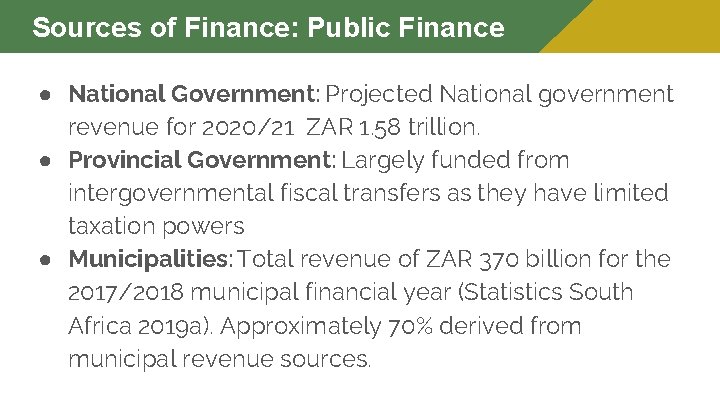
Sources of Finance: Public Finance ● National Government: Projected National government revenue for 2020/21 ZAR 1. 58 trillion. ● Provincial Government: Largely funded from intergovernmental fiscal transfers as they have limited taxation powers ● Municipalities: Total revenue of ZAR 370 billion for the 2017/2018 municipal financial year (Statistics South Africa 2019 a). Approximately 70% derived from municipal revenue sources.
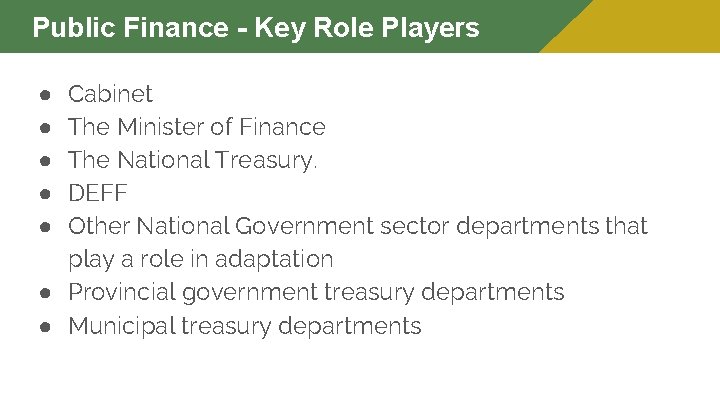
Public Finance - Key Role Players Cabinet The Minister of Finance The National Treasury. DEFF Other National Government sector departments that play a role in adaptation ● Provincial government treasury departments ● Municipal treasury departments ● ● ●
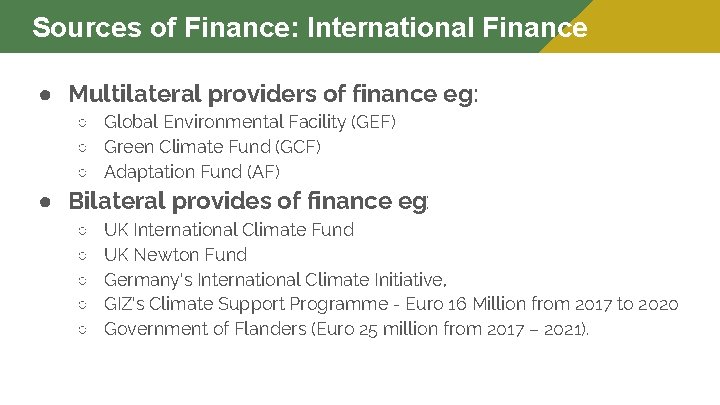
Sources of Finance: International Finance ● Multilateral providers of finance eg: ○ Global Environmental Facility (GEF) ○ Green Climate Fund (GCF) ○ Adaptation Fund (AF) ● Bilateral provides of finance eg: ○ ○ ○ UK International Climate Fund UK Newton Fund Germany’s International Climate Initiative, GIZ’s Climate Support Programme - Euro 16 Million from 2017 to 2020 Government of Flanders (Euro 25 million from 2017 – 2021).
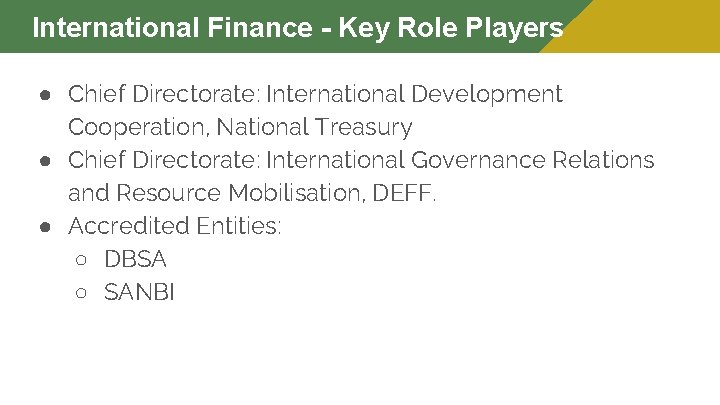
International Finance - Key Role Players ● Chief Directorate: International Development Cooperation, National Treasury ● Chief Directorate: International Governance Relations and Resource Mobilisation, DEFF. ● Accredited Entities: ○ DBSA ○ SANBI
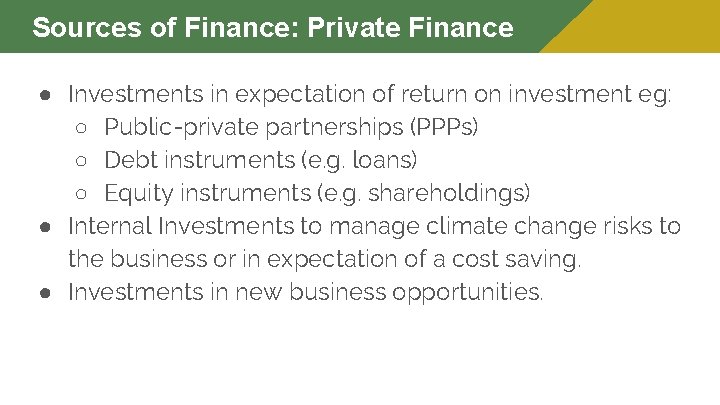
Sources of Finance: Private Finance ● Investments in expectation of return on investment eg: ○ Public-private partnerships (PPPs) ○ Debt instruments (e. g. loans) ○ Equity instruments (e. g. shareholdings) ● Internal Investments to manage climate change risks to the business or in expectation of a cost saving. ● Investments in new business opportunities.
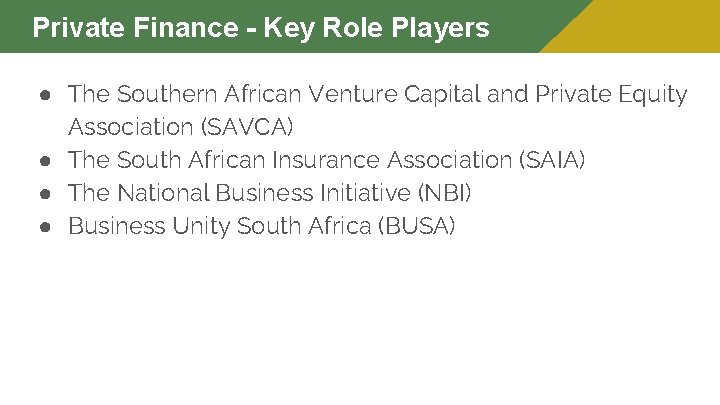
Private Finance - Key Role Players ● The Southern African Venture Capital and Private Equity Association (SAVCA) ● The South African Insurance Association (SAIA) ● The National Business Initiative (NBI) ● Business Unity South Africa (BUSA)
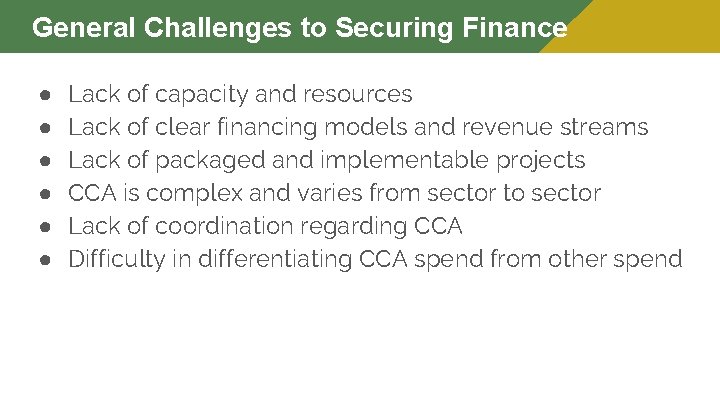
General Challenges to Securing Finance ● ● ● Lack of capacity and resources Lack of clear financing models and revenue streams Lack of packaged and implementable projects CCA is complex and varies from sector to sector Lack of coordination regarding CCA Difficulty in differentiating CCA spend from other spend
Challenges to Securing Public Finance ● Lack of available public sector financing: ○ There has been a decline in National Government revenue. ○ Many municipalities have a revenue deficit and struggle to provide basic services ○ There are competing spending priorities. ○ COVID-19 Pandemic ● CCA largely unfunded mandate ● Limited understanding of key government decisionmakers ● Benefits of CCA actions sometimes difficult to quantify
Challenges to Securing International Finance ● ● ● ● ● Expected reduction in international finance due to Covid-19 SA considered a middle-income country by many donors Shift away from grants towards loans The limited pool of Accredited Entities in South Africa Contracting and procurement obstacles for municipalities Competition for funds Complexity of the application process Difficulty in aligning to donor requirements Benefits of CCA actions are sometimes difficult to quantify
Challenges to Securing Private Finance ● A drop in the availability of corporate social investment financing ● Municipal Finance Management Act (No. 56 of 2003) ● Limited availability of private equity and venture capital ● The complexity of public-private partnerships
General Opportunities for Securing Finance ● Existing capacity and resources ● Income-generating potential of select CCA actions
Opportunities for Securing Public Finance ● CC highlighted in the 2019 – 2024 MTSF ● National Treasury is active in addressing CC ● Finances available in sector department budgets
Opportunities for Securing International Finance ● Existing accredited entities in South Africa ● GCF Readiness and NAP support financing are available ● DBSA’s finance facilities ● Leverage public sector finance to access international finance
Opportunities for Securing Private Finance ● Private Sector Funders active in SA ● The private sector has a vested interested in CCA ● Leverage public sector finance to attract private sector finance
Recommendations 1 - 6 ● ● ● Recommendation 1: Establish a finance sub-committee of the Intergovernmental Committee on Climate Change (IGCCC). Recommendation 2: Mainstream further NCCAS priorities (including considerations of CCA related to gender and vulnerable communities) into MTSF Recommendation 3: Use the National Committee on Climate Change to promote liaison between Government and key Private Sector stakeholders focussed on CC finance. Recommendation 4: Continue to secure financing to top up the budget of DEFF CCA Chief Directorate. Recommendation 5: Expand DEFF's CCA Chief Directorate and DEFF's International Governance and Resource Mobilisation Chief Directorate to support CCA resource mobilisation actions. Recommendation 6: Establish a facility in DEFF’s Climate Change Adaptation Chief Directorate to support the identification and packaging of climate change adaptation projects.
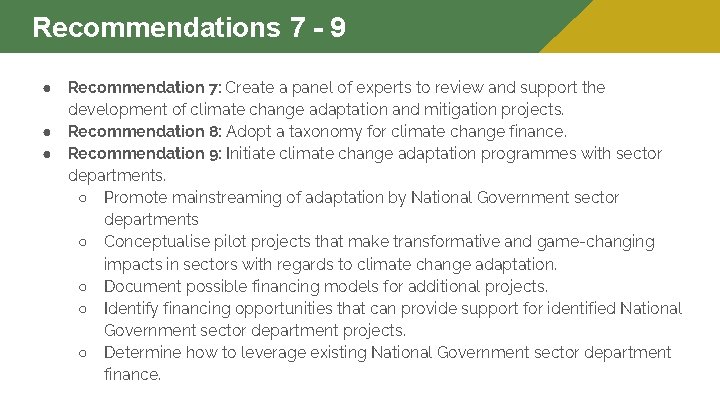
Recommendations 7 - 9 ● ● ● Recommendation 7: Create a panel of experts to review and support the development of climate change adaptation and mitigation projects. Recommendation 8: Adopt a taxonomy for climate change finance. Recommendation 9: Initiate climate change adaptation programmes with sector departments. ○ Promote mainstreaming of adaptation by National Government sector departments ○ Conceptualise pilot projects that make transformative and game-changing impacts in sectors with regards to climate change adaptation. ○ Document possible financing models for additional projects. ○ Identify financing opportunities that can provide support for identified National Government sector department projects. ○ Determine how to leverage existing National Government sector department finance.
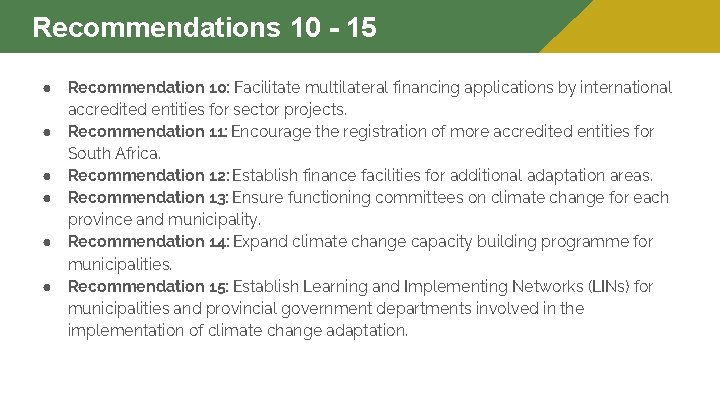
Recommendations 10 - 15 ● ● ● Recommendation 10: Facilitate multilateral financing applications by international accredited entities for sector projects. Recommendation 11: Encourage the registration of more accredited entities for South Africa. Recommendation 12: Establish finance facilities for additional adaptation areas. Recommendation 13: Ensure functioning committees on climate change for each province and municipality. Recommendation 14: Expand climate change capacity building programme for municipalities. Recommendation 15: Establish Learning and Implementing Networks (LINs) for municipalities and provincial government departments involved in the implementation of climate change adaptation.
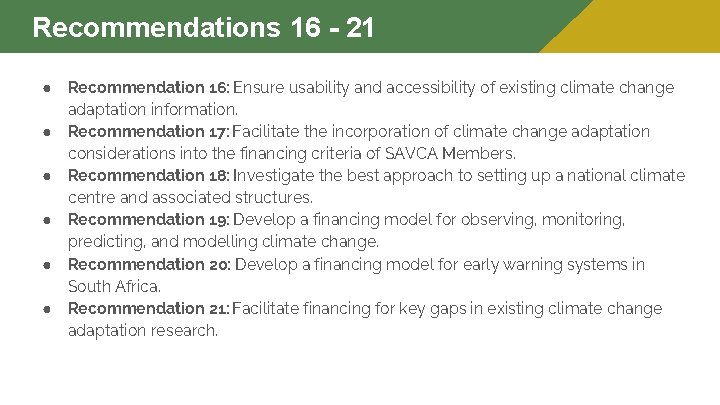
Recommendations 16 - 21 ● ● ● Recommendation 16: Ensure usability and accessibility of existing climate change adaptation information. Recommendation 17: Facilitate the incorporation of climate change adaptation considerations into the financing criteria of SAVCA Members. Recommendation 18: Investigate the best approach to setting up a national climate centre and associated structures. Recommendation 19: Develop a financing model for observing, monitoring, predicting, and modelling climate change. Recommendation 20: Develop a financing model for early warning systems in South Africa. Recommendation 21: Facilitate financing for key gaps in existing climate change adaptation research.
Thanks and Way Forward ● Minutes ● Written comments: 31 st July ● Final Draft