
US Government Unit One Chapter One Civics Today

- Slides: 17
US Government Unit One Chapter One – Civics Today
What is Civics? • Civics is the study of the rights and duties of citizens.
The Need for Government • What is a government? – A government is the ruling authority of a community. – A government has the power to make and enforce laws for its members or citizens.
The Need for Government • Thomas Hobbs claimed that without government, people would compete for territory, resources, and power. Fighting, then, would be common place, and survival would depend on both strength and cunning. • Government, therefore, can make it possible for people to live together peacefully and productively.
What are some key functions of government? • 1. Governments help to keep order and provide security – They make laws to help prevent conflicts among people and to settle conflicts that do arise – They set up armed forces and agencies to defend citizens and their land from enemies • 2. They provide services that would not be available without cooperation and coordination – To keep the public healthy and safe, and help the needy
What are some key functions of government? • 3. They guide the community by: – Setting public policy • A course of government action to achieve community goals – Formulating budgets • A plan for collecting and spending money – Developing relations with the community’s neighbors and other outsiders
Levels of Government • What are the levels of government in the US, from the broadest to the narrowest? – The National (Federal) Government • Has authority over the next two – The State Governments • Has authority over Local • Must submit to Federal – The Local Governments • Must submit to both State and Federal
Government in the US • The United States has a type of government that is known as a democracy. – This type of government rests the power in the hands of the people, not a single ruler, or even a group of rulers. • The word “democracy” comes from the Greek words: – Demos = people – Kratein = to rule • Ancient Greece was the birthplace of democracy
Government in the US • The United States is not a direct democracy – Meaning that, unlike ancient Athens, all citizens do not meet and debate government matters and vote firsthand • Citizens in the U. S. choose a smaller group to represent them, make laws, and govern on their behalf – This is known as a representative democracy
Government in the US • Democracies have free and open elections – Everyone’s vote carries the same weight • One person, one vote – All candidates have the right to express their views freely – Legal requirements for voting are kept to a minimum – Citizens may vote freely by secret ballot, without fear of punishment
5 Fundamental Principles of American Democracy 1. Rule of Law All people are bound by law – 2. Limited Government – The government may do only what the people give it power to do 3. Consent of the Governed – Citizens are the source of government power • And that, by voting
5 Fundamental Principles of American Democracy 4. Democracy – The people rule 5. Representative Government – People elect their leaders
America’s Citizens • The US Constitution (The Supreme Law of the Land in the United States), establishes two ways to become a citizen: – By birth – A process called naturalization (for foreigners)
America’s Citizens • You would automatically be a citizen if: – You were born in a state, D. C. , in an American territory, or on a US military base overseas • A child born abroad to American parents may hold dual citizenship • Children born on US soil to non-US citizens can acquire citizenship (except foreign diplomats). – American citizens hold their citizenship for life, unless they choose to give it up.
America’s Citizens Naturalization Process • Noncitizens (aliens) may become naturalized citizens – They may apply for citizenship after living in the U. S. for 5 years (3 years if married to a U. S. citizen) – Then they will have an interview with and INS agent (Immigration and Naturalization Service) – Then they can take the citizenship exam – If the INS decides to grant citizenship, the new citizen pledges allegiance to this country in a ceremony • The U. S. restricts the number of immigrants who can enter the country. Preference goes to relatives of U. S. citizens and people with needed skills
America’s Citizens • Every U. S. citizen today is a product of immigration • Today, Latin America accounts for the largest share of newcomers, followed by Asia • Hispanics are the fastest-growing ethnic group
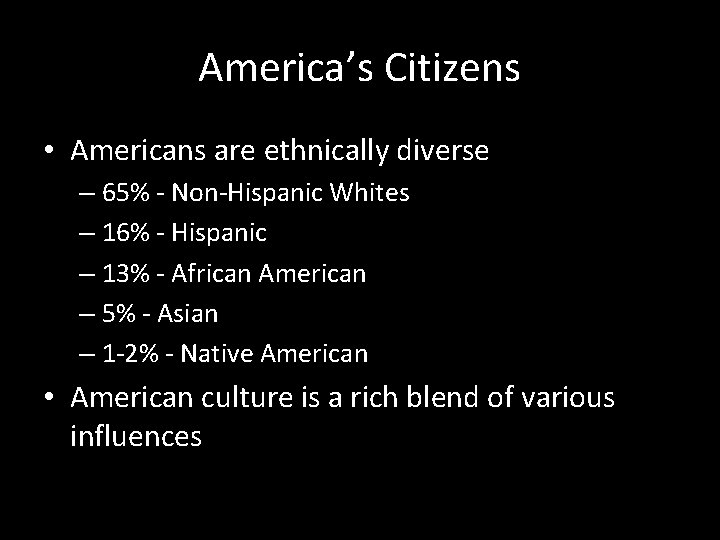
America’s Citizens • Americans are ethnically diverse – 65% - Non-Hispanic Whites – 16% - Hispanic – 13% - African American – 5% - Asian – 1 -2% - Native American • American culture is a rich blend of various influences