
US Congress Representation and Policy Making Constitutional Underpinnings
- Slides: 20
US Congress Representation and Policy Making
Constitutional Underpinnings for Representation • We have a republic – framers were concerned that a direct democracy could not control factions • Read Federalist #10 – Discuss in groups and then with the Class • Delegate Model v. Trustee Model • Delegate Model = act only as mouthpieces, follow the constituents, have no autonomy to make decisions • Trustee Model = constituents entrust representatives to make choices for them • Read the Delegate v. Trustee Model Article in Google Classroom and respond to the Comprehension questions
Bicameral Legislature • Framers purposefully created Congress and the Executive as two separate branches to stop one branch from being too powerful (separation of powers) – unlike a Parliament that selects the Prime Minister without an election • House and Senate were created during the Connecticut Compromise (The Great Compromise) because the House favors large states while the Senate favors small states • House – population based • Senate – 2 per state
Powers of Congress - Constitutional Enumerated • Taxes • Borrow Money • Regulate Commerce • Coin and Regulate Money • Post Offices • Patents • Declare War • Raise and Support Military Implied • Necessary and Proper Clause • Mc. Culloch v. Maryland • Commerce Clause • Gibbons v. Ogden – expands • Gonzalez v. Raich – expands • US v. Lopez - limits • US v. Morrison – limits
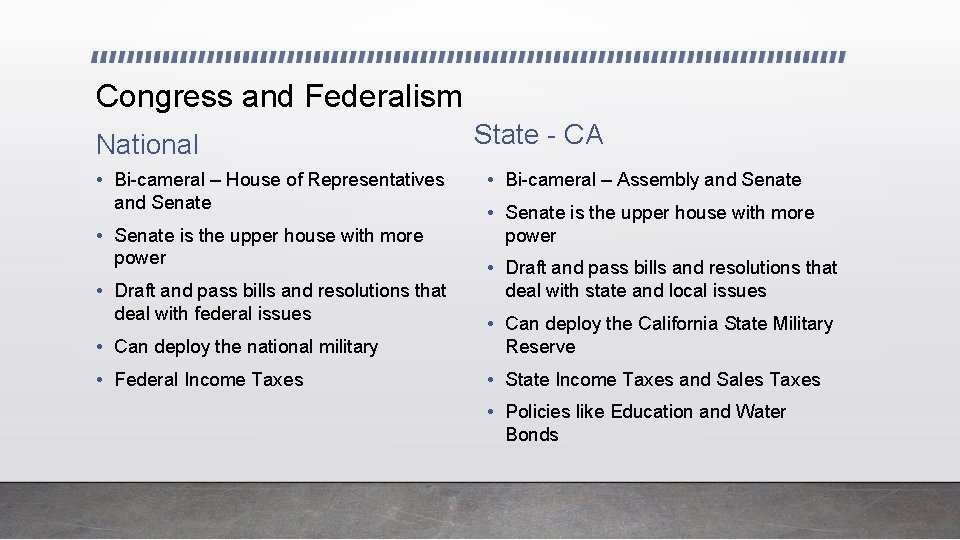
Congress and Federalism National • Bi-cameral – House of Representatives and Senate • Senate is the upper house with more power • Draft and pass bills and resolutions that deal with federal issues State - CA • Bi-cameral – Assembly and Senate • Senate is the upper house with more power • Draft and pass bills and resolutions that deal with state and local issues • Can deploy the national military • Can deploy the California State Military Reserve • Federal Income Taxes • State Income Taxes and Sales Taxes • Policies like Education and Water Bonds
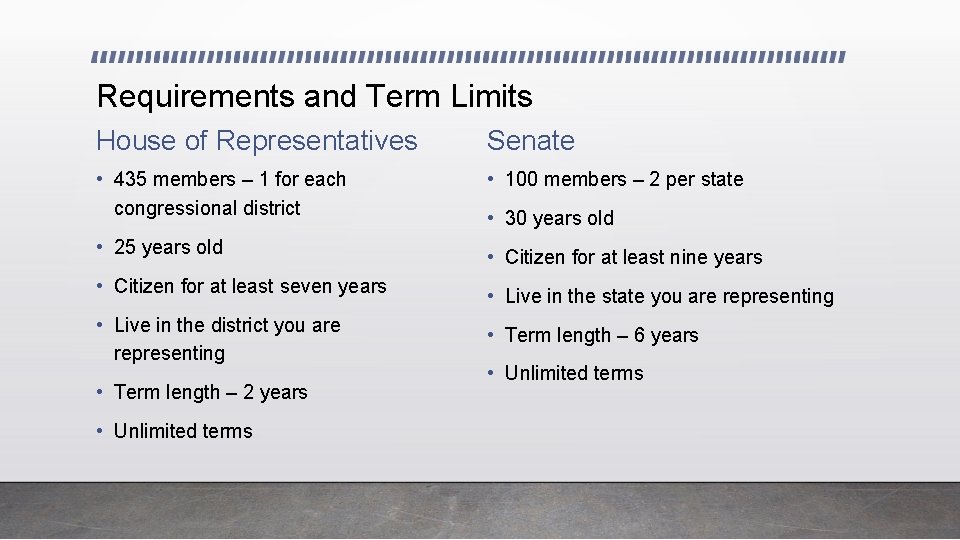
Requirements and Term Limits House of Representatives Senate • 435 members – 1 for each congressional district • 100 members – 2 per state • 25 years old • Citizen for at least nine years • Citizen for at least seven years • Live in the state you are representing • Live in the district you are representing • Term length – 6 years • Term length – 2 years • Unlimited terms • 30 years old • Unlimited terms
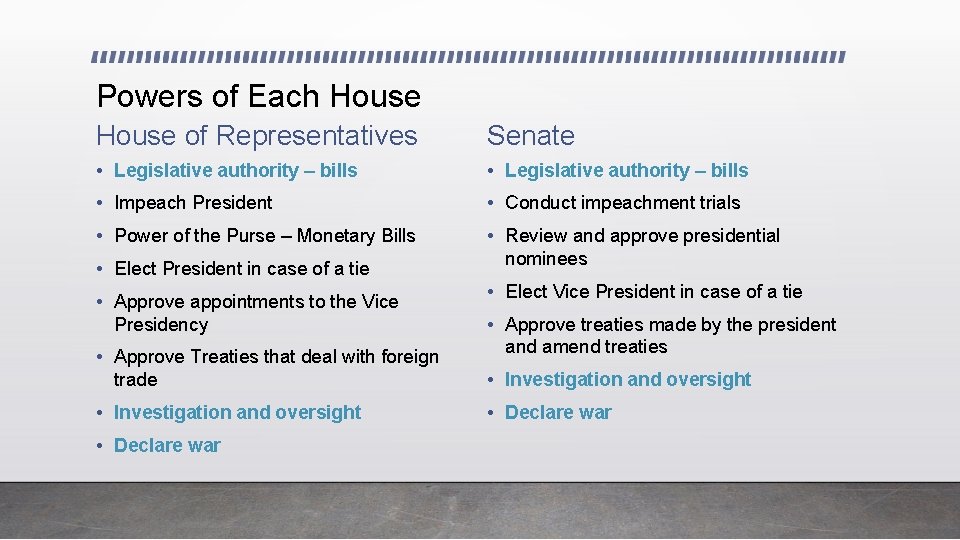
Powers of Each House of Representatives Senate • Legislative authority – bills • Impeach President • Conduct impeachment trials • Power of the Purse – Monetary Bills • Review and approve presidential nominees • Elect President in case of a tie • Approve appointments to the Vice Presidency • Approve Treaties that deal with foreign trade • Investigation and oversight • Declare war • Elect Vice President in case of a tie • Approve treaties made by the president and amend treaties • Investigation and oversight • Declare war
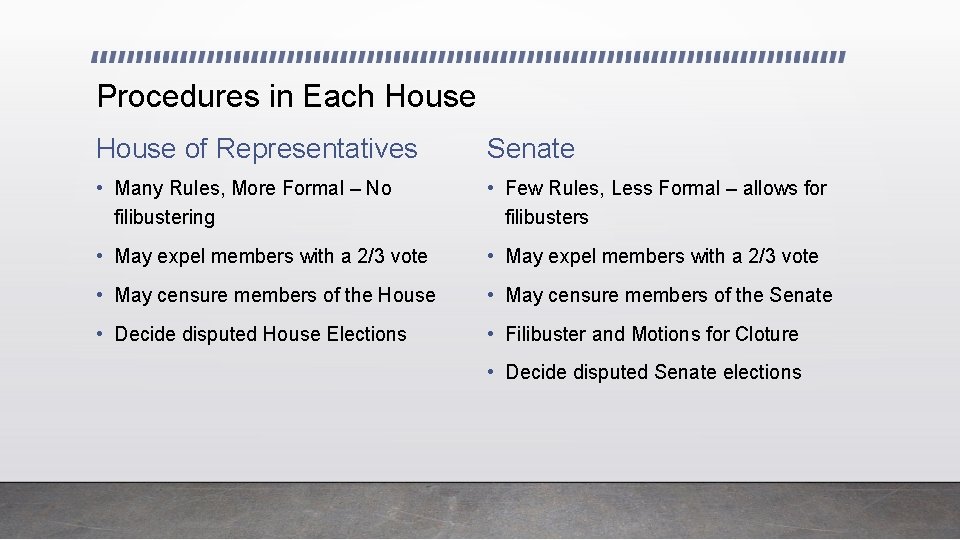
Procedures in Each House of Representatives Senate • Many Rules, More Formal – No filibustering • Few Rules, Less Formal – allows for filibusters • May expel members with a 2/3 vote • May censure members of the House • May censure members of the Senate • Decide disputed House Elections • Filibuster and Motions for Cloture • Decide disputed Senate elections
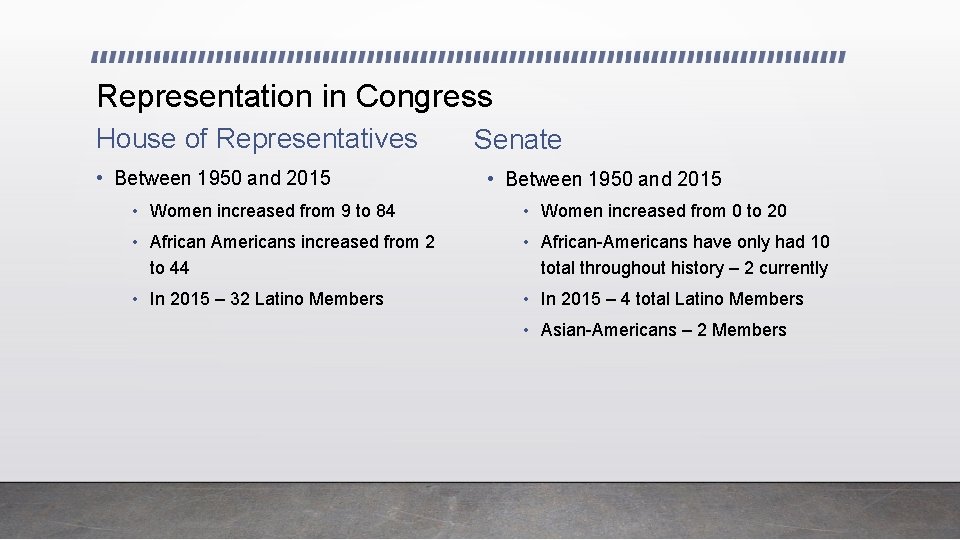
Representation in Congress House of Representatives • Between 1950 and 2015 Senate • Between 1950 and 2015 • Women increased from 9 to 84 • Women increased from 0 to 20 • African Americans increased from 2 to 44 • African-Americans have only had 10 total throughout history – 2 currently • In 2015 – 32 Latino Members • In 2015 – 4 total Latino Members • Asian-Americans – 2 Members
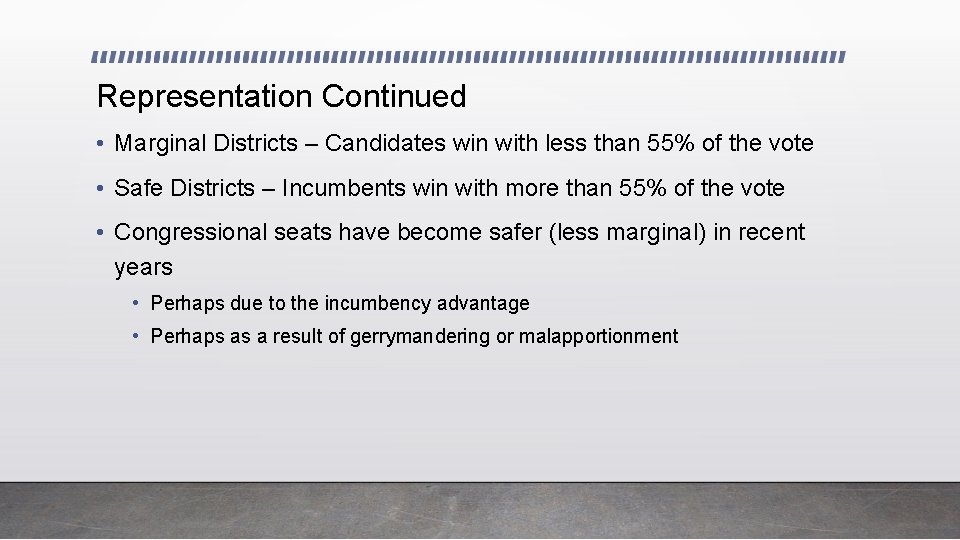
Representation Continued • Marginal Districts – Candidates win with less than 55% of the vote • Safe Districts – Incumbents win with more than 55% of the vote • Congressional seats have become safer (less marginal) in recent years • Perhaps due to the incumbency advantage • Perhaps as a result of gerrymandering or malapportionment
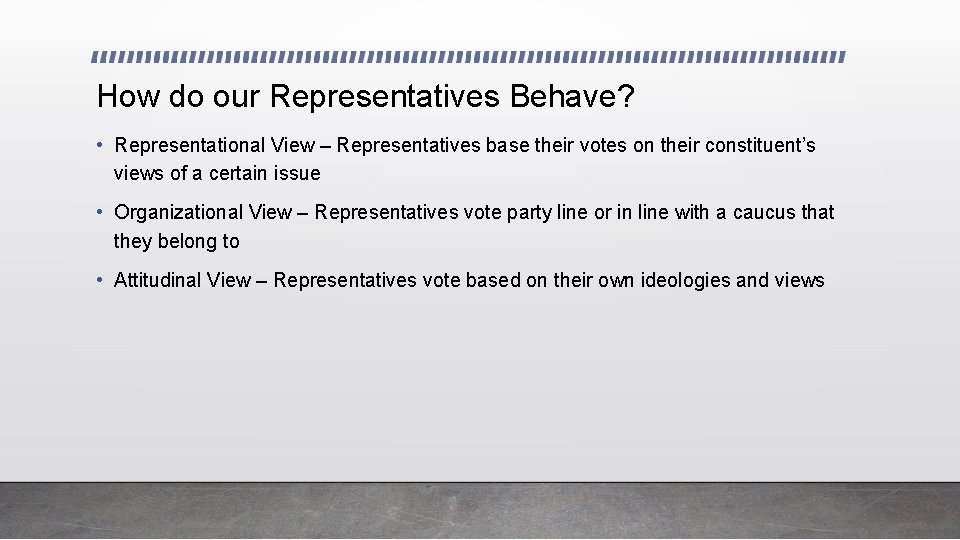
How do our Representatives Behave? • Representational View – Representatives base their votes on their constituent’s views of a certain issue • Organizational View – Representatives vote party line or in line with a caucus that they belong to • Attitudinal View – Representatives vote based on their own ideologies and views
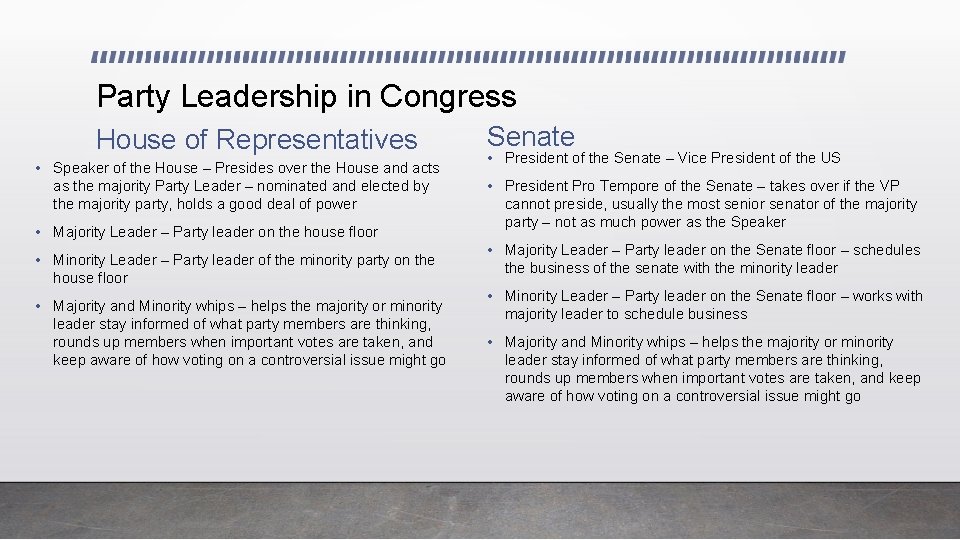
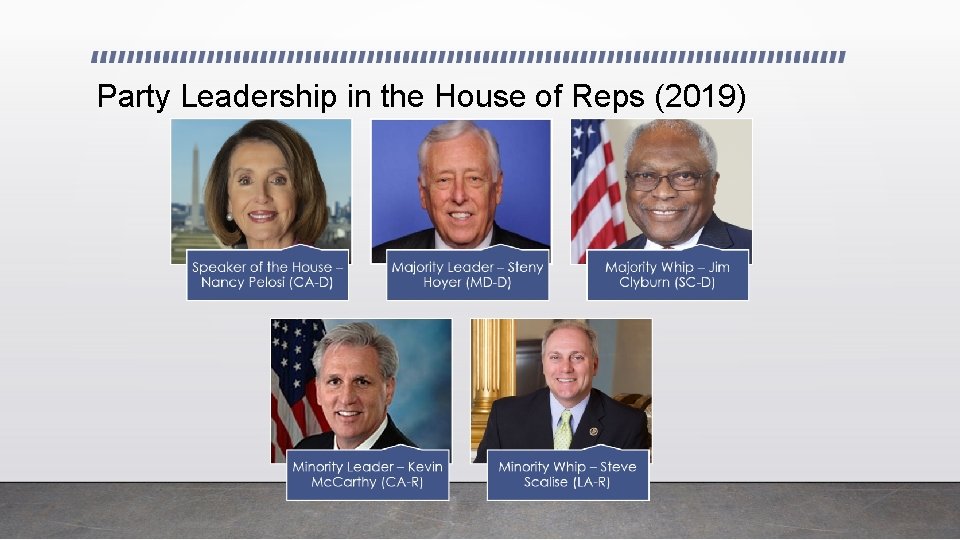
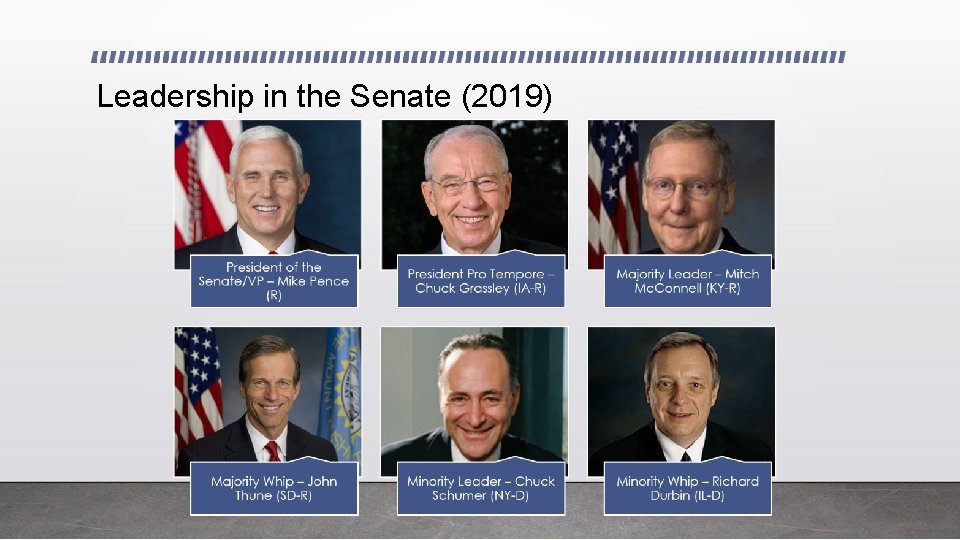
Party Leadership in Congress House of Representatives • Speaker of the House – Presides over the House and acts as the majority Party Leader – nominated and elected by the majority party, holds a good deal of power • Majority Leader – Party leader on the house floor • Minority Leader – Party leader of the minority party on the house floor • Majority and Minority whips – helps the majority or minority leader stay informed of what party members are thinking, rounds up members when important votes are taken, and keep aware of how voting on a controversial issue might go Senate • President of the Senate – Vice President of the US • President Pro Tempore of the Senate – takes over if the VP cannot preside, usually the most senior senator of the majority party – not as much power as the Speaker • Majority Leader – Party leader on the Senate floor – schedules the business of the senate with the minority leader • Minority Leader – Party leader on the Senate floor – works with majority leader to schedule business • Majority and Minority whips – helps the majority or minority leader stay informed of what party members are thinking, rounds up members when important votes are taken, and keep aware of how voting on a controversial issue might go
Party Leadership in the House of Reps (2019)
Leadership in the Senate (2019)
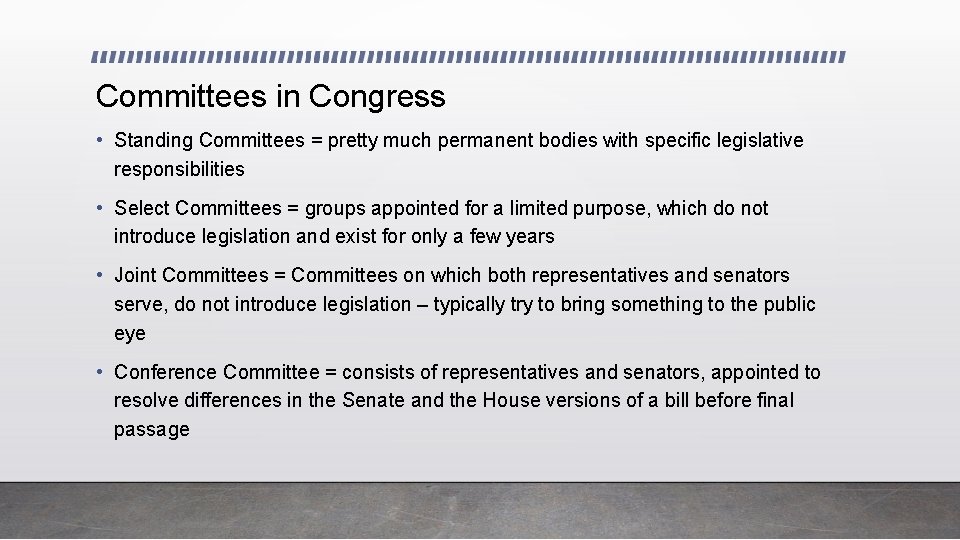
Committees in Congress • Standing Committees = pretty much permanent bodies with specific legislative responsibilities • Select Committees = groups appointed for a limited purpose, which do not introduce legislation and exist for only a few years • Joint Committees = Committees on which both representatives and senators serve, do not introduce legislation – typically try to bring something to the public eye • Conference Committee = consists of representatives and senators, appointed to resolve differences in the Senate and the House versions of a bill before final passage
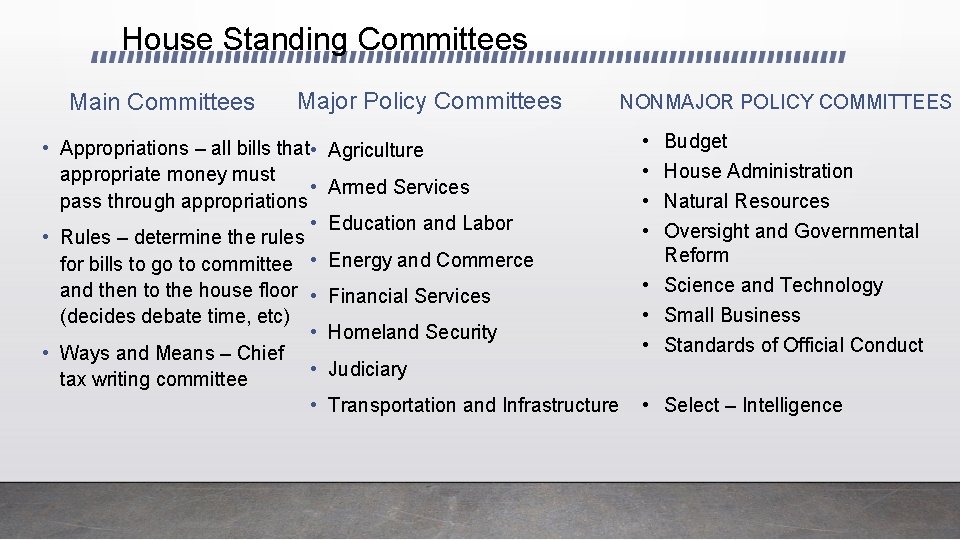
House Standing Committees Main Committees Major Policy Committees • Appropriations – all bills that • appropriate money must • pass through appropriations • • Rules – determine the rules for bills to go to committee • and then to the house floor • (decides debate time, etc) • • Ways and Means – Chief • tax writing committee • Agriculture Armed Services Education and Labor Energy and Commerce Financial Services Homeland Security NONMAJOR POLICY COMMITTEES • • Budget House Administration Natural Resources Oversight and Governmental Reform • Science and Technology • Small Business • Standards of Official Conduct Judiciary Transportation and Infrastructure • Select – Intelligence
Senate Standing Committees Major Policy Committees Minor and Select COmmittees • Agriculture, Nutrition, and Forestry • Rules and Administration • Appropriations • Small Business and Entrepreneurship • Armed Services • Veterans’ Affairs • Banking, Housing, and Urban Affairs • Budget • Select – Aging • Commerce, Science, and Transportation • Select – Ethics • Energy and Natural Resources • Select – Indian Affairs • Environment and Public Works • Select - Intelligence • Finance • Foreign Relations • Health, Education, Labor, and Pensions • Homeland Security and Governmental Affairs • Judiciary
Filibusters and Motions for Cloture • The House does not allow for Filibustering because the House Rules Committee sets time limits on speeches made on the House floor • The Senate does not have such a rule – senators can make a speech or series of speeches for as long as they want to delay a bill from being voted on • Filibusters can be stopped with a motion for cloture or the cloture rule • Debate can be cut off if 2/3 of senators present and voting agree to a cloture motion (technically the number is 60 senators) • The Nuclear Option • Point of order to change the 60 senator rule for motion for cloture • Point of order is denied • Denial is overridden with a simple majority and the rule is changed
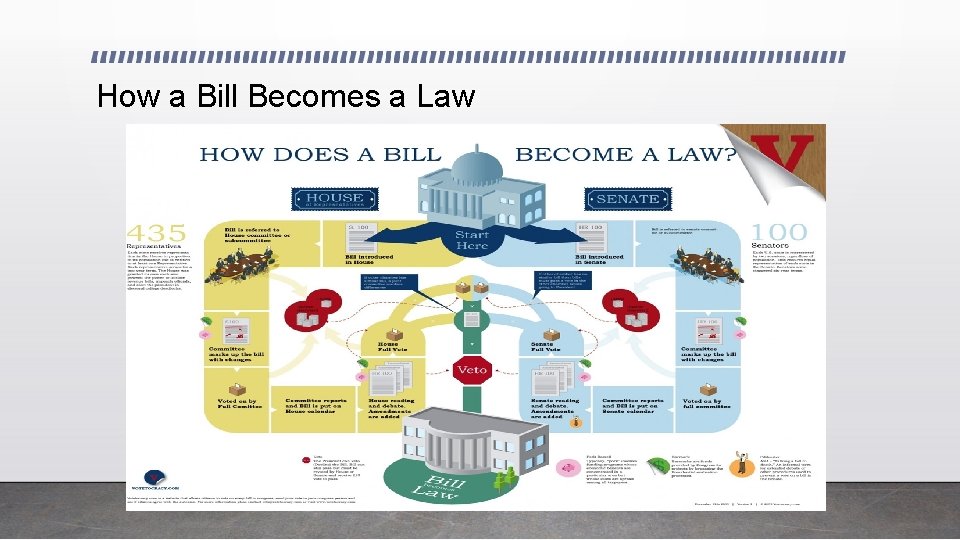
How a Bill Becomes a Law
Congress Webquest and Law Game • Login or create an account in i. Civics • Enter the class code: Roberts 71922 • Once you are registered in my class you will see 2 assignments – a Congress Webquest and a Law. Making Simulation Game • Complete both on i. Civics by April 3 rd or earlier