
US Army Combined Arms Center SOLDIERS AND LEADERS
US Army Combined Arms Center SOLDIERS AND LEADERS - OUR ASYMMETRIC ADVANTAGE Building and Maintaining Readiness to Win in a Complex World AUSA Institute of Land Warfare 1 November 2016 LTG Michael D. Lundy Commanding General U. S. Army Combined Arms Center CAC CIG Planner: MAJ Daniel W. Clark / 913 -684 -8669 / daniel. w. clark 48. mil@mail. mil As Of: 10/31/2016
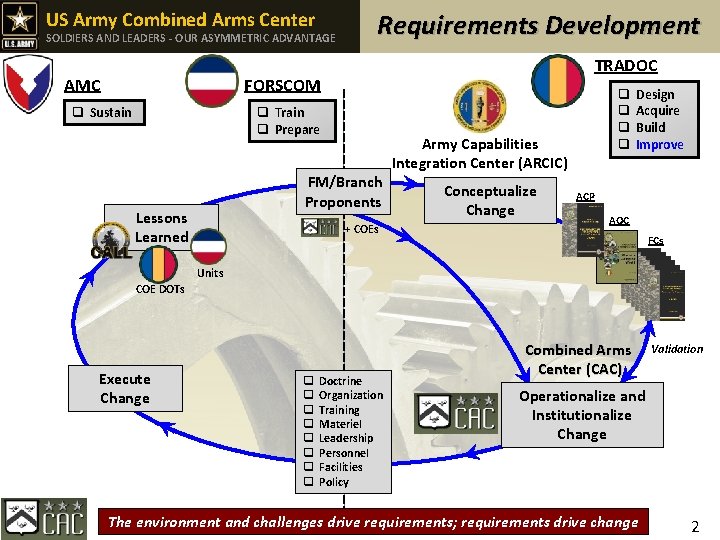
US Army Combined Arms Center SOLDIERS AND LEADERS - OUR ASYMMETRIC ADVANTAGE AMC Requirements Development TRADOC FORSCOM q Sustain q Train q Prepare FM/Branch Proponents Lessons Learned + COEs q q Army Capabilities Integration Center (ARCIC) Conceptualize Change Design Acquire Build Improve ACP AOC FCs Units COE DOTs Execute Change q q q q Doctrine Organization Training Materiel Leadership Personnel Facilities Policy Combined Arms Center (CAC) Validation Operationalize and Institutionalize Change The environment and challenges drive requirements; requirements drive change 2
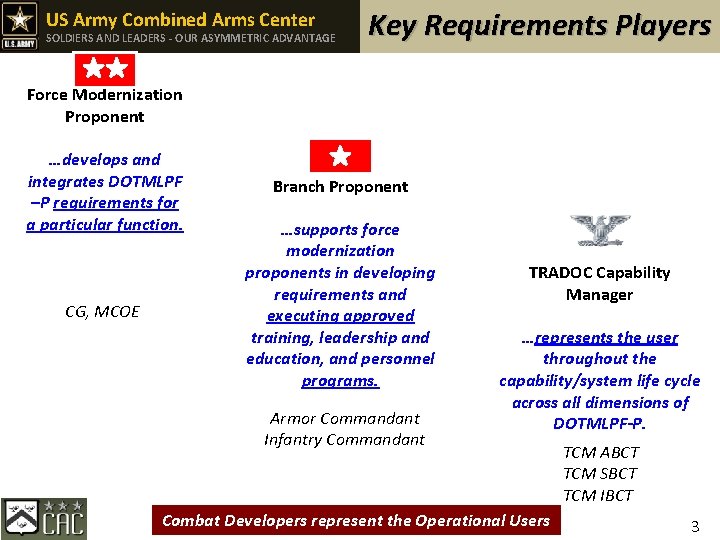
US Army Combined Arms Center SOLDIERS AND LEADERS - OUR ASYMMETRIC ADVANTAGE Key Requirements Players Force Modernization Proponent …develops and integrates DOTMLPF –P requirements for a particular function. CG, MCOE Branch Proponent …supports force modernization proponents in developing requirements and executing approved training, leadership and education, and personnel programs. Armor Commandant Infantry Commandant TRADOC Capability Manager …represents the user throughout the capability/system life cycle across all dimensions of DOTMLPF-P. Combat Developers represent the Operational Users TCM ABCT TCM SBCT TCM IBCT 3
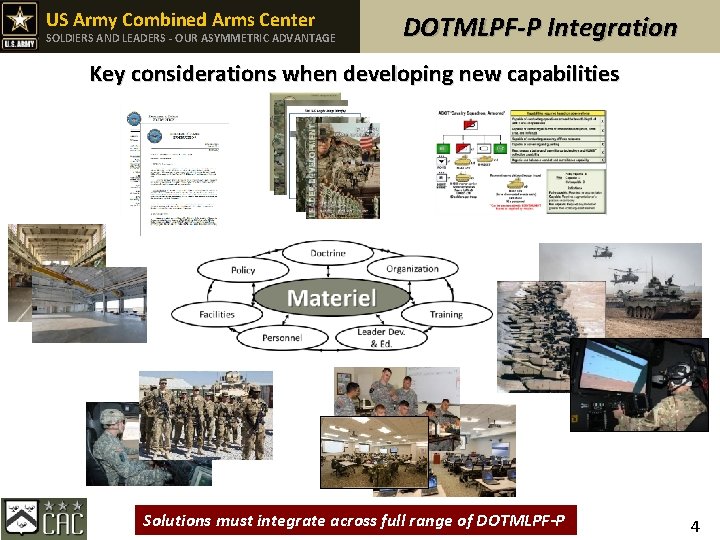
US Army Combined Arms Center SOLDIERS AND LEADERS - OUR ASYMMETRIC ADVANTAGE DOTMLPF-P Integration Key considerations when developing new capabilities Solutions must integrate across full range of DOTMLPF-P 4
US Army Combined Arms Center SOLDIERS AND LEADERS - OUR ASYMMETRIC ADVANTAGE Getting Requirements Right q Operational versus Technical Requirements q Battle Lab Experimentation q S&T focused on valid requirements – transition to POR q Human-Machine Interface q Cognitive Aiding and Offloading (Defrag the Hard drive) q Relationship of Requirement Solutions to other Variables q Good Enough versus Nice to Have or Unobtanium q Utility across the Range of Military Operations versus Niche Capabilities q Growth Capability - Upgradability q Open Architectures q Capability versus Vulnerability q Reliability, Sustainability, Affordability balance points All requirements compete for limited resources 5
US Army Combined Arms Center SOLDIERS AND LEADERS - OUR ASYMMETRIC ADVANTAGE Discussion
- Slides: 6