
URONIC ACID PATHWAY This is an alternative oxidativ
- Slides: 8
URONIC ACID PATHWAY This is an alternative oxidativ pathway for glucose. It is also known as glucoronic acid pathway. It includes the synthesis of glucoronic acid , pentoses, vitamin, ascorbic acid. In most of the pathways of carbohydrate metabolism phosphate esters participate, where as in UAP the free sugars or sugar acid are involved.
In liver, the uronic acid pathway catalyzes the conversion of glucose to : glucuronic acid ascorbic acid (except inhuman beings and other species for which ascorbate is a vitamin), and Pentoses HMP Shunt path way
Reactions of uronic acid pathway 1. formation and importance of UDP glucoronate 2. conversion of UDP glucoronate to L-gluconate 3. synthesis of ascorbic acid in some animals 4. oxidation of L-gluconate.
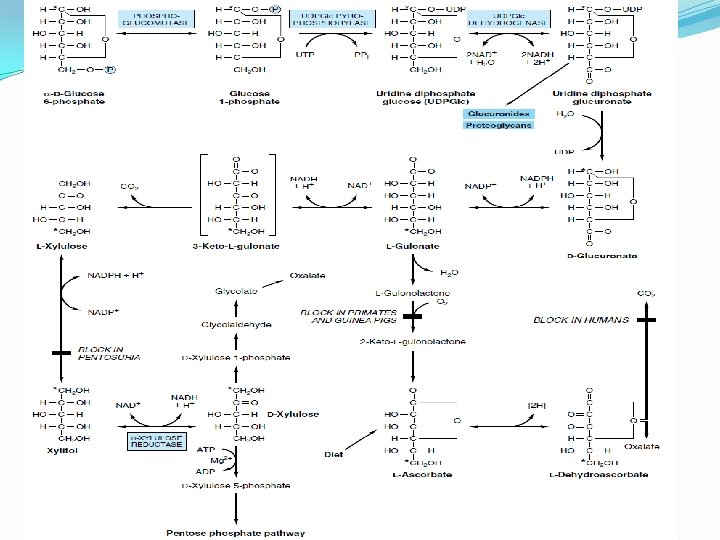
1. Formation and importance of UDP glucuronate Glucose 6 -phosphate is converted in to glucose -1 phosphate, UDP glucose is then synthesized by the enzyme UDP glucose pyrophosphorylase, UDP glucose dehydrogenase oxidises udp glucose to udp glucuronate. Udp glucoronate is metabolically active form of glucoronate which is utilized for conjugation with many substances like bilirubin, steroid hormones, and some drugs. Some insoluble substances are also converted to soluble ones, and the drugs are detoxified. It is also required for the synthesis of glycosaminoglycans & proteoglycans.
2. Conversion of UDP glucuronate to L-gluconate Udp glucuronate loses it UDP moiety in a hydrolytic reaction and releases D-glucoronate which is reduced to L-gulonate by NADPH dependent reaction. 3. synthesis of ascorbic acid in some animals L-gulonate is the precursor for ascorbic acid (vitc)synthesis in many animals, the enzyme L-gulonolactone oxidase is absent in men other primates and guinea pigs, there fore vitamin C has to be supplemented in diet for these animals.
4. Oxidation of L-gulonate It is oxidise to 3 -ketogulonate and the decarboxylated to a pentose, L-xylulose, which is converted in to Dxylulose via xylitol by a reduction(NADPH dependent) and an oxidation(IMAP-dependent ). D-xylulose after getting phosphporylated can enter the HMP for further metabolism.
Significance of UAP It is an alternative pathway for oxidation of glucose with no production of energy. Mainly glucuronic acid is used for the detoxification of drugs /foreign substances , for the synthesis of mucopolysaccarides. Essential pentosuria (autosomal disorder)caused due to the deficiency of enzyme L-xylitol dehydrogenase, administration of glucuronic acid increases the quantity of xylulose excreted.