
Urology Homework Group 4A Done by Nadine Othman

Urology Homework Group 4(A) Done by Nadine Othman
1 -Indications for open surgery in BPH Surgical removal of prostate gland under general or regional anesthesia. Excellent outcomes in terms of improvement of symptoms , highest morbidity rate, associated with risk of significant blood loss Reserved for patients with : 1 -Very large prostate 2 -Concomitant bladder stones or bladder diverticula 3 -Inability to be positioned for transurethral surgery 4 -Concomitant inguinal hernia 5 -Long urethra 6 -Urethral stricture 7 -Intraoperative bleeding during TURP obscuring vision Aseel sadaqa
2 -Indications for surgery in BPH 123456 - Failure of medical treatment Refractory/Recurrent UTI Recurrent gross hematuria Refractory/Recurrent urinary retention Renal insufficiency / deterioration Secondary bladder pathological changes ( large diverticulum, stones ) Raghad alqazaqi
3 -Voided urine samples 1 - Vb 1 : First 10 ml of urine, this represents : - Urethra - Acute prostatitis 2 - Vb 2 : Midstream urine, this represents : - Bladder 3 - Vb 3 : First 10 ml of urine after prostate massage, this represents : - Chronic prostatitis 4 - EPS : Expressed prostatic specimen, measured after prostate massage in chronic prostatitis Mohammad hashem
4 - Acute urine retention Vs Chronic Acute urine retention: painful inability to void urine with relief of pain following drainage of the bladder by catheterization Chronic urine retention: Failure to empty bladder despite maintaining an ability to urinate which result in elevated (PVR) urine volume Ro’aa jaradat
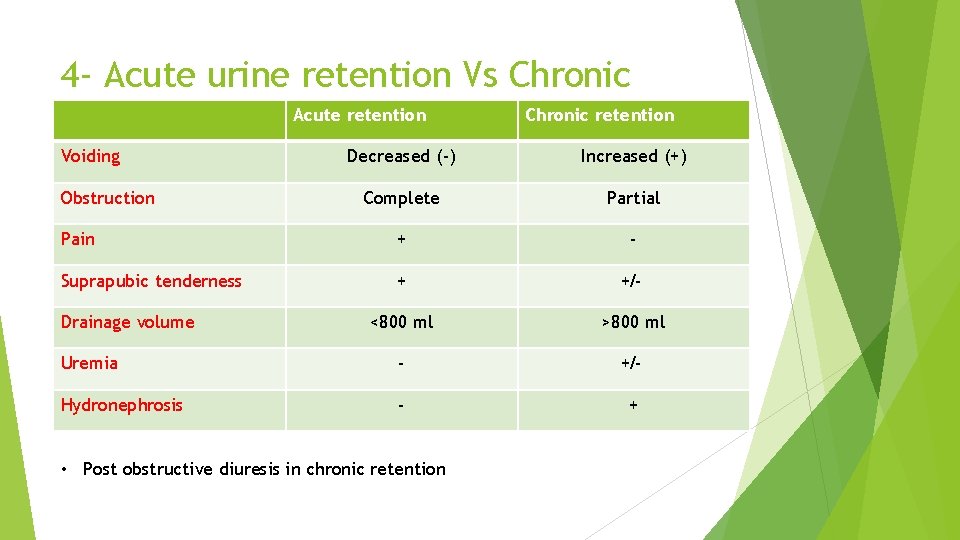
4 - Acute urine retention Vs Chronic Acute retention Voiding Chronic retention Decreased (-) Increased (+) Complete Partial Pain + - Suprapubic tenderness + +/- <800 ml >800 ml Uremia - +/- Hydronephrosis - + Obstruction Drainage volume • Post obstructive diuresis in chronic retention
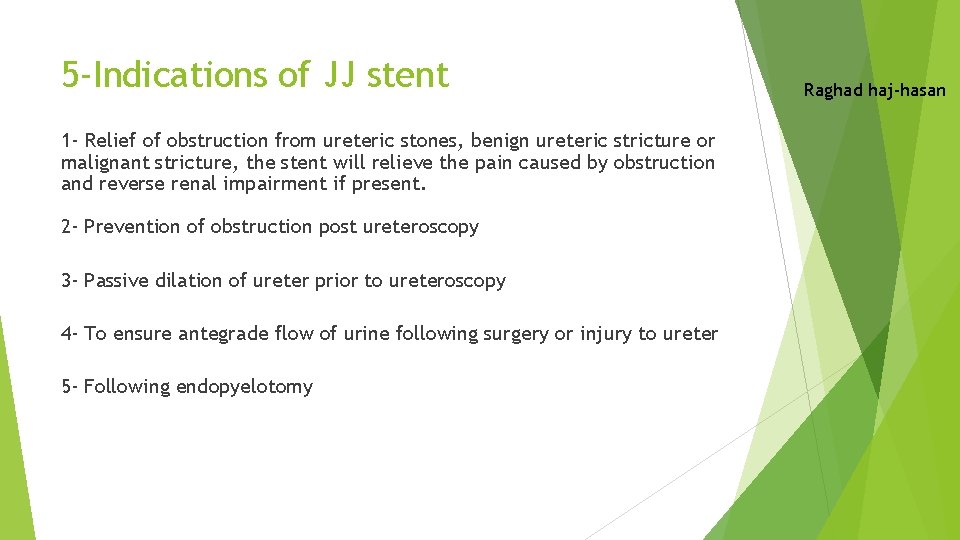
5 -Indications of JJ stent 1 - Relief of obstruction from ureteric stones, benign ureteric stricture or malignant stricture, the stent will relieve the pain caused by obstruction and reverse renal impairment if present. 2 - Prevention of obstruction post ureteroscopy 3 - Passive dilation of ureter prior to ureteroscopy 4 - To ensure antegrade flow of urine following surgery or injury to ureter 5 - Following endopyelotomy Raghad haj-hasan
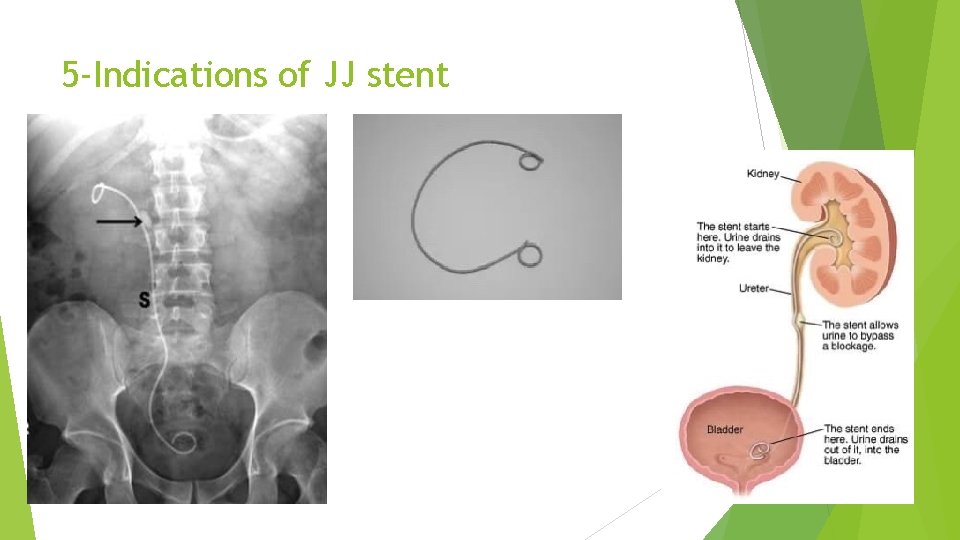
5 -Indications of JJ stent
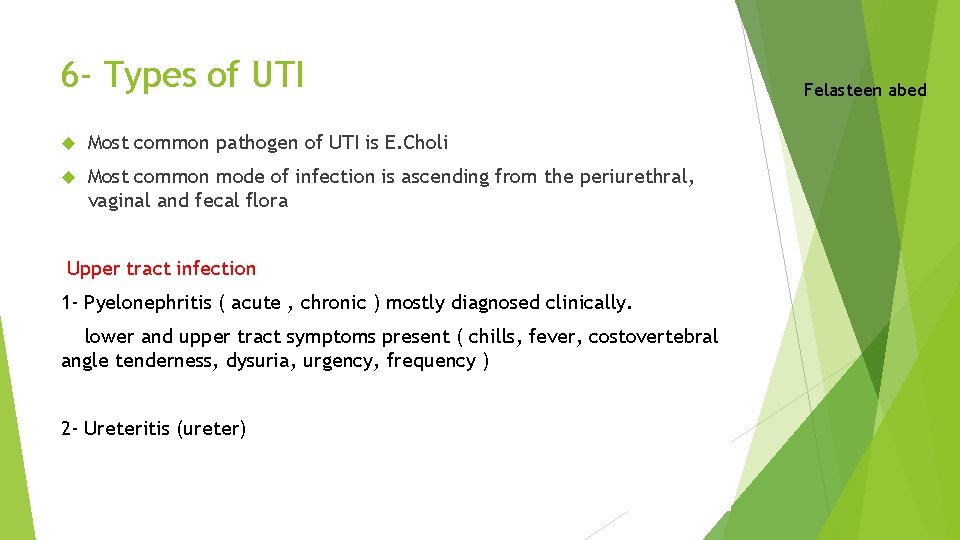
6 - Types of UTI Most common pathogen of UTI is E. Choli Most common mode of infection is ascending from the periurethral, vaginal and fecal flora Upper tract infection 1 - Pyelonephritis ( acute , chronic ) mostly diagnosed clinically. lower and upper tract symptoms present ( chills, fever, costovertebral angle tenderness, dysuria, urgency, frequency ) 2 - Ureteritis (ureter) Felasteen abed
6 - Types of UTI Lower tract infection 1 - Cystitis 2 - Urethritis 3 - Prostatitis Lowe tract symptoms ( dysuria, frequency, urgency ) Upper tract symptoms ( chills, fever, costovertebral angle tenderness, nausea, vomiting)
6 - Types of UTI There is : A- Symptomatic UTI : There’s signs and symptoms of UTI and laboratory testing confirm the diagnosis 1 - In urinanalysis (5 -15) WBC per high-power 2 - In culture 100, 000 cfu/ml - Isolated ( 5 -6 months between attacks ) OR - Recurrent ( >3 attacks/year or >2 attacks/6 months ) *Re- infection (new organism) *Persistent (because of inappropriate treatment)
6 - Types of UTI B- Asymptomatic UTI : Urinanalysis and culture are negative and treatment only in case of pregnancy. C- Complicated UTI : Occur when anatomic abnormalities, immunocompromised, multi-drug resistant bacteria and cause functional or structural abnormalities -Functional : renal failure, neurogenic bladder, VUR -Structural : stricture, BPH, anatomic malformation D- Uncomplicated UTI : In healthy patients with normal urinary tract anatomy
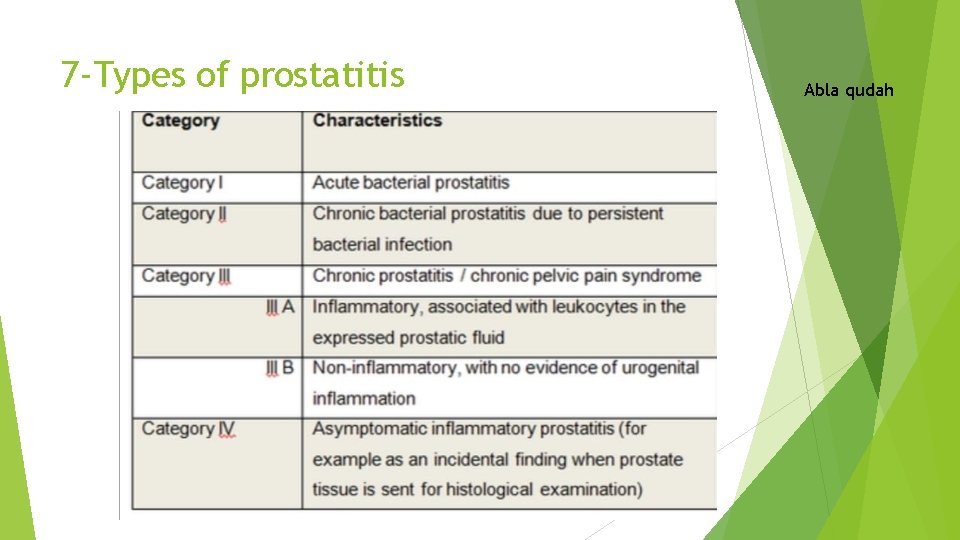
7 -Types of prostatitis Abla qudah
8 -Ways of urine sampling 1 - Voided Urine Simplest ways: A-Random specimen(for analysis) B-First morning specimen(analysis and microscopic) C-Midstream clean catch specimen(for culture and sensitivity testing) 2 - Catheter collection specimen -These specimens are obtained by investing a catheter or sterile flexible tube into bladder via urethra to withdraw urine -When the patient is bedridden or can’t urinate independently Aya tawalbeh
8 -Ways of urine sampling 3 - Suprapubic aspiration specimen -This method is used when a bedridden patient can’t be catheterized or sterile specimen is required
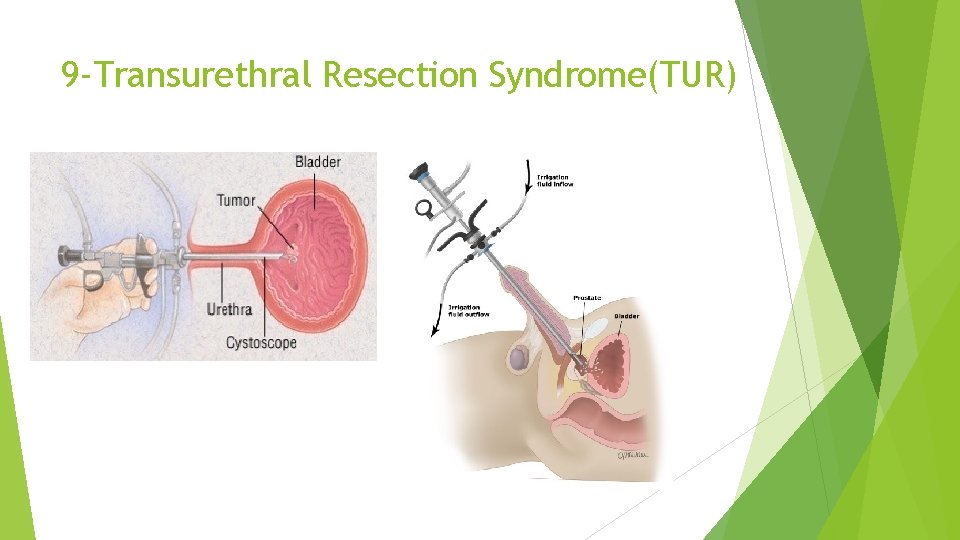
9 -Transurethral Resection Syndrome(TUR) Arise from the infusion of a large volume of hypotonic irrigating solution into the circulation during endoscopic procedures (TURP, TURBT, PCNL) Most commonly after prolonged TURP of large prostate Irrigation fluid: glycine+water During TURP this fluid enter the circulation leading to ( Hypervolemia, Hyponatremia ) Signs and symptoms Dilutional hyponatremia is the most important risk factor leading to the signs and symptoms 1 - confusion 2 - bradycardia 3 - nausea, vomiting 4 - seizures 5 - hypertension due to fluid overload 6 - visual disturbances (flashing light), in case of spinal anesthesia ( TURP due to glycine inhibitory neurotransmitter which affects on retina) Lubna sameer
9 -Transurethral Resection Syndrome(TUR) Prevention : use a continuous irrigating cystoscope, limit resection time and avoid aggressive resection near the capsule Treatment - for prolonged procedures, where greater degree of fluid may occur, measure serum Na+ >> give 20 -40 mg IV furosemide 1 - If Na+ comes back normal >> you’ll have done little harm by giving furosemide 2 - If it comes back Na+ <125 mmol/l >> need more treatment and intervention to prevent development of severe TUR syndrome
9 -Transurethral Resection Syndrome(TUR)
10 -Causes of urethral stricture 1 - Trauma 2 - Infection ( sexual transmitted disease ) 3 - Damage from surgical tools(catheter, endoscopy) ( iatrogenic )>>Most common cause 4 - Congenital 5 - Malignancies 6 - Post-operative 7 - Non-infectious inflammatory process Abdulrahman bdeir
11 -Types of foley’s catheter 1 - According to size -In French, 1 French=0. 33 mm - The size represents the external circumference of the foley’s catheter which represents the internal circumference of the urethra - Usually start with 16 French ( in BPH/Large prostate, use larger size. In stricture, use smaller size ) Hadeel salameen
11 -Types of foley’s catheter 2 - According to material - Latex : Less biocompatible, more risk for UTI, more formation of biofilms so can’t be used longer than 3 weeks - Silicon : More biocompatible, less risk for UTI, less risk for biofilms formation so can be used for up to 3 months
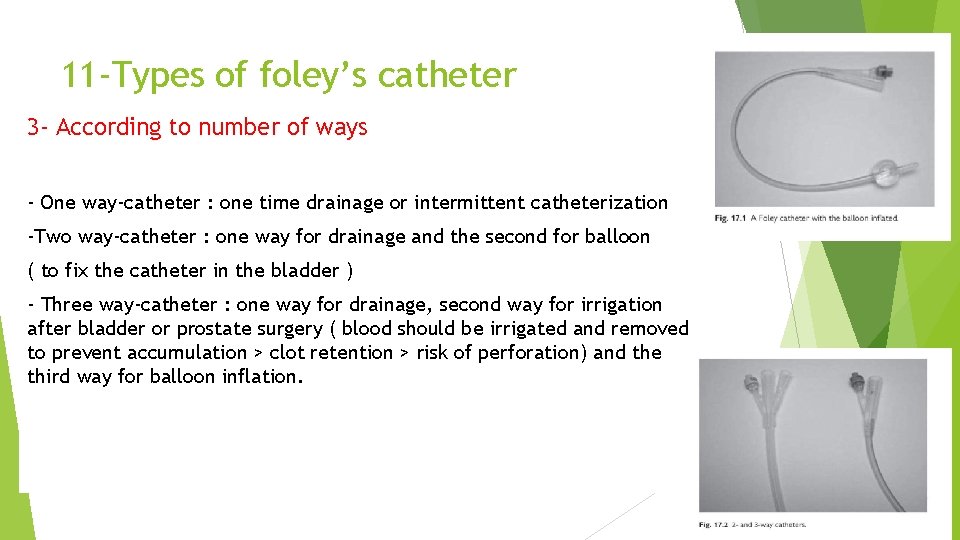
11 -Types of foley’s catheter 3 - According to number of ways - One way-catheter : one time drainage or intermittent catheterization -Two way-catheter : one way for drainage and the second for balloon ( to fix the catheter in the bladder ) - Three way-catheter : one way for drainage, second way for irrigation after bladder or prostate surgery ( blood should be irrigated and removed to prevent accumulation > clot retention > risk of perforation) and the third way for balloon inflation.
12 -Grades of varicocele Subclinical : Non-palpable enlargement of the venous plexus of the spermatic tone, which is diagnosed only by ultrasound, angiography or any other imaging method Grade I : Small palpable distensions detected during a Valsalva maneuver Grade II : Moderate with easily palpable distention on upright examination Grade III : Large visible veins on upright examination without palpation Grade IV : Very large varicosities become visible immediately when the patient stands up, the varicosities are hypertensive and subcutaneous varices are present too Mohammad badwan
13 -Testicular torsion VS Epididymorchitis Testicular torsion Epididymorchitis Age (10 -30) years (16 -30)&(51 -70) years Pain Sudden onset not affected by Gradual onset worse when position standing Onset After exercise, sleep or minor trauma Rarely after sleep Time to presentation < 6 hours > 24 hours Past episodes Frequently >2 weeks past Only if previous infection Severity Peaks in hours Peaks in days Vomiting Common from pain Unusual Fever Up to 20% Up to 95% Swelling After 12 hours Common Dysuria Rare Common Urinanalysis 30% have wbc/bacteria, voiding complication rare 50% may be normal , voiding complication common Physical exam - Cremasteric reflex - Prehn sign + Cremasteric reflex + Prehn sign Color Doppler Decreased testicular flow Increased testicular flow Akram Oran
13 -Testicular torsion VS Epididymorchitis Management : testicular torsion is managed by surgery ( Orchidopexy or Orchidectomy ) while epididymorchitis is managed by antibiotics and if it fails we do orchidectomy
14 -Indications of surgery in varicocele 1 - Fertility problems 2 - Pain 3 - Abnormal semen analysis 4 - Testicular asymmetry 5 - Testicular atrophy 6 - Grade III or higher in pediatric Tamara abbadi
15 - Bladder cancer risk factors 1 - Smoking: the most important risk factor, smokers are more likely to get bladder cancer 3 times more than non-smokers 2 - Age: risk increases with age 3 - Male gender 4 - Exposure to certain chemicals ( eg : arsenic ) 5 - Previous cancer treatment: people who received radiation treatment aimed for pelvis have high risk of developing bladder cancer 6 - Chronic bladder inflammation: like the inflammation that happens due to schistosomiasis infection and inflammation from long term use of urinary catheter 7 - Family history of bladder cancer ﻣﺤﻤﺪ ﺧﺎﻟﺪ ﺍﻟﻌﺎﻳﺪ
16 - Intravesical therapy of bladder cancer 1. Intravesical chemotherapy For low non-invasive bladder cancer after TURT within 6 hours then induction and maintenance Decrease risk of recurrence 2. Intravesical BCG immunotherapy For high grade bladder cancer after TURT and for carcinoma in situ Not done immediately after TURT or if there’s hematuria or immunosuppression Decrease risk of recurrence and progression Loulou mahmoud
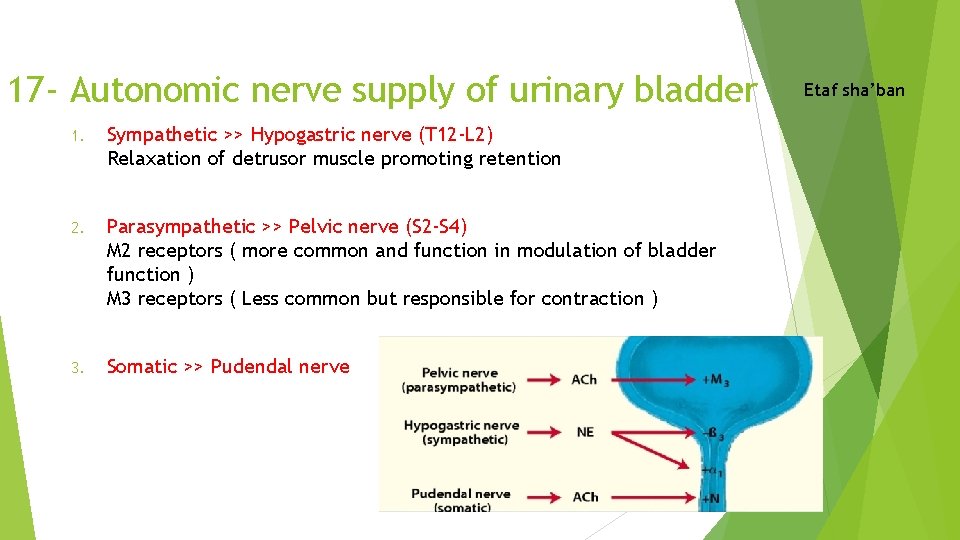
17 - Autonomic nerve supply of urinary bladder 1. Sympathetic >> Hypogastric nerve (T 12 -L 2) Relaxation of detrusor muscle promoting retention 2. Parasympathetic >> Pelvic nerve (S 2 -S 4) M 2 receptors ( more common and function in modulation of bladder function ) M 3 receptors ( Less common but responsible for contraction ) 3. Somatic >> Pudendal nerve Etaf sha’ban
18 - Treatment of bladder perforation 1 -Emergency treatment of shock and hemorrhage 2 -Surgical treatment 1 - Penetrating injury>> surgical exploration and repair 2 - Blunt injury A- Extraperitoneal>> Most cases managed with catheter drainage only for 1 -3 weeks B- Intraperitoneal>> Surgical exploration and repair via transperitoneal approach, suctioning or urine from peritoneal cavity, closure of perforation, suprapubic and perurethral catheterization Rawan Fayumi
19 - Grades of renal trauma Grade I : Contusion or non-expanding subcapsular hematoma, no laceration Grade II : Non-expanding perirenal hematoma, cortical laceration <1 cm deep without urinary extravasation Grade III : Cortical laceration >1 cm deep without urinary extravasation Grade IV : Laceration through corticomedullary junction into collecting system. Or vascular, segmental renal artery or vein injury with contained hematoma or partial vessel laceration or vessel thrombosis Grade V : Shattered kidney or renal pedicle avulsion Suha kaabneh
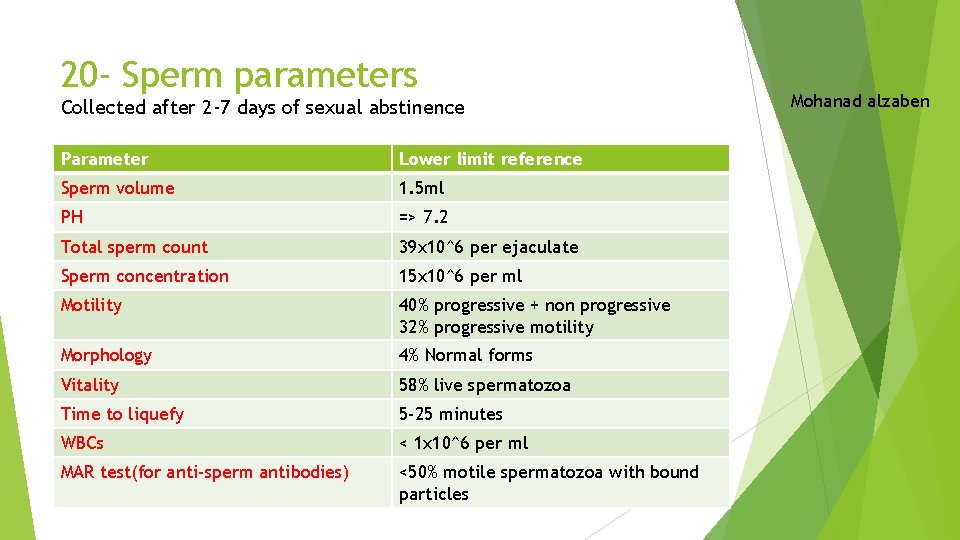
20 - Sperm parameters Collected after 2 -7 days of sexual abstinence Parameter Lower limit reference Sperm volume 1. 5 ml PH => 7. 2 Total sperm count 39 x 10^6 per ejaculate Sperm concentration 15 x 10^6 per ml Motility 40% progressive + non progressive 32% progressive motility Morphology 4% Normal forms Vitality 58% live spermatozoa Time to liquefy 5 -25 minutes WBCs < 1 x 10^6 per ml MAR test(for anti-sperm antibodies) <50% motile spermatozoa with bound particles Mohanad alzaben
21 - PSA (prostate specific antigen) Is a blood test used primarily to screen for prostate cancer Considered normal up to 4 ng/ml 4 -10 ng/ml >> grey zone >> we go to PSA kinetics : 1. Total PSA = Free PSA(15%)+ Complexed PSA(85%) 2. Free to total PSA ratio < 18% ratio>> suggestion of cancer or other differentials (prostatitis) >18% ratio>> suggest benign cause 3. PSA Density = Serum PSA / Prostate volume >18% density>> suggestion of cancer <18% density>> suggestion of benign cause 4. PSA velocity Change of > 0. 75 ng/ml/year associated with increase risk of cancer 5. PSA doubling time Used in staging and follow up of prostate cancer Mohmad zoubi
22 - Causes of elevated levels of PSA in men 1. Getting older 2. BPH 3. UTI and prostatitis 4. Ejaculation 5. Parathyroid hormone 6. Prostate injury 7. Surgical procedure involving prostate 8. Prostate cancer In Females it increases in hyperandrogenic state Ena’am Doumi
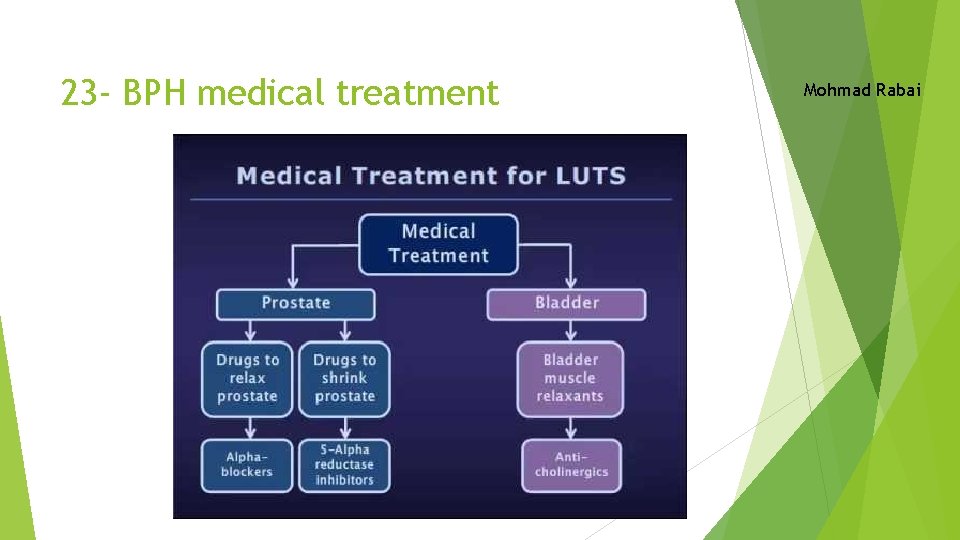
23 - BPH medical treatment 1. Alpha 1 adrenergic antagonists ( Tamsulosin, Doxazosin ) Relax bladder neck muscle and prostate muscle fibers S. E >> Orthostatic hypotension 2. 5 -alpha reductase inhibitor ( Finasteride ) Shrink/Reduce the size of prostate by inhibiting conversion of testosterone into DHT and thus suppressing prostate growth S. E>> Decrease libido and ejaculation dysfunction 3. Anti-cholinergic Bladder muscle relaxant 4. PDE 5 inhibitor ( Tadalafil ) Life style and home messages ( limit caffeine and alcohol, bladder training and schedule bathroom visits, healthy diets and exercise ) Mohmad Rabai
23 - BPH medical treatment Mohmad Rabai

24 - Importance of antibiotics in patient with VUR Antibiotics ( continuous antibiotic prophylaxis ) LOWERS : 1 - The occurrence of a subsequent UTI 2 - The risk of renal scarring and damage 3 - The upgrading of VUR Ru’a Tafesh
25 - VUR: Abnormal backflow of urine from bladder to kidney that can cause the ureters and kidney to swell. Cystogram(MCUG) can be used to determine severity of VUR Grade I : Urine flow back into on or both of the ureters but doesn’t reach the kidney (urine reflux into non-dilated ureters) Grade II : Flow back up to the kidney but doesn’t cause dilatation of renal pelvis Grade III : Mild to moderate dilatation of the ureter, renal pelvis and calyces with minimal blunting at fornices Grade IV : Moderate to severe dilatation of the ureter, renal pelvis and calyces with mild tortuosity Grade V : Severe dilatation with severe tortuosity, blunting renal fornices, cortical thinning and ballooning Aseel Adnan
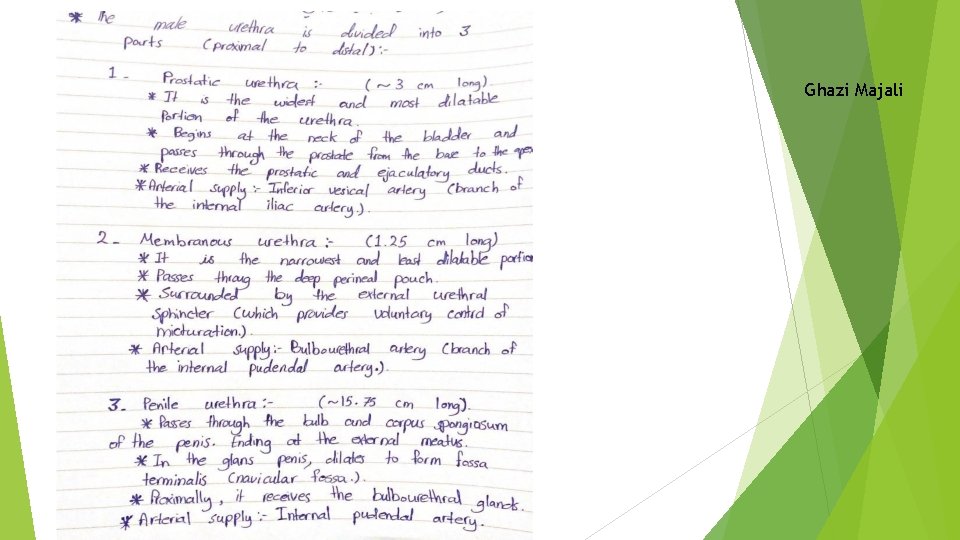
26 - Parts of the urethra 1. Posterior urethra >> composed of the membranous and prostatic portions 2. Anterior urethra >> includes 3 segments ( bulbar urethra, penile urethra, fossa navicularis ) Ghazi Majali
Ghazi Majali
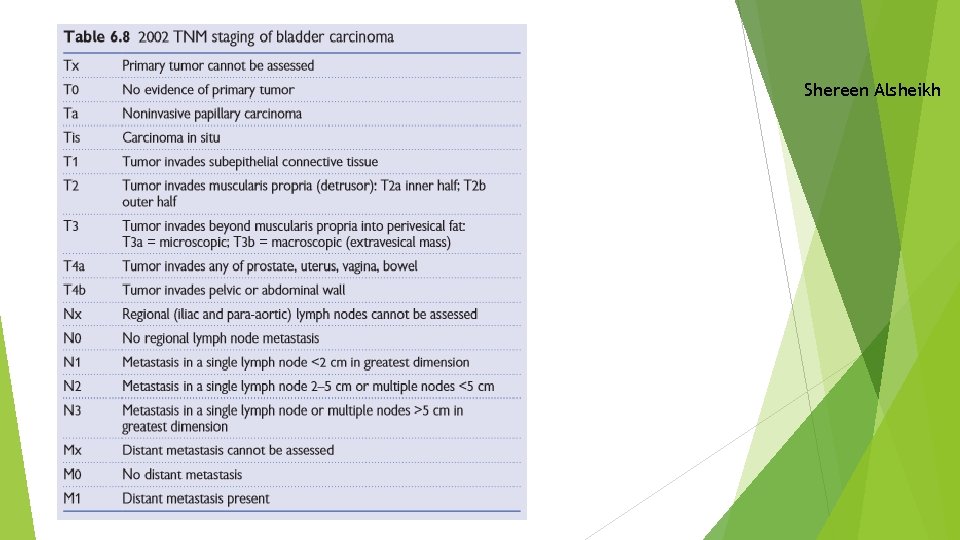
27 - Bladder cancer TNM Most common in older population and it’s 3 times more common in males, it has several types including 1 - Transitional cell carcinoma(90%) 2 - Squamous cell carcinoma(8%) 3 - Adenocarcinoma(2%) Clinically presented as: Frequency, urgency, hematuria, dysuria, pelvic pain Diagnosed by cystoscopy and biopsy mainly then TNM used to determine amount of spread. . Shereen Alsheikh
Shereen Alsheikh
28 - Signs and symptoms of urethral trauma 1. 2. 3. 4. 5. 6. 7. Pain with voiding or inability to void Blood at meatus/Blood at vaginal introitus Perineal, scrotal, labial, penile ecchymosis and edema Abnormal location of prostate on DRE high riding prostate or may appear to be absent Blood on DRE or vaginal examination Hematuria although not specific but hematuria on a first voided specimen may indicate injury Hematoma or swelling Gharam Majali
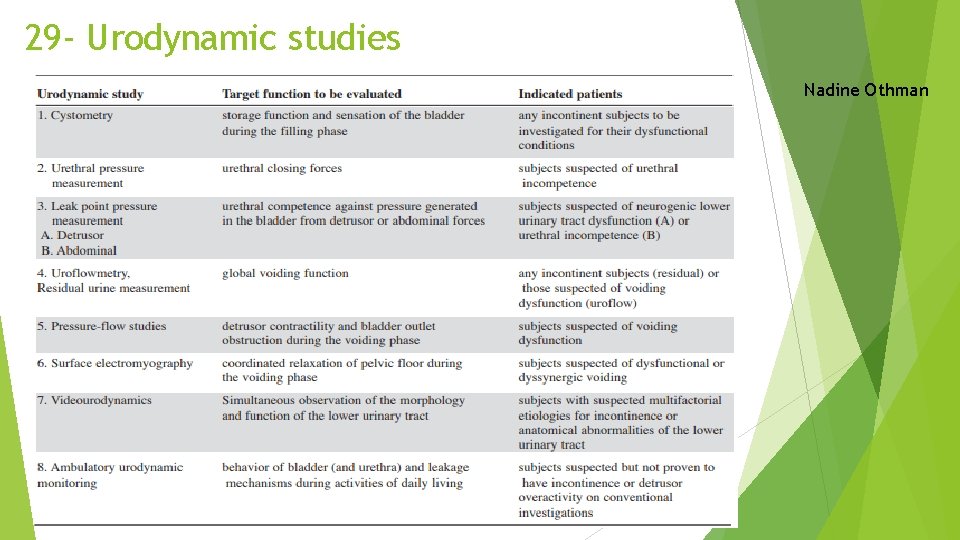
29 - Urodynamic studies Nadine Othman
30 - Treatment protocol of prostate and bladder cancer Prostate cancer - If life expectancy <10%, Watchful waiting - If life expectancy > 10%, asses the risk 1. Low risk>> Active surveillance, PSA and biopsy every 6 months-1 year 2. Intermediate risk>> Radical prostatectomy - with mets>> short course ADT(androgen deprivation therapy) then radiotherapy 3. High risk -Localized>> Radical prostatectomy + EBT(extrabeam radiotherapy) -Local advanced>> neoadjuvant hormonal + EBT -Mets>> Hormonal therapy Khaled Samara
Bladder cancer ttt if its T 1 , T 2 A -TURBT Complications of TURBT are uncommon, including bleeding, sepsis, bladder perforation, incomplete resection, and urethral stricture. Second resection: an early repeat TUR (within 2– 6 weeks) should be undertaken: (a) if the first resection was incomplete, (b) when the pathologist reports that the resected specimen contains no muscularis propria, or (c) if a high-grade, but apparently non-invasive, T 1 tumour has been reported since perhaps 10% (3– 25%) of these G 3 p. T 1 tumours are understaged T 2 tumours.
in the absence of these indications for a second resection, review cystoscopy is performed at 3 months. If this demonstrates recurrence, 70% will recur further. If not, only 20% will recur further. If the bladder is clearat follow-up, subsequent cystoscopies are performed under local anesthetic at 9 months and thereafter annually for 5 y B - Alternatives to TURBT, Transurethral cystodiathermy or laser are accepted, quicker and less morbid. If its T 3 cystectomy T 4 chemo&radiotherapy
- Slides: 47