
UROGENITAL SYSTEM THE PELVIC WALLS PELVIC DIAPHRAGM Dr
- Slides: 34
UROGENITAL SYSTEM THE PELVIC WALLS & PELVIC DIAPHRAGM Dr. Aiman Q. Afar Head Department of Anatomy, Histology and Embryology College of Medicine / University of Mutah Wednesday 3 April 2019 1
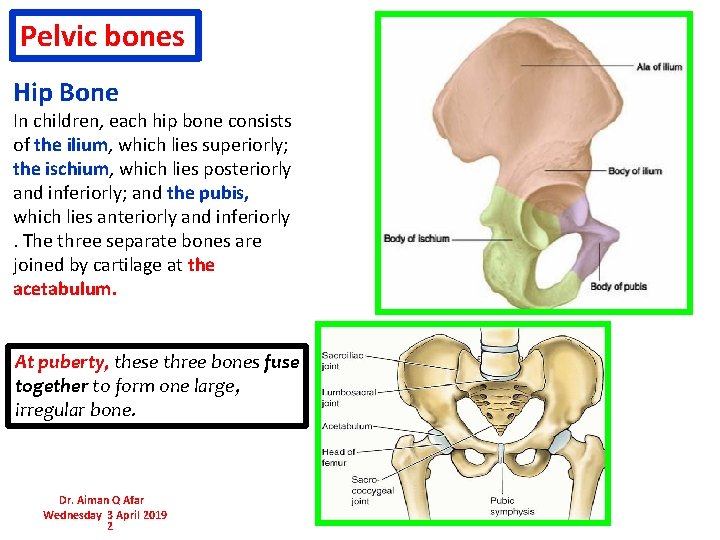
Pelvic bones Hip Bone In children, each hip bone consists of the ilium, which lies superiorly; the ischium, which lies posteriorly and inferiorly; and the pubis, which lies anteriorly and inferiorly. The three separate bones are joined by cartilage at the acetabulum. At puberty, these three bones fuse together to form one large, irregular bone. Dr. Aiman Q Afar Wednesday 3 April 2019 2
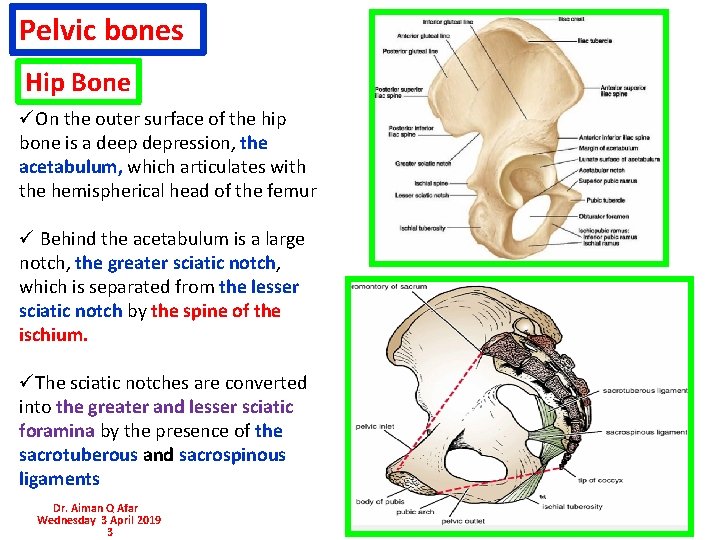
Pelvic bones Hip Bone üOn the outer surface of the hip bone is a deep depression, the acetabulum, which articulates with the hemispherical head of the femur ü Behind the acetabulum is a large notch, the greater sciatic notch, which is separated from the lesser sciatic notch by the spine of the ischium. üThe sciatic notches are converted into the greater and lesser sciatic foramina by the presence of the sacrotuberous and sacrospinous ligaments Dr. Aiman Q Afar Wednesday 3 April 2019 3
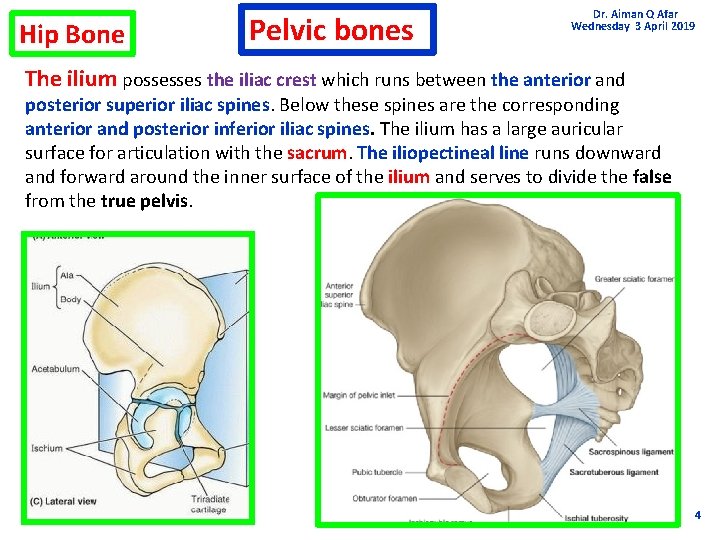
Hip Bone Pelvic bones Dr. Aiman Q Afar Wednesday 3 April 2019 The ilium possesses the iliac crest which runs between the anterior and posterior superior iliac spines. Below these spines are the corresponding anterior and posterior inferior iliac spines. The ilium has a large auricular surface for articulation with the sacrum. The iliopectineal line runs downward and forward around the inner surface of the ilium and serves to divide the false from the true pelvis. 4
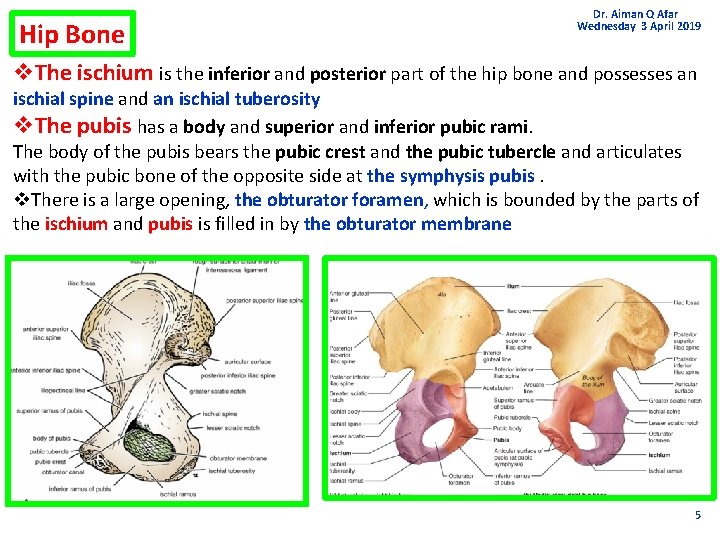
Hip Bone Dr. Aiman Q Afar Wednesday 3 April 2019 v. The ischium is the inferior and posterior part of the hip bone and possesses an ischial spine and an ischial tuberosity v. The pubis has a body and superior and inferior pubic rami. The body of the pubis bears the pubic crest and the pubic tubercle and articulates with the pubic bone of the opposite side at the symphysis pubis. v. There is a large opening, the obturator foramen, which is bounded by the parts of the ischium and pubis is filled in by the obturator membrane 5
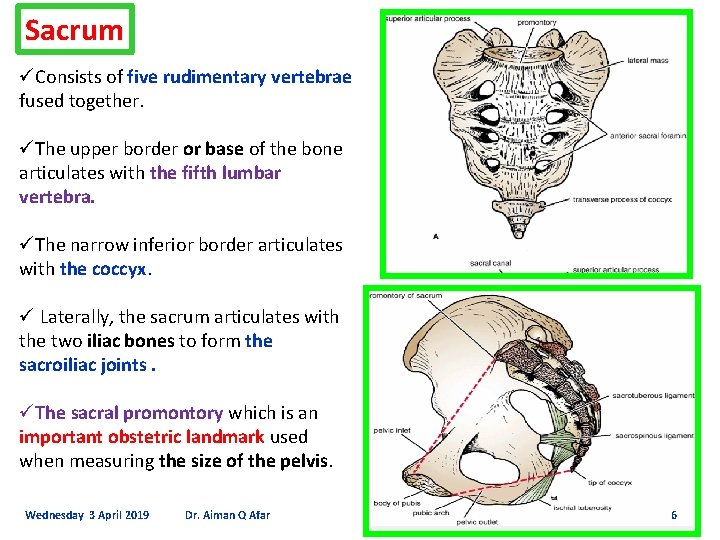
Sacrum üConsists of five rudimentary vertebrae fused together. üThe upper border or base of the bone articulates with the fifth lumbar vertebra. üThe narrow inferior border articulates with the coccyx. ü Laterally, the sacrum articulates with the two iliac bones to form the sacroiliac joints. üThe sacral promontory which is an important obstetric landmark used when measuring the size of the pelvis. Wednesday 3 April 2019 Dr. Aiman Q Afar 6
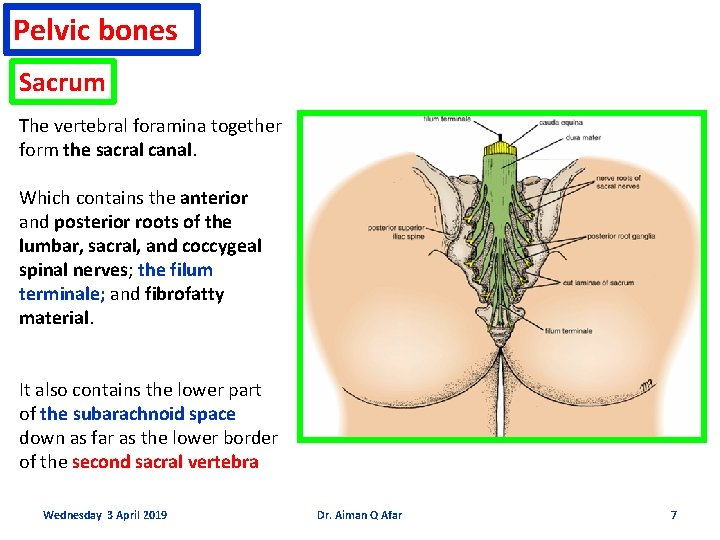
Pelvic bones Sacrum The vertebral foramina together form the sacral canal. Which contains the anterior and posterior roots of the lumbar, sacral, and coccygeal spinal nerves; the filum terminale; and fibrofatty material. It also contains the lower part of the subarachnoid space down as far as the lower border of the second sacral vertebra Wednesday 3 April 2019 Dr. Aiman Q Afar 7
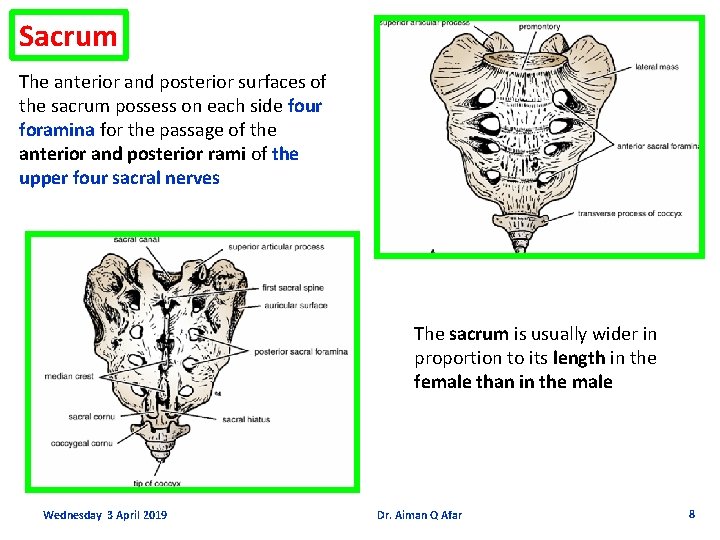
Sacrum The anterior and posterior surfaces of the sacrum possess on each side four foramina for the passage of the anterior and posterior rami of the upper four sacral nerves The sacrum is usually wider in proportion to its length in the female than in the male Wednesday 3 April 2019 Dr. Aiman Q Afar 8
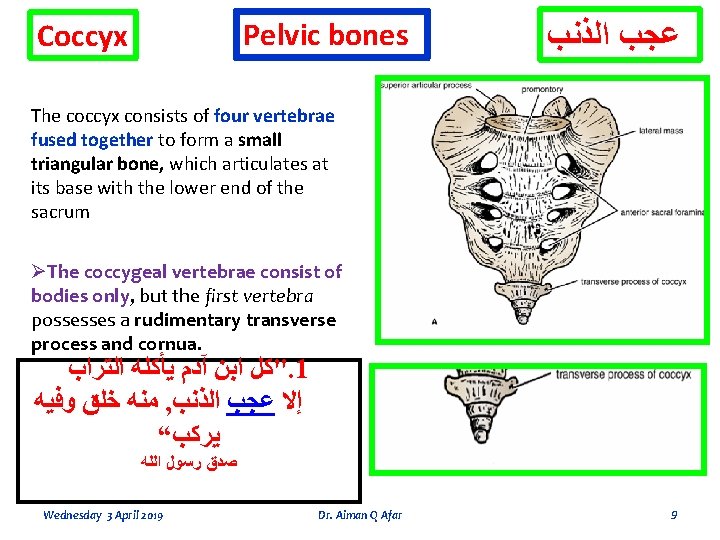
Pelvic bones Coccyx ﻋﺠﺐ ﺍﻟﺬﻧﺐ The coccyx consists of four vertebrae fused together to form a small triangular bone, which articulates at its base with the lower end of the sacrum ØThe coccygeal vertebrae consist of bodies only, but the first vertebra possesses a rudimentary transverse process and cornua. "ﻛﻞ ﺍﺑﻦ آﺪﻡ ﻳﺄﻜﻠﻪ ﺍﻟﺘﺮﺍﺏ. 1 ﻣﻨﻪ ﺧﻠﻖ ﻭﻓﻴﻪ , ﺇﻻ ﻋﺠﺐ ﺍﻟﺬﻧﺐ “ ﻳﺮﻛﺐ ﺻﺪﻕ ﺭﺳﻮﻝ ﺍﻟﻠﻪ Wednesday 3 April 2019 Dr. Aiman Q Afar 9
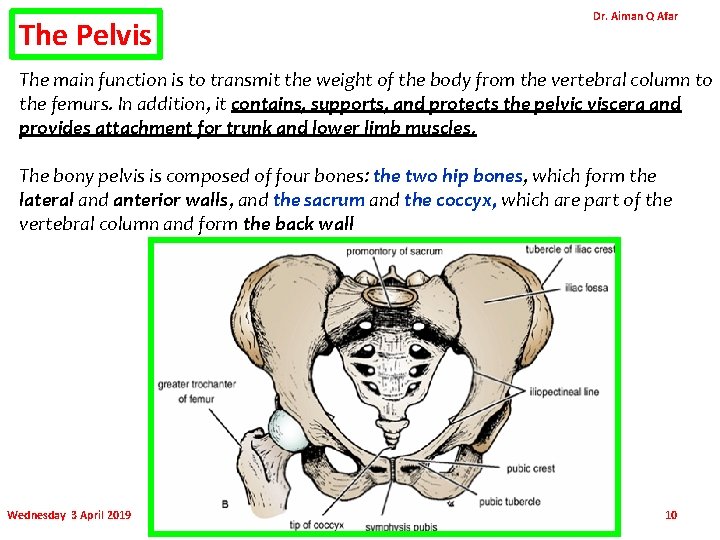
The Pelvis Dr. Aiman Q Afar The main function is to transmit the weight of the body from the vertebral column to the femurs. In addition, it contains, supports, and protects the pelvic viscera and provides attachment for trunk and lower limb muscles. The bony pelvis is composed of four bones: the two hip bones, which form the lateral and anterior walls, and the sacrum and the coccyx, which are part of the vertebral column and form the back wall Wednesday 3 April 2019 10
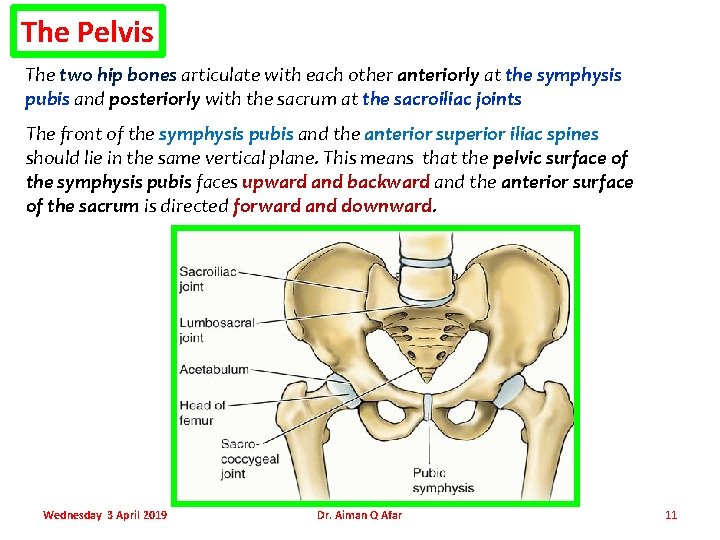
The Pelvis The two hip bones articulate with each other anteriorly at the symphysis pubis and posteriorly with the sacrum at the sacroiliac joints The front of the symphysis pubis and the anterior superior iliac spines should lie in the same vertical plane. This means that the pelvic surface of the symphysis pubis faces upward and backward and the anterior surface of the sacrum is directed forward and downward. Wednesday 3 April 2019 Dr. Aiman Q Afar 11
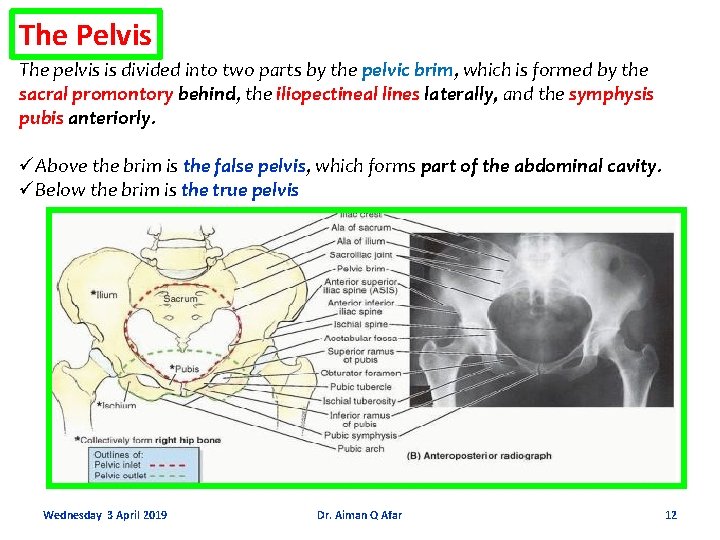
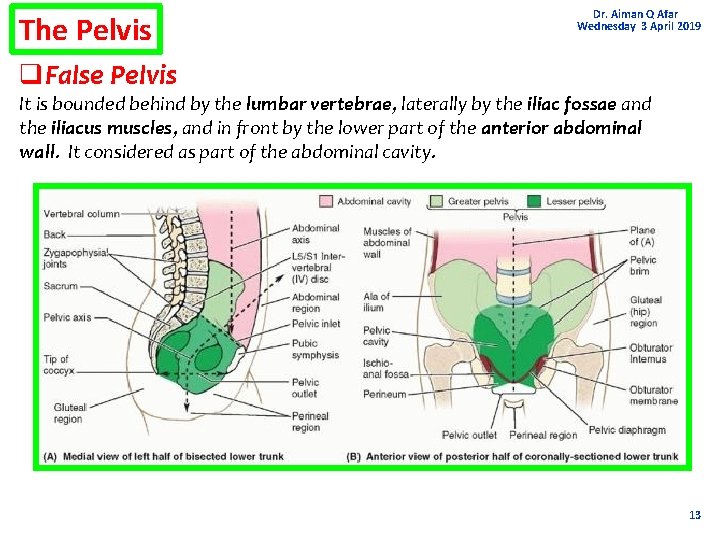
The Pelvis The pelvis is divided into two parts by the pelvic brim, which is formed by the sacral promontory behind, the iliopectineal lines laterally, and the symphysis pubis anteriorly. üAbove the brim is the false pelvis, which forms part of the abdominal cavity. üBelow the brim is the true pelvis Wednesday 3 April 2019 Dr. Aiman Q Afar 12
The Pelvis Dr. Aiman Q Afar Wednesday 3 April 2019 q. False Pelvis It is bounded behind by the lumbar vertebrae, laterally by the iliac fossae and the iliacus muscles, and in front by the lower part of the anterior abdominal wall. It considered as part of the abdominal cavity. 13
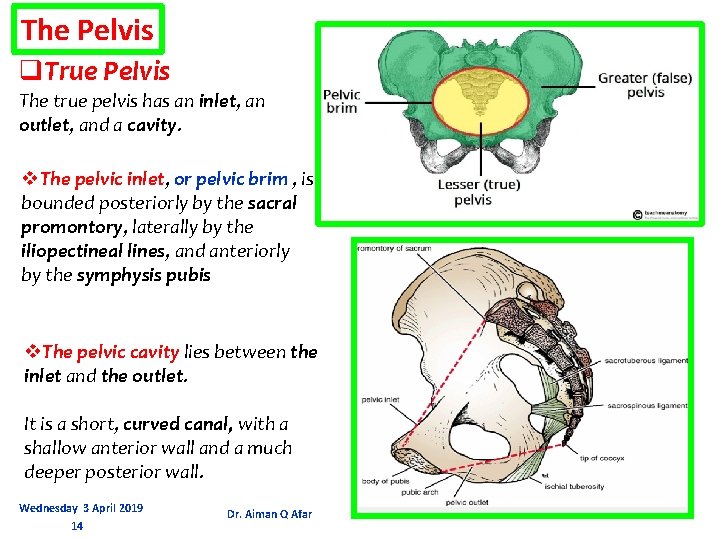
The Pelvis q. True Pelvis The true pelvis has an inlet, an outlet, and a cavity. v. The pelvic inlet, or pelvic brim , is bounded posteriorly by the sacral promontory, laterally by the iliopectineal lines, and anteriorly by the symphysis pubis v. The pelvic cavity lies between the inlet and the outlet. It is a short, curved canal, with a shallow anterior wall and a much deeper posterior wall. Wednesday 3 April 2019 14 Dr. Aiman Q Afar
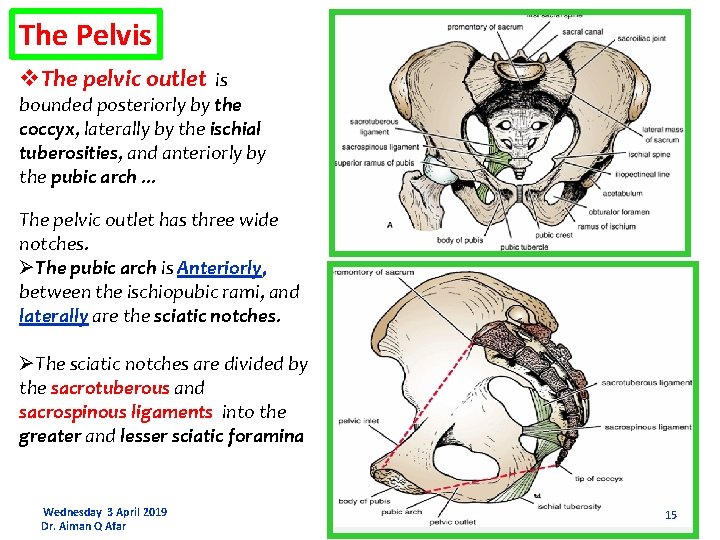
The Pelvis v. The pelvic outlet is bounded posteriorly by the coccyx, laterally by the ischial tuberosities, and anteriorly by the pubic arch. . . The pelvic outlet has three wide notches. ØThe pubic arch is Anteriorly, between the ischiopubic rami, and laterally are the sciatic notches. ØThe sciatic notches are divided by the sacrotuberous and sacrospinous ligaments into the greater and lesser sciatic foramina Wednesday 3 April 2019 Dr. Aiman Q Afar 15
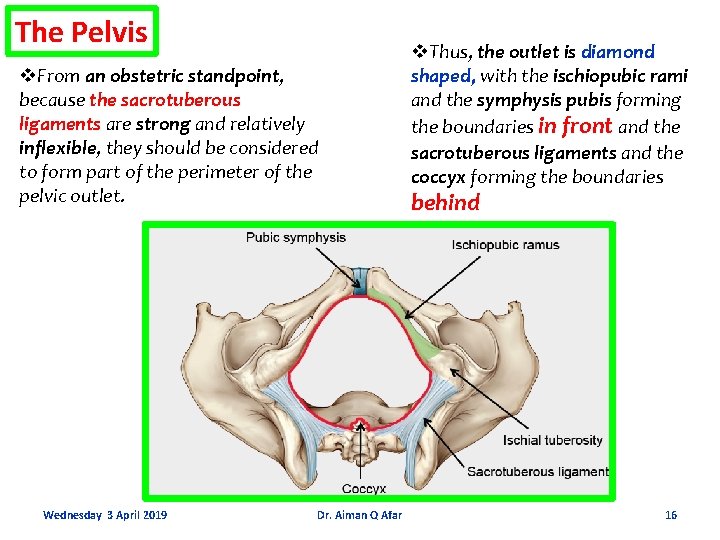
The Pelvis v. From an obstetric standpoint, because the sacrotuberous ligaments are strong and relatively inflexible, they should be considered to form part of the perimeter of the pelvic outlet. Wednesday 3 April 2019 Dr. Aiman Q Afar v. Thus, the outlet is diamond shaped, with the ischiopubic rami and the symphysis pubis forming the boundaries in front and the sacrotuberous ligaments and the coccyx forming the boundaries behind 16
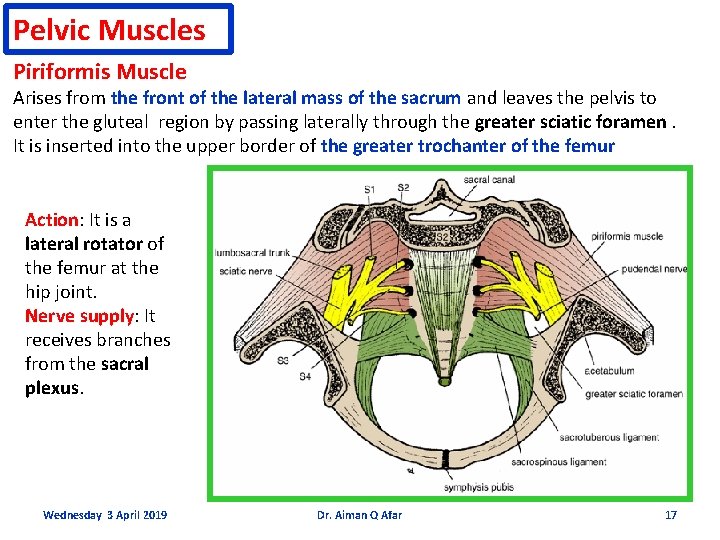
Pelvic Muscles Piriformis Muscle Arises from the front of the lateral mass of the sacrum and leaves the pelvis to enter the gluteal region by passing laterally through the greater sciatic foramen. It is inserted into the upper border of the greater trochanter of the femur Action: It is a lateral rotator of the femur at the hip joint. Nerve supply: It receives branches from the sacral plexus. Wednesday 3 April 2019 Dr. Aiman Q Afar 17
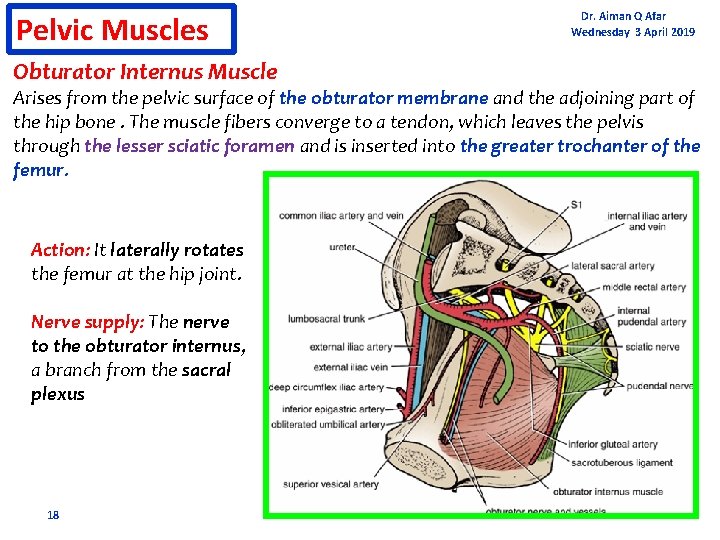
Pelvic Muscles Obturator Internus Muscle Dr. Aiman Q Afar Wednesday 3 April 2019 Arises from the pelvic surface of the obturator membrane and the adjoining part of the hip bone. The muscle fibers converge to a tendon, which leaves the pelvis through the lesser sciatic foramen and is inserted into the greater trochanter of the femur. Action: It laterally rotates the femur at the hip joint. Nerve supply: The nerve to the obturator internus, a branch from the sacral plexus 18
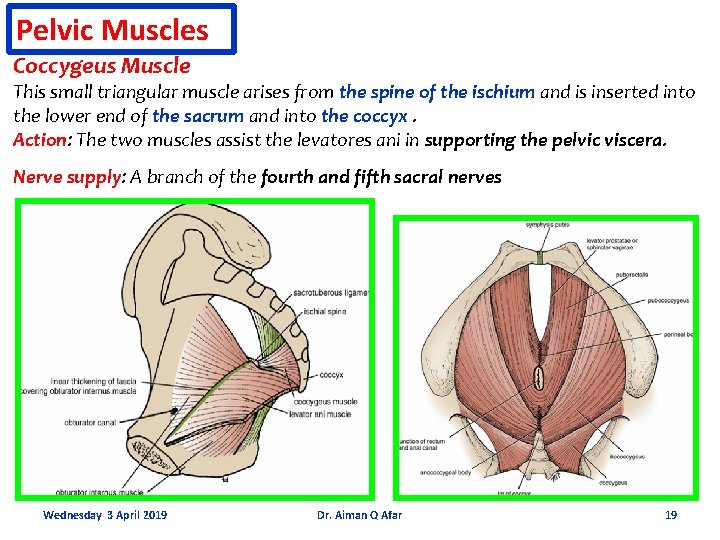
Pelvic Muscles Coccygeus Muscle This small triangular muscle arises from the spine of the ischium and is inserted into the lower end of the sacrum and into the coccyx. Action: The two muscles assist the levatores ani in supporting the pelvic viscera. Nerve supply: A branch of the fourth and fifth sacral nerves Wednesday 3 April 2019 Dr. Aiman Q Afar 19
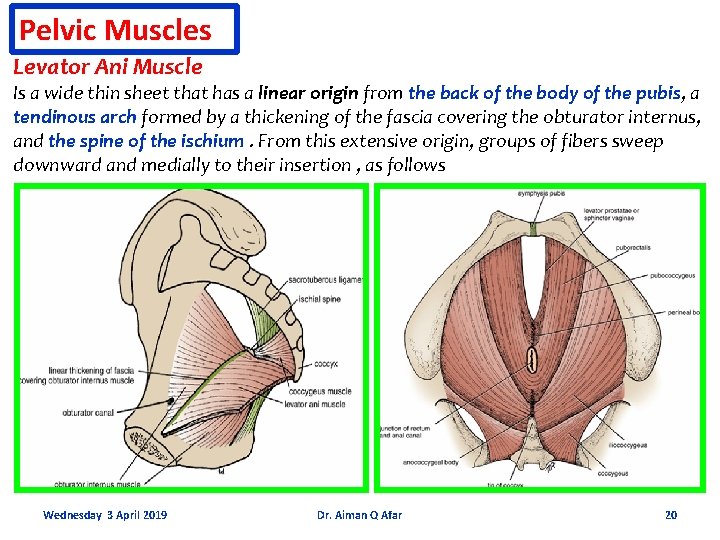
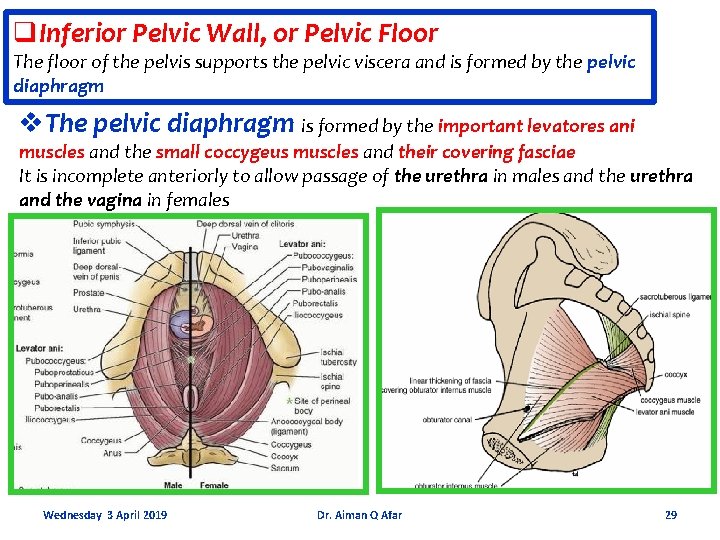
Pelvic Muscles Levator Ani Muscle Is a wide thin sheet that has a linear origin from the back of the body of the pubis, a tendinous arch formed by a thickening of the fascia covering the obturator internus, and the spine of the ischium. From this extensive origin, groups of fibers sweep downward and medially to their insertion , as follows Wednesday 3 April 2019 Dr. Aiman Q Afar 20
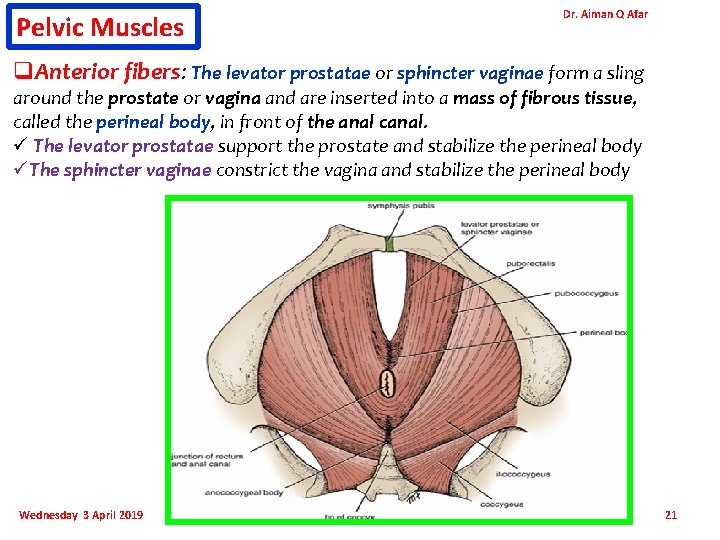
Pelvic Muscles Dr. Aiman Q Afar q. Anterior fibers: The levator prostatae or sphincter vaginae form a sling around the prostate or vagina and are inserted into a mass of fibrous tissue, called the perineal body, in front of the anal canal. ü The levator prostatae support the prostate and stabilize the perineal body üThe sphincter vaginae constrict the vagina and stabilize the perineal body Wednesday 3 April 2019 21
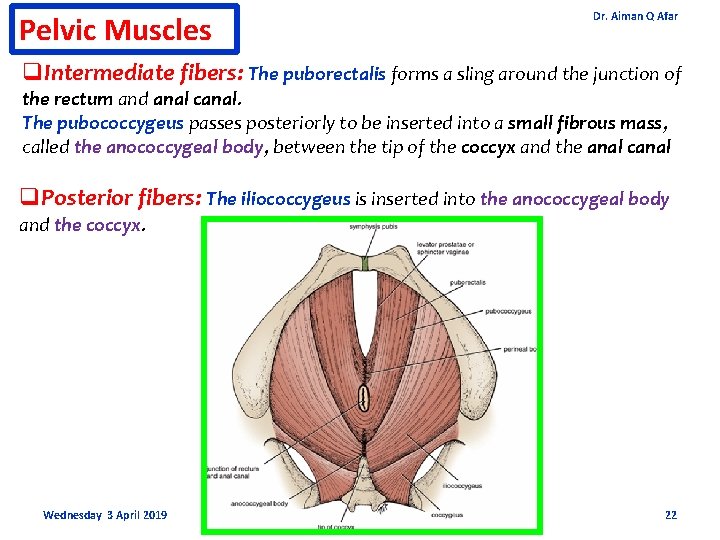
Pelvic Muscles Dr. Aiman Q Afar q. Intermediate fibers: The puborectalis forms a sling around the junction of the rectum and anal canal. The pubococcygeus passes posteriorly to be inserted into a small fibrous mass, called the anococcygeal body, between the tip of the coccyx and the anal canal q. Posterior fibers: The iliococcygeus is inserted into the anococcygeal body and the coccyx. Wednesday 3 April 2019 22
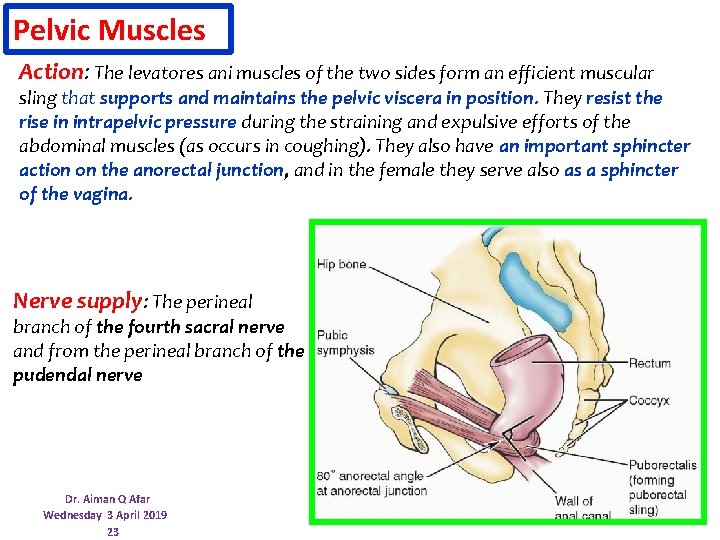
Pelvic Muscles Action: The levatores ani muscles of the two sides form an efficient muscular sling that supports and maintains the pelvic viscera in position. They resist the rise in intrapelvic pressure during the straining and expulsive efforts of the abdominal muscles (as occurs in coughing). They also have an important sphincter action on the anorectal junction, and in the female they serve also as a sphincter of the vagina. Nerve supply: The perineal branch of the fourth sacral nerve and from the perineal branch of the pudendal nerve Dr. Aiman Q Afar Wednesday 3 April 2019 23
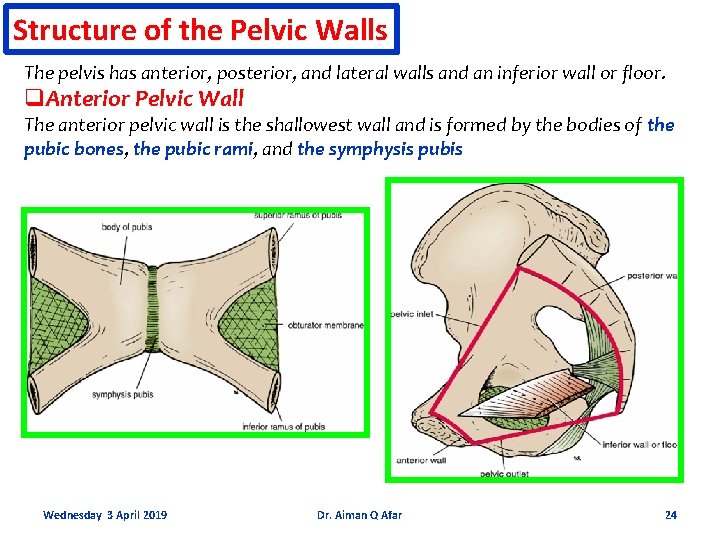
Structure of the Pelvic Walls The pelvis has anterior, posterior, and lateral walls and an inferior wall or floor. q. Anterior Pelvic Wall The anterior pelvic wall is the shallowest wall and is formed by the bodies of the pubic bones, the pubic rami, and the symphysis pubis Wednesday 3 April 2019 Dr. Aiman Q Afar 24
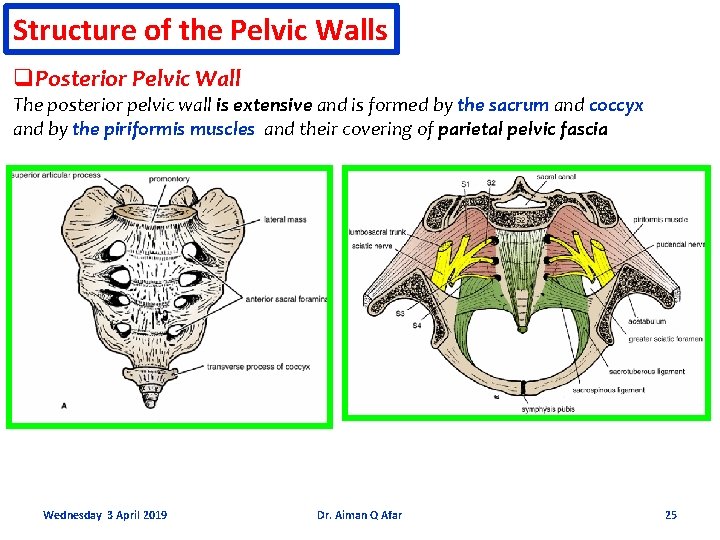
Structure of the Pelvic Walls q. Posterior Pelvic Wall The posterior pelvic wall is extensive and is formed by the sacrum and coccyx and by the piriformis muscles and their covering of parietal pelvic fascia Wednesday 3 April 2019 Dr. Aiman Q Afar 25
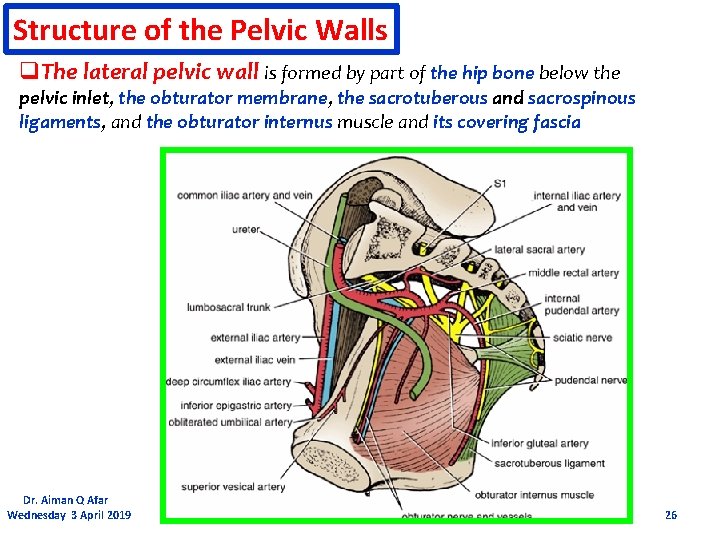
Structure of the Pelvic Walls q. The lateral pelvic wall is formed by part of the hip bone below the pelvic inlet, the obturator membrane, the sacrotuberous and sacrospinous ligaments, and the obturator internus muscle and its covering fascia Dr. Aiman Q Afar Wednesday 3 April 2019 26
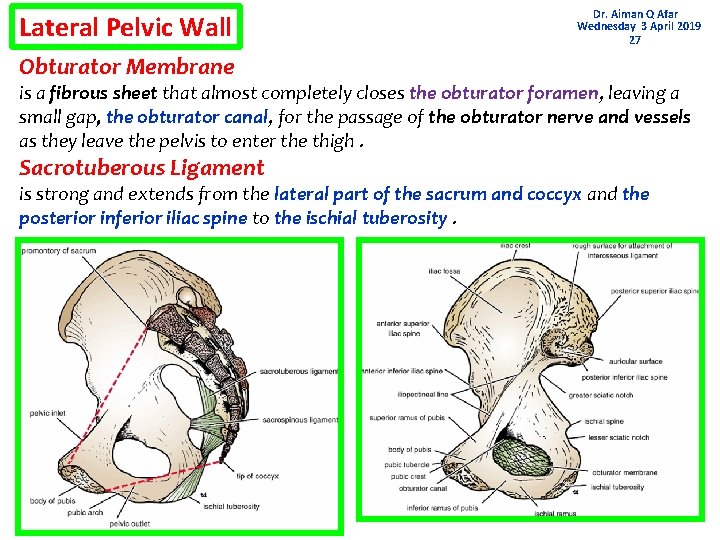
Lateral Pelvic Wall Dr. Aiman Q Afar Wednesday 3 April 2019 27 Obturator Membrane is a fibrous sheet that almost completely closes the obturator foramen, leaving a small gap, the obturator canal, for the passage of the obturator nerve and vessels as they leave the pelvis to enter the thigh. Sacrotuberous Ligament is strong and extends from the lateral part of the sacrum and coccyx and the posterior inferior iliac spine to the ischial tuberosity.
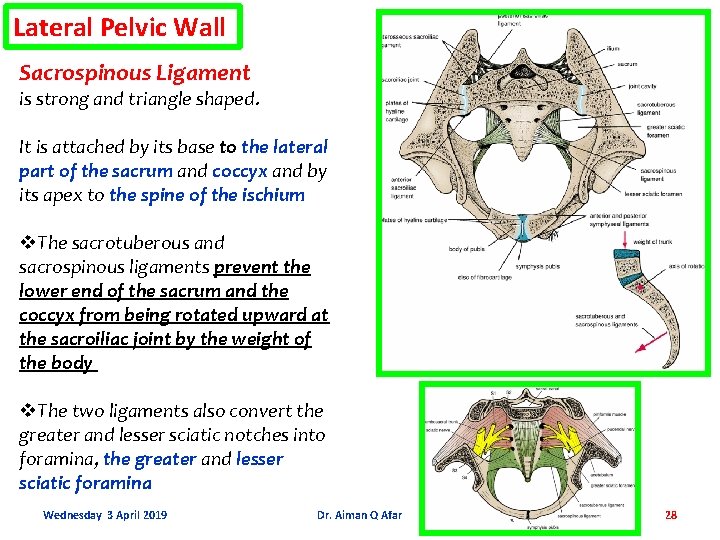
Lateral Pelvic Wall Sacrospinous Ligament is strong and triangle shaped. It is attached by its base to the lateral part of the sacrum and coccyx and by its apex to the spine of the ischium v. The sacrotuberous and sacrospinous ligaments prevent the lower end of the sacrum and the coccyx from being rotated upward at the sacroiliac joint by the weight of the body v. The two ligaments also convert the greater and lesser sciatic notches into foramina, the greater and lesser sciatic foramina Wednesday 3 April 2019 Dr. Aiman Q Afar 28
q. Inferior Pelvic Wall, or Pelvic Floor The floor of the pelvis supports the pelvic viscera and is formed by the pelvic diaphragm v. The pelvic diaphragm is formed by the important levatores ani muscles and the small coccygeus muscles and their covering fasciae It is incomplete anteriorly to allow passage of the urethra in males and the urethra and the vagina in females Wednesday 3 April 2019 Dr. Aiman Q Afar 29
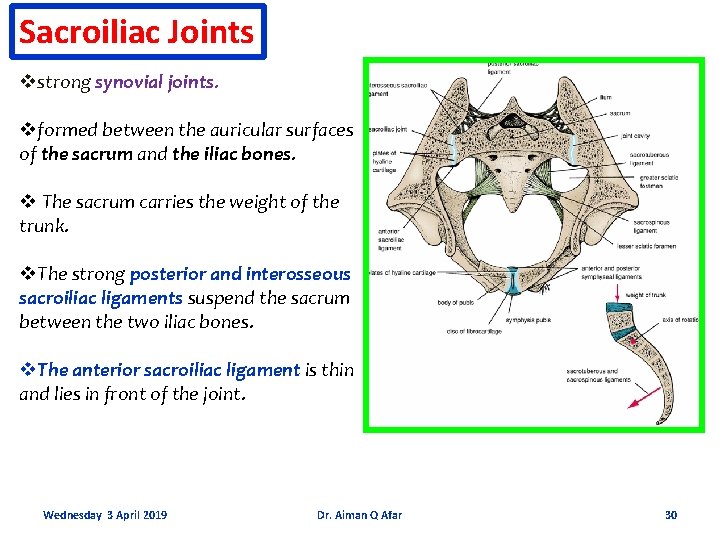
Sacroiliac Joints vstrong synovial joints. vformed between the auricular surfaces of the sacrum and the iliac bones. v The sacrum carries the weight of the trunk. v. The strong posterior and interosseous sacroiliac ligaments suspend the sacrum between the two iliac bones. v. The anterior sacroiliac ligament is thin and lies in front of the joint. Wednesday 3 April 2019 Dr. Aiman Q Afar 30
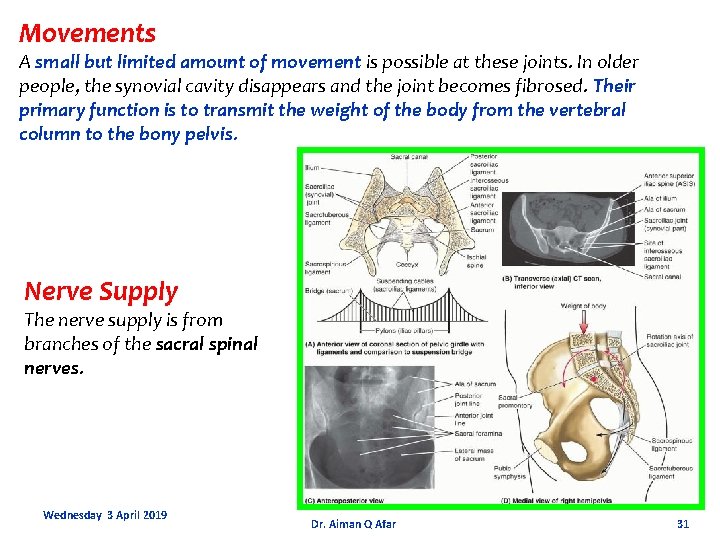
Movements A small but limited amount of movement is possible at these joints. In older people, the synovial cavity disappears and the joint becomes fibrosed. Their primary function is to transmit the weight of the body from the vertebral column to the bony pelvis. Nerve Supply The nerve supply is from branches of the sacral spinal nerves. Wednesday 3 April 2019 Dr. Aiman Q Afar 31
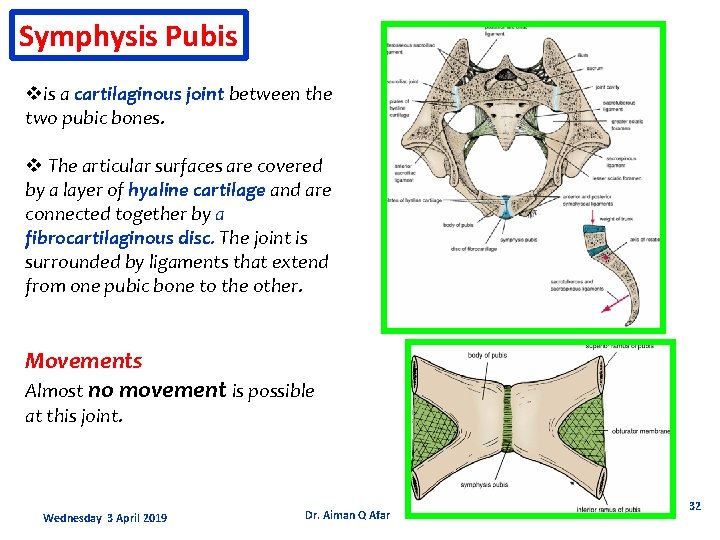
Symphysis Pubis vis a cartilaginous joint between the two pubic bones. v The articular surfaces are covered by a layer of hyaline cartilage and are connected together by a fibrocartilaginous disc. The joint is surrounded by ligaments that extend from one pubic bone to the other. Movements Almost no movement is possible at this joint. Wednesday 3 April 2019 Dr. Aiman Q Afar 32
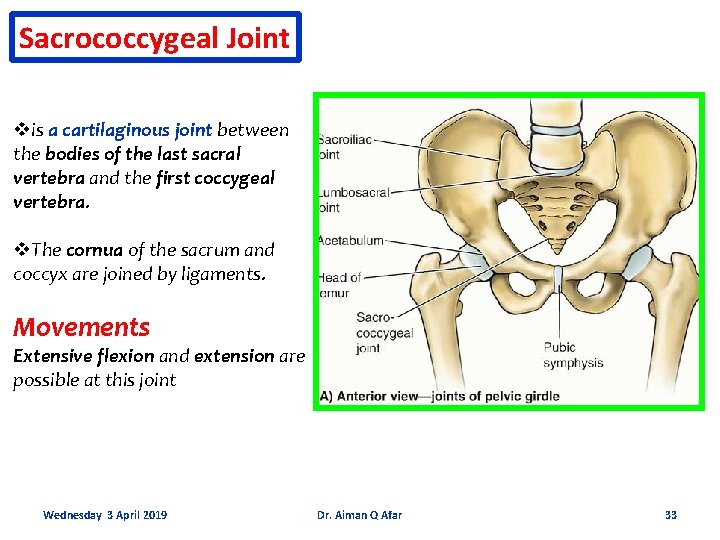
Sacrococcygeal Joint vis a cartilaginous joint between the bodies of the last sacral vertebra and the first coccygeal vertebra. v. The cornua of the sacrum and coccyx are joined by ligaments. Movements Extensive flexion and extension are possible at this joint Wednesday 3 April 2019 Dr. Aiman Q Afar 33
Dr. Aiman Q Afar Wednesday 3 April 2019 Dr. Aiman Q Afar 34