
URINE FORMATION 2 Reabsorption 1 Filtration 3 Secretion
URINE FORMATION
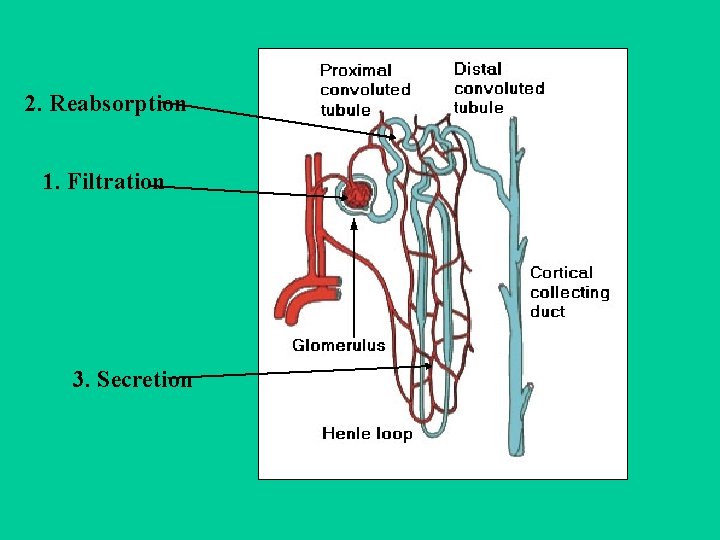
2. Reabsorption 1. Filtration 3. Secretion
GLOMERULAR FILTRATION • 180 liters per day filtered (4 X total body water) • Filters water & dissolved substances (plasma) • Hydrostatic pressure forces substances out of capillaries • As osmotic pressure increases in the capillaries, filtration decreases
Con’t • Filtration is also regulated by changes in blood pressure or blood volume or by vasodilation • Renin (enzyme) regulates filtration by reacting to a. Drop in blood pressure b. Sympathetic stimulation c. Decrease in ions (Na+, K+, Cl-)
TUBULAR REABSORPTION • Substances are transported out of the tubular fluid & into intersticial fluid • PURPOSE: reclaim materials body needs & remove waste • MOVEMENTS: A. Lipid soluble B. Channel proteins C. Active transport
CON’T • Most absorption takes place in the proximal convoluted portion • Examples of substances that get reabsorbed: proteins, water, vitamins, amino acids, glucose, creatin, uric acid, urea, Na+, K+ • Water is reabsorbed by osmosis • As Na+ reabsorption increases, so does water reabsorption
Primary substances • UREA: Byproduct of amino acid metabolism • URIC ACID: byproduct of organic base (in nucleic acids) metabolism
TUBULAR SECRETION • Substances move from capillaries into tubule to be secreted out of body • Active transport • Examples of substances secreted: K+, H+, creatine, histamines, antibiotics, narcotics, ammonia • Secretion of H+ ions regulate body fluid p. H
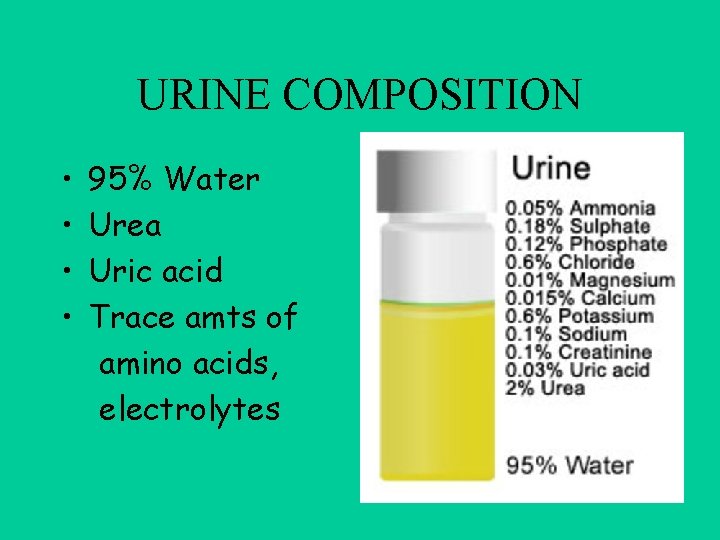
URINE COMPOSITION • • 95% Water Urea Uric acid Trace amts of amino acids, electrolytes
URINE PRODUCTION • Produce 0. 6 -2. 5 liters urine per day • AFFECTED BY: a. Fluid intake b. Environment: temp/humidity c. Emotional condition d. Body temperature/respiration
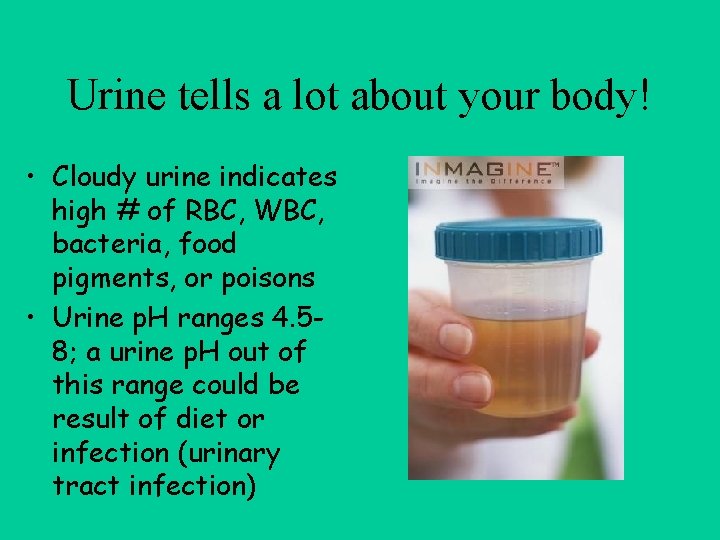
Urine tells a lot about your body! • Cloudy urine indicates high # of RBC, WBC, bacteria, food pigments, or poisons • Urine p. H ranges 4. 58; a urine p. H out of this range could be result of diet or infection (urinary tract infection)
CON’T • Calcium crystals can result in kidney stones • Bilirubin can indicate liver disease • Too much sugar (glucose) indicates diabetes • Too much protein in urine can indicate pregnancy or high protein diet; high protein can also be an indication of bone cancer
- Slides: 12