
Urine drug testing and the roles of a

- Slides: 48
Urine drug testing and the roles of a Medical Review Officer Matt Noble, MD MPH Medical Toxicology Fellow Certified MRO
Outline What is a Medical Review Officer? Who regulates testing? Who gets tested? Urine collection procedure Lab interpretation The MRO verification process On the horizon of drug testing
Outline What is a Medical Review Officer? Who regulates testing? Who gets tested? Urine collection procedure Lab interpretation The MRO verification process On the horizon of drug testing
MRO responsibilities Interpret forensic drug testing results within the context of a regulatory framework Dept of Transportation 49 CFR Part 40 Interact with the donor to discuss results and facilitate appropriate actions and requests Confirm or deny legitimate medical reasons for positive results
Outline What is a Medical Review Officer? Who regulates testing? Who gets tested? Urine collection procedure Lab interpretation The MRO verification process On the horizon of drug testing
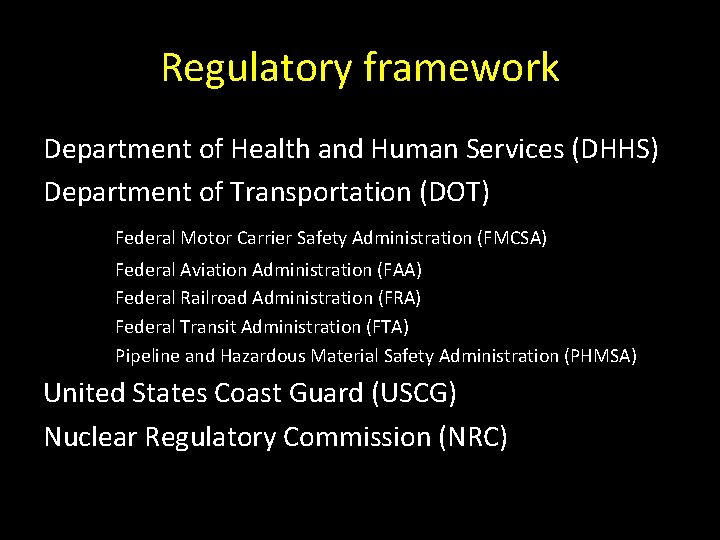
Regulatory framework Department of Health and Human Services (DHHS) Department of Transportation (DOT) Federal Motor Carrier Safety Administration (FMCSA) Federal Aviation Administration (FAA) Federal Railroad Administration (FRA) Federal Transit Administration (FTA) Pipeline and Hazardous Material Safety Administration (PHMSA) United States Coast Guard (USCG) Nuclear Regulatory Commission (NRC)
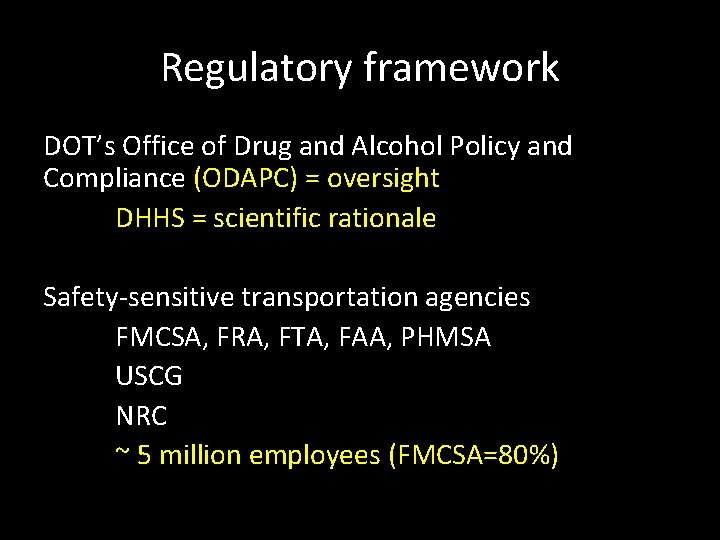
Regulatory framework DOT’s Office of Drug and Alcohol Policy and Compliance (ODAPC) = oversight DHHS = scientific rationale Safety-sensitive transportation agencies FMCSA, FRA, FTA, FAA, PHMSA USCG NRC ~ 5 million employees (FMCSA=80%)
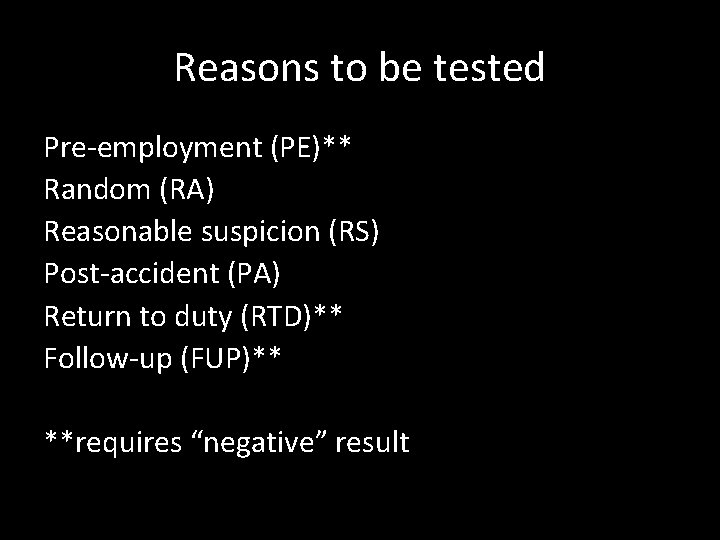
Reasons to be tested Pre-employment (PE)** Random (RA) Reasonable suspicion (RS) Post-accident (PA) Return to duty (RTD)** Follow-up (FUP)** **requires “negative” result
Outline What is a Medical Review Officer? Who regulates testing? Who gets tested? Urine collection procedure Lab interpretation The MRO verification process On the horizon of drug testing
Specimens Urine Hair Nail Saliva Breath (alcohol)
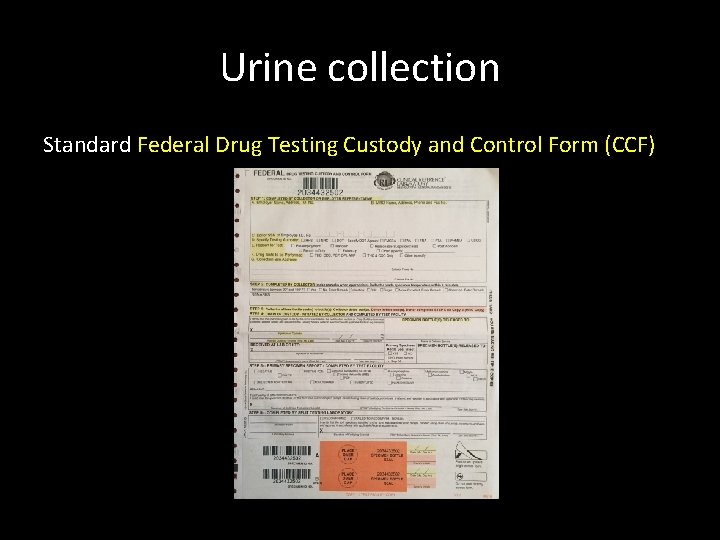
Urine collection Standard Federal Drug Testing Custody and Control Form (CCF)
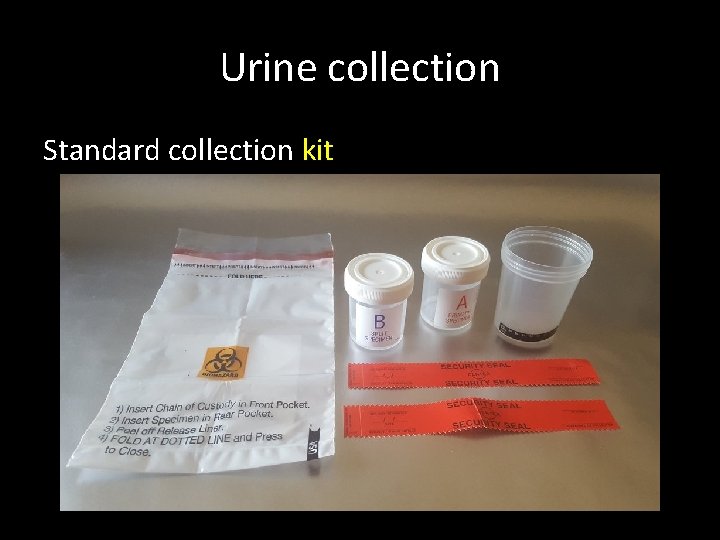
Urine collection Standard collection kit
Urine collection Collector must meet training requirements • “knowledgeable of” process per DOT regulations • “instructed on” how to collect (trained) • demonstrates proficiency (5 consecutive error-free mock collections) Training occurs: • prior to being certified • every 5 years • after any errors
Urine collection Approved collection site Single-toilet room is preferred donor has privacy (full-length door) Multi-stall room if necessary donor has visual privacy (partial-length door) may be monitored (in bathroom, not in stall) “Integrity of collection” bluing in toilet, tape tank, remove trash, etc.
Urine collection Collector explains procedure and completes Step 1 of CCF, donor washes hands “Failure to cooperate is a refusal to test” donor fails to wash hands, admits to adulterating/substituting specimen, found to have device “You may not leave before I excuse you” Selection of kit, by collector or donor, is the point of no return
Urine collection Donor provides at least 45 m. L Collector: • notes temperature, • splits sample (30 ml to bottle A, 15 ml to bottle B), and • completes Step 2 of CCF
“Shy bladder” Donor unable to provide sufficient sample volume on first attempt • First specimen is discarded • Donor is given up to 3 hours and 40 oz of fluid to provide an adequate urine specimen If donor unable to provide new sufficient sample, collector contacts employer representative If donor is unwilling (ie, leaves) = refusal to test
Direct Observation collection When directed by employer Invalid result, canceled positive test, RTD or FUP tests When determined by collector Suspected tampering (abnormal temperature or odor/color) ALWAYS by same gender observer Observer does NOT have to be a trained collector If employee declines to allow observed collection = refusal to test
Direct Observation procedure Nothing except skin between navel and knees Turning around one full turn Donor may then return clothing to proper position prior to providing specimen
“Fatal” specimen flaws • Specimen IDs on bottle and form do not match • Specimen bottle seal broken (may redesignate bottle B as bottle A) • Collector’s name and signature missing • Insufficient quantity of urine for analysis (may redesignate bottle B as bottle A) Flaw documented on form and report “rejected for testing” (NO attempt to test specimen)
“Correctable” flaws • Collector’s signature omitted • Form is expired Flaw documented on form CONTINUE testing process Attempt to correct flaw (may be “rejected” if not successful)
Temperature not recorded Neither a fatal nor a correctable flaw CONTINUE testing process Attempt to correct
Outline What is a Medical Review Officer? Who regulates testing? Who gets tested? Urine collection procedure Lab interpretation The MRO verification process On the horizon of drug testing
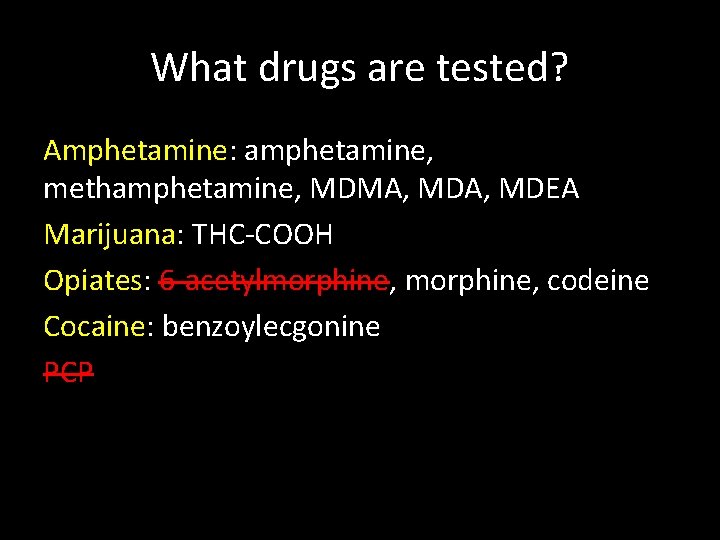
What drugs are tested? Amphetamine: amphetamine, methamphetamine, MDMA, MDEA Marijuana: THC-COOH Opiates: 6 -acetylmorphine, codeine Cocaine: benzoylecgonine PCP Only 11 compounds are currently tested for
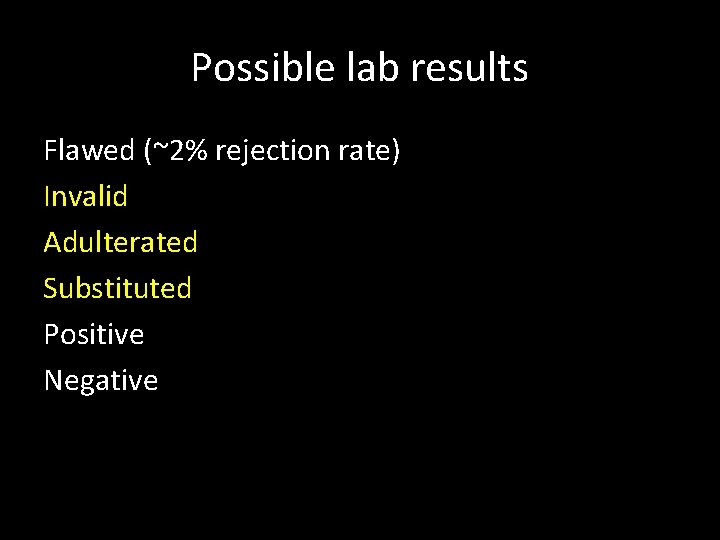
Possible lab results Flawed (~2% rejection rate) Invalid Adulterated Substituted Positive Negative
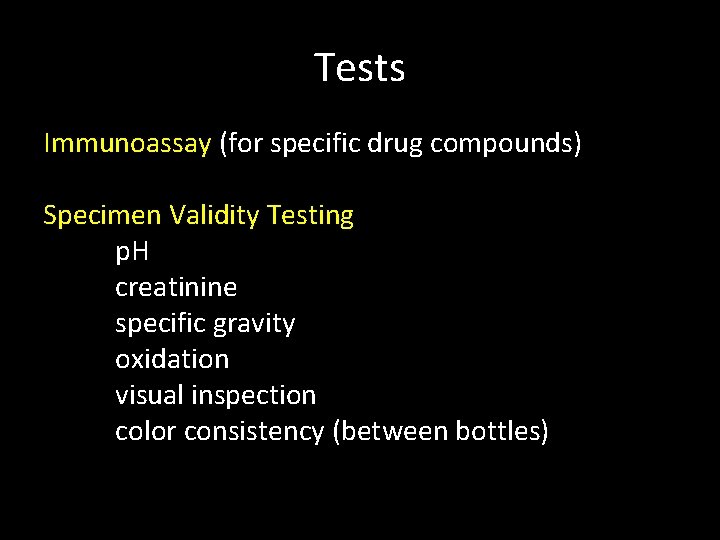
Tests Immunoassay (for specific drug compounds) Specimen Validity Testing p. H creatinine specific gravity oxidation visual inspection color consistency (between bottles)
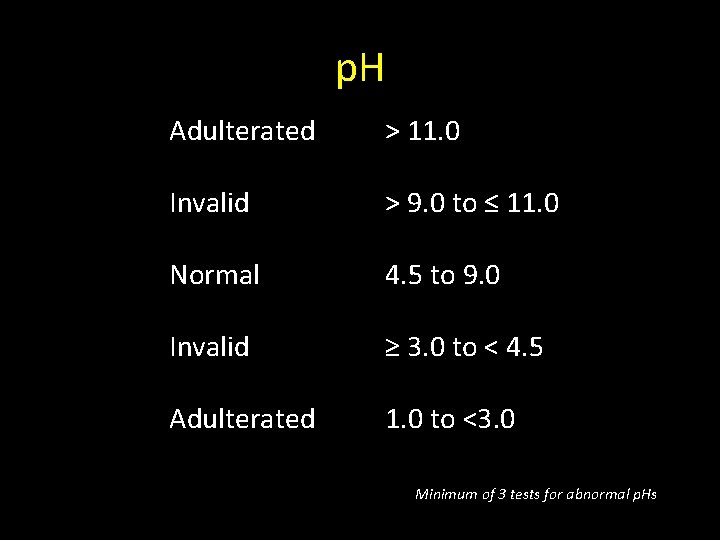
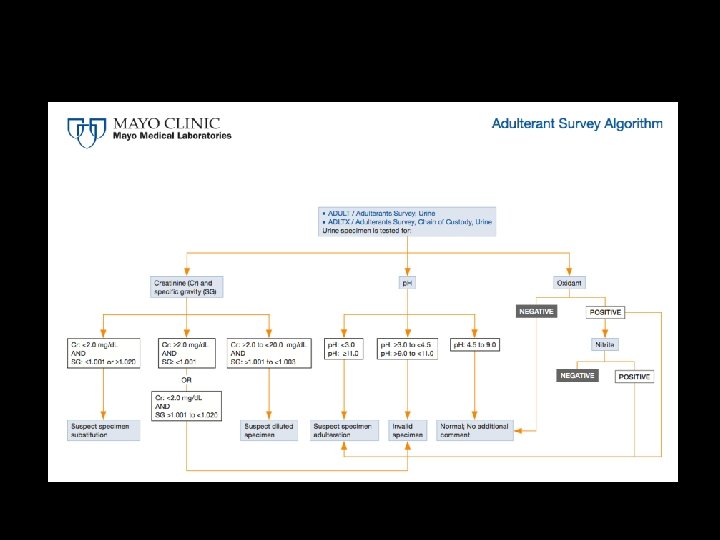
p. H Adulterated > 11. 0 Invalid > 9. 0 to ≤ 11. 0 Normal 4. 5 to 9. 0 Invalid ≥ 3. 0 to < 4. 5 Adulterated 1. 0 to <3. 0 Minimum of 3 tests for abnormal p. Hs
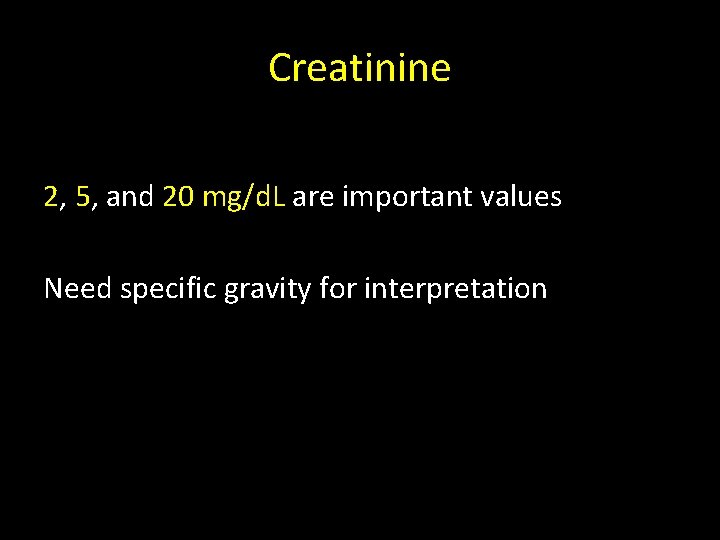
Creatinine 2, 5, and 20 mg/d. L are important values Need specific gravity for interpretation
Creatinine and Specific Gravity Dilution: lower than expected values for normal human urine Substitution: values outside the physiologically possible range of human urine Invalid: incongruent results
Confirmatory testing Gas Chromatography–Mass Spectrometry (GC/MS) or Tandem Mass Spectrometry (MS/MS) Used whenever initial immunoassay results are positive (over cutoff value) for any of the 11 tested compounds
Confirmatory testing If initial immunoassay below cutoff = negative If immunoassay at or above cutoff confirmatory testing If confirmatory testing below cutoff = negative If confirmatory testing at or above cutoff = positive Lab reports only “positive” or “negative, ” without concentration (unless quantitative values requested) Exception is morphine or codeine (MRO needs concentrations)
Dilute specimens Definition: Cr between 2 and 20 mg/d. L and SG is between 1. 0010 and 1. 0030 If positive (for drug), dilution irrelevant If negative, further action based on how dilute Cr between 2 and 5 mg/d. L = recollection Cr >5 mg/d. L = employer discretion/policy
Invalid specimens “Invalid” is a laboratory result Will never be reported with a “negative” result may accompany “positive, ” “adulterated, ” or “substituted” results Reasons may include: inconsistent Cr and SG results abnormal p. H abnormal nitrite concentration presence of chromium or halogen or glutaraldehyde or oxidant or surfactant
Outline What is a Medical Review Officer? Who regulates testing? Who gets tested? Urine collection procedure Lab interpretation The MRO verification process On the horizon of drug testing
MRO responsibilities Interpret forensic drug testing results within the context of a regulatory framework Dept of Transportation 49 CFR Part 40 Interact with the donor to discuss results and facilitate appropriate actions and requests Confirm or deny legitimate medical reasons for positive results
“Legitimate medical explanations” None for PCP or 6 -acetylmorphine
What drugs are tested? Amphetamine: amphetamine, methamphetamine, MDMA, MDEA Marijuana: THC-COOH Opiates: 6 -acetylmorphine, codeine Cocaine: benzoylecgonine PCP
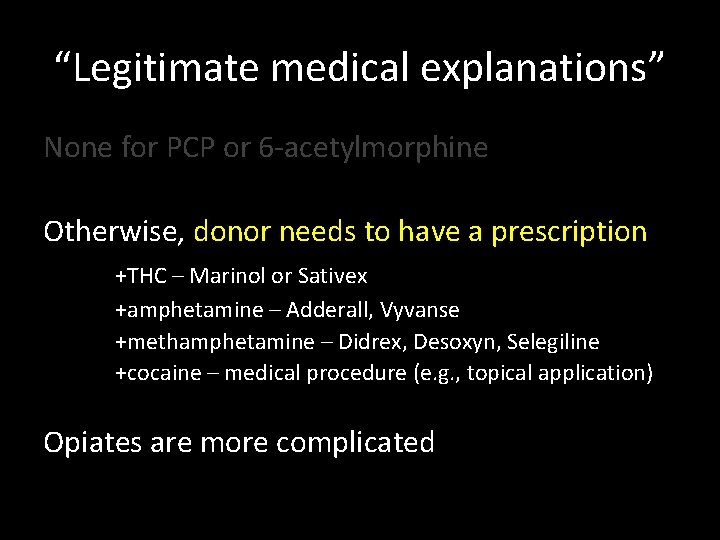
“Legitimate medical explanations” None for PCP or 6 -acetylmorphine Otherwise, donor needs to have a prescription +THC – Marinol or Sativex +amphetamine – Adderall, Vyvanse +methamphetamine – Didrex, Desoxyn, Selegiline +cocaine – medical procedure (e. g. , topical application) Opiates are more complicated
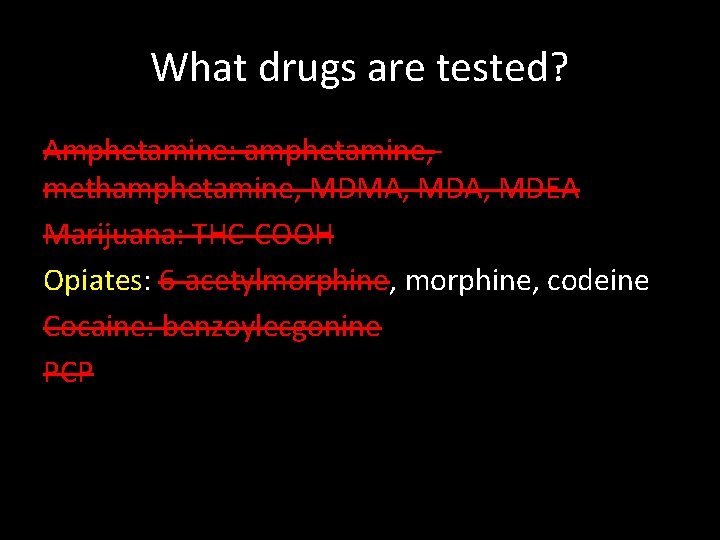
What drugs are tested? Amphetamine: amphetamine, methamphetamine, MDMA, MDEA Marijuana: THC-COOH Opiates: 6 -acetylmorphine, codeine Cocaine: benzoylecgonine PCP
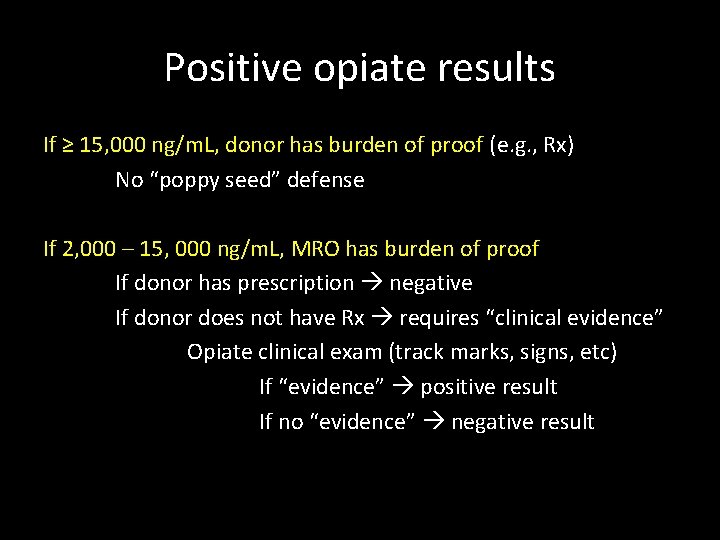
Positive opiate results If ≥ 15, 000 ng/m. L, donor has burden of proof (e. g. , Rx) No “poppy seed” defense If 2, 000 – 15, 000 ng/m. L, MRO has burden of proof If donor has prescription negative If donor does not have Rx requires “clinical evidence” Opiate clinical exam (track marks, signs, etc) If “evidence” positive result If no “evidence” negative result
Outline What is a Medical Review Officer? Who regulates testing? Who gets tested? Urine collection procedure Lab interpretation The MRO verification process On the horizon of drug testing
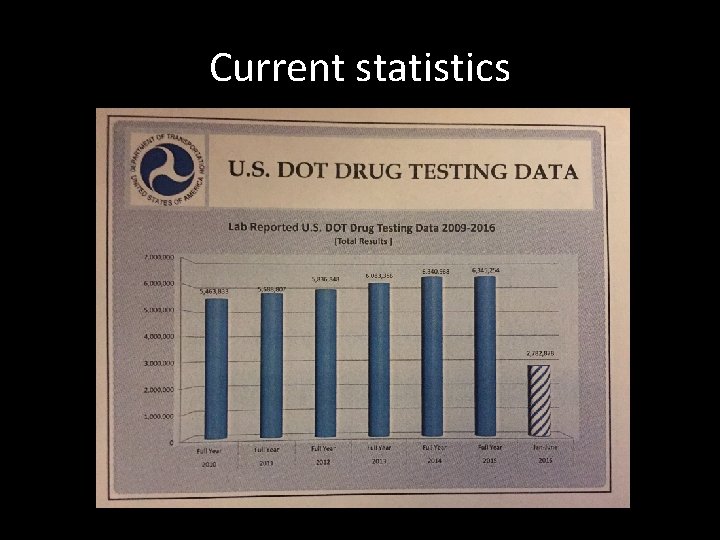
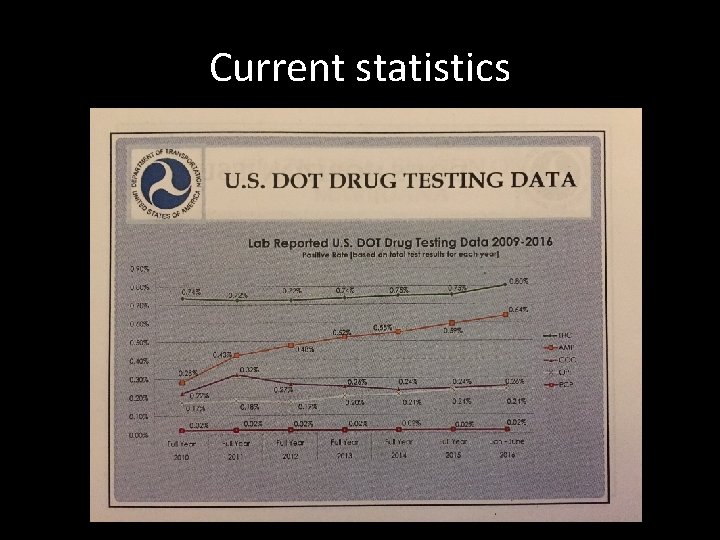
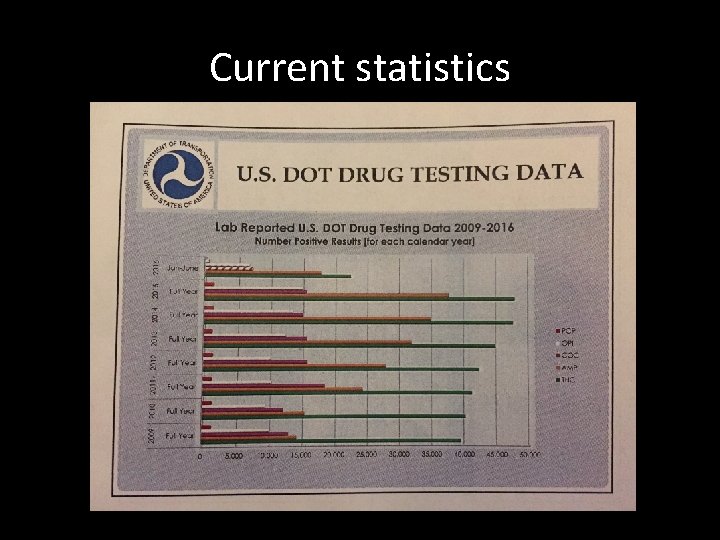
Current statistics
Current statistics
Current statistics
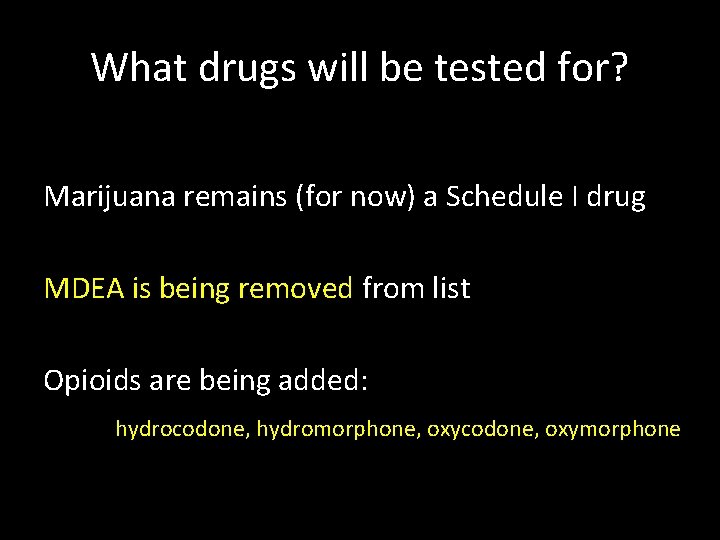
What drugs will be tested for? Marijuana remains (for now) a Schedule I drug MDEA is being removed from list Opioids are being added: hydrocodone, hydromorphone, oxycodone, oxymorphone
Practically… With the addition of four opioids, the number of “positive” lab results will dramatically increase, as will the work of MROs to confirm these results
Questions?