
Urine Concentration Mechanism Prof Mona Soliman MBBS MSc
Urine Concentration Mechanism Prof. Mona Soliman, MBBS, MSc, Ph. D Head, Medical Education Department Professor of Physiology & Medical Education College of Medicine King Saud University 1
Learning Objectives: Ø Identify and describe that the loop of Henle is referred to as countercurrent multiplier and the loop and vasa recta as countercurrent exchange systems in concentrating and diluting urine Ø Explain what happens to osmolarity of tubular fluid in the various segments of the loop of Henle when concentrated urine is being produced. Ø Explain the factors that determine the ability of loop of Henle to make a concentrated medullary gradient Ø Differentiate between water diuresis and osmotic diuresis Ø Appreciate clinical correlates of diabetes mellitus and diabetes insipidus 2
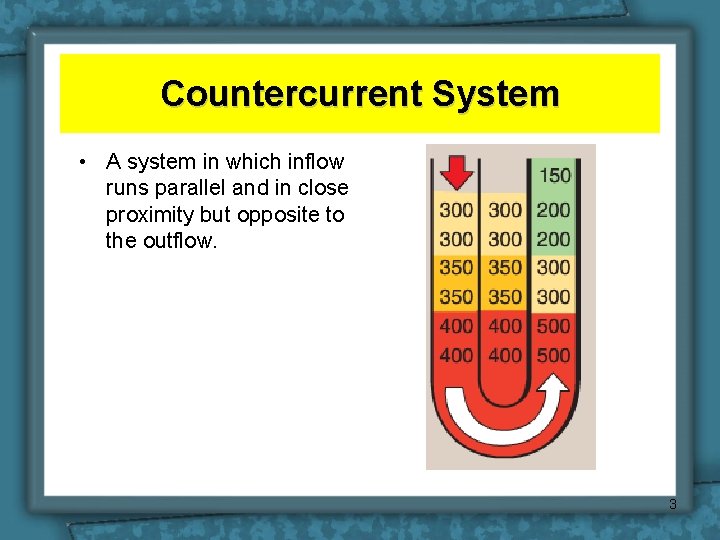
Countercurrent System • A system in which inflow runs parallel and in close proximity but opposite to the outflow. 3
Mechanism for urine concentration/dilution • While the loop of Henle reabsorbs another 20% of the salt/water in tubular fluid, primary function is to determine osmolarity of urine (i. e. whether concentrated or diluted) using countercurrent multiplier system • While collecting duct is where urine concentration is determined, osmolarity of interstitial fluid in medulla must be high and osmolarity of tubular fluid must be low – Countercurrent multiplier system achieves this 4
Countercurrent multiplier system • Is the repetitive reabsorption of Na. Cl by the thick ascending loop of Henle and continued inflow of new Na. Cl from PCT into LOH • The Na. Cl reabsorbed from the ascending LOH keeps adding newly arrived Na. Cl (into LOH from PCT), thus multiplying its concentration in the medulla 5
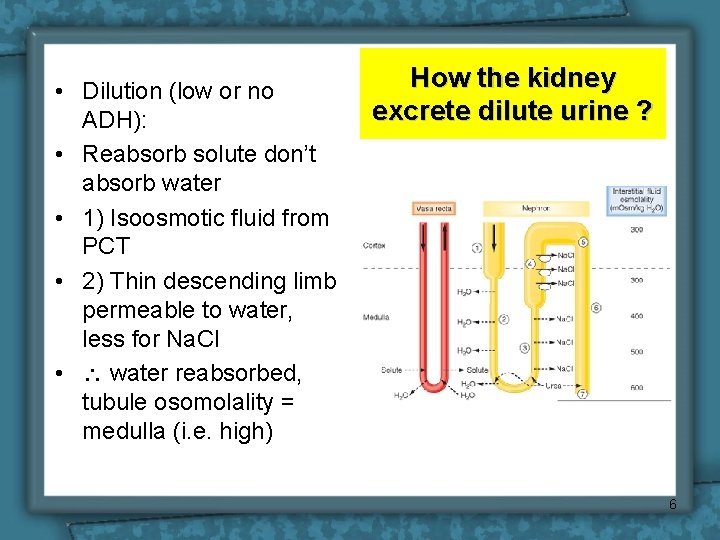
• Dilution (low or no ADH): • Reabsorb solute don’t absorb water • 1) Isoosmotic fluid from PCT • 2) Thin descending limb permeable to water, less for Na. Cl • water reabsorbed, tubule osomolality = medulla (i. e. high) How the kidney excrete dilute urine ? 6
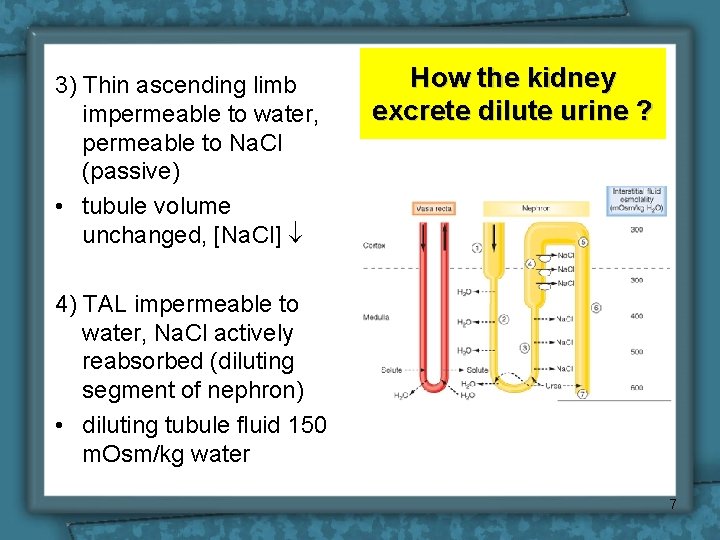
3) Thin ascending limb impermeable to water, permeable to Na. Cl (passive) • tubule volume unchanged, [Na. Cl] How the kidney excrete dilute urine ? 4) TAL impermeable to water, Na. Cl actively reabsorbed (diluting segment of nephron) • diluting tubule fluid 150 m. Osm/kg water 7

How the kidney excrete dilute urine ? 5) Collecting duct reabsorb Na. Cl • osmolality, may reach 50 m. Osm/kg water 8

• Concentration of urine (ADH dependent): How the kidney excrete concentrated urine ? • 1 -4 same as dilution • Reabsorbed Na. Cl in loop of Henle osmolality of interstitium • Generated by Countercurrent Multiplication 9
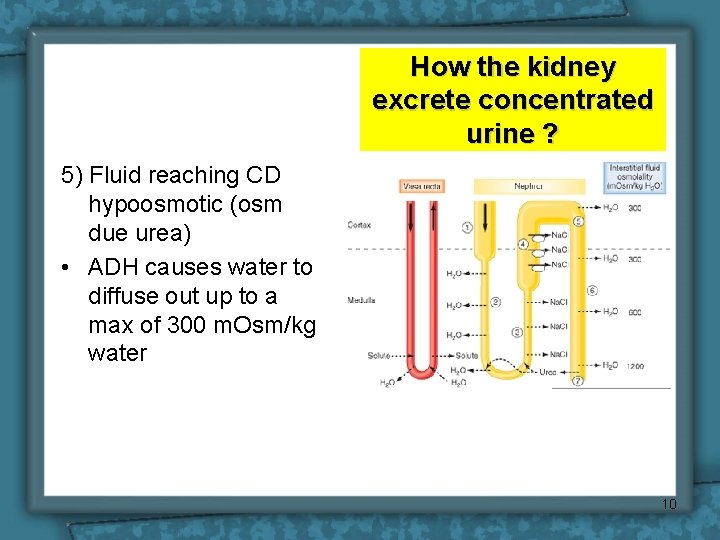
How the kidney excrete concentrated urine ? 5) Fluid reaching CD hypoosmotic (osm due urea) • ADH causes water to diffuse out up to a max of 300 m. Osm/kg water 10
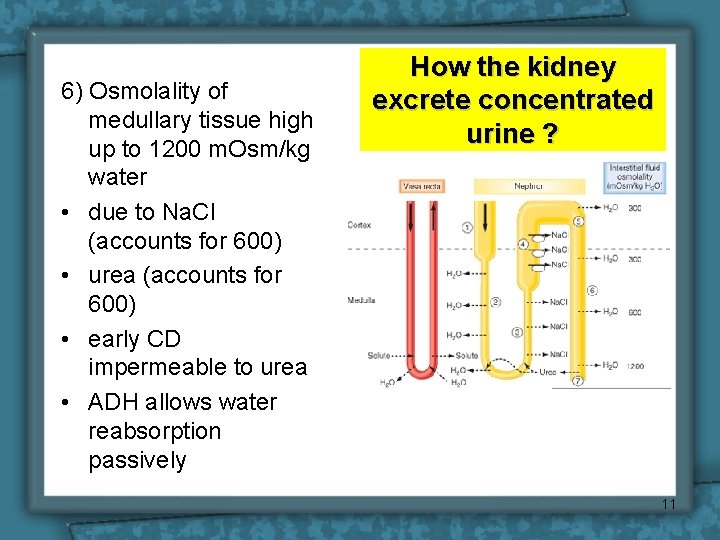
6) Osmolality of medullary tissue high up to 1200 m. Osm/kg water • due to Na. Cl (accounts for 600) • urea (accounts for 600) • early CD impermeable to urea • ADH allows water reabsorption passively How the kidney excrete concentrated urine ? 11
How the kidney excrete concentrated urine ? • When ADH levels high urea levels in medullary CD & interstitium equilibrate • Most water absorbed in presence of ADH is in the cortical collecting duct 12

Countercurrent exchange in the Vasa Recta • There are two special features of the renal medullary blood flow that contribute to the preservation of the high solute concentration: 1. The medullary blood flow is low, accounting for less than 5% of the renal blood flow. This sluggish blood flow is sufficient to supply the metabolic needs of the tissues but helps to minimize solute loss from the medullary interstitium 2. The vasa recta serve as countercurrent exchanger, minimizing washout of solutes from the medullary interstitium. • The vasa recta do not create the medullary hyperosmolarity, but they do prevent from being dissipated 13

14
- Slides: 14