
URINE ANALYSIS 1 Urine analysis Microscopic examination of


- Slides: 54
URINE ANALYSIS 1 Urine analysis
Microscopic examination of urine 2 Urine analysis
Procedure 1. Centrifugation about 10 ml of urine and discharge the supernatant leaving only 2 -3 drops. 2. Mix the remained amount of urine well , and place one drop on clean dry slide. 3. Apply the cover glass , avoid formation of air bubbles , examine under microscope (objective 40). 3 Urine analysis
Urine deposits or sediments w Urine deposits divided into two main groups: 1. Organized deposit. 2. Un organized deposit. 4 Urine analysis
Organized deposit 5 Urine analysis
Organized deposit 1. Cell. 2. Cast. 3. Organism. 6 Urine analysis
Cells 7 Urine analysis
Cells 1. 2. 3. 4. 5. 8 Epithelial cells: Red blood cells: WBCs: Pus cells: Yeast: Urine analysis
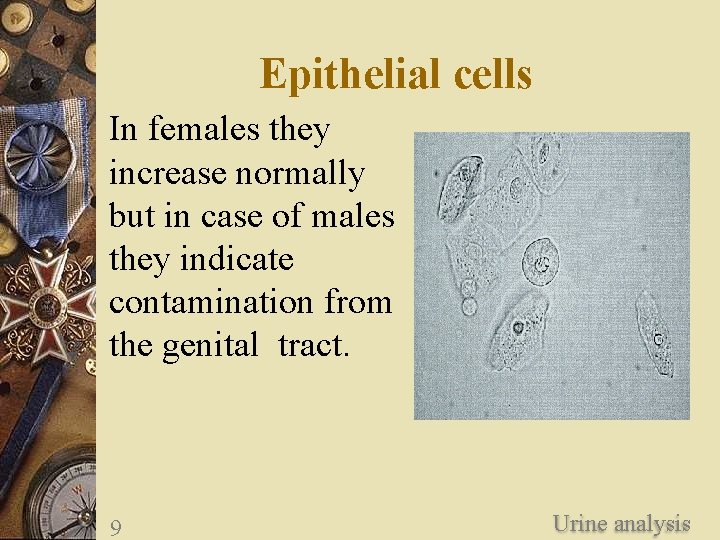
Epithelial cells w Normally a few epithelial cells occur in the urine. w A marked increase is these cells in the urine is seen destruction of the tissues in the urinary tract.
Epithelial cells In females they increase normally but in case of males they indicate contamination from the genital tract. 9 Urine analysis
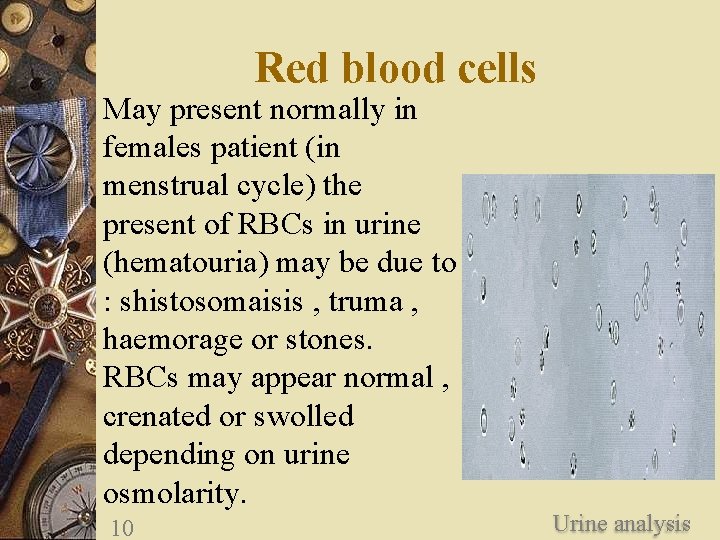
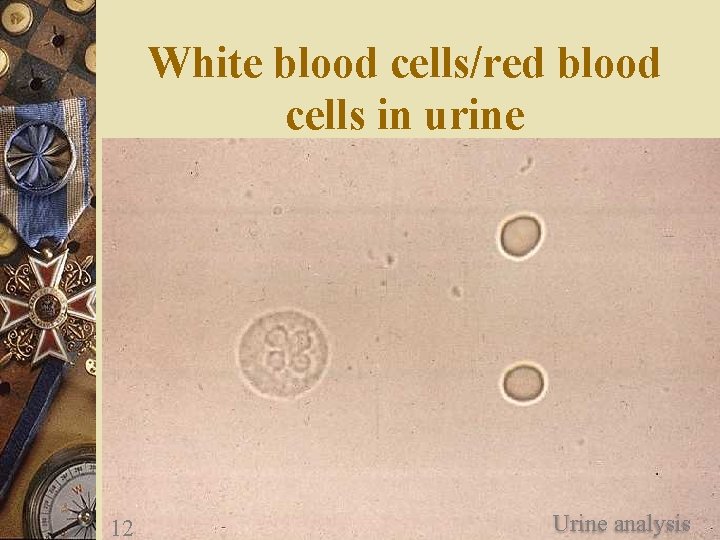
Red blood cells May present normally in females patient (in menstrual cycle) the present of RBCs in urine (hematouria) may be due to : shistosomaisis , truma , haemorage or stones. RBCs may appear normal , crenated or swolled depending on urine osmolarity. 10 Urine analysis
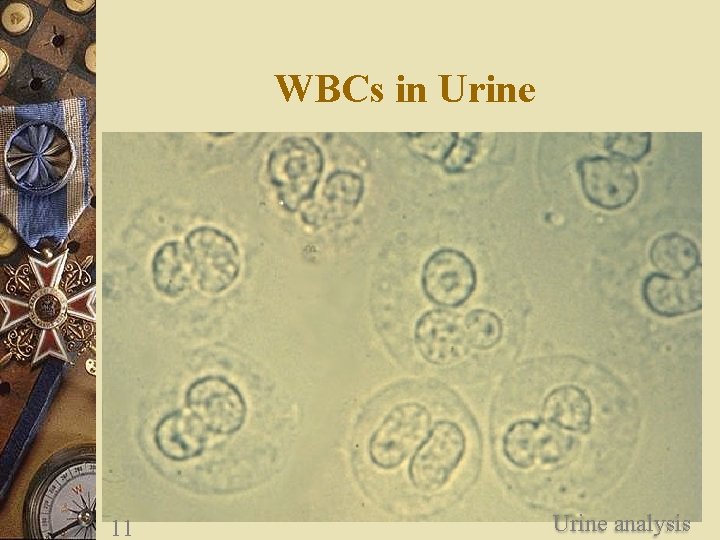
WBCs in Urine 11 Urine analysis
White blood cells/red blood cells in urine 12 Urine analysis
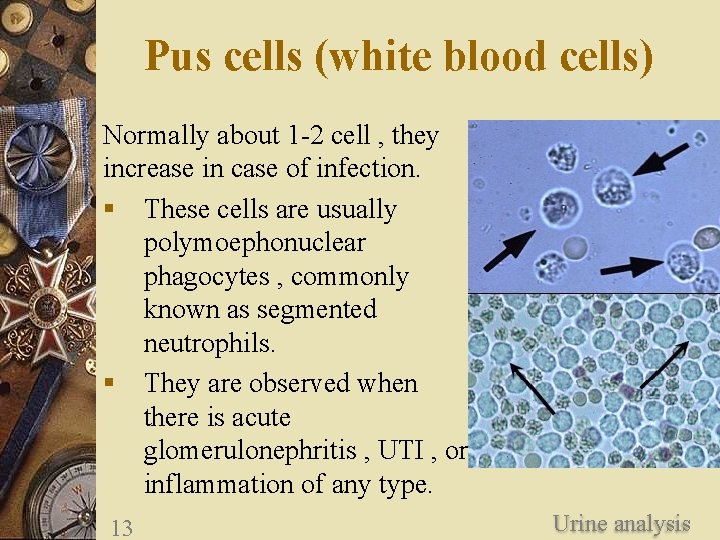
Pus cells (white blood cells) Normally about 1 -2 cell , they increase in case of infection. § These cells are usually polymoephonuclear phagocytes , commonly known as segmented neutrophils. § They are observed when there is acute glomerulonephritis , UTI , or inflammation of any type. 13 Urine analysis
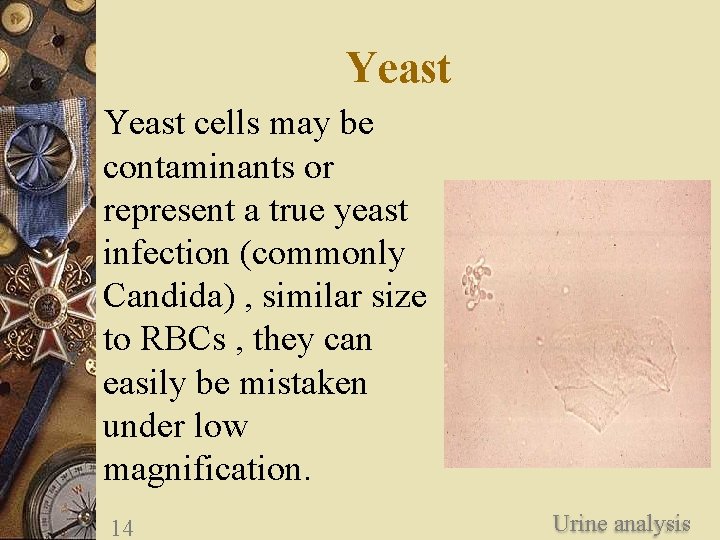
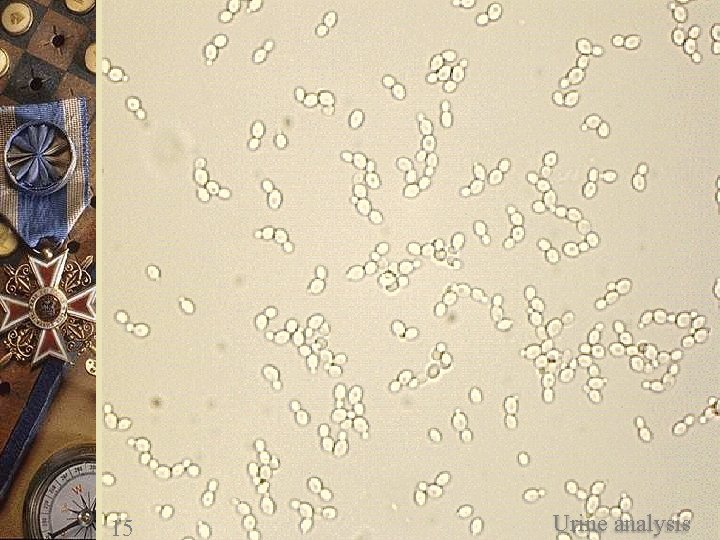
Yeast cells may be contaminants or represent a true yeast infection (commonly Candida) , similar size to RBCs , they can easily be mistaken under low magnification. 14 Urine analysis
15 Urine analysis
Cast 16 Urine analysis
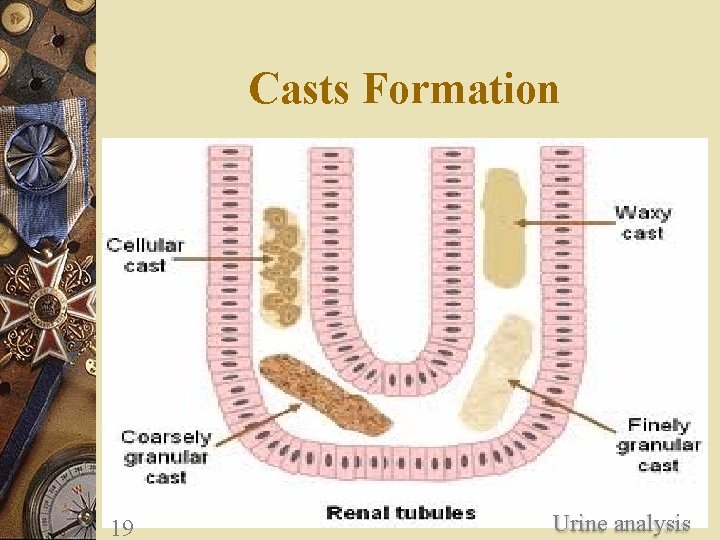
Cast w Not normally present in urine , are formed by coagulation of albuminous material in the kidney tubules , when found indicate renal dysfunction , and usually associated with albuminuria , the end of cast may be round or broken they has three main class. w Dehydration and acidic urine especially predisposes to cast formation. 17 Urine analysis
w They comprise tamm-Horsfall mucoprotein from the tubular epithelia in the ascending limb of the loop of Henle. w Unlike cells , casts should be examined under low power and are most often located around the edges of the cover slip. 18 Urine analysis
Casts Formation 19 Urine analysis
Types of cast (class) 1. Hyaline cast. 2. Cellular cast. 3. Granular cast. 20 Urine analysis
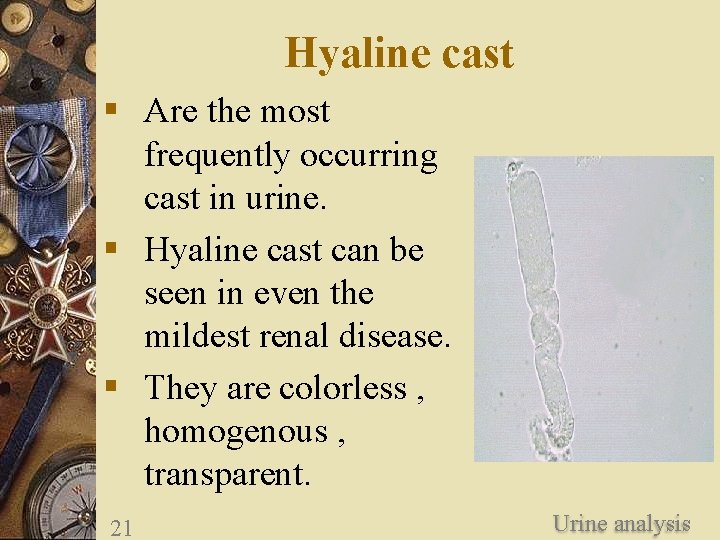
Hyaline cast § Are the most frequently occurring cast in urine. § Hyaline cast can be seen in even the mildest renal disease. § They are colorless , homogenous , transparent. 21 Urine analysis
Cellular cast w They are partially or fully composed of pus cell , epithelial cell or RBCs. w Are present in renal infection and in non infectious inflammation. w RBCs casts indicate to glomerular disease. 22 Urine analysis
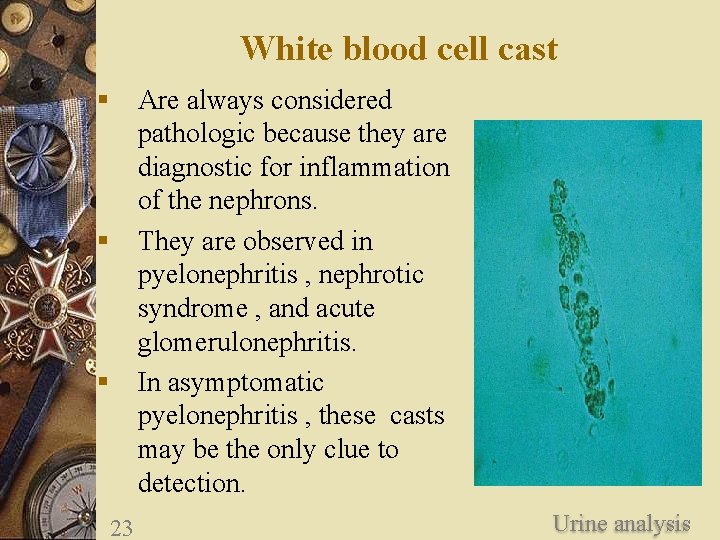
White blood cell cast § Are always considered pathologic because they are diagnostic for inflammation of the nephrons. § They are observed in pyelonephritis , nephrotic syndrome , and acute glomerulonephritis. § In asymptomatic pyelonephritis , these casts may be the only clue to detection. 23 Urine analysis
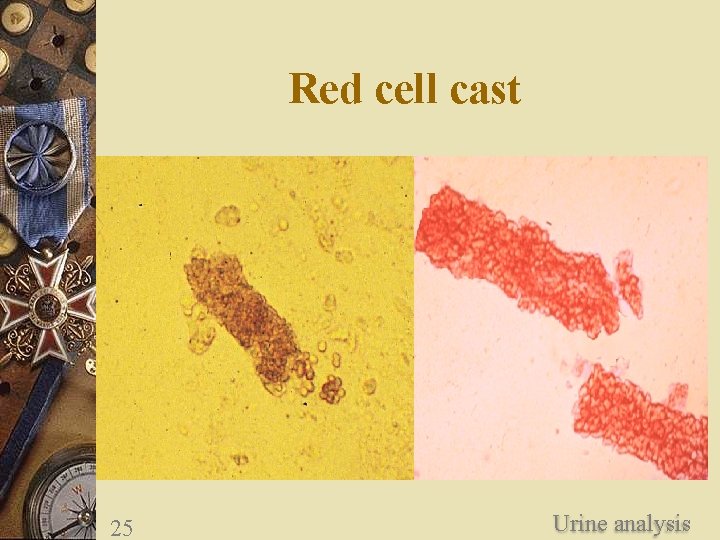
Red blood cell cast w Are also always considered pathologic because they diagnostic for glomerular inflammation that results in renal hematuria. w They are seen in subacute bacterial endocarditis , kidney infarcts , collagen diseases , and acute glomerulonephritis. 24 Urine analysis
Red cell cast 25 Urine analysis
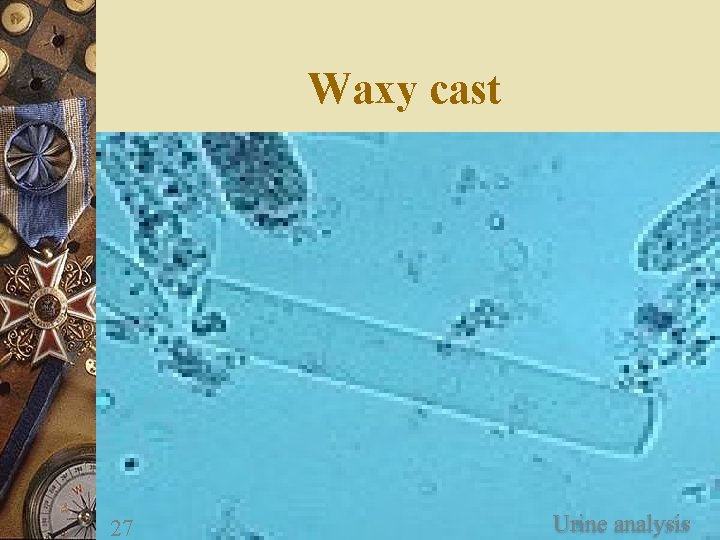
Waxy cast w Are uniformly yellowish , refractile , and brittle appearing , with sharply defined , often broken edges. w They are almost always pathologic because they indicate tubular inflammation or deterioration. w They are formed by renal stases in the collecting ducts and are , therefore , found in chronic renal diseases. 26 Urine analysis
Waxy cast 27 Urine analysis
Organism 28 Urine analysis
Organism 1. 2. 3. 4. 29 Bacteria. Spermatozoma. Sperm. Trichomonas vaginalis. Urine analysis
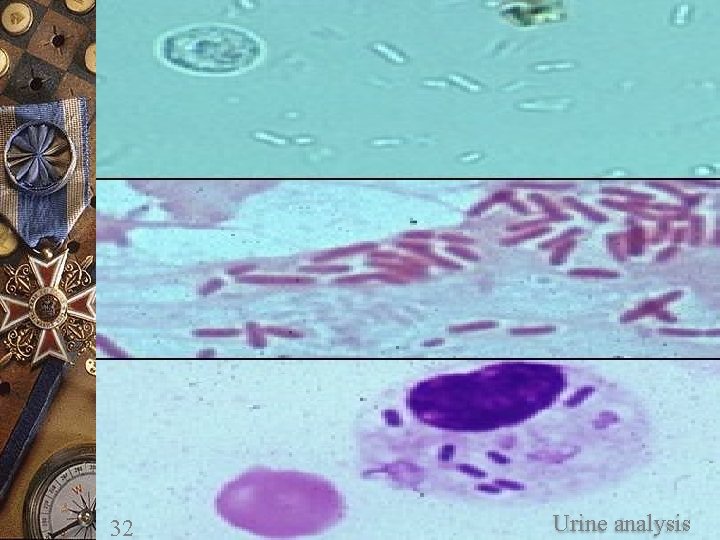
Bacteria w Normal urine is sterile and contains no bacteria. w Small number of organisms seen in a fresh urine specimen usually represent skin or air contamination. w If the urine preserved well without contamination , the present of bacteria indicate to infection and usually associted with the present of pus cell. w The number of organisms accompanied by WBCs and the symptoms of UTI , are highly diagnostic for true infection. 30 Urine analysis
w Clinically significant bacteriuria is considered more than 20 organisms. w Asymptomatic bacteriuria , in which there are significant numbers of bacteria without appreciable clinical symptoms , occurs somewhat commonly in young girls , pregnant women , and diabetic patients , if left untreated , it may result in pyelonephritis and , subsequently , permanent renal damage. 31 Urine analysis
32 Urine analysis
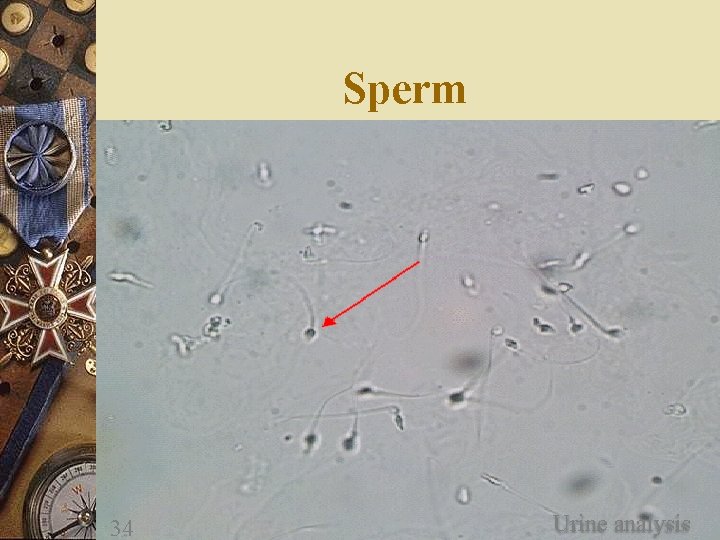
Spermatozoma w Spermatozoa are often seen in urine of males. w They are usually not reported because they are of no pathologic significance. w Must report when found in large number , may indicate prostate abnormalities. 33 Urine analysis
Sperm 34 Urine analysis
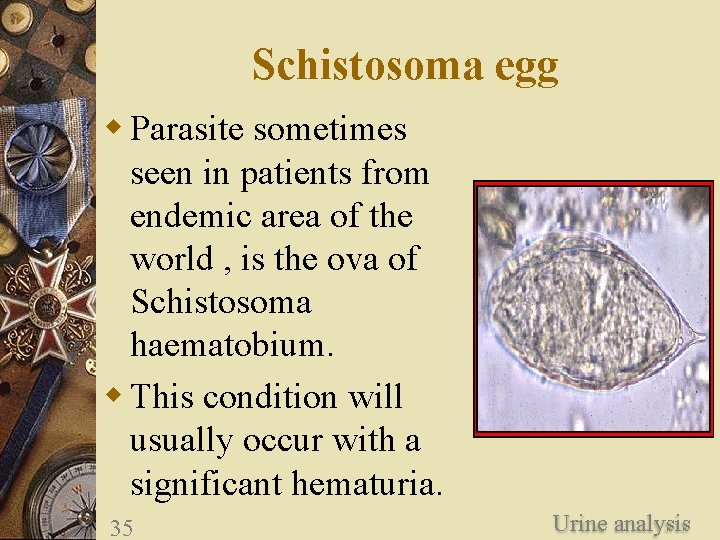
Schistosoma egg w Parasite sometimes seen in patients from endemic area of the world , is the ova of Schistosoma haematobium. w This condition will usually occur with a significant hematuria. 35 Urine analysis
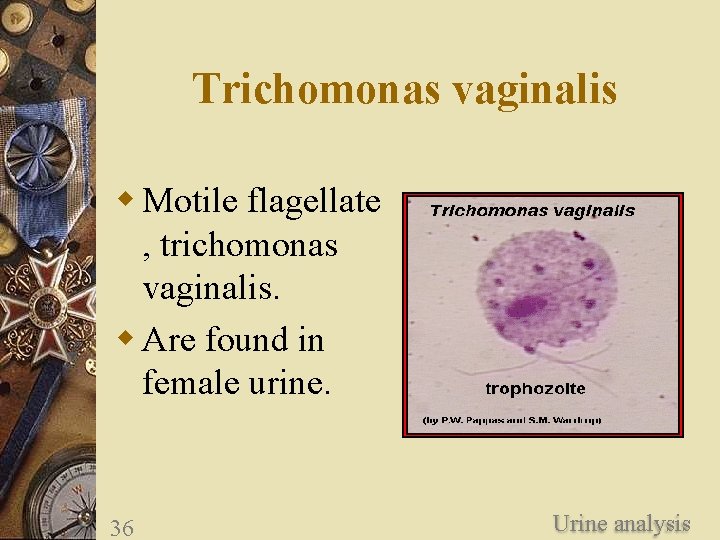
Trichomonas vaginalis w Motile flagellate , trichomonas vaginalis. w Are found in female urine. 36 Urine analysis
Un organized deposit 37 Urine analysis
Crystals w The identification of them depend on the urine PH. 1. Acid crystals (p. H values of less than 7). 2. Alkaline crystals (p. H values greater than 7). 38 Urine analysis
Acid crystals include 39 Urine analysis
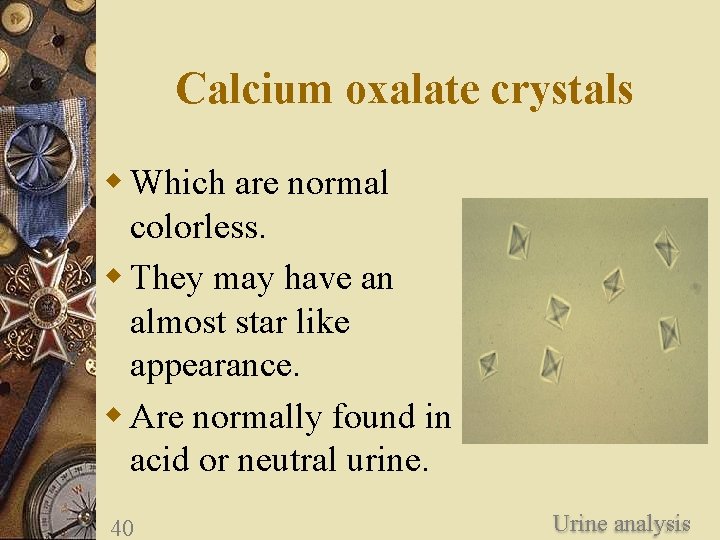
Calcium oxalate crystals w Which are normal colorless. w They may have an almost star like appearance. w Are normally found in acid or neutral urine. 40 Urine analysis
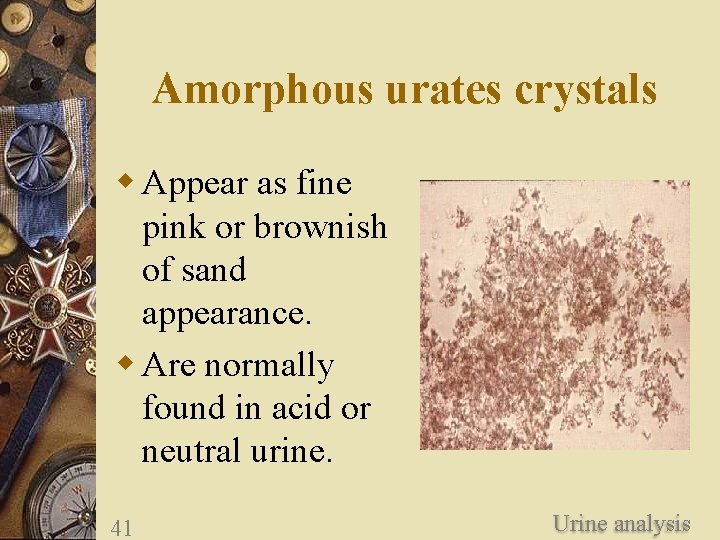
Amorphous urates crystals w Appear as fine pink or brownish of sand appearance. w Are normally found in acid or neutral urine. 41 Urine analysis
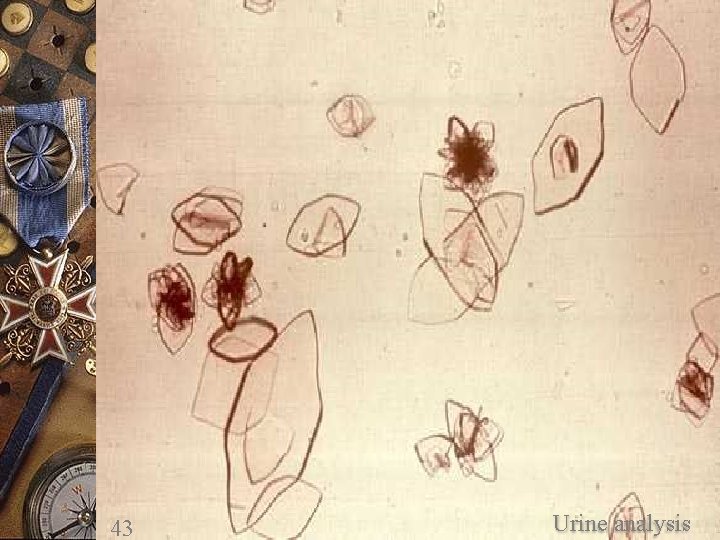
Uric acid crystals w Exhibit extreme pleomorphism in size and in shape. w They appear readily in acid urine allowed to stand at room temperature. w Yellow to red brown crystals. w Large numbers of uric acid crystal may be seen in individuals with leukemia or patients undergoing chemotherapy. 42 Urine analysis
43 Urine analysis
Alkaline crystals include 44 Urine analysis
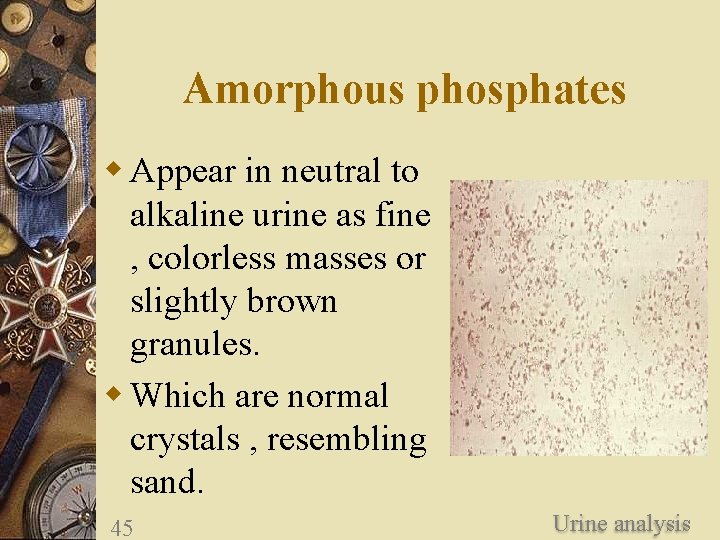
Amorphous phosphates w Appear in neutral to alkaline urine as fine , colorless masses or slightly brown granules. w Which are normal crystals , resembling sand. 45 Urine analysis
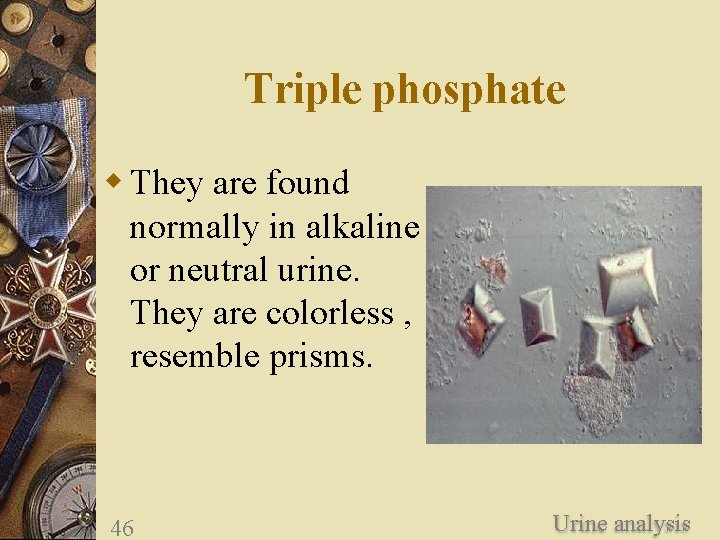
Triple phosphate w They are found normally in alkaline or neutral urine. They are colorless , resemble prisms. 46 Urine analysis
Others 47 Urine analysis
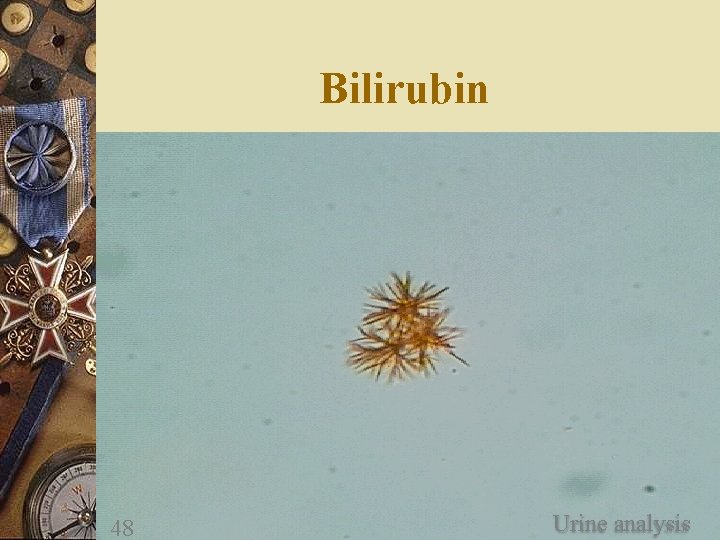
Bilirubin 48 Urine analysis
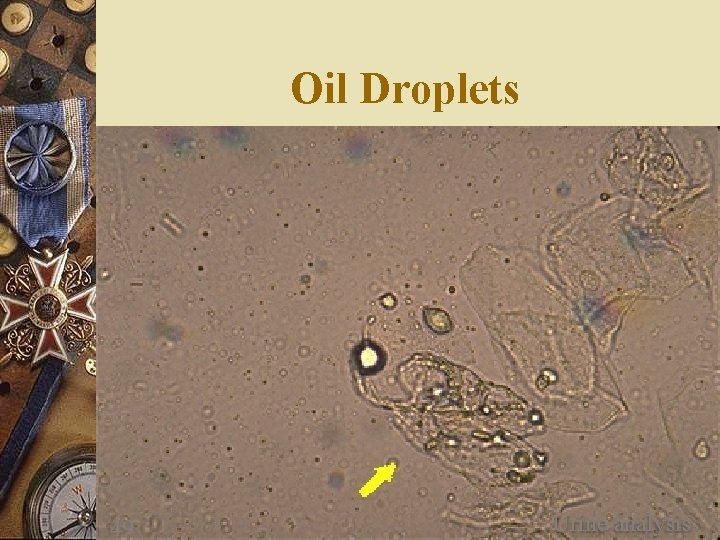
Oil Droplets 49 Urine analysis
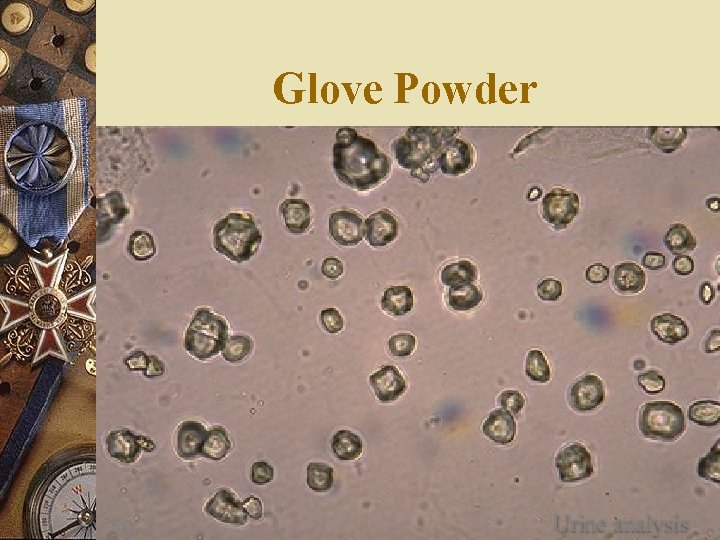
Glove Powder 50 Urine analysis
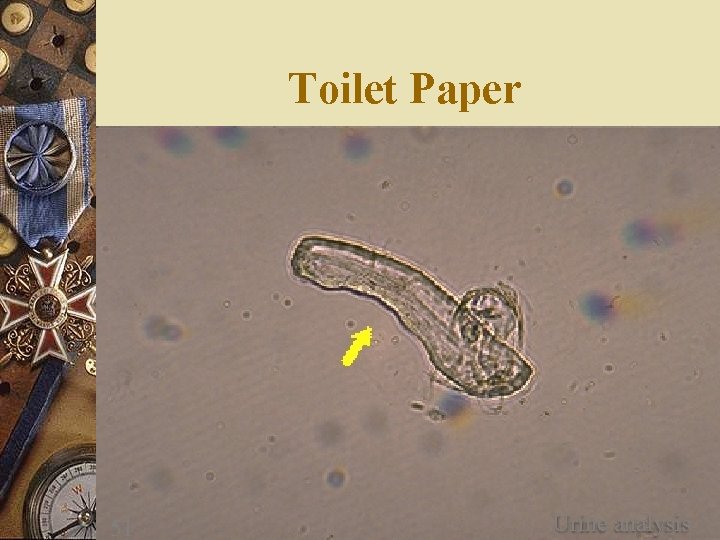
Toilet Paper 51 Urine analysis