
Urinary System one of four organ systems involved
- Slides: 9
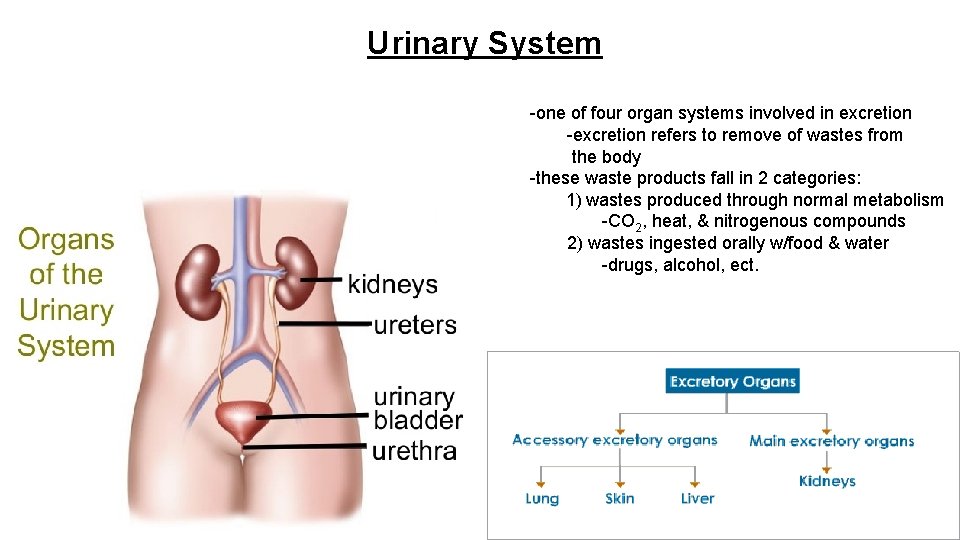
Urinary System -one of four organ systems involved in excretion -excretion refers to remove of wastes from the body -these waste products fall in 2 categories: 1) wastes produced through normal metabolism -CO 2, heat, & nitrogenous compounds 2) wastes ingested orally w/food & water -drugs, alcohol, ect.
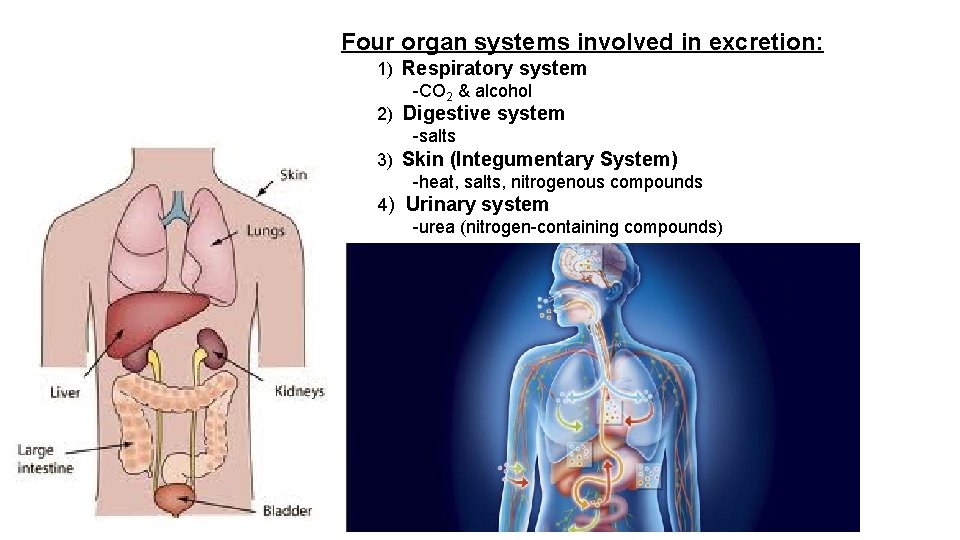
Four organ systems involved in excretion: 1) Respiratory system -CO 2 & alcohol 2) Digestive system -salts 3) Skin (Integumentary System) -heat, salts, nitrogenous compounds 4) Urinary system -urea (nitrogen-containing compounds)
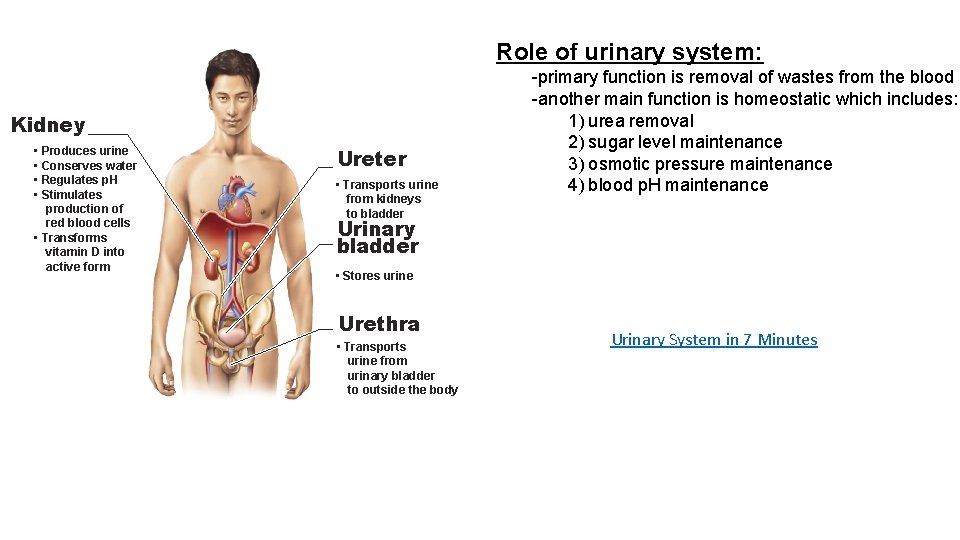
Role of urinary system: Kidney • Produces urine • Conserves water • Regulates p. H • Stimulates production of red blood cells • Transforms vitamin D into active form Ureter • Transports urine from kidneys to bladder -primary function is removal of wastes from the blood -another main function is homeostatic which includes: 1) urea removal 2) sugar level maintenance 3) osmotic pressure maintenance 4) blood p. H maintenance Urinary bladder • Stores urine Urethra • Transports urine from urinary bladder to outside the body Urinary System in 7 Minutes
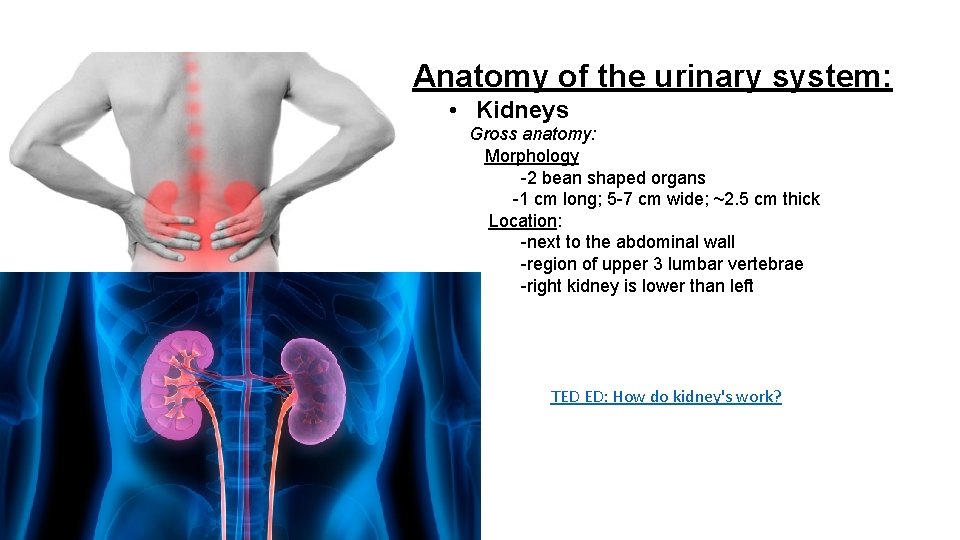
Anatomy of the urinary system: • Kidneys Gross anatomy: Morphology -2 bean shaped organs -1 cm long; 5 -7 cm wide; ~2. 5 cm thick Location: -next to the abdominal wall -region of upper 3 lumbar vertebrae -right kidney is lower than left TED ED: How do kidney's work?
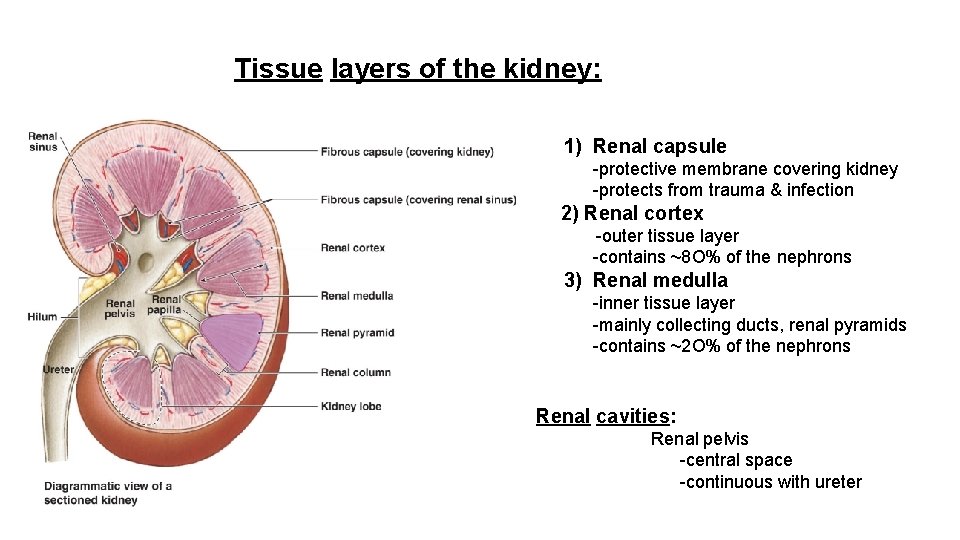
Tissue layers of the kidney: 1) Renal capsule -protective membrane covering kidney -protects from trauma & infection 2) Renal cortex -outer tissue layer -contains ~8 O% of the nephrons 3) Renal medulla -inner tissue layer -mainly collecting ducts, renal pyramids -contains ~2 O% of the nephrons Renal cavities: Renal pelvis -central space -continuous with ureter
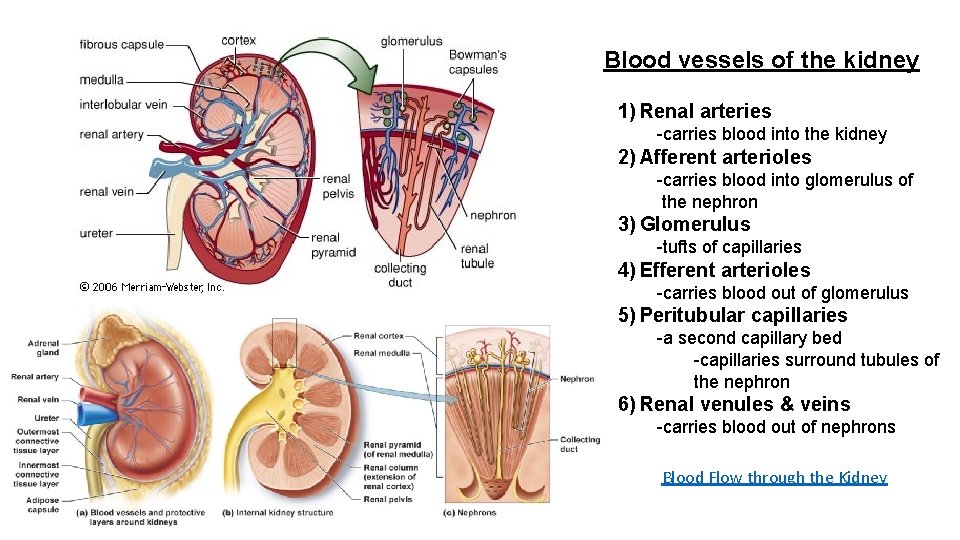
Blood vessels of the kidney 1) Renal arteries -carries blood into the kidney 2) Afferent arterioles -carries blood into glomerulus of the nephron 3) Glomerulus -tufts of capillaries 4) Efferent arterioles -carries blood out of glomerulus 5) Peritubular capillaries -a second capillary bed -capillaries surround tubules of the nephron 6) Renal venules & veins -carries blood out of nephrons Blood Flow through the Kidney
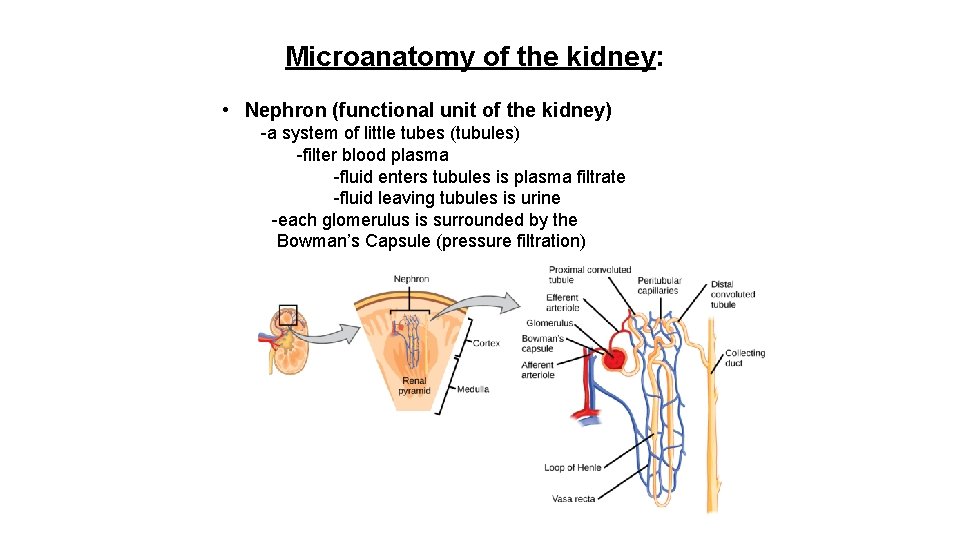
Microanatomy of the kidney: • Nephron (functional unit of the kidney) -a system of little tubes (tubules) -filter blood plasma -fluid enters tubules is plasma filtrate -fluid leaving tubules is urine -each glomerulus is surrounded by the Bowman’s Capsule (pressure filtration)
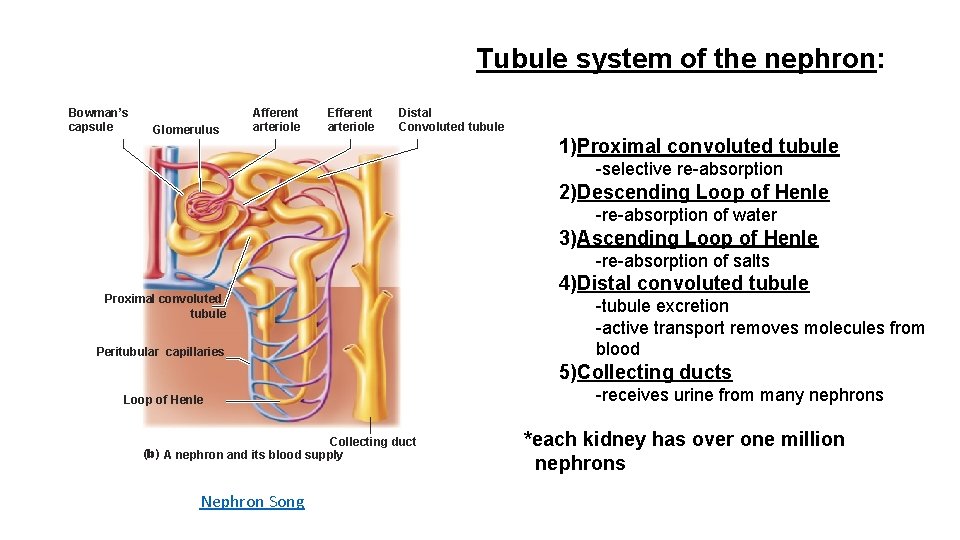
Tubule system of the nephron: Bowman’s capsule Glomerulus Afferent arteriole Efferent arteriole Distal Convoluted tubule 1)Proximal convoluted tubule -selective re-absorption 2)Descending Loop of Henle -re-absorption of water 3)Ascending Loop of Henle -re-absorption of salts Proximal convoluted tubule Peritubular capillaries 4)Distal convoluted tubule -tubule excretion -active transport removes molecules from blood 5)Collecting ducts Loop of Henle Collecting duct (b) A nephron and its blood supply Nephron Song -receives urine from many nephrons *each kidney has over one million nephrons
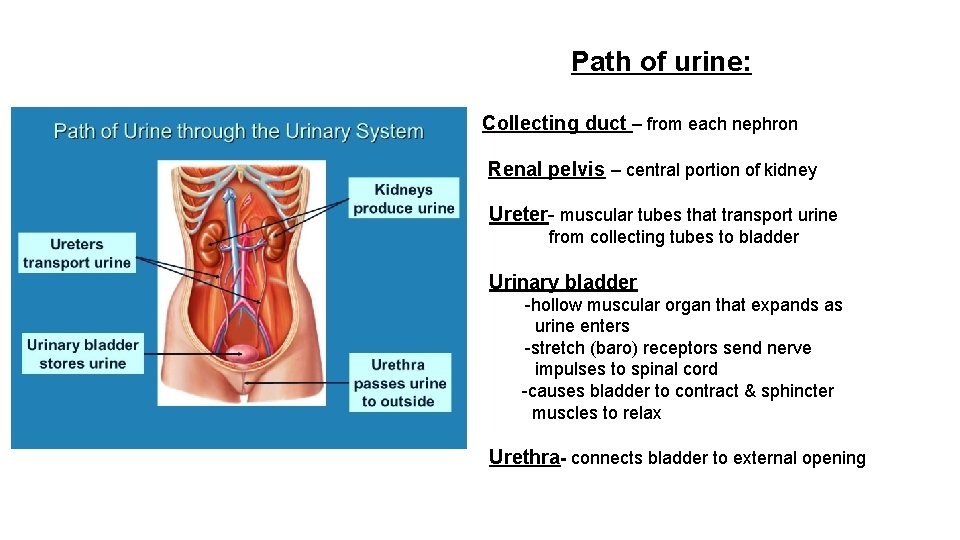
Path of urine: Collecting duct – from each nephron Renal pelvis – central portion of kidney Ureter- muscular tubes that transport urine from collecting tubes to bladder Urinary bladder -hollow muscular organ that expands as urine enters -stretch (baro) receptors send nerve impulses to spinal cord -causes bladder to contract & sphincter muscles to relax Urethra- connects bladder to external opening