
Urinary System Health Science 1 Structures of Urinary
- Slides: 18
Urinary System Health Science 1
Structures of Urinary System KIDNEYS Bean-shaped organs Located between peritoneum and the back muscles (RETROPERITONEAL) RENAL PELVIS – funnel shaped structure at the beginning of the ureter MEDULLA Inner, striated layer Striated cones are RENAL PYRAMIDS Base of each pyramid faces cortex, while apex empties into cuplike cavities called CALYCES
Structures of Urinary System CORTEX Composed of millions of microscopic functional units called nephrons. NEPHRON Functional unit of the kidney Parts include: Bowman’s capsule Glomerulus Proximal convoluted tubule- responsible for correcting water imbalance. Loop of Henle Distal convoluted tubule Collecting tubule
Structures of Urinary System URETERS One from each kidney Carry urine from kidney to bladder Smooth muscle tube with mucous membrane lining Peristalsis pushes urine down ureters URINARY BLADDER Hollow, muscular organ Made of elastic fibers and involuntary muscle Stores urine – usually about 500 cc Emptying urine (voiding) is involuntary but controlled through nervous system (voluntary) Urine leaves through URETHRA to outside opening = URINARY MEATUS
Urine Production FILTRATION First step in urine formation Blood from renal artery enters glomerulus High blood pressure in glomerulus forces fluid (FILTRATE) to filter into Bowman’s capsule Filtrate does not contain plasma proteins or RBCs – they’re too big, if blood seen ineffective filtration Bowman’s capsule filters out 125 cc of fluid/min. – 7500 cc/hour As filtrate continues through nephron, 90% of water is reabsorbed
Urine Production REABSORPTION- only what is needed by the body Water and useful substances are reabsorbed blood levels of certain substances are high (glucose, amino acids, vitamins, sodium) then those substances will not be reabsorbed SECRETION Opposite of reabsorption Secretion transports substances from blood into collecting tubules Substances/waste products include creatinine, hydrogen ions, potassium ions, and some drugs Electrolytes are selectively secreted to maintain body’s acid-base balance Aldosterone: hormone that controls secretion
Urine Production Chemical Control Reabsorption of H 20 in distal convoluted tubule controlled by ADH (antidiuretic hormone) Secretion and regulation of ADH controlled by hypothalamus DIURETICS inhibit reabsorption of H 20 Renin: hormone released when BP drops Nervous Control Direct control through nerve impulses on kidney blood vessels Indirect control though stimulation of endocrine glands
Urine Production Urinary Output Ave = 1500 ml/day URINALYSIS – examination of urine to determine presence of blood cells, bacteria, acidity level, specific gravity and physical characteristics (color, clarity and odor)
Functions of Urinary System: Excretion Removing waste Formation of urine Fluid and electrolyte balance Electrolytes are selectively secreted to maintain body’s acid -base balance Elimination of urine
Urinary Disorders ENURESIS – bedwetting GLYCOSURIA – sugar in urine NOCTURIA – frequent urination at night POLYURIA – excessive amounts of urine PYURIA – pus in urine ANURIA – no urine produced HEMATURIA – blood in urine DIURETIC – drug or substance to increase urine production INCONTINENCE – involuntary urination
Urinary Disorders CYSTITIS Inflammation of the mucous membrane lining of the urinary bladder Most common cause – E. Coli Symp – DYSURIA (painful urination) and frequency Usually in females (shorter urethra) Rx – antibiotics
Urinary Disorders Glomerulonephritis inflammation of the tiny filters (glomerulus) Causes: kidney infections, immune disorders, HTN, Diabetes Can lead to kidney failure Rx: treat the cause and flush kidneys, plenty of fluids, limit salt and protein intake
Urinary Disorders RENAL CALCULI (Kidney Stones) Made of crystals of calcium phosphate and uric acid Gradually they get larger until they block ureters First symptom – severe pain Other symptoms – nausea and vomiting, frequency, chills, fever, hematuria Diagnosis – by symptoms, ultrasound, or x-ray Rx – increase fluids to flush out stone, medications, and if needed – LITHOTRIPSY nephrolithiasis
Urinary Disorders LITHOTRIPSY Surgical procedure to remove kidney stones Shock waves hit dense stones and break them up Done on outpatient basis http: //www. youtube. com/watch? v=ov. Hd. QDQ 8 Pqo
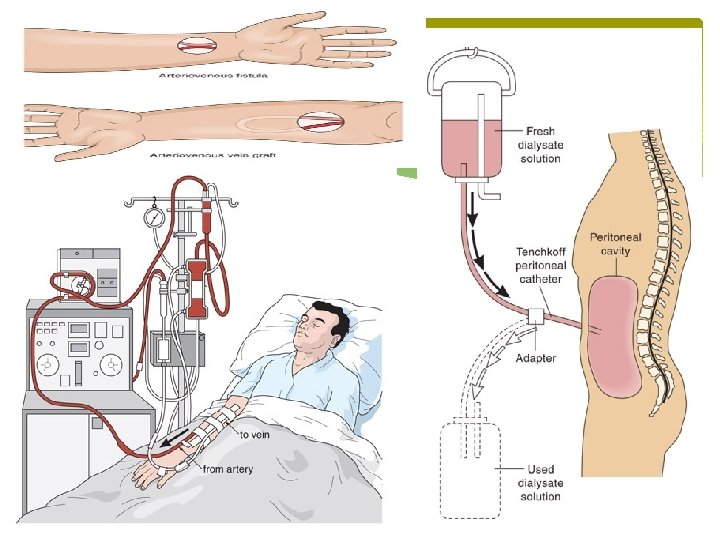
Urinary Disorders DIALYSIS (HEMODIALYSIS) Used for kidney failure Involves the passage of blood through device with semipermeable membrane Dialysis serves as substitute kidney Blood from patient flows through machine and is filtered Can be done at home or in clinic Takes 2 -4 hours, 2 -3 times a week http: //www. youtube. com/watch? v=IQKQ 4 eo. Kf. Tg
Kidney Failure Acute Sudden change in function s/s: decreased or no urination, tired, swelling, nausea, wgt loss, Cause: meds, infection, tumor Rx: treat cause, fluids, possible dialysis, Kidney function is restored or back to functional Chronic Causes: HTN, diabetes, longtern NSAID’s (ibuprofen), other kidney diseases Rx: dialysis, low salt/protein diet, change meds May progress to complete kidney failure
Urinary Disorders KIDNEY TRANSPLANT As a last resort Involves donor organ from someone with a similar immune system Main complication – rejection