
URINARY SYSTEM FUNCTION OF KIDNEYS Filters the blood
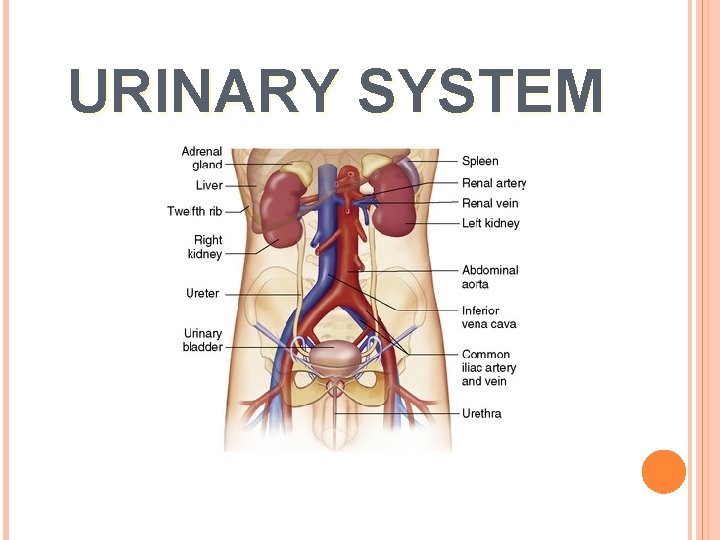
URINARY SYSTEM
FUNCTION OF KIDNEYS Filters the blood to eliminate waste products in urine Regulation of water, electrolyte , and acid-base balance Regulation Aiding of blood pressure in red blood cell (RBC) formation Word roots (keys) to the kidneys • ur- , urin- , or uro- (Greek means urine) e. g Urology : branch of medicine concerned with the urinary tract • Renal (from ren- [Latin] means kidney) • Nephro- or nephr- (Greek means kidney) e. g nephritis & nephrologist
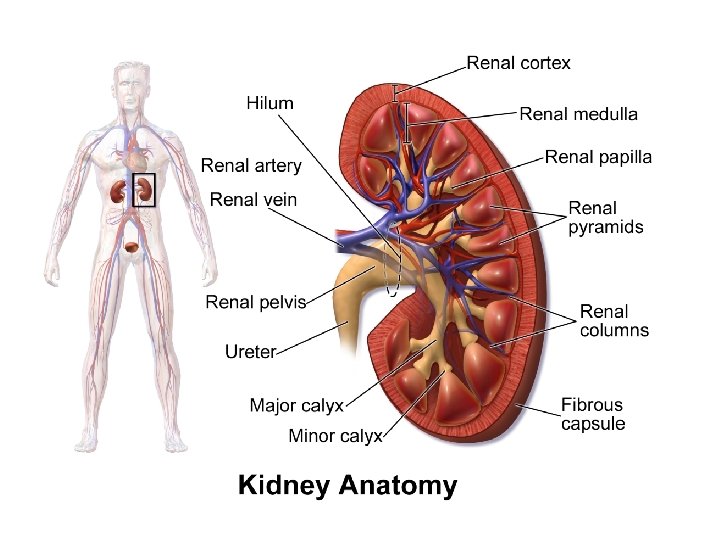
KIDNEYS Bean-shaped, 4” long (4 inches , 10 -11 cm) , highly vascular organs, located on either side of the vertebral column between T 12 -L 3 Receive 20 -25% of the cardiac output Atop each kidney lies a suprarenal gland (adrenal gland). These glands affect the function of the kidneys through hormones that reach kidney via blood (not directly), specially the hormone aldosterone Kidneys filter arterial blood which is supplied by renal artery on each side. The filtered blood returns to the inferior vena cava through the renal veins. Anatomically; each kidney has three regions 1. 2. 3. renal cortex : darkest area renal medulla (contains 8 -12 pyramids [with circular bases] & calyces [singular = calyx , the opening at the end of each pyramid]) renal pelvis (expansion of the upper end of the ureter)
4
THE NEPHRON Is the functional & structural unit of the kidney , looks like a cup with a long tube behind it Each kidney contains about 1 -1. 25 million nephrons. humans can stay alive normally with an overall of 200, 000 nephrons The main functions of the nephron are mechanical filtration : at glomeruli at beginning of each nephron everything is filtered except large proteins (e. g albumin & some globulins) by the power of the hydrostatic capillary pressure , the resulting fluid in Bowman’s capsule is called glomerular filtrate , not urine Ø selective reabsorption of needed substances Ø selective secretion of substances that weren't filtered mechanically Ø
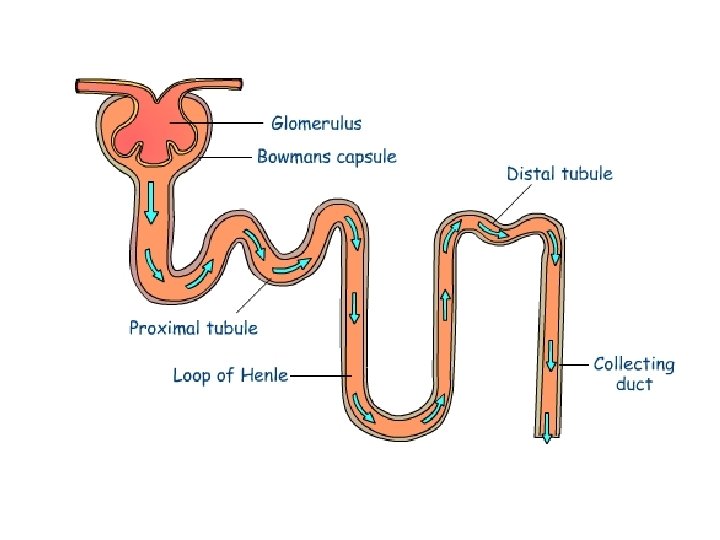
Each nephron consists of 1. Bowman’s capsule looks like a cup and contains the glomerulus which is a cluster of capillaries , (plu. glomeruli), the site of filtration at the beginning of the nephron , 2. Proximal convoluted tubule * both the Bowman’s capsule & the porximal convoluted tubule are located in the renal cortex 3. Loop of Henle; a U-shaped tubule , has thin descending & thick ascending limbs; it is present in the medulla 4. Distal convoluted tubule 5. Collecting tubule; each collecting duct is connected to 10 -12 nephrons via their collecting tubules; these ducts gather in medullary renal pyramids & which empty the urine into the minor calyces The fluid of the collecting ducts is the urine
7
BLADDER Stores urine (up to 300 ml in male , 400 ml in female) Urination starts with the micturition reflex (parasympathetic reflex) → contraction of the bladder + relaxation of the internal sphincter * we have two sphincters for the bladder neck : - involuntary inner smooth muscle sphincter (affected by the parasympathetic) - voluntary external skeletal muscle sphincter Successful urination occurs when the cerebral cortex directs towards stimulating voluntary relaxation of the external sphincter of bladder; usually children gain control of their external sphincter at the age of 5 for girls & at 6 for the boys The urethra channels urine outside the body from the bladder. The external opening of the urethra is called urethral meatus. In the male, the urethra passes through the prostate gland & the penis. At old age its common to have gradual hypertrophy of the prostate causing urethral obstruction In the male, the urethra is joined by the ejaculatory duct, and thus it serves as a passageway for semen as well as urine
• • • How Kidneys Produce Urine Blood enters the kidneys through the right and left renal arteries Arterioles carry blood to the capillaries Glomeruli filter the blood Blood passes through the glomeruli Glomerular (Bowman) capsule surrounds each glomerulus Renal tubule is attached to each Bowman capsule so, Three steps in the formation of urine • Glomerular filtration • Tubular reabsorption • Tubular secretion
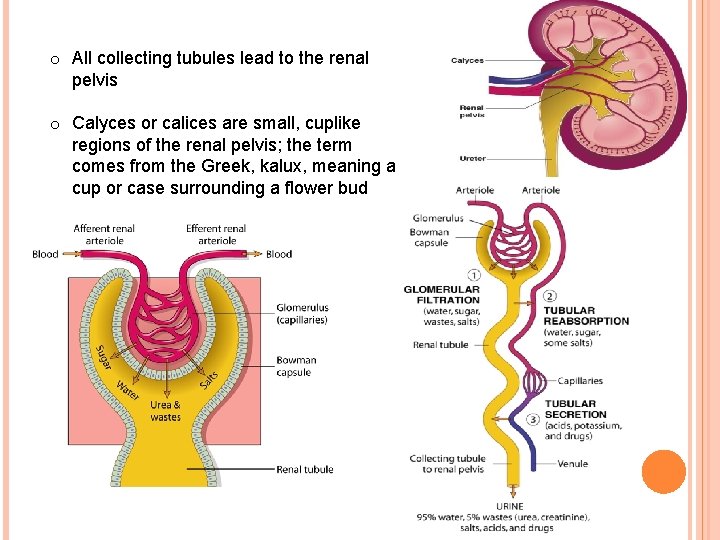
o All collecting tubules lead to the renal pelvis o Calyces or calices are small, cuplike regions of the renal pelvis; the term comes from the Greek, kalux, meaning a cup or case surrounding a flower bud
CLINICAL TERMS Anuria – the absence of urine formation , normally the urine is formed by an average of 1 ml per minute i. e. About 1500 ml/d Oliguria – oligo : few , diminished urine production in relation to fluid intake, usually less than 400 ml in 24 hours (the minimum rate of urine formation) Polyuria – poly: many , excessive production of urine Nocturia – excessive urination at night , present with diabetic patients , with this condition the patient wake up during night more than once to urinate Azotemia (or uremia) - abnormally high levels of nitrogen-containing compounds, such as urea (normally 40 mg per 100 ml , but here it may exceeds 300 mg) , creatinine and other nitrogen-rich compounds in the blood , caused by renal failure Dysuria – painful urination , caused by inflammation of urethra or bladder Enuresis – night time urinary incontinence in a girl over age 5 or boy over age 6 Hematuria – presence of blood in the urine , red urine , maybe caused by calculus which cause internal bleeding of the urinary system , may also occur with cysteitis and acute glomerulonephritis
Glycosuria – abnormal presence of glucose in urine, seen in diabetes Proteinuria – presence of protein in the urine , it indicates damage of the glomeruli & it’s a serious condition Pyuria – Py- : pus , pus in the urine , under this condition we will find a huge amount of pus cells in the urine under the microscope Urinary hesitancy – a delay between trying to urinate and the flow actually beginning , common at old age at the early stages of prostate hypertrophy , also in cysteitis Urinary incontinence – a loss of control over bladder and urethral sphincters, resulting in involuntary leakage of urine , common at old age & women who gave birth many times, sometimes accompanies sneezing Urinary tenesmus – ineffective, painful straining to empty bladder due to feeling that the bladder is full but its empty , maybe caused by inflammation of the neck of the bladder or calculus Suprapubic pain : caused by cysteitis Urine retention – retaining urine in the bladder. It is a common complication of benign prostatic hyperplasia (BPH). * * Benign : not cancerous & stays at one place , hyperplasia: excessive proliferation of normal cells in the normal tissue arrangement
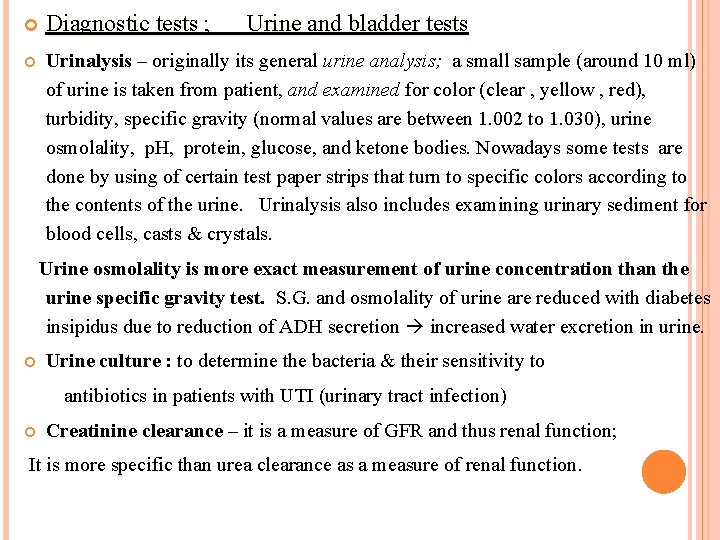
Diagnostic tests ; Urine and bladder tests Urinalysis – originally its general urine analysis; a small sample (around 10 ml) of urine is taken from patient, and examined for color (clear , yellow , red), turbidity, specific gravity (normal values are between 1. 002 to 1. 030), urine osmolality, p. H, protein, glucose, and ketone bodies. Nowadays some tests are done by using of certain test paper strips that turn to specific colors according to the contents of the urine. Urinalysis also includes examining urinary sediment for blood cells, casts & crystals. Urine osmolality is more exact measurement of urine concentration than the urine specific gravity test. S. G. and osmolality of urine are reduced with diabetes insipidus due to reduction of ADH secretion increased water excretion in urine. Urine culture : to determine the bacteria & their sensitivity to antibiotics in patients with UTI (urinary tract infection) Creatinine clearance – it is a measure of GFR and thus renal function; It is more specific than urea clearance as a measure of renal function.
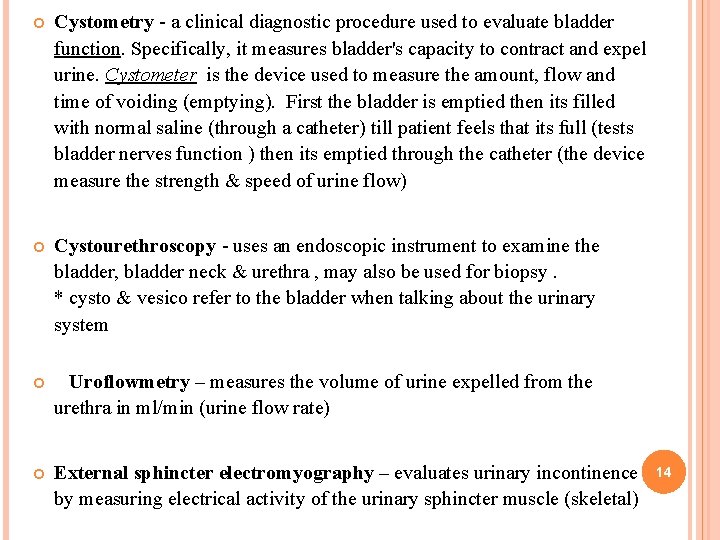
Cystometry - a clinical diagnostic procedure used to evaluate bladder function. Specifically, it measures bladder's capacity to contract and expel urine. Cystometer is the device used to measure the amount, flow and time of voiding (emptying). First the bladder is emptied then its filled with normal saline (through a catheter) till patient feels that its full (tests bladder nerves function ) then its emptied through the catheter (the device measure the strength & speed of urine flow) Cystourethroscopy - uses an endoscopic instrument to examine the bladder, bladder neck & urethra , may also be used for biopsy. * cysto & vesico refer to the bladder when talking about the urinary system Uroflowmetry – measures the volume of urine expelled from the urethra in ml/min (urine flow rate) External sphincter electromyography – evaluates urinary incontinence by measuring electrical activity of the urinary sphincter muscle (skeletal) 14
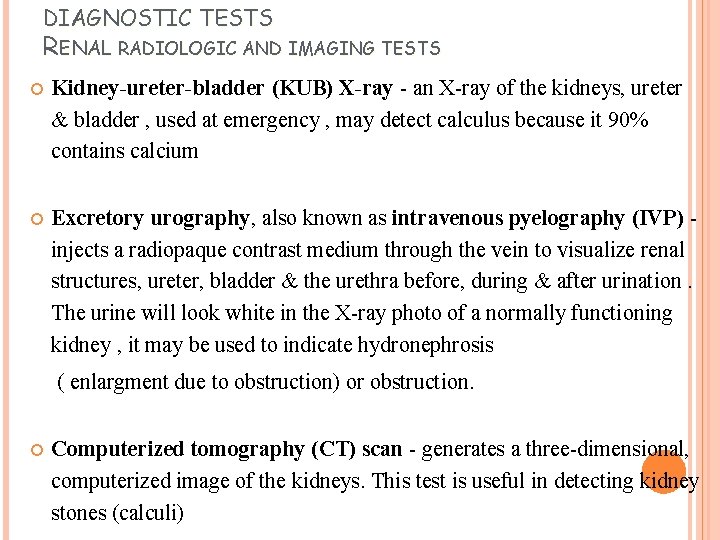
DIAGNOSTIC TESTS RENAL RADIOLOGIC AND IMAGING TESTS Kidney-ureter-bladder (KUB) X-ray - an X-ray of the kidneys, ureter & bladder , used at emergency , may detect calculus because it 90% contains calcium Excretory urography, also known as intravenous pyelography (IVP) injects a radiopaque contrast medium through the vein to visualize renal structures, ureter, bladder & the urethra before, during & after urination. The urine will look white in the X-ray photo of a normally functioning kidney , it may be used to indicate hydronephrosis ( enlargment due to obstruction) or obstruction. Computerized tomography (CT) scan - generates a three-dimensional, computerized image of the kidneys. This test is useful in detecting kidney stones (calculi)
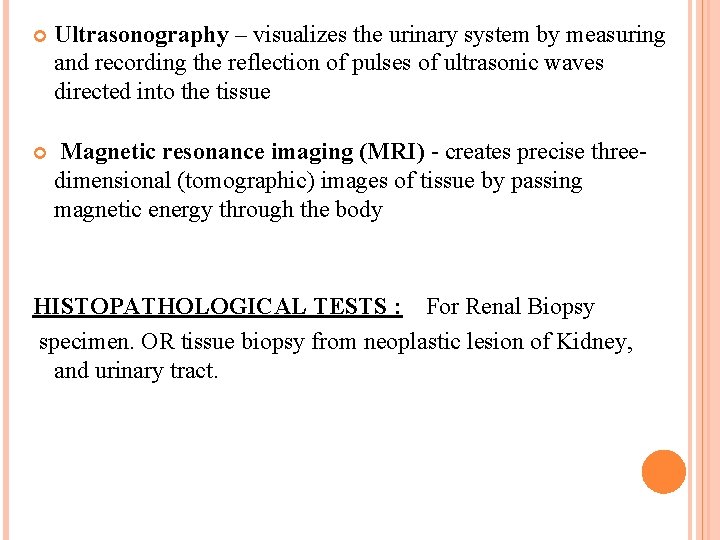
Ultrasonography – visualizes the urinary system by measuring and recording the reflection of pulses of ultrasonic waves directed into the tissue Magnetic resonance imaging (MRI) - creates precise threedimensional (tomographic) images of tissue by passing magnetic energy through the body HISTOPATHOLOGICAL TESTS : For Renal Biopsy specimen. OR tissue biopsy from neoplastic lesion of Kidney, and urinary tract.
URINARY SYSTEM DISORDERS Acute renal failure – is the sudden interruption of renal function. * acute : sudden & severe , chronic : gradual This potentially life-threatening condition is classified by cause of onset into: Intrarenal failure (parenchymal renal failure) Postrenal failure – obstruction of renal outflow (usually in the ureters) Prerenal failure (hypoperfusion , maybe caused by low blood supply ) Acute (poststreptococcal) glomerulonephritis - when a child gets tonsilitis caused by Streptococcus, the antibodies made by the body may attack the kidney nephrons , specially the glomerulus (same as what may happen to cardiac valves with tonsilitis). Symptoms include : fever , hematuria , highblood pressure. Acute pyelonephritis pyel: pelvis , inflammation (usually bacterial) affecting the kidney & its pelvis. It may cause poisoning (by the bacterial toxins) if it wasn’t treated. 17
Benign prostatic hyperplasia - occurs when the prostate gland enlarges enough to compress the urethra, causing urinary obstruction. Chronic glomerulonephritis - is an inflammation of the glomerulus of the kidney characterized by gradual decrease of urine production, blood & protein in the urine & edema (due to loss of blood protein , reducing colloid osmotic pressure). Confirmed by renal puncture & taking the sample , even after diagnosed we can do very little. This harder to be noticed than the acute one , its usually discovered after its too late. Chronic renal failure - is the typically slow, progressive loss of kidney function & glomerular filtration. Solved by renal transplantation. Cystitis - inflammation of the bladder, usually caused by an ascending infection. May be caused by calculus , because it forms a shelter for the bacteria from the WBCs due to the blood vessels not reaching their. Such infections caused by calculus may end up with chronic renal failure. **catheters cant be kept in the body for more than 72 hours because they are foreign bodies , may cause cystitis by foley’s catheter 18
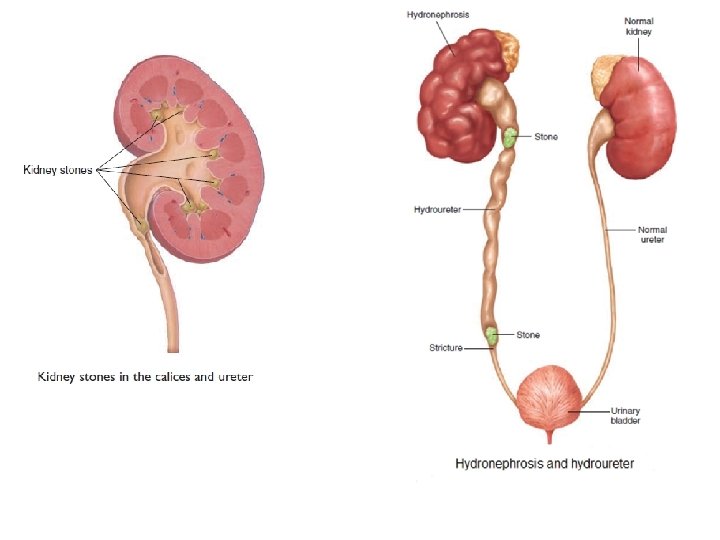
URINARY SYSTEM DISORDERS (CONT. ) Cystocele - a herniation of the urinary bladder through the vaginal wall , common at women who gave birth many times. (-cele is from Greek = hernia) Hydronephrosis - a distention (enlargement) of the kidneys that is caused by partial or complete obstruction of the urine flow. This obstruction causes higher pressure in the kidneys & distension. If the obstruction is at the beginning of the ureter we will have distension of the kidney & its pelvis , of its at its end we will have distension of the ureter as well (hydroureter) …. . (check the picture). If the obstruction is removed at an early stage the kidney will regain its normal size. Hypospadias (congenital)- a condition in which the urethral opening is on the ventral surface of the penis. This condition rarely occurs in females, where the opening occurs within the vagina. Can be corrected surgically right after birth. Nephrotic syndrome (a type of chronic renal failure)- a condition marked by severe proteinuria, low blood albumin levels & edema. Usually die at young age , can be treated by cancer toxic therapy. 19
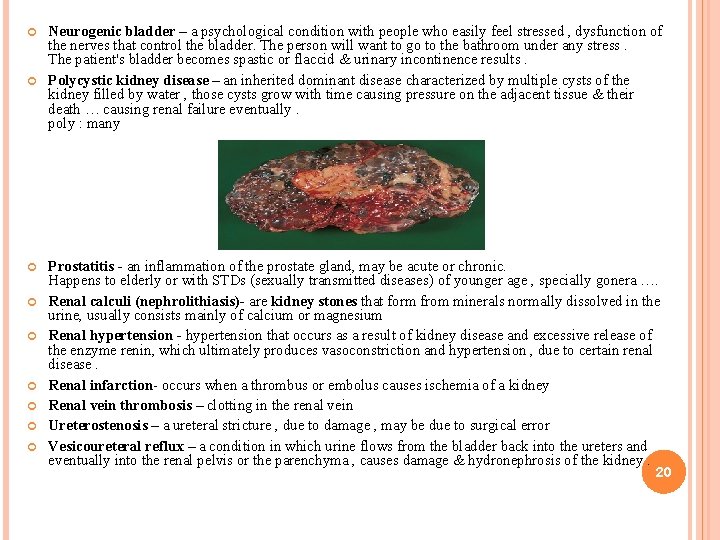
Neurogenic bladder – a psychological condition with people who easily feel stressed , dysfunction of the nerves that control the bladder. The person will want to go to the bathroom under any stress. The patient's bladder becomes spastic or flaccid & urinary incontinence results. Polycystic kidney disease – an inherited dominant disease characterized by multiple cysts of the kidney filled by water , those cysts grow with time causing pressure on the adjacent tissue & their death … causing renal failure eventually. poly : many Prostatitis - an inflammation of the prostate gland, may be acute or chronic. Happens to elderly or with STDs (sexually transmitted diseases) of younger age , specially gonera …. Renal calculi (nephrolithiasis)- are kidney stones that form from minerals normally dissolved in the urine, usually consists mainly of calcium or magnesium Renal hypertension - hypertension that occurs as a result of kidney disease and excessive release of the enzyme renin, which ultimately produces vasoconstriction and hypertension , due to certain renal disease. Renal infarction- occurs when a thrombus or embolus causes ischemia of a kidney Renal vein thrombosis – clotting in the renal vein Ureterostenosis – a ureteral stricture , due to damage , may be due to surgical error Vesicoureteral reflux – a condition in which urine flows from the bladder back into the ureters and eventually into the renal pelvis or the parenchyma , causes damage & hydronephrosis of the kidney. 20
21
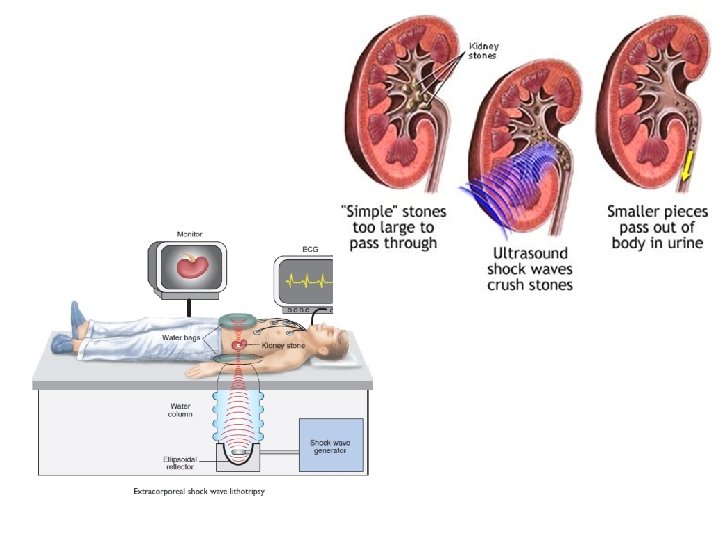
TREATMENT Lithotripsy – litho : calculus , tripsy : destruction a medical procedure that uses shock waves to break up stones in the kidney, bladder, or ureter. Usually they use more than one shock wave source & the waves meet at the stone , thus the patient must stay still during the procedure. Some times the patient is given sedatives to remove the slight pain or irritation. After the procedure, the tiny pieces of stones (gravel) pass out of the body in the urine.
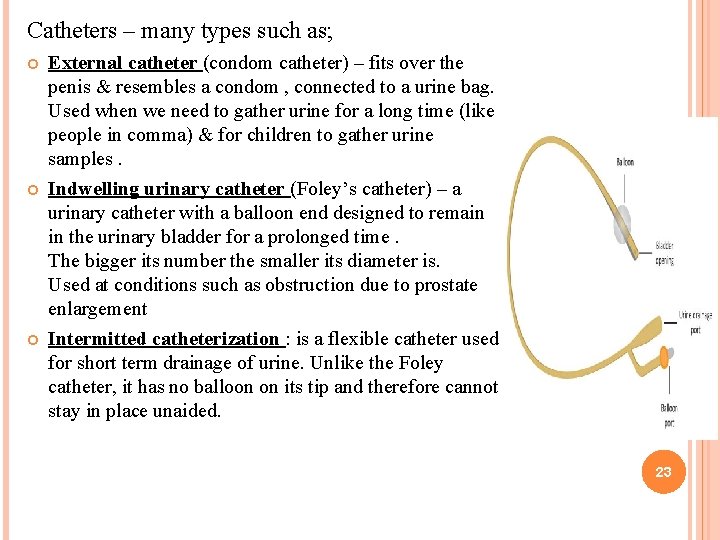
Catheters – many types such as; External catheter (condom catheter) – fits over the penis & resembles a condom , connected to a urine bag. Used when we need to gather urine for a long time (like people in comma) & for children to gather urine samples. Indwelling urinary catheter (Foley’s catheter) – a urinary catheter with a balloon end designed to remain in the urinary bladder for a prolonged time. The bigger its number the smaller its diameter is. Used at conditions such as obstruction due to prostate enlargement Intermitted catheterization : is a flexible catheter used for short term drainage of urine. Unlike the Foley catheter, it has no balloon on its tip and therefore cannot stay in place unaided. 23
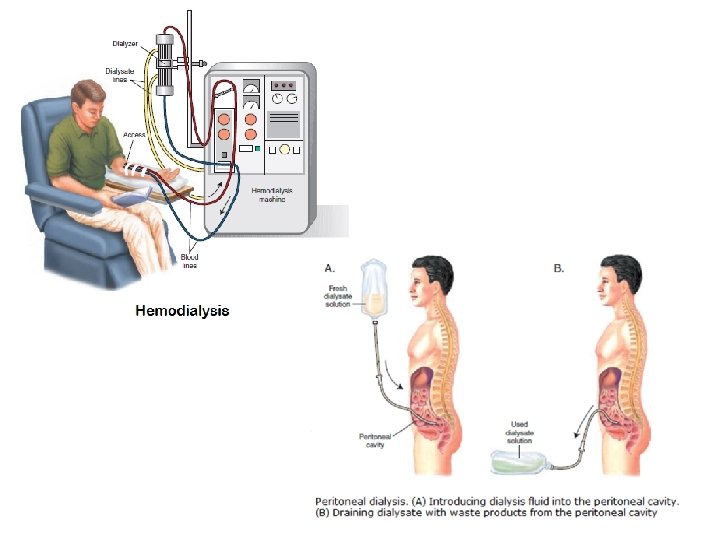
Dialysis (in Greek means separation) – a medical technique for removing waste products from the body when the kidneys fail Hemodialysis = removes toxic wastes directly from blood. Blood is pumped through an external filter called a dialyzing unit or dialyzer ( has permeable membrane & fluid with the same as normal blood concentrations of different substances, making the blood exchange substances till its normal again) to remove toxins and is then returned to the body. Needs time (1 -2 hours) , twice or three times per week. Peritoneal dialysis = used at emergency usually with people who pass out due to uremia , removes toxins from blood by using the peritoneal membrane surrounding the abdominal cavity as a semipermeable dialyzing membrane. A dialyzing solution (dialysate) is instilled into the peritoneal cavity , its breached by two holes , we introduce the dialysate through one hole then after appropriate dwelling time (around 15 minutes) the spoiled fluid (used dialysate) is sucked through the another hole, taking toxins and waste with it , till the patient has reached a stable state. 24
25
26
Circumcision - Removal of all or part of the foreskin or prepuce of the penis , best done at the age of 4 -5 months or right after birth. Cystectomy – partial or total removal of the urinary bladder & surrounding structures , done with cystitis & tumors , when total removal is done its replaced by a urine bag outside the body connected to the inside through a tube , same as cystomy. Cystotomy (or vesicostomy)– a surgical connection between the urinary bladder and the skin (by a catheter) used to temporarily divert urine away from the urethra (due to obstruction) & into a closed collection chamber. 27
- Slides: 27