
Urinary System Function 1 2 of blood and
Urinary System
Function 1. _____ 2. ____ of blood ____ and ____. 3. regulation of the concentration of _____ in the _____ 4. Regulation of extracellular _____, _____. 5. _____________.
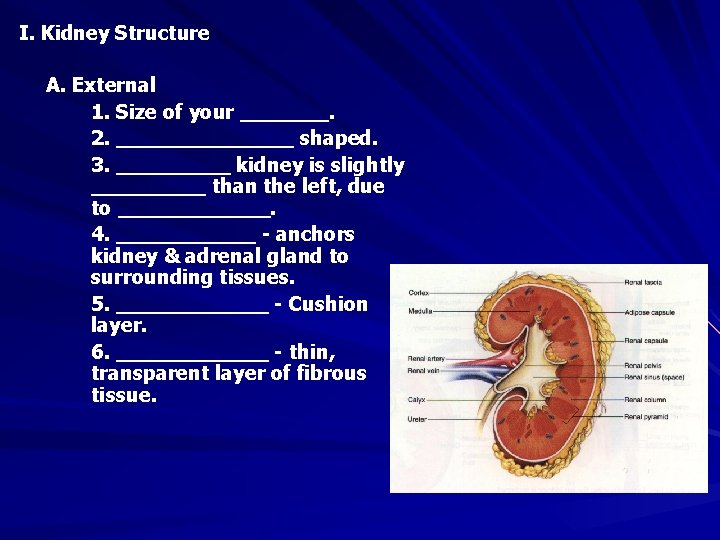
I. Kidney Structure A. External 1. Size of your _______. 2. _______ shaped. 3. _____ kidney is slightly _____ than the left, due to ______. 4. ______ - anchors kidney & adrenal gland to surrounding tissues. 5. ______ - Cushion layer. 6. ______ - thin, transparent layer of fibrous tissue.
B. Internal 1. Renal ________ - inner most. a. _______ - Concave portion where the renal artery & vein unit with the kidney. b. __________ - space. c. __________ - membrane line basin. d. _______ - funnel shaped channels from the pelvis & collects newly formed urine. 2. ______ - Outermost layer 3. ______ 4. ______ - Parts of the cortex extends into the medulla. 5. ______ - functional subunit of the kidney.
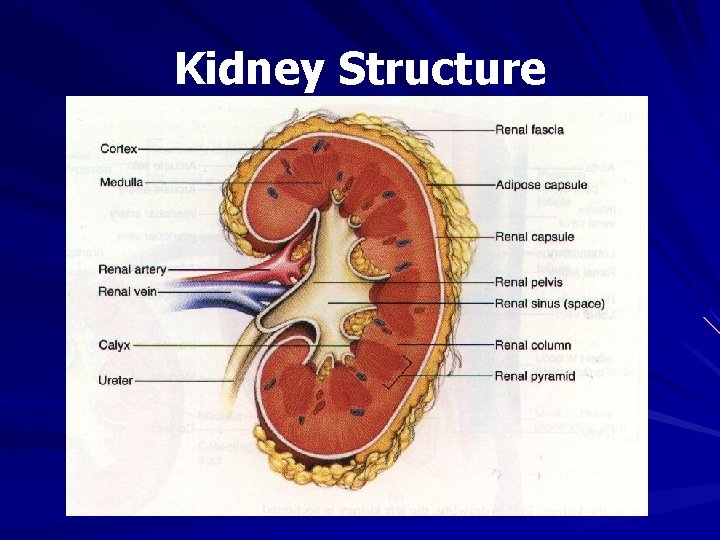
Kidney Structure
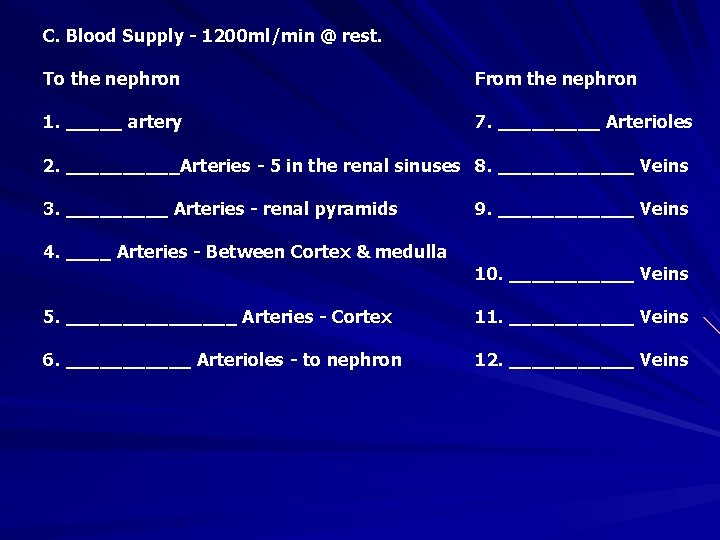
C. Blood Supply - 1200 ml/min @ rest. To the nephron From the nephron 1. _____ artery 7. _____ Arterioles 2. _____Arteries - 5 in the renal sinuses 8. ______ Veins 3. _____ Arteries - renal pyramids 4. ____ Arteries - Between Cortex & medulla 9. ______ Veins 10. ______ Veins 5. ________ Arteries - Cortex 11. ______ Veins 6. ______ Arterioles - to nephron 12. ______ Veins
Kidney Overview
Review What are some of the functions of the excretory system? How much blood are in the kidneys at rest? What are some factors that can influence the amount of blood in the kidneys? What are the two parts of the kidneys?
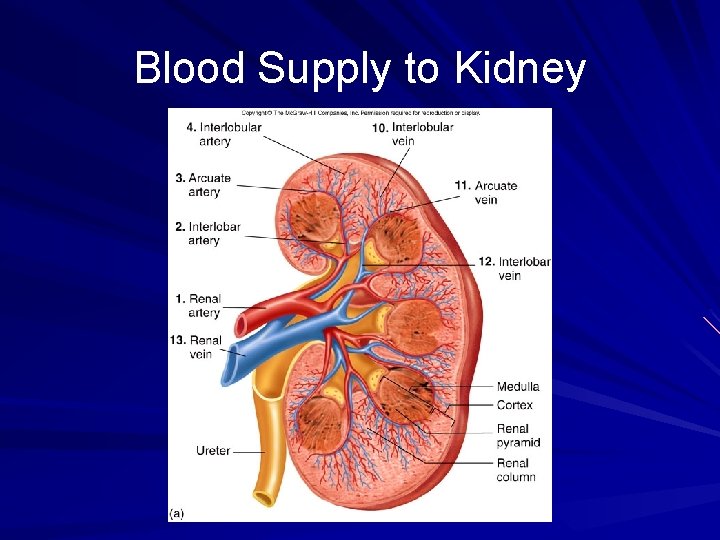
Blood Supply to Kidney
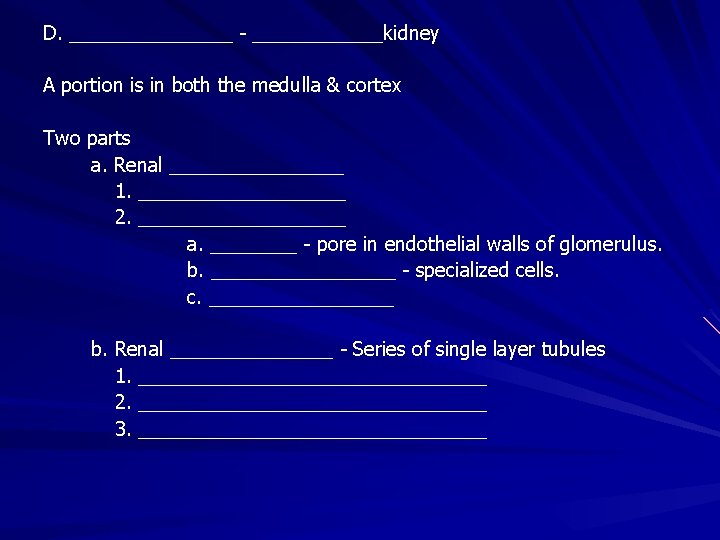
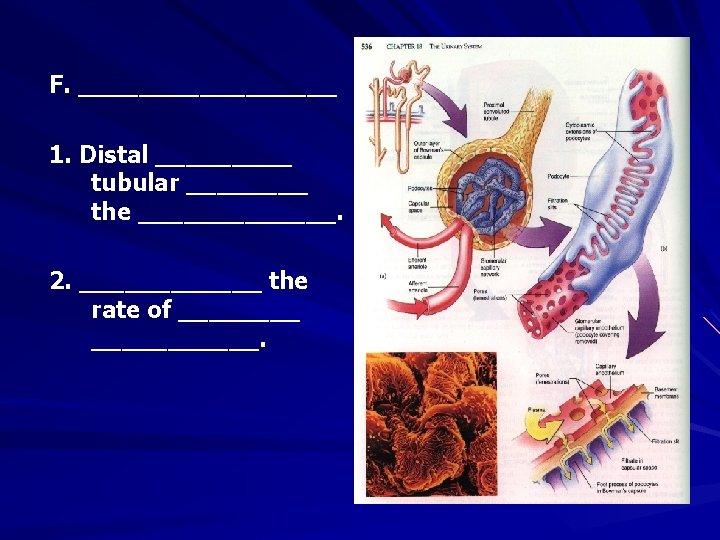
D. ________ - ______kidney A portion is in both the medulla & cortex Two parts a. Renal ________ 1. __________ 2. __________ a. ____ - pore in endothelial walls of glomerulus. b. _________ - specialized cells. c. _________ b. Renal ________ - Series of single layer tubules 1. ________________ 2. ________________ 3. ________________
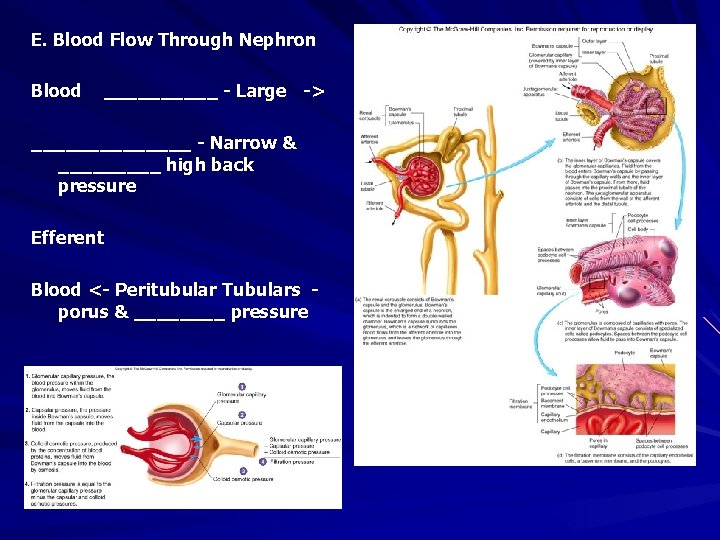
E. Blood Flow Through Nephron Blood _____ - Large -> _______ - Narrow & _____ high back pressure Efferent Blood <- Peritubular Tubulars porus & ____ pressure
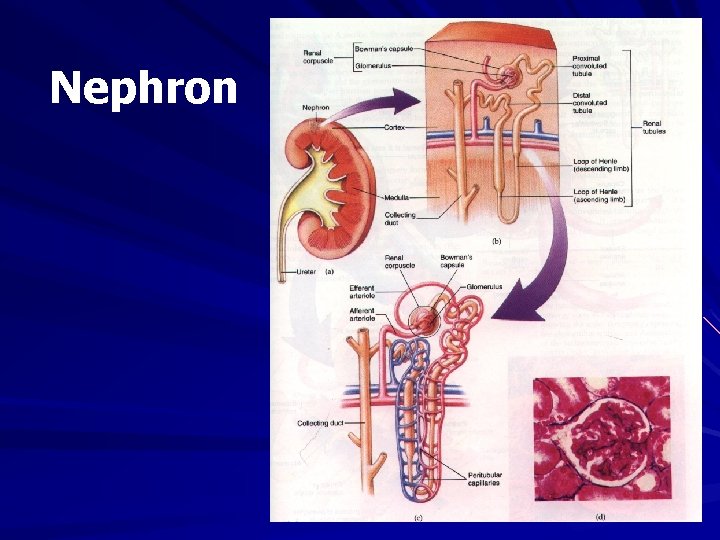
Nephron
Review What is a nephron? What are the two parts of the nephron? What is the job of the podocytes? Where in the nephron is the juxtaglomular appratus?
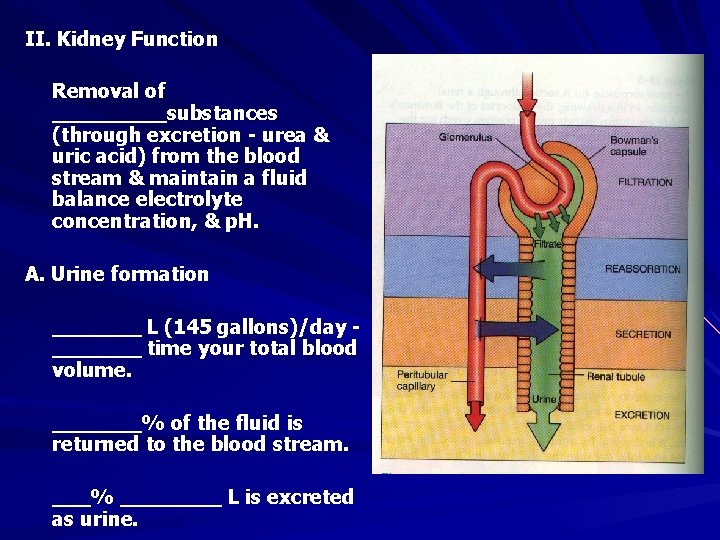
II. Kidney Function Removal of _____substances (through excretion - urea & uric acid) from the blood stream & maintain a fluid balance electrolyte concentration, & p. H. A. Urine formation _______ L (145 gallons)/day _______ time your total blood volume. _______% of the fluid is returned to the blood stream. ___% ____ L is excreted as urine.
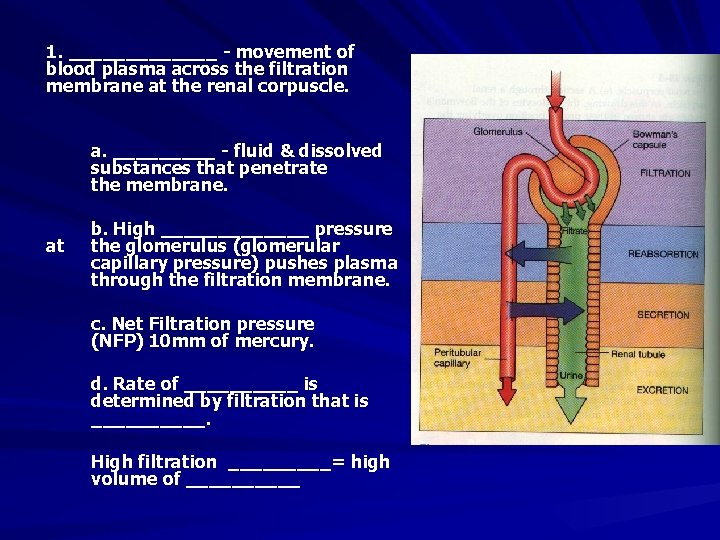
1. _______ - movement of blood plasma across the filtration membrane at the renal corpuscle. a. _____ - fluid & dissolved substances that penetrate the membrane. at b. High _______ pressure the glomerulus (glomerular capillary pressure) pushes plasma through the filtration membrane. c. Net Filtration pressure (NFP) 10 mm of mercury. d. Rate of _____ is determined by filtration that is _____. High filtration _____= high volume of _____
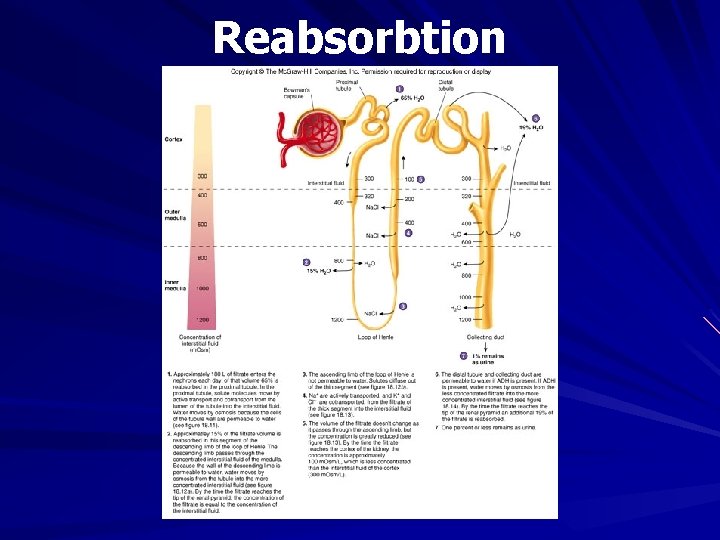
Reabsorbtion
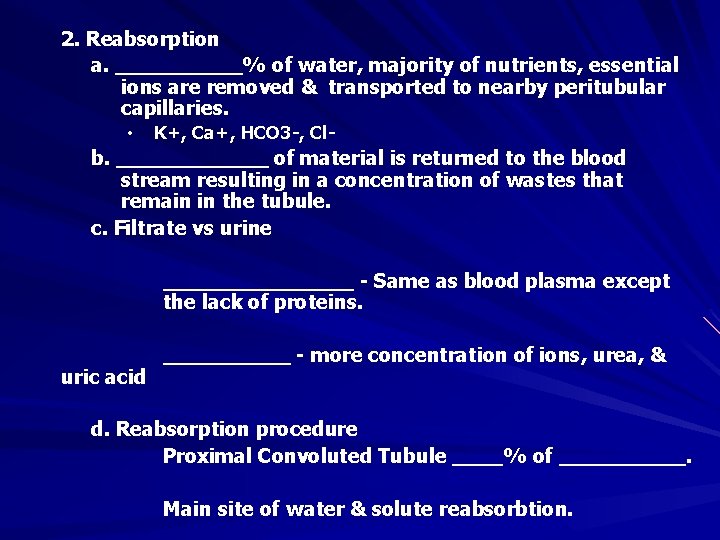
2. Reabsorption a. _____% of water, majority of nutrients, essential ions are removed & transported to nearby peritubular capillaries. • K+, Ca+, HCO 3 -, Cl- b. ______ of material is returned to the blood stream resulting in a concentration of wastes that remain in the tubule. c. Filtrate vs urine ________ - Same as blood plasma except the lack of proteins. uric acid _____ - more concentration of ions, urea, & d. Reabsorption procedure Proximal Convoluted Tubule ____% of _____. Main site of water & solute reabsorbtion.
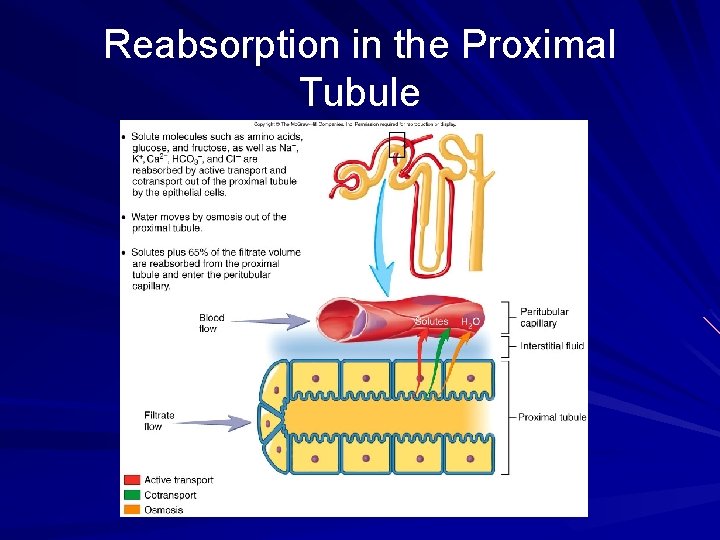
Reabsorption in the Proximal Tubule
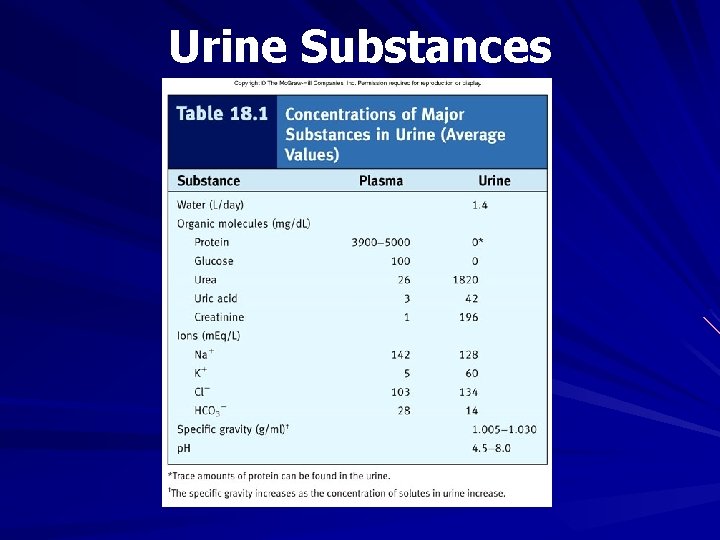
Urine Substances
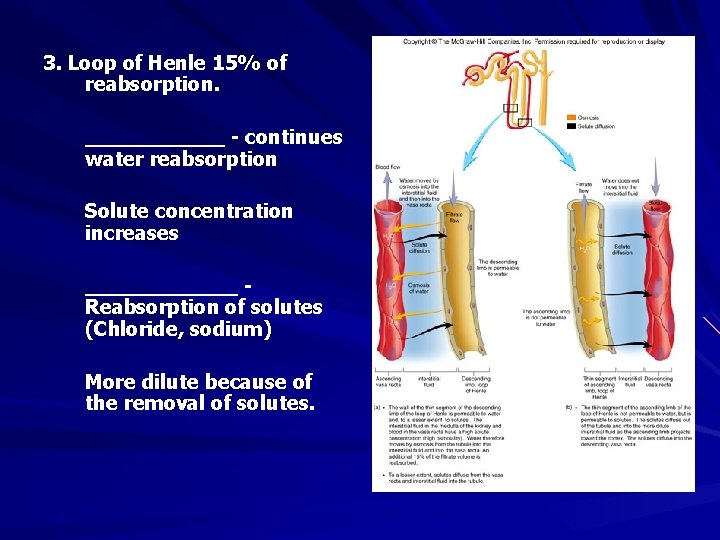
3. Loop of Henle 15% of reabsorption. ______ - continues water reabsorption Solute concentration increases ______ Reabsorption of solutes (Chloride, sodium) More dilute because of the removal of solutes.
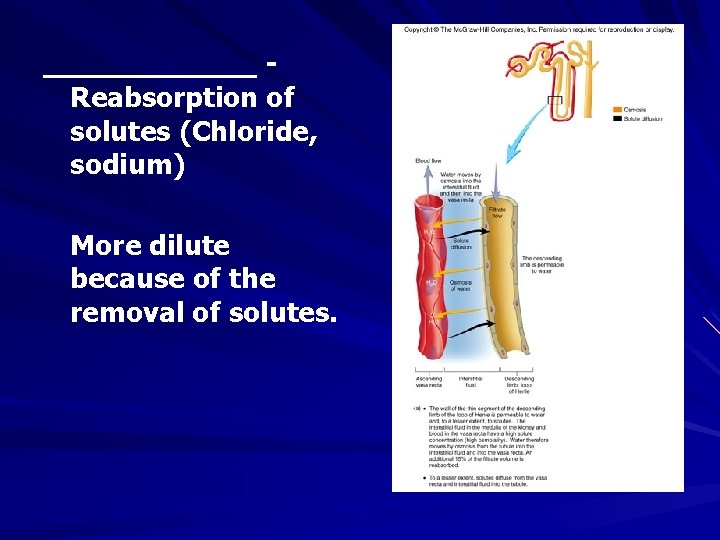
______ Reabsorption of solutes (Chloride, sodium) More dilute because of the removal of solutes.
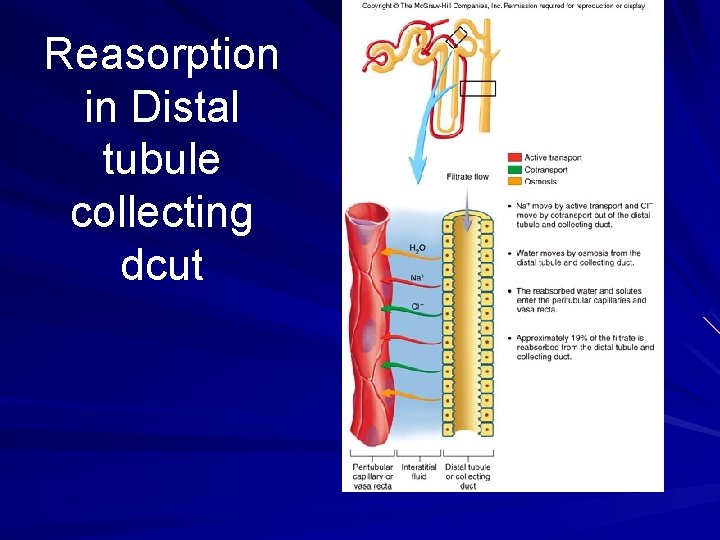
Reasorption in Distal tubule collecting dcut
4. _______ - Net movement of unwanted substance from the peritubular capillaries into the proximal convoluted. How does this movement occur? ________ - H ions (controls the body’s p. H), Potassium ions, Penicillin) _____ – urea _____
Review What are three parts to urine formation? How is each part different? What are some methods that each part uses for urine formation?
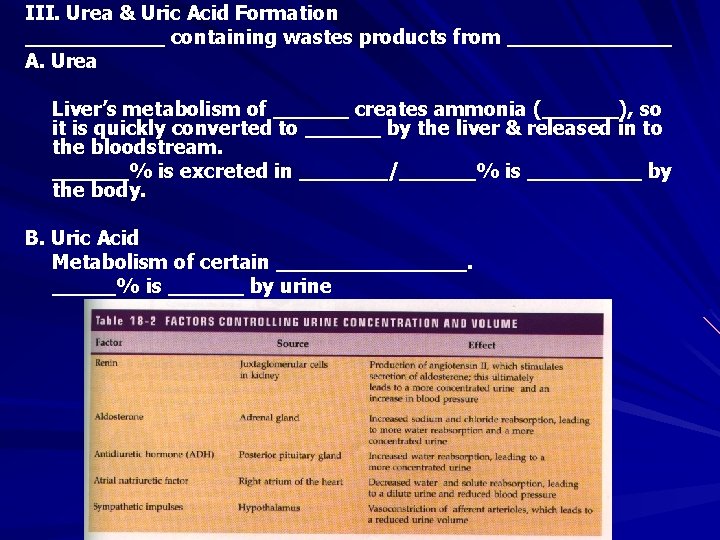
III. Urea & Uric Acid Formation ______ containing wastes products from _______ A. Urea Liver’s metabolism of ______ creates ammonia (______), so it is quickly converted to ______ by the liver & released in to the bloodstream. ______% is excreted in _______/______% is _____ by the body. B. Uric Acid Metabolism of certain ________% is ______ by urine
IV. Regulation of Urine Concentration & Volume _______in response to our changing condition of our _______ to maintain a constant blood composition & volume. ______ -Increases slat in urine & _____ urine volume. _____ exercise - Urine volume is less with ______. Juxtaglomerular regulates urine formation & is triggered when NFP ______.

Review Where does urea and uric acid come from? What are some activities that can increase urine output? What are some that can decrease urine output?
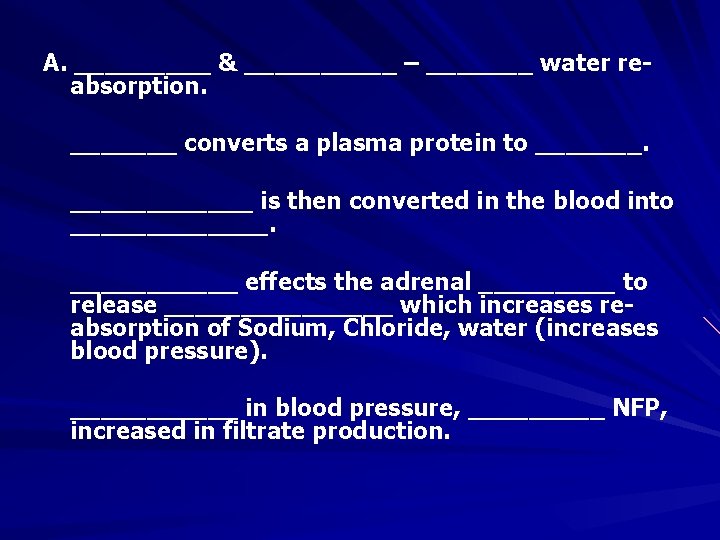
A. _____ & _____ – _______ water reabsorption. _______ converts a plasma protein to _______ is then converted in the blood into _______ effects the adrenal _____ to release ________ which increases reabsorption of Sodium, Chloride, water (increases blood pressure). ______ in blood pressure, _____ NFP, increased in filtrate production.
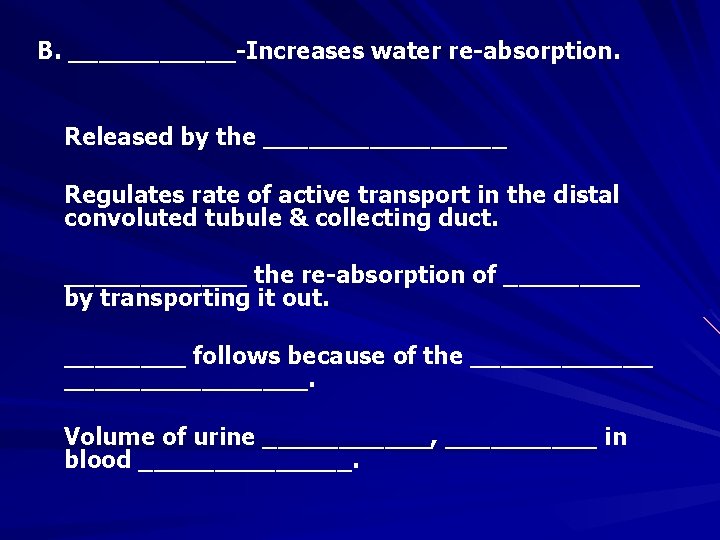
B. ______-Increases water re-absorption. Released by the ________ Regulates rate of active transport in the distal convoluted tubule & collecting duct. ______ the re-absorption of _____ by transporting it out. ____ follows because of the ________________. Volume of urine ______, _____ in blood _______.
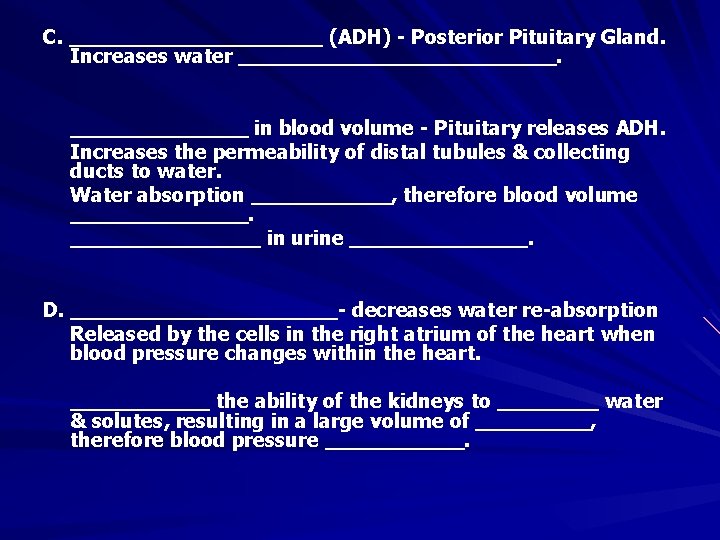
C. __________ (ADH) - Posterior Pituitary Gland. Increases water _____________ in blood volume - Pituitary releases ADH. Increases the permeability of distal tubules & collecting ducts to water. Water absorption ______, therefore blood volume ________ in urine _______. D. ___________- decreases water re-absorption Released by the cells in the right atrium of the heart when blood pressure changes within the heart. ______ the ability of the kidneys to ____ water & solutes, resulting in a large volume of _____, therefore blood pressure ______.
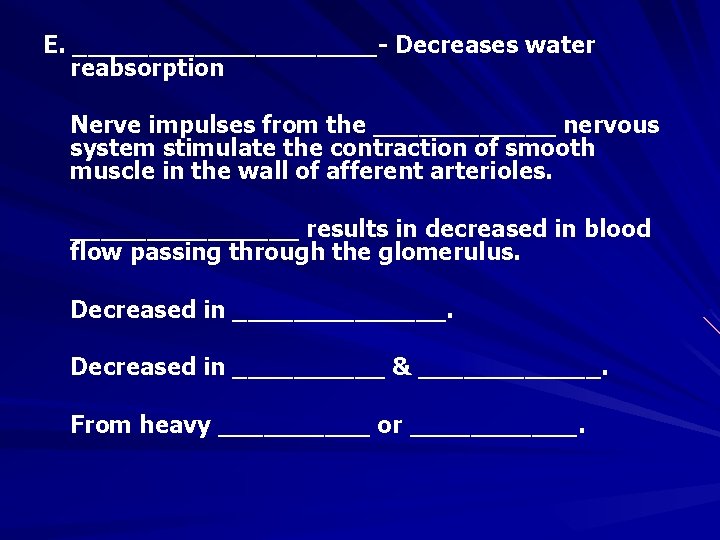
E. __________- Decreases water reabsorption Nerve impulses from the ______ nervous system stimulate the contraction of smooth muscle in the wall of afferent arterioles. ________ results in decreased in blood flow passing through the glomerulus. Decreased in _______. Decreased in _____ & ______. From heavy _____ or ______.
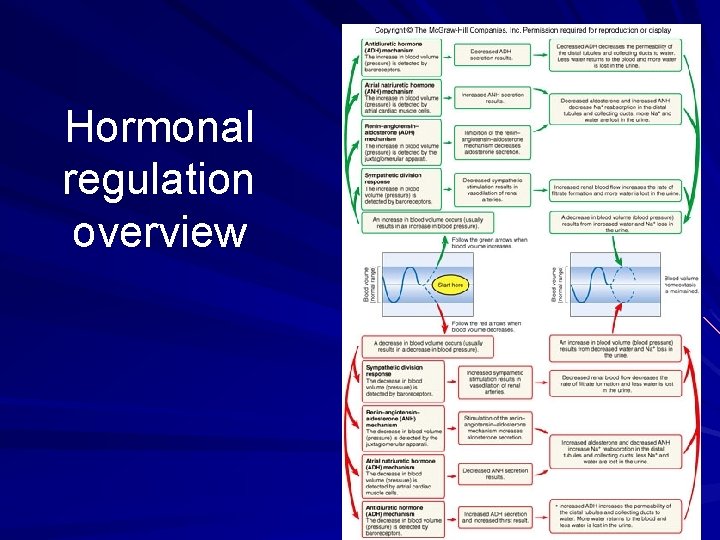
Hormonal regulation overview
Review Renin, angiotension I & II, aldosterone, and ADH increase water reabsorption, how? Why would you need your body to reabsorb water? How does Atrial Natriuretic Factor decrease water reabsorption? Why?
V. Maintenance of Body Fluids Uptake of water & _____ = _____. Organs involved Skin, liver, organs of the alimentary canal, & kidney (largest effect).
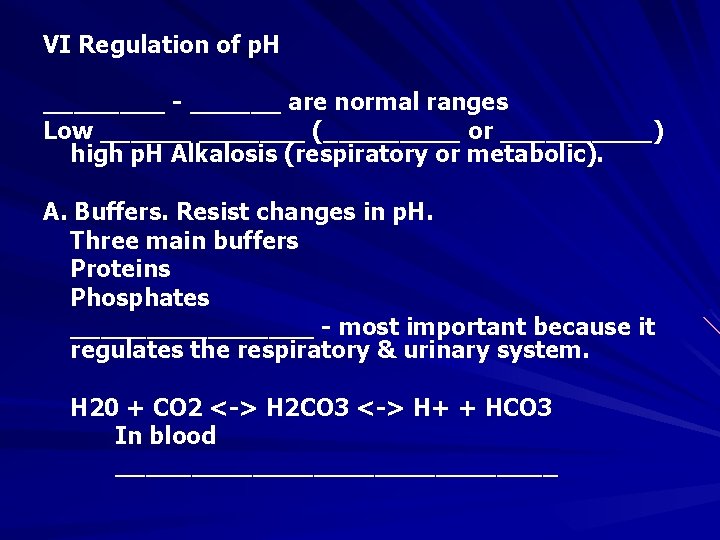
VI Regulation of p. H ____ - ______ are normal ranges Low _______ (_____ or _____) high p. H Alkalosis (respiratory or metabolic). A. Buffers. Resist changes in p. H. Three main buffers Proteins Phosphates ________ - most important because it regulates the respiratory & urinary system. H 20 + CO 2 <-> H 2 CO 3 <-> H+ + HCO 3 In blood _______________
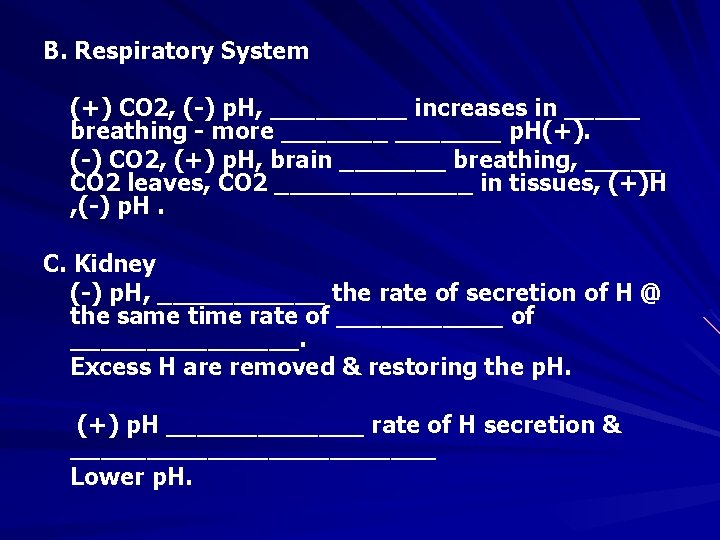
B. Respiratory System (+) CO 2, (-) p. H, _____ increases in _____ breathing - more _______ p. H(+). (-) CO 2, (+) p. H, brain _______ breathing, _____ CO 2 leaves, CO 2 _______ in tissues, (+)H , (-) p. H. C. Kidney (-) p. H, ______ the rate of secretion of H @ the same time rate of _______________. Excess H are removed & restoring the p. H. (+) p. H _______ rate of H secretion & ____________ Lower p. H.
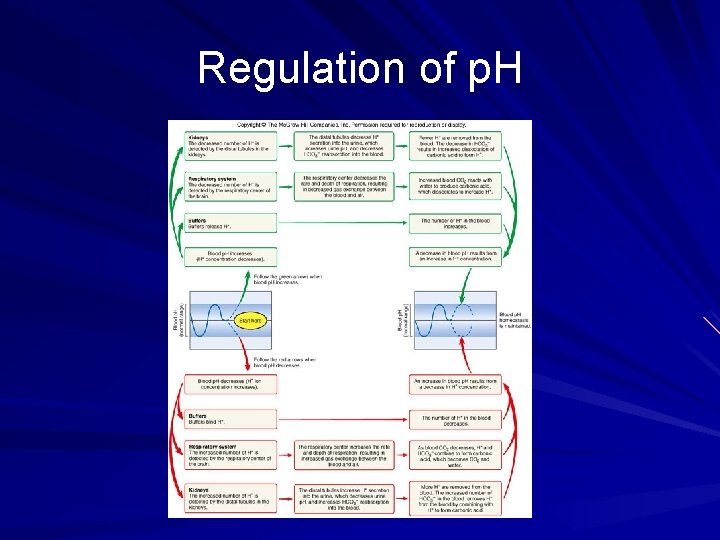
Regulation of p. H
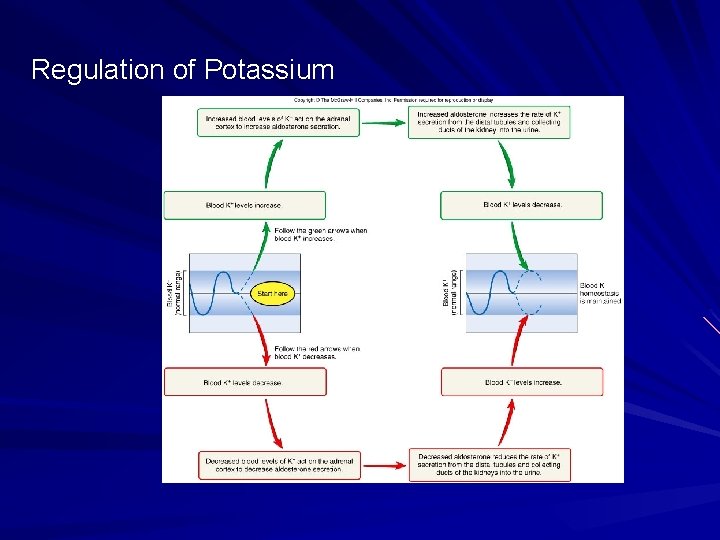
Regulation of Potassium
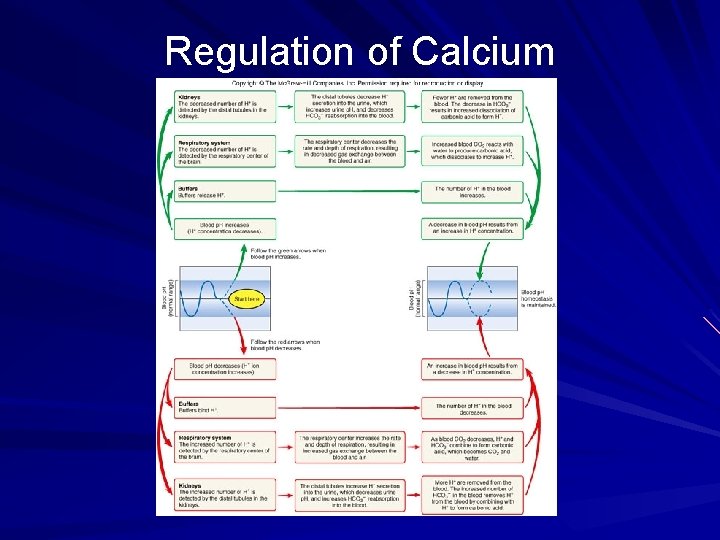
Regulation of Calcium
Review What is the p. H range that your body should be in for normal function? What is the main mechanism that controls normal blood chemical ranges? How does your body deal with excessive Hydrogen ions?
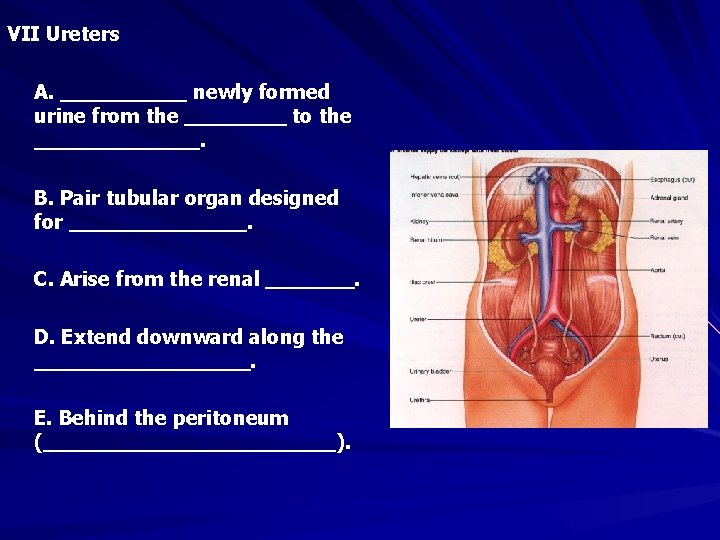
VII Ureters A. _____ newly formed urine from the ____ to the _______. B. Pair tubular organ designed for _______. C. Arise from the renal _______. D. Extend downward along the _________. E. Behind the peritoneum (____________).
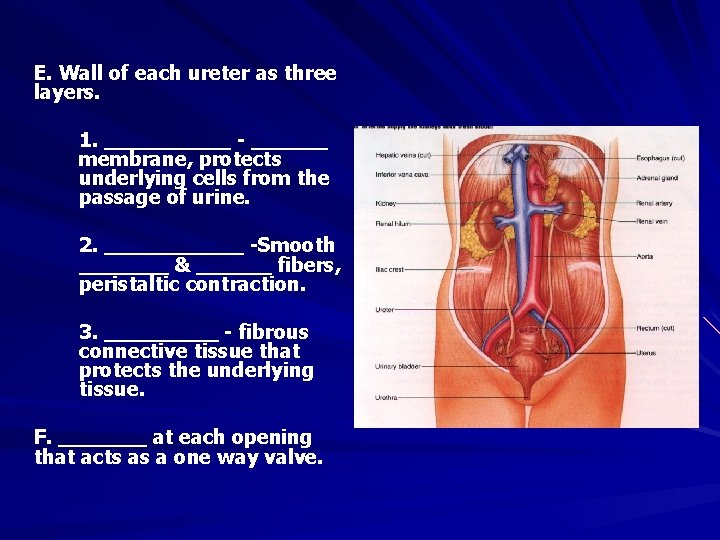
E. Wall of each ureter as three layers. 1. _____ - ______ membrane, protects underlying cells from the passage of urine. 2. ______ -Smooth _______ & ______ fibers, peristaltic contraction. 3. _____ - fibrous connective tissue that protects the underlying tissue. F. _______ at each opening that acts as a one way valve.
Review What is the job of the ureter? How many do ureters do you have? Why is the ureter coated in mucus? Why are there flaps at the top and bottom of the ureter?
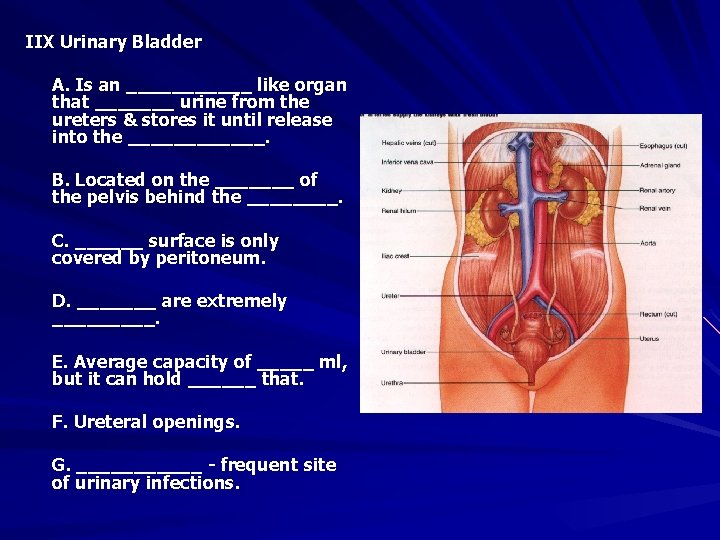
IIX Urinary Bladder A. Is an ______ like organ that _______ urine from the ureters & stores it until release into the ______. B. Located on the _______ of the pelvis behind the ____. C. ______ surface is only covered by peritoneum. D. _______ are extremely _____. E. Average capacity of _____ ml, but it can hold ______ that. F. Ureteral openings. G. ______ - frequent site of urinary infections.
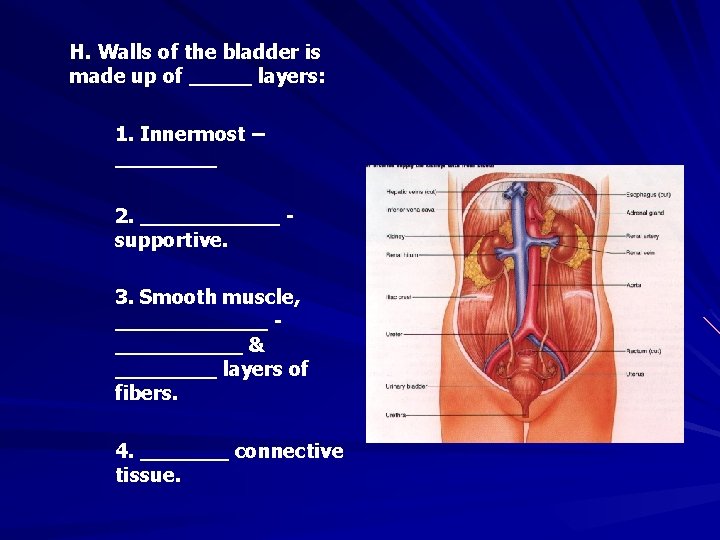
H. Walls of the bladder is made up of _____ layers: 1. Innermost – ____ 2. ______ supportive. 3. Smooth muscle, ______ & ____ layers of fibers. 4. _______ connective tissue.
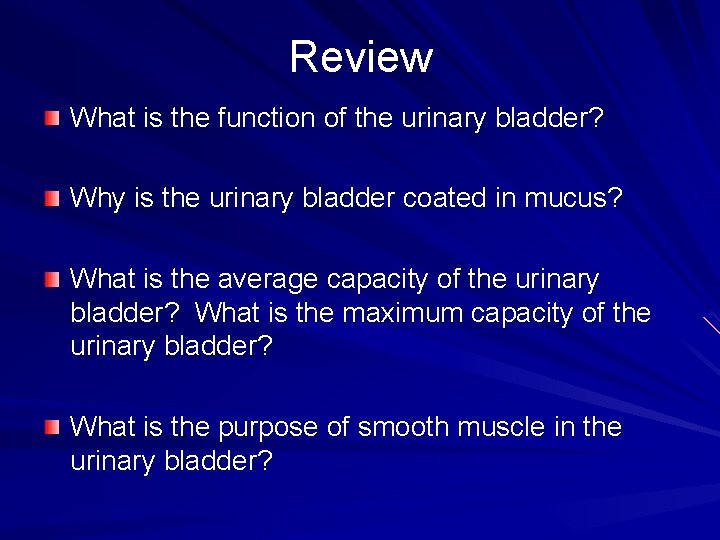
Review What is the function of the urinary bladder? Why is the urinary bladder coated in mucus? What is the average capacity of the urinary bladder? What is the maximum capacity of the urinary bladder? What is the purpose of smooth muscle in the urinary bladder?
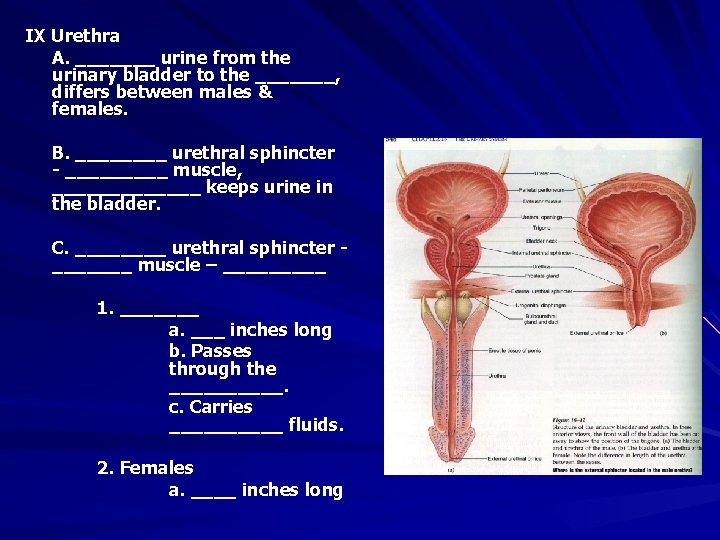
IX Urethra A. _______ urine from the urinary bladder to the _______, differs between males & females. B. ____ urethral sphincter - _____ muscle, _______ keeps urine in the bladder. C. ____ urethral sphincter _______ muscle – _____ 1. _______ a. ___ inches long b. Passes through the _____. c. Carries _____ fluids. 2. Females a. ____ inches long
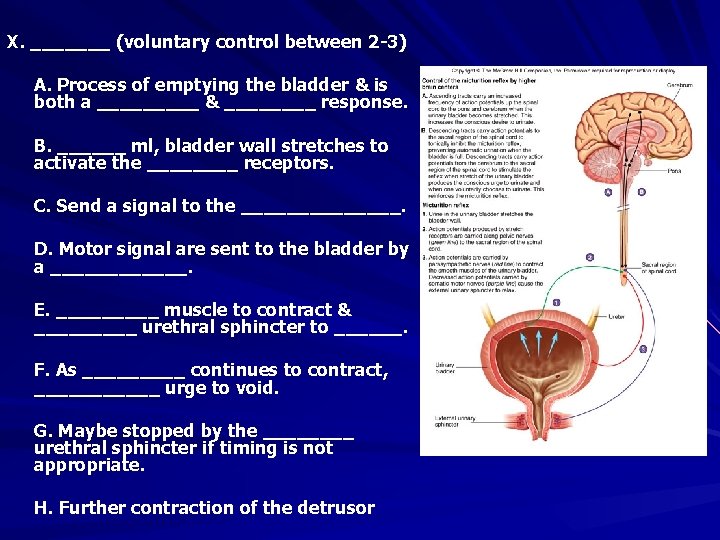
X. _______ (voluntary control between 2 -3) A. Process of emptying the bladder & is both a _____ & ____ response. B. ______ ml, bladder wall stretches to activate the ____ receptors. C. Send a signal to the _______. D. Motor signal are sent to the bladder by a ______. E. _____ muscle to contract & _____ urethral sphincter to ______. F. As _____ continues to contract, ______ urge to void. G. Maybe stopped by the ____ urethral sphincter if timing is not appropriate. H. Further contraction of the detrusor
Review What is the function of the urethra? Define micturition. Is micturition negative or positive feedback? How big is the urinary bladder have to be in order to send a signal to begin micturition?
XI Problems with the Urinary System A. ____ - absence of urine due to kidney failure or obstruction B. _____ - kidney stones due to increased salts in urine. Uric acid crystals that precipitate out of the blood stream & build up in the lower gut. _____ of calcium salts. C. ______ - Inflammation of the urinary bladder due to entry of a bacteria through the urethera. D. ______ - Presence of blood in the urine caused by cuts in the urinary tract E. Renal Failure & Dialysis
1. loss of the kidney’s ability to respond to changes in the body. 2. rapid loss of fluid, electrolytes. 3. build up of wastes Acute - abrupt stoppage, temporary. 4. Pain, Reduce urine output, bleeding. 5. Injury, infection, drugs. 6. Chronic - progressive loss of kidney function because of reduced glomerular function. 7. Build of urea in blood, p. H imbalance, electrolytes imbalance. 8. Kidney failure - no formation of urine, result in rapid build. of of toxic wastes, & acidic p. H - death in 8 - 10 days. 9. Kidney transplant or dialysis - 3 times a week.
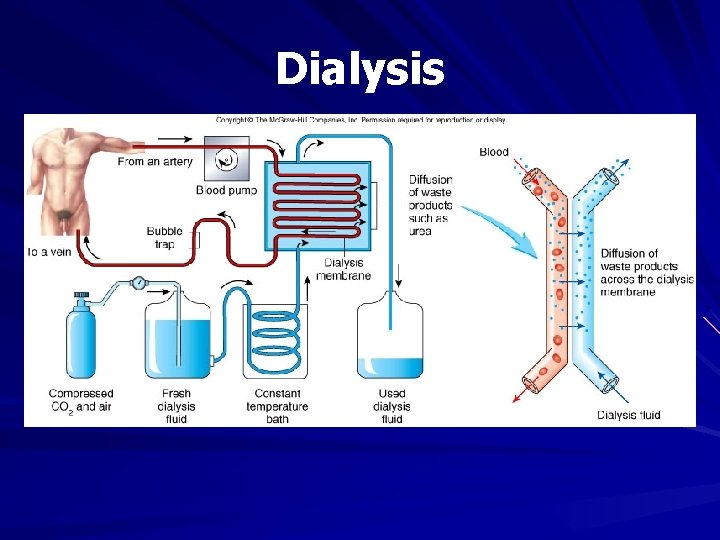
Dialysis
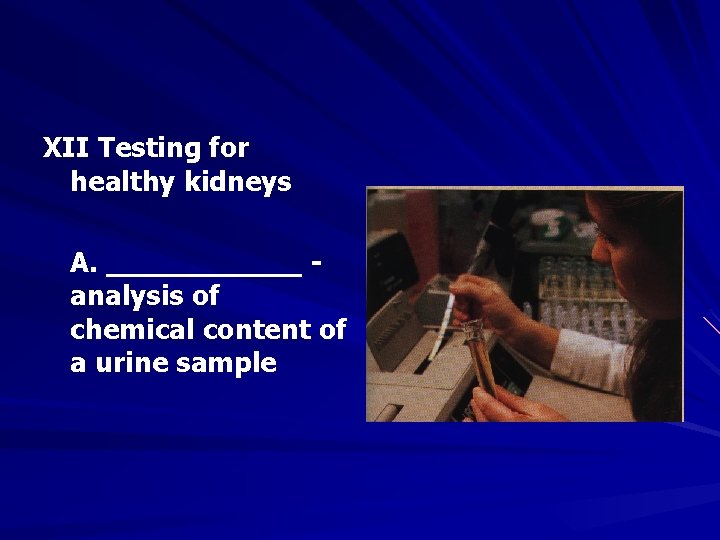
XII Testing for healthy kidneys A. ______ analysis of chemical content of a urine sample
Review Define urinalysis. What are some causes that can affect the kidney to stop its function? How fast can death occur if the kidney does not return back to normal function? What can be done to preserve the life of an individual while waiting for a kidney transplant? What basic principle is dialysis based upon?
- Slides: 56