
Urinary Stones Urolithiasis Urology Department Ain Shams University


- Slides: 51
Urinary Stones (Urolithiasis) Urology Department Ain Shams University, 2009
Renal and Ureteral Stones • Renal stones or nephrolithiasis are a common disease, affecting one in ten of the population, although a significant proportion will remain asymptomatic. • Male to female ratio is 3: 1. • The peak age for developing stones is between 30 and 50, and recurrence is common. Urology Department Ain Shams University, 2009
Pathophysiology • Supersaturation-Crystallization. • Low levels of inhibitors. • Stasis of urine, infection, and persistent change in p. H. • The presence of nanobacteria. Urology Department Ain Shams University, 2009
Types of Renal Stones The four most common types of stones are: • Calcium stones(85%), • Uric acid stones(10%), • Struvite stones, and • Cystine stones. Urology Department Ain Shams University, 2009
Calcium Stones Calcium stones include calcium oxalate and calcium phosphate and due to hypercalciuria which occurs in: • Hyperparathyroidism. • Renal tubular acidosis. • Prolonged immobilization. • Renal calcium leak. Urology Department Ain Shams University, 2009
Uric acid stones Causes: • Genetic enzyme deficiency. • High intake of purine-containing foods. • Cytotoxic chemotherapy. • Acidic urine. Urology Department Ain Shams University, 2009
Struvite Stones (Magnesium Ammonium Phosphates) • This type of stone, also called an infection stone, develops with urea-splitting organisms, e. g. Proteus, that release ammonia and makes urine alkaline. • Struvite stones are more common in women. • The stones usually grow to be quite large, stag horn stones. Urology Department Ain Shams University, 2009
Cystine Stones • Some people inherit a rare, congenital condition that results in large amounts of cystine in the urine (cystinuria). • Cystine stones are the hardest stones. Urology Department Ain Shams University, 2009
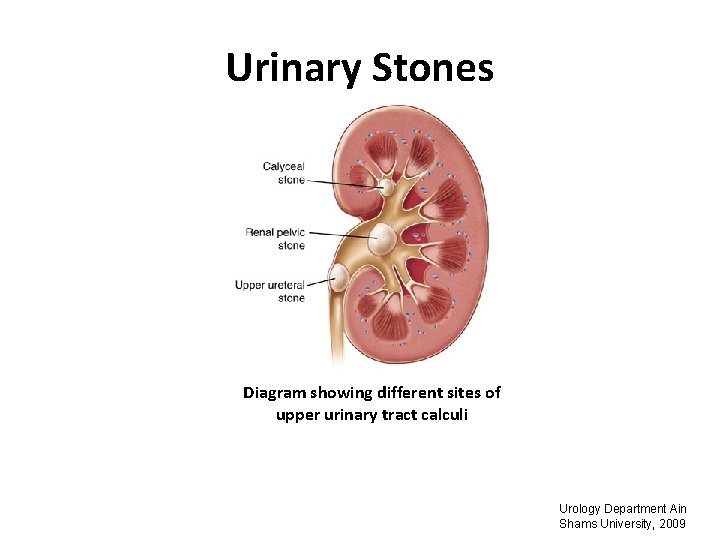
Urinary Stones Diagram showing different sites of upper urinary tract calculi Urology Department Ain Shams University, 2009
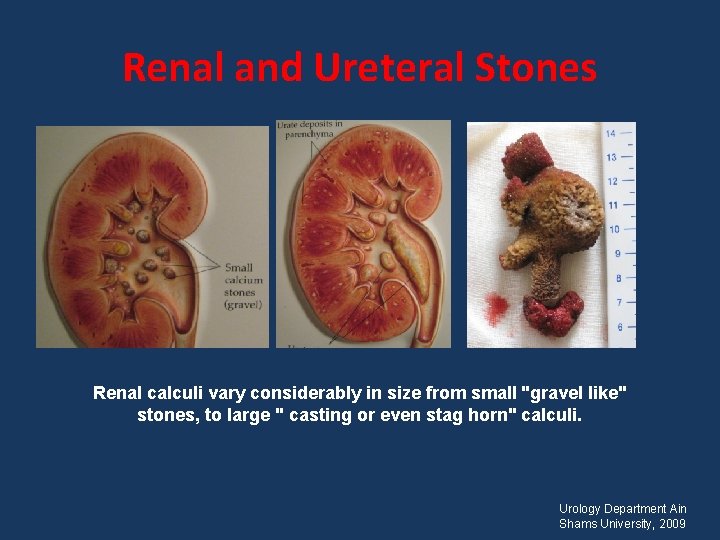
Renal and Ureteral Stones Renal calculi vary considerably in size from small "gravel like" stones, to large " casting or even stag horn" calculi. Urology Department Ain Shams University, 2009
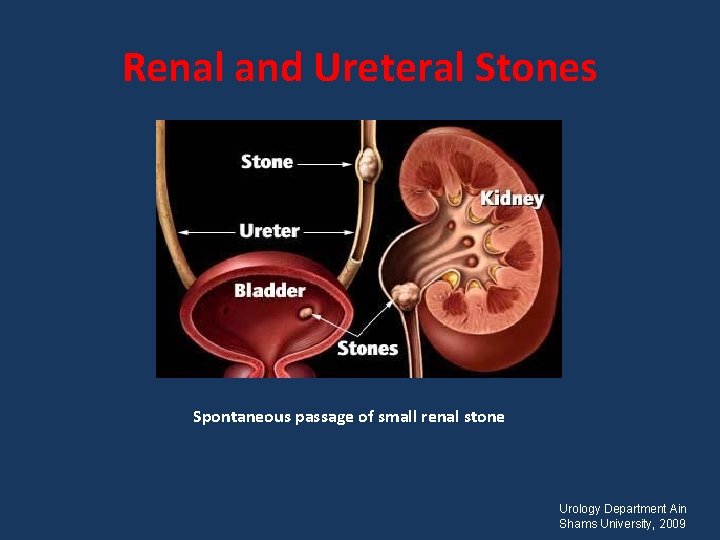
Renal and Ureteral Stones • Stones may pass out of the kidney, become lodged in the ureter. • A lodged stone can obstruct the flow of urine, causing back pressure and dilatation in the affected ureter and kidney. Urology Department Ain Shams University, 2009
Renal and Ureteral Stones Spontaneous passage of small renal stone Urology Department Ain Shams University, 2009
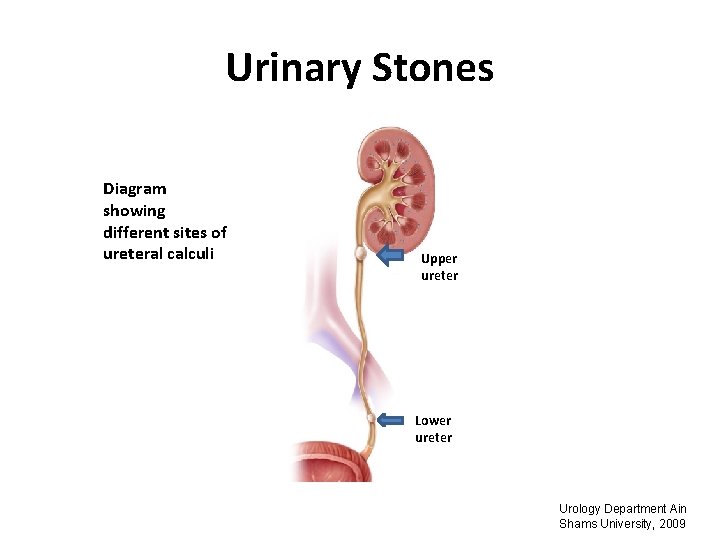
Urinary Stones Diagram showing different sites of ureteral calculi Upper ureter Lower ureter Urology Department Ain Shams University, 2009
Presentation • Many stones will cause no symptoms at all, and discovered during investigations for other conditions. • Classical presentation: ureteric colic due to spasm of ureter, or by persistent dull aching loin pain due to dilatation of the kidney. Urology Department Ain Shams University, 2009
Presentation Other symptoms which may be present include: • Rigors and fever. • Dysuria. • Hematuria. • Urinary retention. • Nausea and vomiting in infants. Urology Department Ain Shams University, 2009
Differential Diagnosis Other diagnoses which must be considered in the acute situation are other causes of colicky abdominal pain e. g. • Bowel obstruction. • Strangulated hernia. • Appendicitis. Urology Department Ain Shams University, 2009
Investigations Laboratory: • Urine dip-strip and microscopy looking for crystals, blood cells, pus cells and p. H. • Urine culture and sensitivity to reveal infection. • Urea and creatinine - looking for evidence of renal impairment. Urology Department Ain Shams University, 2009
Investigations Laboratory: Metabolic study should be done in all surgically active stones, i. e. multiple, bilateral, rapidly recurrent, or at young age. • Serum calcium, • uric acid, • phosphate, • bicarbonate and • parathormone level. Urology Department Ain Shams University, 2009
Investigations Imaging: • Ultrasonography is an easy and quick examination that can diagnose both radiopaque as well as radiolucent stones, and renal dilatation. • X-ray, KUB film looking for radio-opaque stones. • IVU • Helical CT scan. Urology Department Ain Shams University, 2009
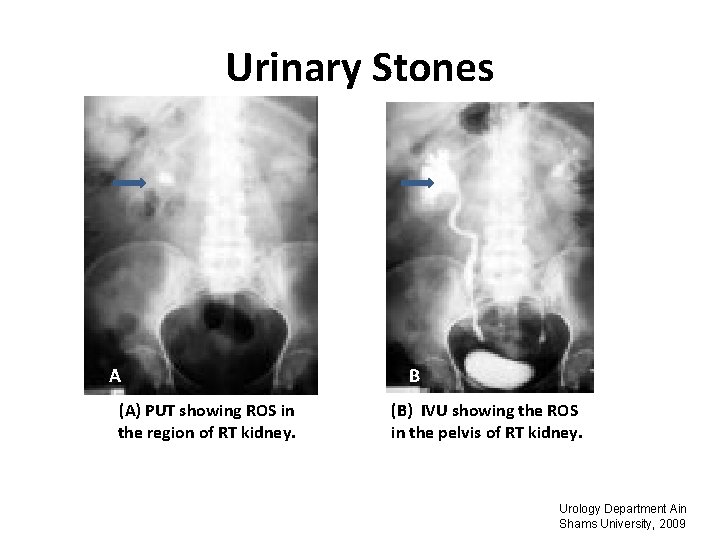
Urinary Stones A (A) PUT showing ROS in the region of RT kidney. B (B) IVU showing the ROS in the pelvis of RT kidney. Urology Department Ain Shams University, 2009
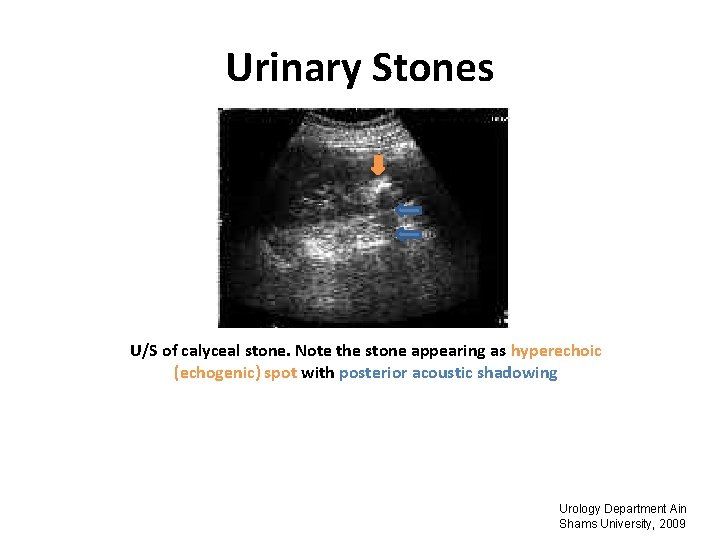
Urinary Stones U/S of calyceal stone. Note the stone appearing as hyperechoic (echogenic) spot with posterior acoustic shadowing Urology Department Ain Shams University, 2009
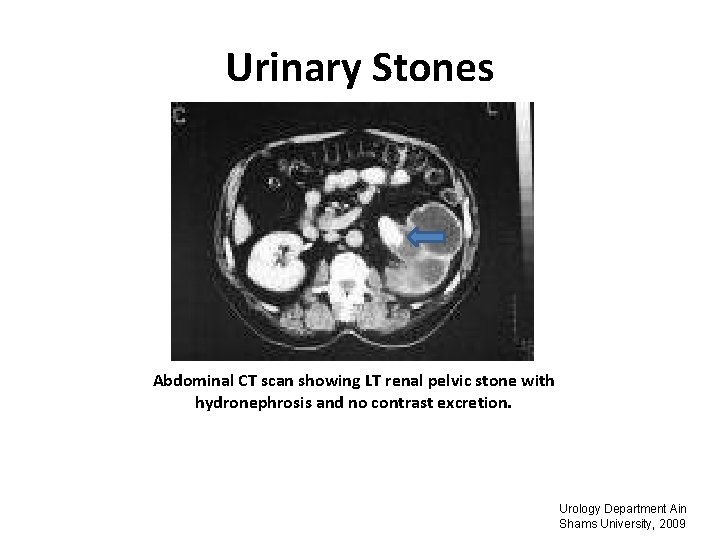
Urinary Stones Abdominal CT scan showing LT renal pelvic stone with hydronephrosis and no contrast excretion. Urology Department Ain Shams University, 2009
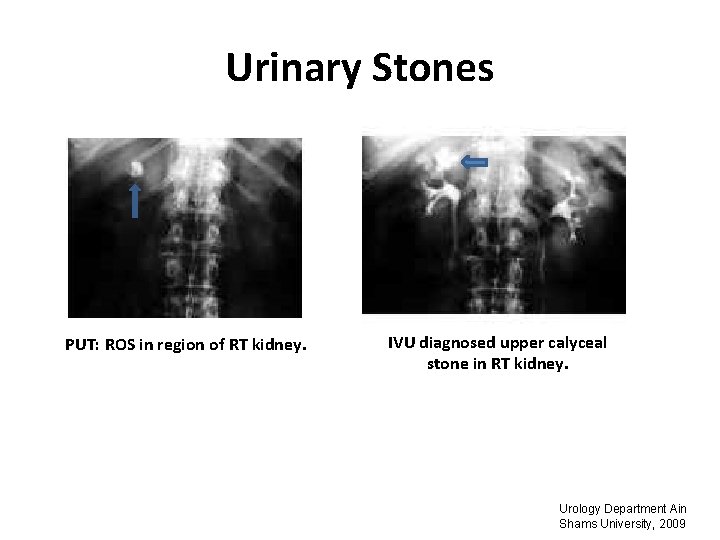
Urinary Stones PUT: ROS in region of RT kidney. IVU diagnosed upper calyceal stone in RT kidney. Urology Department Ain Shams University, 2009
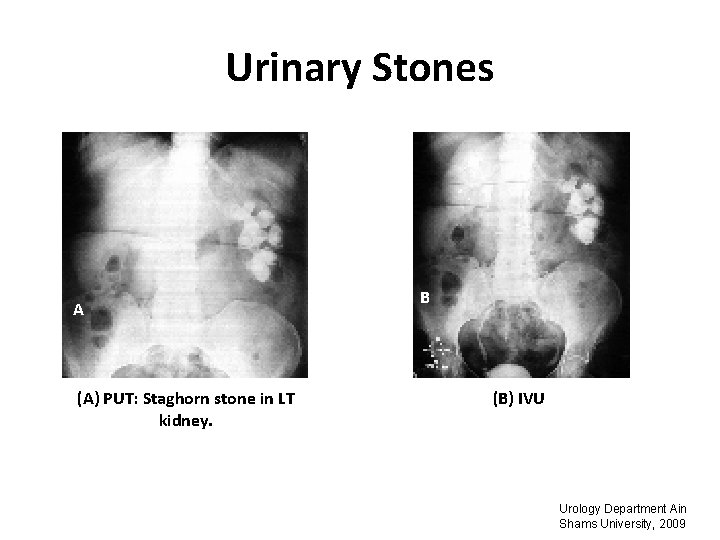
Urinary Stones A (A) PUT: Staghorn stone in LT kidney. B (B) IVU Urology Department Ain Shams University, 2009
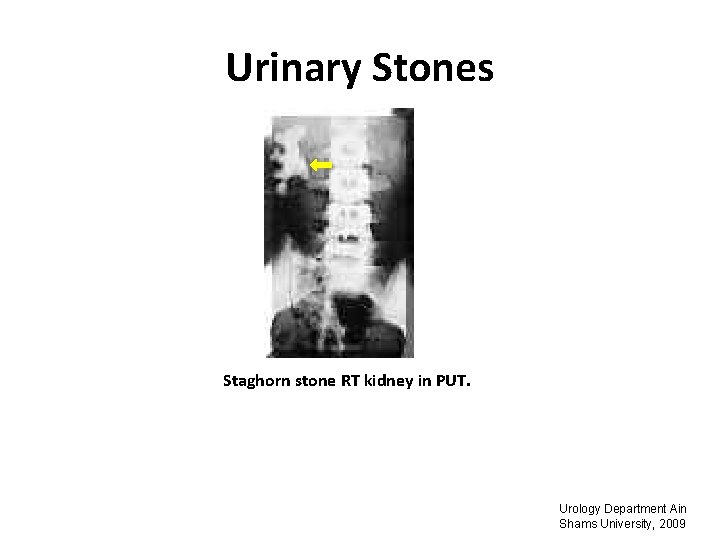
Urinary Stones Staghorn stone RT kidney in PUT. Urology Department Ain Shams University, 2009
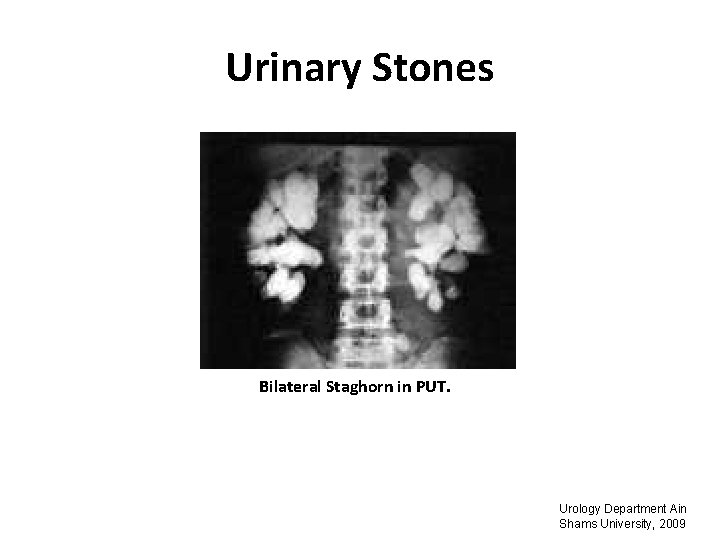
Urinary Stones Bilateral Staghorn in PUT. Urology Department Ain Shams University, 2009
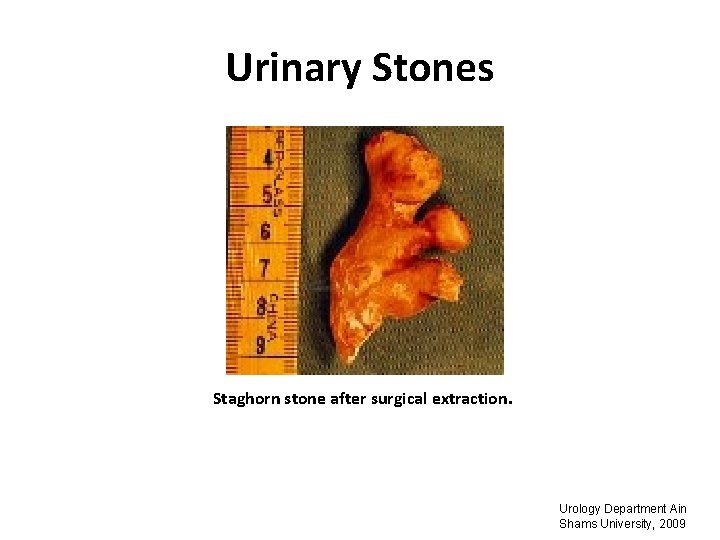
Urinary Stones Staghorn stone after surgical extraction. Urology Department Ain Shams University, 2009
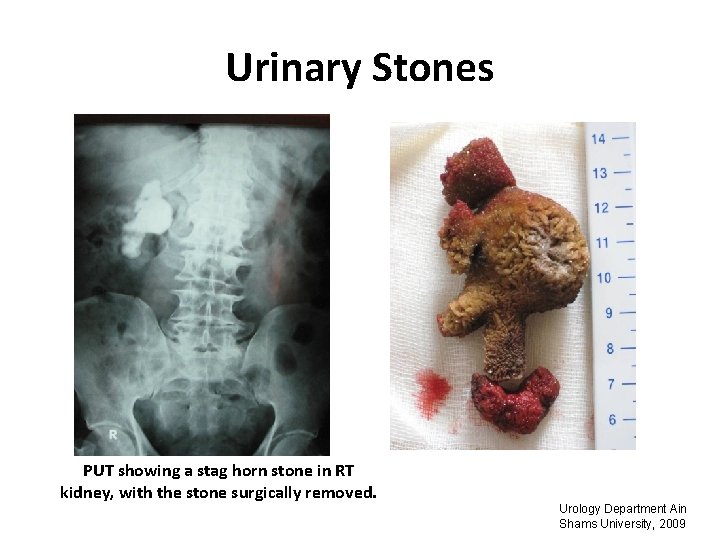
Urinary Stones PUT showing a stag horn stone in RT kidney, with the stone surgically removed. Urology Department Ain Shams University, 2009
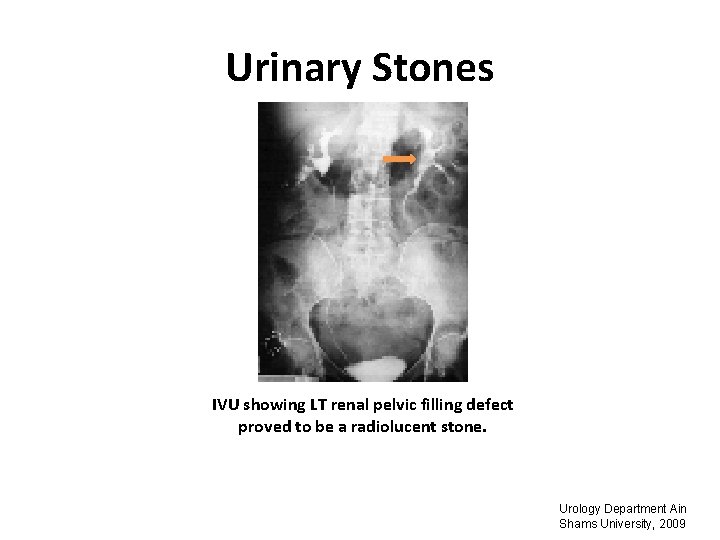
Urinary Stones IVU showing LT renal pelvic filling defect proved to be a radiolucent stone. Urology Department Ain Shams University, 2009
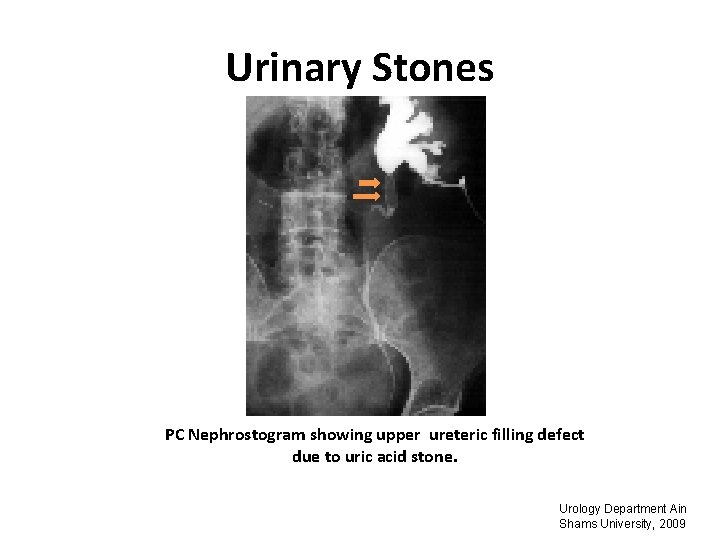
Urinary Stones PC Nephrostogram showing upper ureteric filling defect due to uric acid stone. Urology Department Ain Shams University, 2009
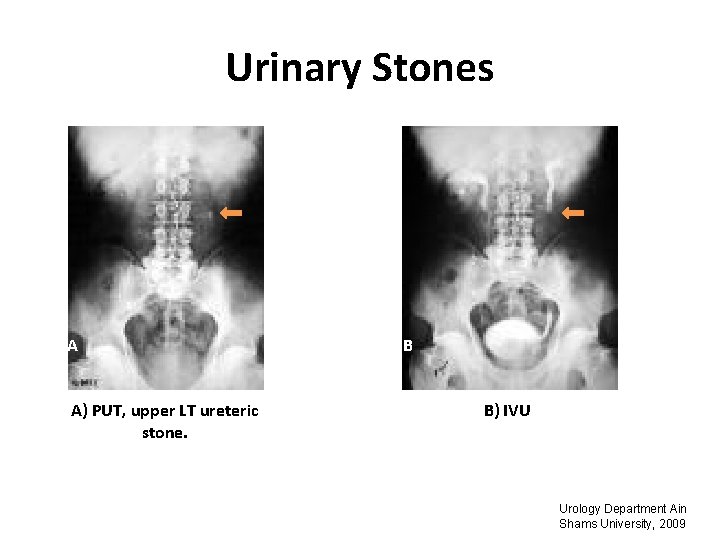
Urinary Stones A A) PUT, upper LT ureteric stone. B B) IVU Urology Department Ain Shams University, 2009
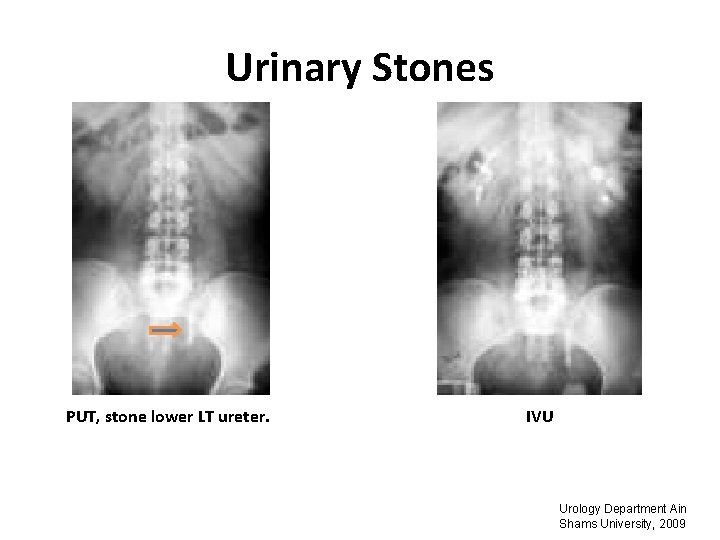
Urinary Stones PUT, stone lower LT ureter. IVU Urology Department Ain Shams University, 2009
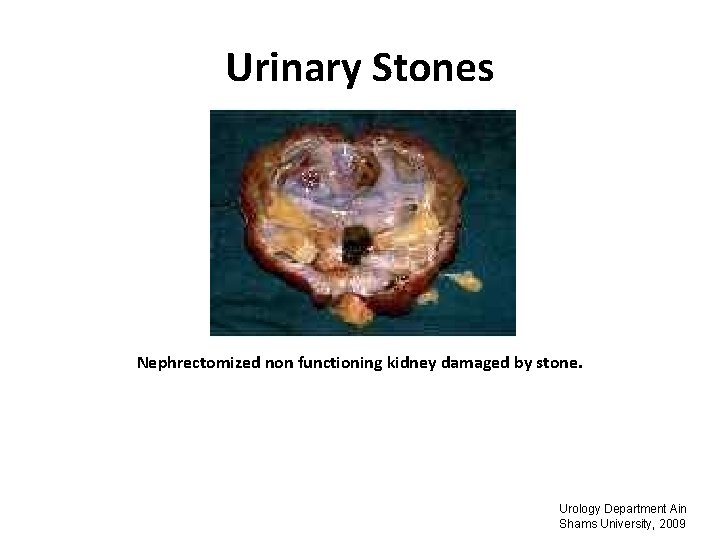
Complications The stone doesn't cause a problem unless it obstructs the flow of urine. This can cause: • Hydro-ureter and hydronephrosis. • Urinary tract infection. • Deterioration then loss of renal function. • Hematuria. Urology Department Ain Shams University, 2009
Urinary Stones Nephrectomized non functioning kidney damaged by stone. Urology Department Ain Shams University, 2009
Management Urology Department Ain Shams University, 2009
Initial management of acute presentation The pain of ureteric colic is very severe, and it needs immediate symptomatic relief. • Immediate pain control may be achieved with diclofenac either by injection, or suppository. • Pethidine is indicated in persistent colic. • Discourage use of anticholinergics and high fluid intake. Urology Department Ain Shams University, 2009
Initial management of acute presentation Indications for hospital admission: • Inadequate pain relief or persistent pain. • Fever. • Solitary Kidney or known non functioning kidney. • Inability to arrange regular follow-up. Urology Department Ain Shams University, 2009
Conservative or expectant treatment • Indicated when the stone is small in size (less than 6 mm). • Conservative treatment entails regular analgesia, liberal fluid intake, and short course of NSAIs to reduce the edema secondary to stone impaction. Urology Department Ain Shams University, 2009
Conservative or expectant treatment • The majority of stones causing ureteric colic will pass spontaneously but may take 1 -6 weeks. • Patients who have not passed a stone or who have continuing symptoms should have the progress of the stone monitored, by plain X-ray, at least weekly to assess the progression of the stone. Urology Department Ain Shams University, 2009
Interventional treatment Indications for intervention: • The patient is unable to manage the pain, or • There are signs of infection or • Obstruction. Urology Department Ain Shams University, 2009
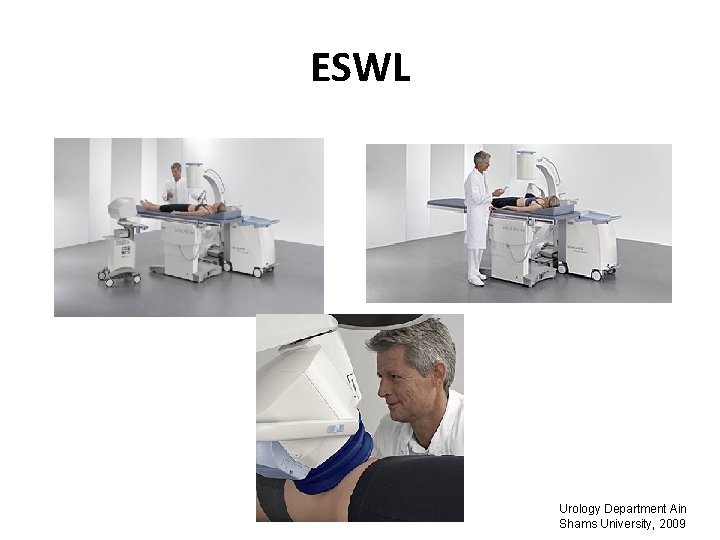
Interventional treatment Treatment modalities include: • • Extracorporeal Shock Wave Lithotripsy (ESWL). Per. Cutaneous Nephro. Lithotripsy (PCNL). Ureteroscopy. Conventional surgery. Urology Department Ain Shams University, 2009
ESWL Urology Department Ain Shams University, 2009
Bladder stones Causes • Small kidney stones occasionally travel down the ureters into the bladder, where they can continue growing into larger stones. • Bladder stones often occur in conditions where urine stagnates in the bladder. Urology Department Ain Shams University, 2009
Bladder stones These conditions may include: • Benign prostatic hyperplasia (BPH): the most common cause of bladder stones in elder men. • Neurogenic bladder. • Bladder diverticula. Other conditions that can cause bladder stones include: • Bladder inflammation. • Catheters. Urology Department Ain Shams University, 2009
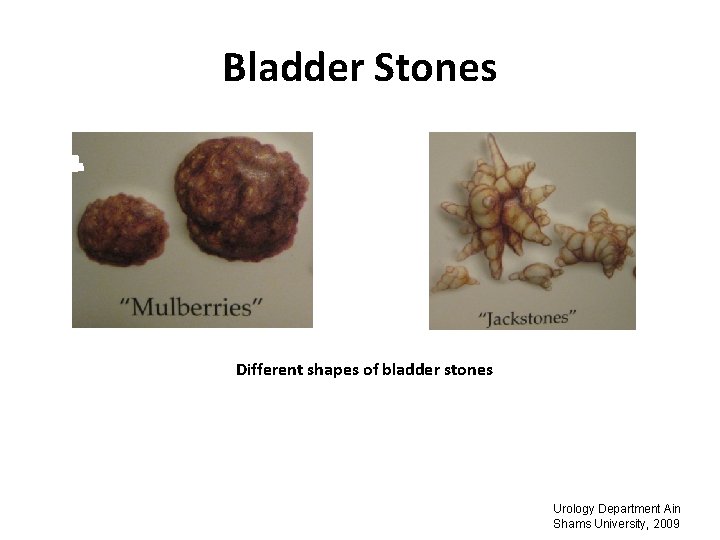
Bladder stones form in a diverse array of shapes and sizes. Bladder stones may be: • Single or multiple. • Tiny or large enough to fill the entire bladder. • Smooth and round or jagged and spiked like toy jacks. Urology Department Ain Shams University, 2009
Bladder Stones Different shapes of bladder stones Urology Department Ain Shams University, 2009
Presentation Bladder stones may irritate the bladder wall or obstruct the flow of urine, symptoms will include: • Lower abdominal pain. • In men, pain or discomfort along the penis. • Frequent and painful micturition. • Difficult voiding or interruption of urine flow. • Retention of urine. • Incontinence. • Hematuria. Urology Department Ain Shams University, 2009
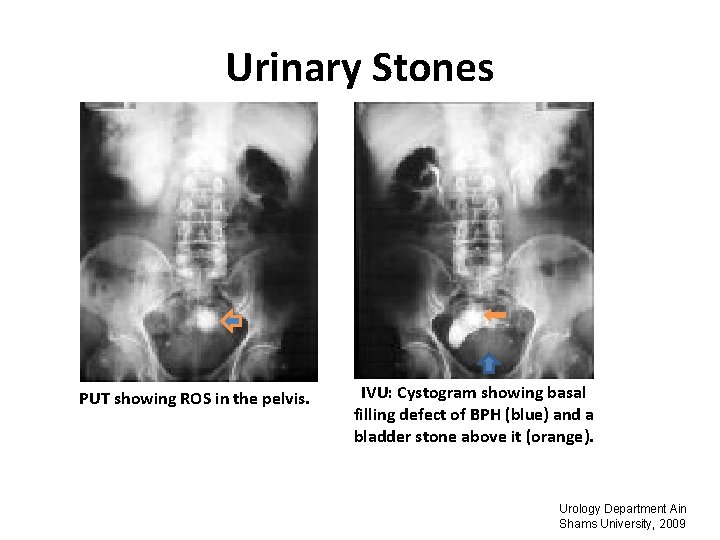
Urinary Stones PUT showing ROS in the pelvis. IVU: Cystogram showing basal filling defect of BPH (blue) and a bladder stone above it (orange). Urology Department Ain Shams University, 2009
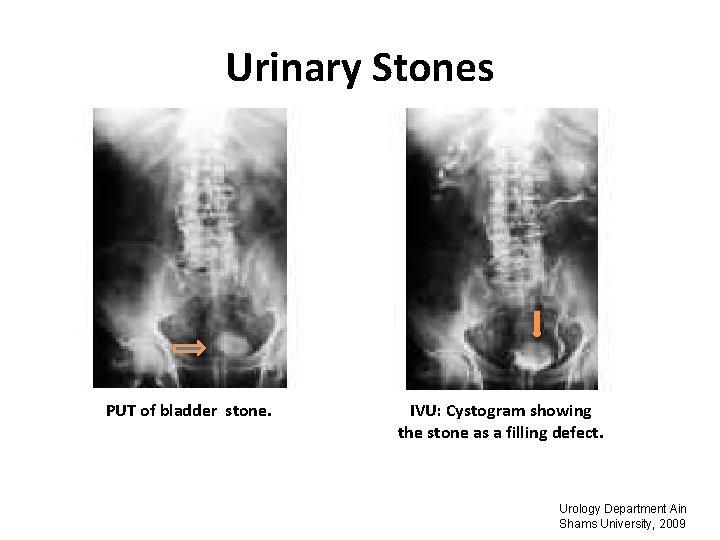
Urinary Stones PUT of bladder stone. IVU: Cystogram showing the stone as a filling defect. Urology Department Ain Shams University, 2009
Treatment If the stone is large or does not pass on its own, it should be removed. • Bladder stones are usually removed endoscopically by a procedure called a cystolitholapaxy. The stone is fragmented and then the pieces are evacuated from the bladder. • Occasionally, bladder stones that are large or too hard to fragment are removed through open surgery called cystolithotomy. Urology Department Ain Shams University, 2009
Thank You