
Urinary Risk Factors for Bladder Cancer ICD9 CM
Urinary Risk Factors for Bladder Cancer ICD-9 -CM Coordination and Maintenance Committee Meeting September 29, 2006 Louis S. Liou, MD, Ph. D Assistant Professor of Urology and Pathology Director of Urological Oncology Research Boston University School of Medicine Boston Medical Center Disclosure: Consultant and Speaker for Abbott Molecular and Quest Diagnostics
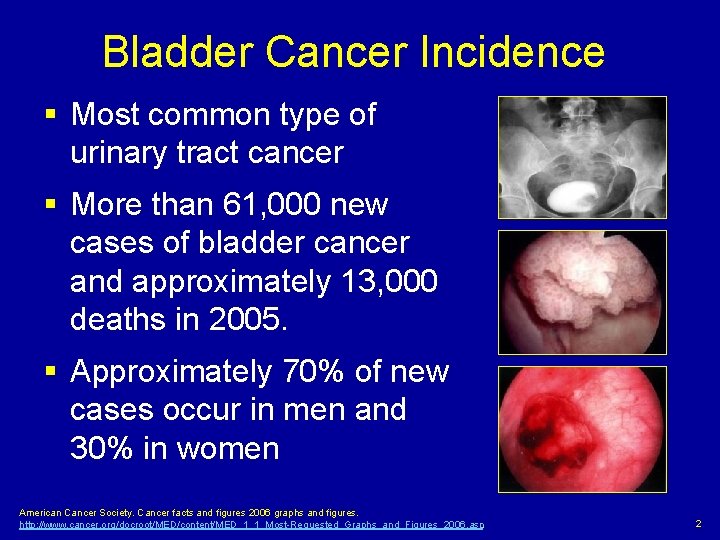
Bladder Cancer Incidence § Most common type of urinary tract cancer § More than 61, 000 new cases of bladder cancer and approximately 13, 000 deaths in 2005. § Approximately 70% of new cases occur in men and 30% in women American Cancer Society. Cancer facts and figures 2006 graphs and figures. http: //www. cancer. org/docroot/MED/content/MED_1_1_Most-Requested_Graphs_and_Figures_2006. asp. 2

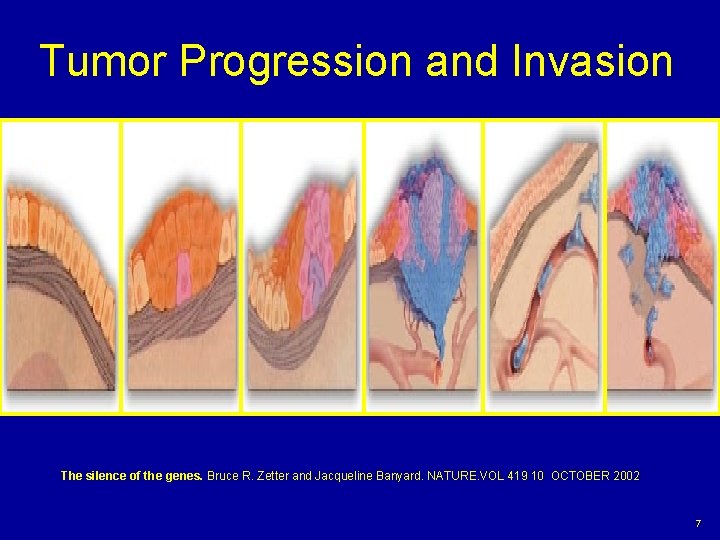
Types of Bladder Cancer § Transitional cell carcinoma is the most common, followed by squamous cell carcinoma § Cancer is staged by the layers of the bladder invaded and by cancer spread § As cancer penetrates the layers, it has a higher chance to spread and becomes harder to treat Tis: carcinoma in situ Ta: noninvasive papillary carcinoma T 1: invasion of subepithelial connective tissue T 2: invasion of muscle layer T 3: invasion of perivesical tissue T 4: invasion of nearby organs 3
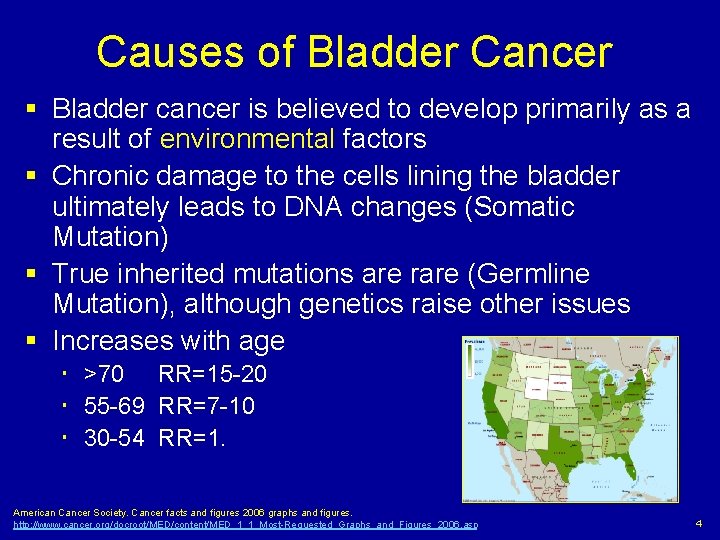
Causes of Bladder Cancer § Bladder cancer is believed to develop primarily as a result of environmental factors § Chronic damage to the cells lining the bladder ultimately leads to DNA changes (Somatic Mutation) § True inherited mutations are rare (Germline Mutation), although genetics raise other issues § Increases with age >70 RR=15 -20 55 -69 RR=7 -10 30 -54 RR=1. American Cancer Society. Cancer facts and figures 2006 graphs and figures. http: //www. cancer. org/docroot/MED/content/MED_1_1_Most-Requested_Graphs_and_Figures_2006. asp 4
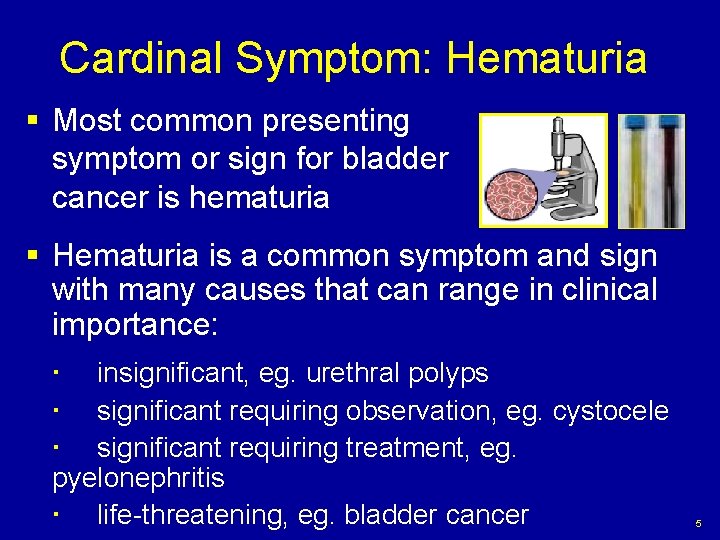
Cardinal Symptom: Hematuria § Most common presenting symptom or sign for bladder cancer is hematuria § Hematuria is a common symptom and sign with many causes that can range in clinical importance: insignificant, eg. urethral polyps significant requiring observation, eg. cystocele significant requiring treatment, eg. pyelonephritis life-threatening, eg. bladder cancer 5
“Good” and “Bad” Hematuria § Gross hematuria is always cause for concern and requires intensive work-up 30% of patients with gross hematuria are diagnosed with bladder cancer § Microscopic hematuria may also require intensive work-up depending on degree greater numbers of bladder cancer patients present with microscopic hematuria § Patients at high risk for bladder cancer have additional risk factors BJU Int. 2002 Sep; 90(4): 355 -7. Comment in: Khan MA, Shaw G, Paris AM. BJU Int. 2003 Feb; 91(3): 301. Is microscopic haematuria a urological emergency? 6
Tumor Progression and Invasion The silence of the genes. Bruce R. Zetter and Jacqueline Banyard. NATURE. VOL 419 10 OCTOBER 2002 7
Visualization of Urine 8

Best Practices “The American Urological Association (AUA) convened the Best Practice Policy Panel on asymptomatic microscopic hematuria to formulate policy statements and recommendations for the evaluation of asymptomatic microhematuria in adults. The literature agrees that gross hematuria warrants a thorough diagnostic evaluation. [B]efore a decision is made to defer evaluation in patients with one or two red blood cells per high-power field, risk factors for significant disease should be taken into consideration. High-risk patients should be considered for full urologic evaluation after one properly performed urinalysis documenting the presence of at least three red blood cells per high-power field. In patients at low risk for disease, some components of the evaluation may be deferred. ” Urology 57: 599– 610, 2001 Am Fam Physician 2001; 63: 1145 -54 9
Risk Factor : Smoking § Smoking is the greatest risk factor § Both current smoking and a prior history of smoking raise the risk § Carcinogens in tobacco become concentrated in the urine and eventually damage the bladder lining § Repeated exposure leads to cell mutation Scher HI, Motzer RJ. Bladder and renal cell carcinomas. In: Kasper DL, Braunwald E, Fauci AS, Hauser SL, Longo DL, Jameson JL, eds. Harrison’s Principles of Internal Medicine. 16 th ed. New York, NY: Mc. Graw-Hill; 2005: 539 -543 10
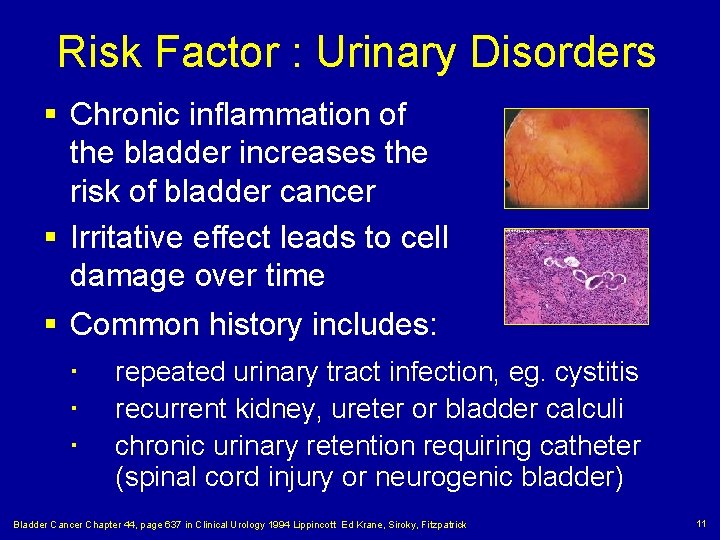
Risk Factor : Urinary Disorders § Chronic inflammation of the bladder increases the risk of bladder cancer § Irritative effect leads to cell damage over time § Common history includes: repeated urinary tract infection, eg. cystitis recurrent kidney, ureter or bladder calculi chronic urinary retention requiring catheter (spinal cord injury or neurogenic bladder) Bladder Cancer Chapter 44, page 637 in Clinical Urology 1994 Lippincott Ed Krane, Siroky, Fitzpatrick 11
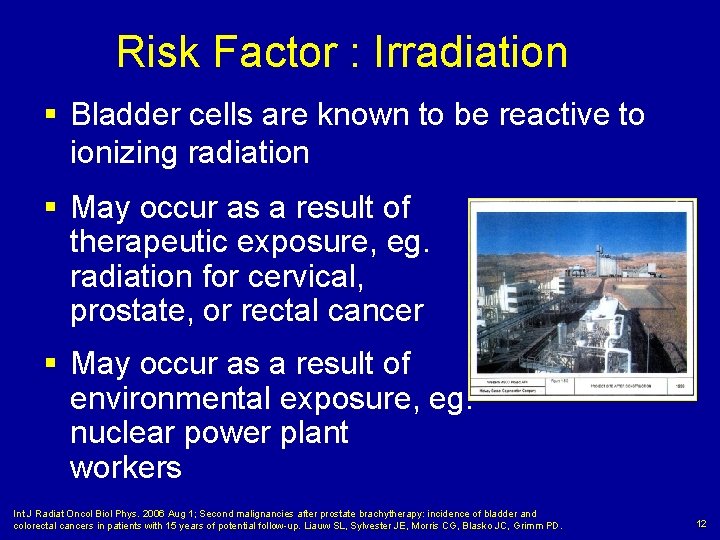
Risk Factor : Irradiation § Bladder cells are known to be reactive to ionizing radiation § May occur as a result of therapeutic exposure, eg. radiation for cervical, prostate, or rectal cancer § May occur as a result of environmental exposure, eg. nuclear power plant workers Int J Radiat Oncol Biol Phys. 2006 Aug 1; Second malignancies after prostate brachytherapy: incidence of bladder and colorectal cancers in patients with 15 years of potential follow-up. Liauw SL, Sylvester JE, Morris CG, Blasko JC, Grimm PD. 12
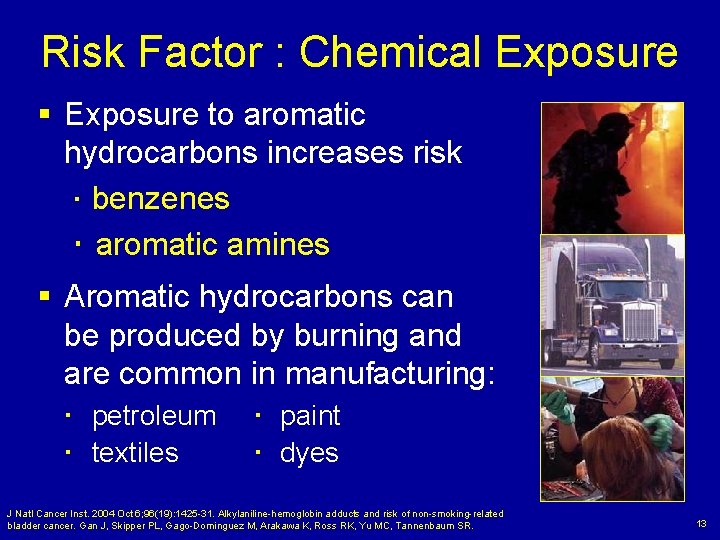
Risk Factor : Chemical Exposure § Exposure to aromatic hydrocarbons increases risk benzenes aromatic amines § Aromatic hydrocarbons can be produced by burning and are common in manufacturing: petroleum textiles paint dyes J Natl Cancer Inst. 2004 Oct 6; 96(19): 1425 -31. Alkylaniline-hemoglobin adducts and risk of non-smoking-related bladder cancer. Gan J, Skipper PL, Gago-Dominguez M, Arakawa K, Ross RK, Yu MC, Tannenbaum SR. 13
Risk Factor : Arsenic Exposure § Arsenic is a naturally occurring element found in soil and rocks § High levels of arsenic can be found in well water, as well as drinking water near farms and mines § Long-term exposure to arsenic raises the risk of bladder cancer Environ Health Perspect. 2006 Jul; 114(7): 1077 -82. Arsenic cancer risk confounder in southwest Taiwan data set. Lamm SH, Engel A, Penn CA, Chen R, Feinleib M. 14
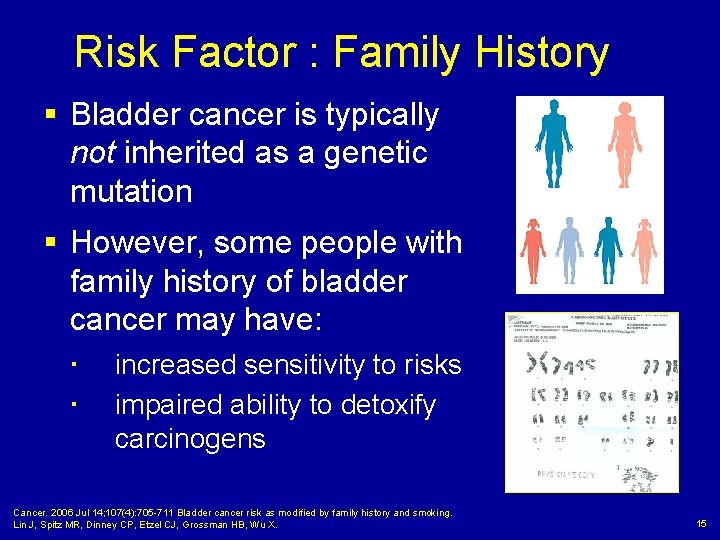
Risk Factor : Family History § Bladder cancer is typically not inherited as a genetic mutation § However, some people with family history of bladder cancer may have: increased sensitivity to risks impaired ability to detoxify carcinogens Cancer. 2006 Jul 14; 107(4): 705 -711 Bladder cancer risk as modified by family history and smoking. Lin J, Spitz MR, Dinney CP, Etzel CJ, Grossman HB, Wu X. 15
Risk Factors for Bladder Cancer Age (incidence increases with age; median age of bladder cancer patient is 73 years) Race (incidence is 2 times greater in whites vs African-Americans) Gender (incidence is 4 times greater in men) Exposure to cigarette smoke History of external beam radiation Neurogenic bladder, recurrent urinary tract infections, urinary stones, chronic indwelling catheter Infection with Schistosoma haematobium Ingestion of Aristolochia fangchi (herb used in some weight-loss formulas) § Exposure to chemicals (hair dyes, aniline, organic solvents, etc) § Exposure to arsenic § Personal or family history of bladder cancer 16
Data Issues ICD-9 -CM currently has unique codes for some of the risk factors in bladder cancer, but not for other major risk factors. This has lead to : § Difficulty consistently identifying and tracking patients at high risk § Hindrance of data review and analysis § Inability to differentiate patients with hematuria based on risk for bladder cancer § Patient Navigator 17
Questions? 18
- Slides: 18