
Urinary catheterization prepared by Noura Mahmoud Out lines

Urinary catheterization prepared by Noura Mahmoud
Out lines ü ü ü Definition purposes for urinary catheterization diameter and types of urinary catheters assessment before urinary catheterization Equipment needed for urinary catheterization and catheter irrigation Procedure of urinary catheterization male and female patients
Definitions Urinary Catheterization: means passing a rubber or plastic tube into the bladder via the urethra to drain urine from the bladder or to obtain a urine specimen. Catheterization is a sterile procedure Urinary catheters: are hollow, partially flexible tubes that collect urine from the bladder

Purposes: A-Intermittent or short term catheterization: 1. Used to obtain a sample 2. To relieve bladder distention. 3. To keep the bladder empty. 4. Prevent urinary retention
Purposes: B-Long-term catheterization: 1. Are used to control incontinence. 2. Prevent retention. 3. Prevent the leakage of urine
Diameters of the catheter Ø Ø § 5 Fr, 6 fr, 8 fr 10 fr, 12 fr, 14 fr, 16 fr, 18 fr, 20 fr, 22 fr, 24 fr, 26 fr. The higher the number the larger the diameter of the catheter. 3 Fr = 1 mm Urinary catheters can be made of: Rubber. Plastic (PVC) Silicone. Latex.
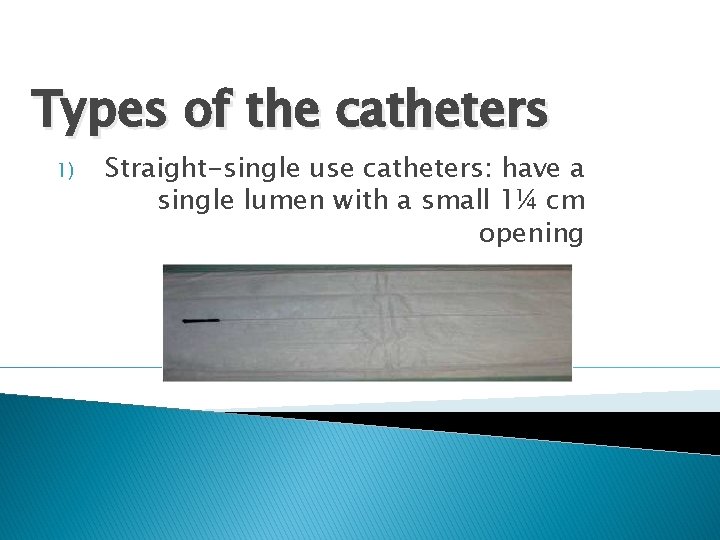
Types of the catheters 1) Straight-single use catheters: have a single lumen with a small 1¼ cm opening
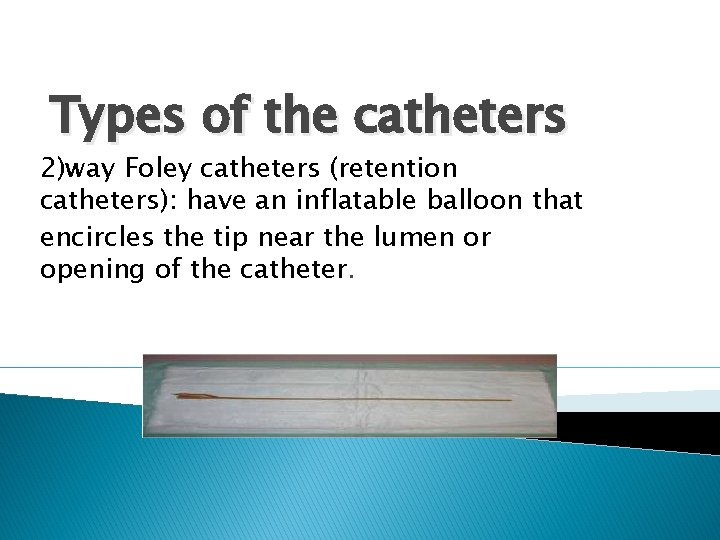
Types of the catheters 2)way Foley catheters (retention catheters): have an inflatable balloon that encircles the tip near the lumen or opening of the catheter.

Types of the catheters 3)Curved or Coude: have a rounded curved tip (elbowed) used in older male patients with enlarged prostates which partially obstruct the urethra
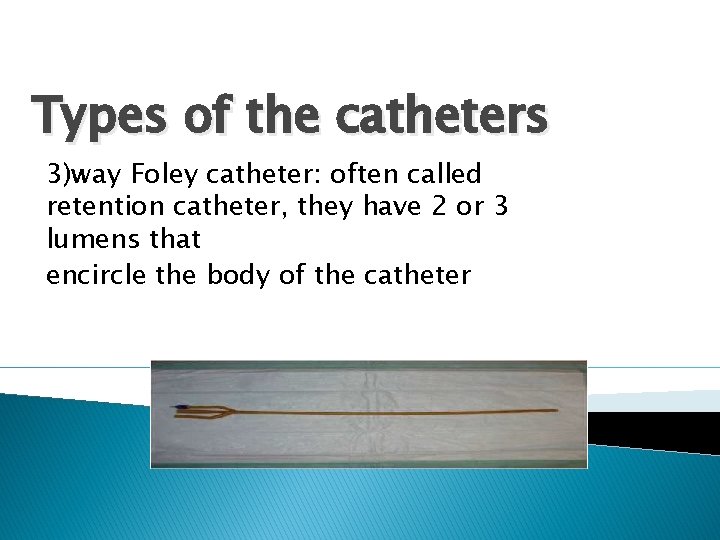
Types of the catheters 3)way Foley catheter: often called retention catheter, they have 2 or 3 lumens that encircle the body of the catheter
Assessment before procedure v v Assess the need for catheterization and the type of catheterization Assess for the need for peritoneal care Assess the urinary meatus for signs of infection or inflammation Assess the client’s ability to assist with the procedure
Assessment before procedure v v Assess the client’s ability to assist with the procedure Assess the light Assess for an allergy to povidoneiodine and/or latex Watch for indications of distress or embarrassment
Equipment: � Indwelling or straight catheter with drainage system � Sterile catheterization kit � Adequate lighting source � Disposable gloves � Sterile gloves Blanket or drape � Soap and washcloth 8. Warm water � Scale � Towel � Forceps �
Procedure q q q Fundamental steps Position during the insertion Ensure adequate lighting Apply disposable gloves, and wash perineal area Remove gloves and wash hands

Procedure q q q Open the catheterization kit, using aseptic technique If the catheter is not included in the kit, carefully drop the sterile catheter onto the field Apply sterile gloves
Procedure q q q Attach the catheter to the urine drainage bag Place the drape from the catheterization kit over the client’s perineal area coat the distal portion of the catheter with water-soluble, sterile lubricant
Procedure q q q cleanse the penis/labia minora with a povidone iodine solution or other antimicrobial cleanser Inject 10 ml sterile, water-soluble lubricant (use a 2% Xylocaine lubricant insert the catheter about 8 inches, until urine is noted in the drainage bag or tubing
procedure q q q If the catheter will be removed as soon as the client’s bladder is empty, insert the catheter another inch, Attach the air or water-filled syringe to the inflation port. Instruct the client to immediately report discomfort
procedure q q q gently pull the catheter until the retention balloon is resting against the bladder neck Secure the catheter Place the drainage bag below the level of the bladder.
procedure q q Remove gloves, dispose of equipment, Help client adjust position Assess and document the amount, color, odor, and quality of urine
Catheter care ü ü ü Place waterproof pad under patient. Provide routine perineal care with soap and water Assess urethral meatus and surrounding tissues for inflammation, Using a clean washcloth, soap, and water, cleans the catheter in a circular motion
Catheter care ü ü ü Replace, as necessary, the adhesive tape (remove any adhesive residue from skin Avoid placing tension on the catheter Empty collection bag when one-half full.
Catheter removal A- Place waterproof pad: (1) Between female’s thighs (if in supine position). (2) Over male’s thighs Remove adhesive tape or tube holder used to secure and anchor catheter. Insert hub of syringe into inflation valve (balloon port). Allow sterile water to return into syringe by gravity
Catheter removal Pull catheter out slowly and gently while wrapping contaminated catheter in waterproof pad. Reposition patient as necessary Empty, measure, and record urine present in drainage bag Observe time the patient urinates, and measure the urine; assess urine characteristics
Documentation post procedure • Record the time and date the catheter was inserted. • Note the size and type of catheter used, • Record the client’s response to the procedure and the amount, color of urine Intake and Output Record • Record the amount of urine returned

Thank you
- Slides: 27