
Uric Acid Mr Mohammed O Jaber MLS Uric
Uric Acid Mr. Mohammed O. Jaber, MLS

Uric Acid Uric acid is formed from the breakdown of nucleic acids and is an end product of purine metabolism. Uric acid is transported by the plasma from the liver to the kidney, where it is filtered and where about 70% is excreted in Urine. The remainder of uric acid is excreted into the GI tract.
Clinical Significance Disease states with increased plasma uric acid Gout Increased catabolism of nucleic acids And renal disease In Gout increased serum levels of uric acid lead to formation of monosodium urate crystals around the joints. Uric acid test is useful to assess for gout and to monitor patients with renal failure
Clinical Significance To monitor if uric acid levels are too high after chemotherapy or radiation. Hypouricemia is seldom observed and associated with rare hereditary metabolic disorders. (e. g. Wilson’s disease , Fanconi’s Syndrome)
Specimen Serum or plasma may be used Stability in serum / plasma: 6 months at -20°C 7 days at 4 -8°C 3 days at 20 -25°C
ANALYTIC METHODS—URIC ACID Chemical Method (old) : Phosphotungstic Acid, read the absorbance(Ab) at 700 nm (UV). blue Colored product Enzymatic Method: is More specific By using Couple reaction of uricase and Peroxidase. Pink solution (Ab at 500 nm spectrophotometric) Pink color solution.
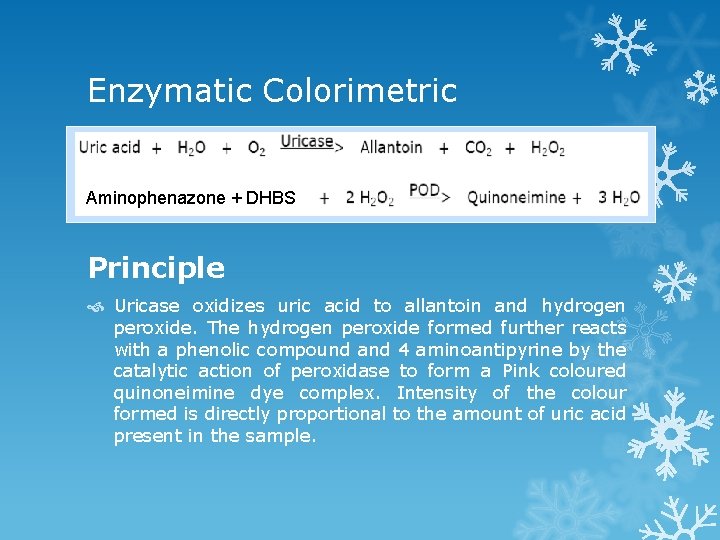
Enzymatic Colorimetric Aminophenazone + DHBS Principle Uricase oxidizes uric acid to allantoin and hydrogen peroxide. The hydrogen peroxide formed further reacts with a phenolic compound and 4 aminoantipyrine by the catalytic action of peroxidase to form a Pink coloured quinoneimine dye complex. Intensity of the colour formed is directly proportional to the amount of uric acid present in the sample.

Normal Rang Female: 2. 6 - 6. 0 mg/d. L Male: 3. 5 -7. 2 mg/d. L
- Slides: 8