
URETER By Dr Leena N Associate Professor Department

URETER By Dr. Leena. N Associate Professor Department of Anatomy
URETER The ureters are a pair of narrow, thick-walled muscular tubes which convey urine from the kidneys to the urinary bladder. Each ureter is about 25 cm (10 inches) long, of which the upper half (5 inches) lies in the abdomen, and the lower half (5 inches) in the pelvis. It measures about 3 mm in diameter, but it is slightly constricted at five places.

The location of the ureters on the posterior abdominal and lateral pelvic walls
Course The ureter begins within the renal sinus as a funnel-shaped dilatation, called the renal pelvis. The pelvis issues from the hilus of the kidney, descends along its medial margin, or partly behind it. Gradually it narrows till the lower end of the kidney. The ureter passes downwards and slightly medially on the tips of transverse processes and the psoas major muscle, and enters the pelvis by crossing in front of the termination of the common iliac artery. In the lesser or true pelvis, the ureter at first runs downwards, and slightly backwards and laterally, following the anterior margin of the greater sciatic notch. Opposite the ischial spine, it turns forwards and medially to reach the base of the urinary bladder.
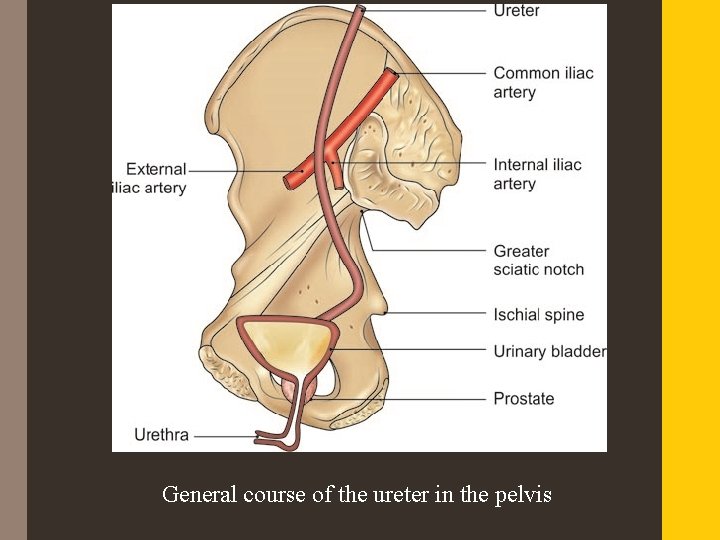
General course of the ureter in the pelvis

Normal constrictions of Ureter • • • 1. At the pelviureteric junction. 2. At the brim of the lesser pelvis. 3. Point of crossing of ureter by ductus deferens or broad ligament of uterus. 4. During its oblique passage through the bladder wall. 5. At its opening in lateral angle of trigone

Constrictions in the course of ureter
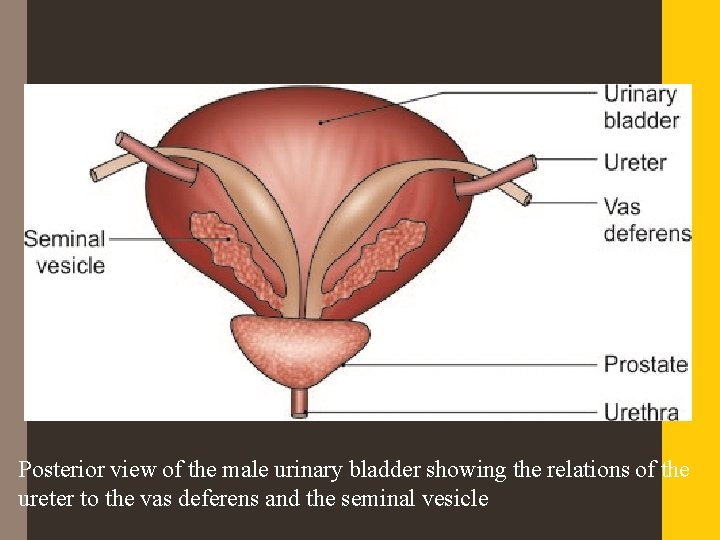
Posterior view of the male urinary bladder showing the relations of the ureter to the vas deferens and the seminal vesicle
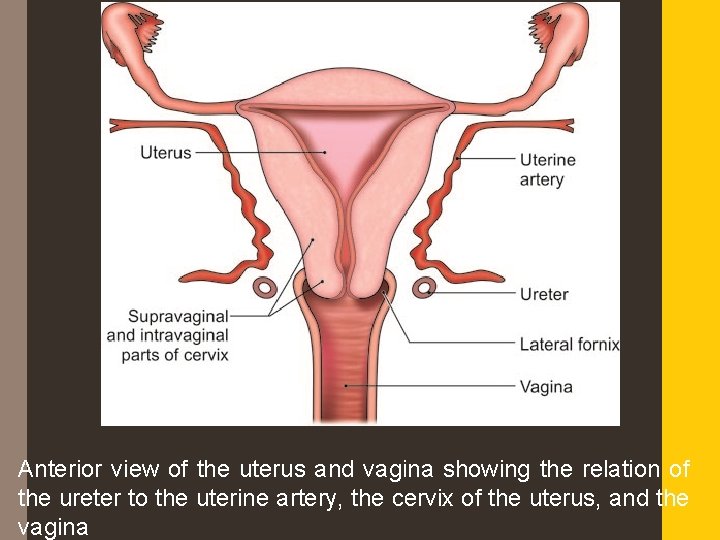
Anterior view of the uterus and vagina showing the relation of the ureter to the uterine artery, the cervix of the uterus, and the vagina
Blood Supply The ureter is supplied by three sets of long arteries: 1. The upper part receives branches from the renal artery. It may also receive branches from the gonadal, or colic vessels. 2. The middle part receives branches from the aorta. It may also receive branches from the gonadal, or iliac vessels. 3. The pelvic part is supplied by branches from the vesical, middle rectal, or uterine vessels.
Nerve supply The ureter is supplied by sympathetic from T 10 to L 1 segments and parasympathetic from S 2 to S 4 nerves.

CLINICAL ANATOMY Ureteric colic: This term is used for severe pain due to a ureteric stone which causes spasm of the ureter. The pain starts in the loin and radiates down the groin, the scrotum or the labium majus and the inner side of the thigh. Ureteric stone: A ureteric stone is liable to become impacted at one of the sites of normal constriction of the ureter, e. g. pelviureteric junction, brim of the pelvis and intravesical course.
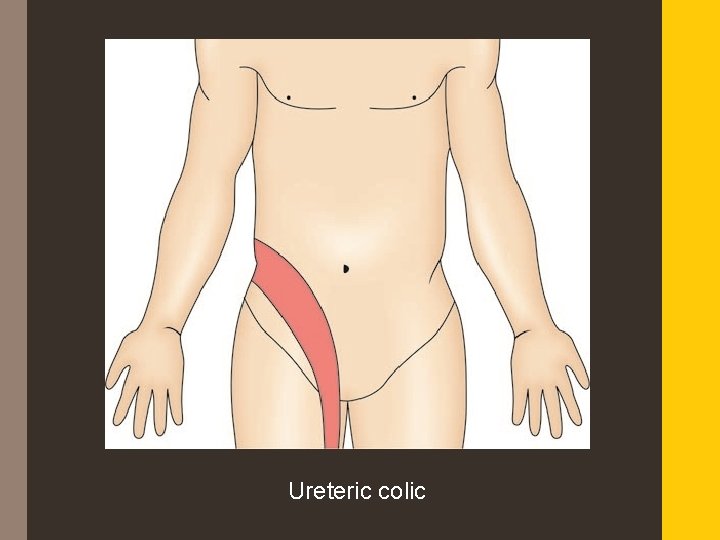
Ureteric colic
- Slides: 13