
Urbanization and Urban Growth 5 1 u Mega
Urbanization and Urban Growth 5. 1
u Mega City: A city with 10 million or more people. – There are 19 mega cities – Tokyo is the most populous city. u Urbanization varies throughout the world but is increasing everywhere. – General population growth contributes to urban growth. – Developing countries are currently urbanizing faster than developed countries
u Since 1920 Urban areas have seen improvement in: – Housing conditions – Medical care – Air and water quality Compared to developing Developed countries have – Stricter water pollution laws – Waste water treatment plants – Water purification plants
u Mexico city has taken the following actions to reduce air pollution: – Banning cars from the central zone – Phasing out unleaded gasoline – Trucks run only on LPG (liquefied petroleum gas) – Reasons for the actions: u Severe air pollution u 2, 000 rural immigrants u Noise congestion and crime u Fecal snow (yes really) dried poo blowing in the air.
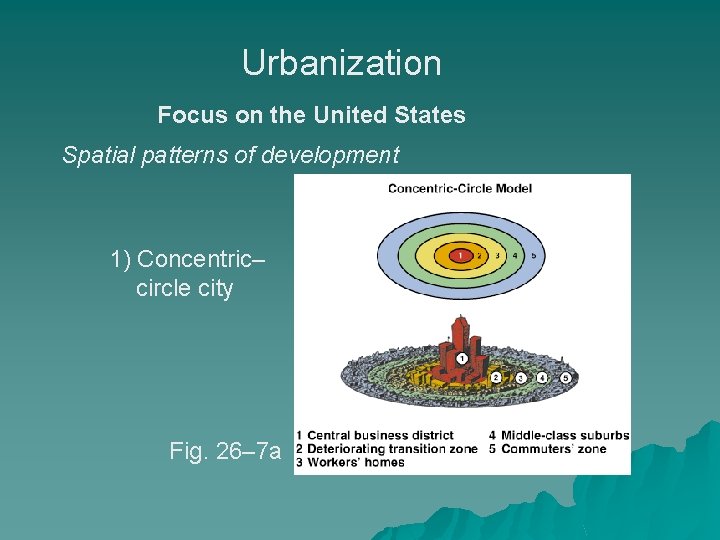
Urbanization Focus on the United States Spatial patterns of development 1) Concentric– circle city Fig. 26– 7 a
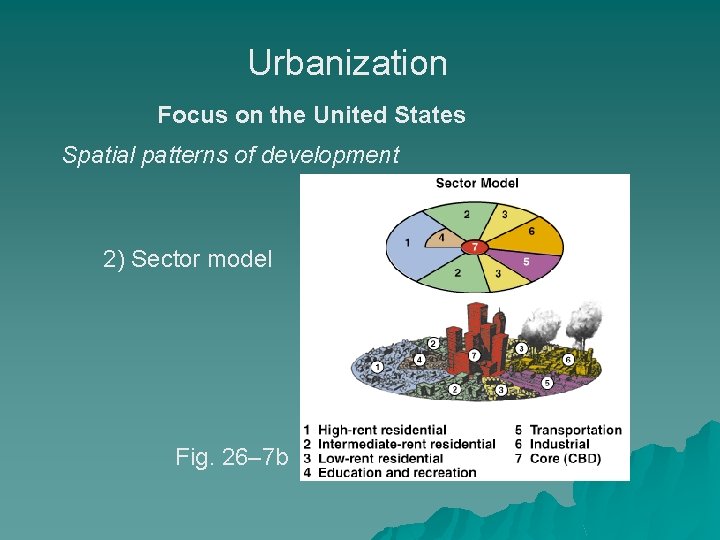
Urbanization Focus on the United States Spatial patterns of development 2) Sector model Fig. 26– 7 b
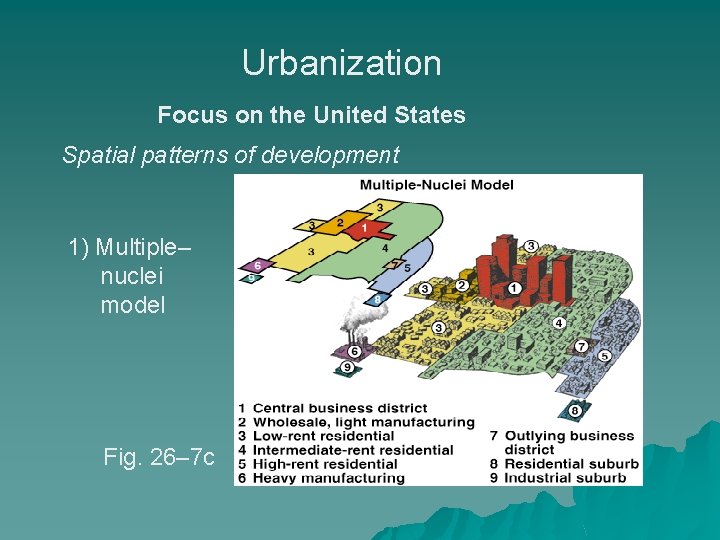
Urbanization Focus on the United States Spatial patterns of development 1) Multiple– nuclei model Fig. 26– 7 c
Problems with Urbanization u Degradation of wildlife habitats u Loss of rural land u Loss of fertile soil u Import minerals u Import energy u Import food u 4% of land 75% of resources
u DPA Noise Pollution and increase in 10 decibels is 50 times greater – 50 db. A – 30 db. A is 100 times difference – Military riffles produces a sound louder than jackhammers, chainsaws or rock music.
Noise can be controlled by: u Separating noisy activities from people u Using anti noise u Shielding workers from noise.
Climate u Urban areas can alter climate by – Generating heat – Absorbing heat – Obstructing wind
Disadvantages of automobiles u 18 million people have been killed in motor vehicle accidents u Automobiles are the largest source of pollution u More Americans have been killed by cars than on any battle fields in all U. S. wars.
Strategies to avoid the “Car Trap” u Investing in public transit system u Subsidizing ecocar development u Instituting full cost gasoline pricing u Instituting full cost on automobiles
Automobile alternatives u Bikes – Inexpensive to buy and maintain – Undemanding of supplies and natural resources – Comparatively safe for pedestrians and cyclists u Light rail (trolleys etc. ) – 1/10 as much to build as highways – Low operating costs – Share right of way with other traffic
Automobile alternatives u Heavy Rail ( Rapid rail) – Good for 120 to 600 mile trips – Mostly used in Japan and Western Europe u Busses – Flexibility of the transportation routes – Lower operating costs than the heavy rail – Less capital investment than heavy rail – Curitiba Brazil has a sophisticated bus system – Japan uses the most mass transit
Urban land use planning and control u Local governments can control land use by zoning u Conservation easements u Best land use controls are found in Western Europe and Japan
Solutions u Sustainable cities – Use energy efficiently – Encourages biodiversity – Composts to improve soil quality u David Orr – Right Scale – Efficient use of resources – A close fit of means and ends u 1800’s Minneapolis wanted the finest public parks of any city in America
- Slides: 17